It looks like the worst of the airport chaos is coming to an end.
Wait times at security checkpoints have plummeted at Atlanta’s Hartsfield-Jackson International Airport, which was one of the hardest hit by Transportation Security Administration staffing shortages.
While last week it warned passengers of four-hour lines, its website listed waits of less than five minutes at all checkpoints just after 6:20 a.m. ET.
The airport had previously suspended this feature during the peak of the staffing shortages, instead displaying a message telling people to expect four-hour waits in line.
Delta Air Lines’ main hub, Hartsfield-Jackson, is also the world’s busiest airport by passenger numbers, handling over 100 million last year.
Every time Pete publishes a story, you’ll get an alert straight to your inbox!
Stay connected to Pete and get more of their work as it publishes.
It’s an especially busy time for flying, too, as people travel for Spring Break.
Atlanta is not the only place where TSA wait times have dropped sharply this week. Houston’s George Bush Intercontinental Airport also suffered from four-hour wait times last week. But on Tuesday morning, its website showed lines of a maximum of 30 minutes.
New York’s John F. Kennedy and LaGuardia airports have also restored their websites’ estimated wait-times feature. Lines at JFK were the longest of any airport monitored by Business Insider, with a wait of 43 minutes, while Newark had 20-minute lines.
Baltimore airport, which handles around 13 million passengers annually, said on social media that it had seen a “return to normal” on Monday.
“The normal, quick and efficient checkpoint operations we’re known for have returned today,” the airport said in an X post.
We know the last few days have been difficult.
The normal, quick and efficient checkpoint operations we’re known for have returned today.
Travelers are once again advised to arrive 2 hours ahead of scheduled departure. pic.twitter.com/QQlAwA8Izb
Lines began to improve after President Donald Trump signed an executive order on Friday to pay TSA agents, bringing many back to work.
The workers hadn’t been paid since mid-February, when a partial government shutdown began. Up to 11% of TSA agents called out of work on the worst-affected days.
While the Senate approved a deal early Friday to fund most of the Department of Homeland Security, it was opposed by Republicans in the House of Representatives who want more funding for Immigration and Customs Enforcement. Democrats want ICE to be reformed in the wake of January’s violence in Minnesota.
TSA agents began receiving paychecks on Monday, though the shutdown is still ongoing. Plus, Congress has gone on recess for two weeks, while the two parties remain at loggerheads.
You might not think it possible, but waiting in line at airport security is somehow getting worse.
Thousands of travelers in the US waited up to three hours at security checkpoints on Sunday as the ongoing partial government shutdown caused staff shortages at the Transportation Security Administration.
Some stalled travelers shared photos of the winding lines and crowds on social media. A video shared on X by Aubry Killion, an anchor at WDSU, the primary NBC affiliate in New Orleans, showed a line of passengers stretching all the way out into the parking garage.
MSY issued the following statement:
“Due to impacts from the federal government’s partial shutdown, the TSA at Louis Armstrong New Orleans International Airport (MSY) is experiencing a shortage of workers at the security checkpoint, which is causing longer-than-average lines.” pic.twitter.com/RGeCcqUVOi
A photo shared to Reddit showed a massive crowd at Hartsfield-Jackson Atlanta International Airport in Georgia, where wait times have reached an hour. The airport is also encouraging travelers to arrive early for their flights.
“The delays are the result of residual impacts from two ground stops issued on Friday, which created a temporary backlog in passenger volumes, combined with current TSA staffing constraints,” a Hartsfield-Jackson Atlanta International Airport spokesperson told Business Insider.
Every time Lauren publishes a story, you’ll get an alert straight to your inbox!
Stay connected to Lauren and get more of their work as it publishes.
Houston Airports, which operates the William P. Hobby and George Bush Intercontinental airports in Texas, warned travelers that the wait times could be hours long.
“As a result of the partial federal government shutdown, passengers at William P. Hobby Airport (HOU) should arrive at least 4 to 5 hours before their flight to allow extra time for TSA screening,” the operatorsaid in a press release. “At times, TSA wait times at HOU may extend beyond 180 minutes.”
Houston Airports said TSA PreCheck may be unavailable at William P. Hobby Airport due to limited staffing. At George Bush Intercontinental Airport, travelers were told to allow extra time for security screening.
The Department of Homeland Security last month said it was suspending TSA Precheck and Global Entry due to the government shutdown, but later backtracked, leaving it up to individual airports.
Lauren Bis, deputy assistant secretary for public affairs at DHS, said TSA agents “received only partial paychecks earlier this month and now face their first full missed paycheck, leading to financial hardship, absences, and crippling staffing shortages.”
TSA agents are federal workers under DHS, which means they are directly affected by the partial shutdown that began in January. During the earlier 43-day government shutdown last year, TSA agents went weeks without pay. A shortage of air traffic controllersat airports in 2025 played a significant role in forcing the government to reach an agreement.
The US Congress failed to reach an agreement to fund DHS in February, in part because Democrats demanded changes to how the department enforces immigration law.
Due to impacts from the federal government’s partial shutdown, the TSA is experiencing a shortage of workers at the security checkpoint, which is causing longer-than-average lines. Passengers with travel scheduled today are advised to arrive at least 3 hours before their…
— New Orleans Airport (@flyneworleans) March 8, 2026
The long waits affected several major airports across the United States. The Louis Armstrong New Orleans International Airport in Louisiana also told travelers to arrive early.
“Due to impacts from the federal government’s partial shutdown, the TSA is experiencing a shortage of workers at the security checkpoint, which is causing longer-than-average lines,” the airport wrote on X. “Passengers with travel scheduled today are advised to arrive at least 3 hours before their scheduled departure to allow plenty of time to undergo security screening.”
Security checkpoints at Charlotte Douglas International Airport in North Carolina are about a 50-minute wait.
The US has been battling Iran for more than 24 hours, and the scale of what the American military brought into the fight is now coming into focus.
After a slow but steady drip of details, we now have a clearer, more comprehensive picture of the kind of US combat platforms involved and the targets struck on the opening day of combat, executed alongside the Israeli military.
US Central Command said forces involved in Operation Epic Fury struck over 1,000 Iranian targets with destroyer-launched Tomahawks, stealth B-2 Spirit bombers armed with 2,000-pound bombs, and US-made drones modeled after Iranian Shaheds, among other assets and munitions. It called the drones “American-made retribution” as the US struck Iran with a weapon Tehran designed.
Here’s the breakdown from US Central Command, which oversees US operations in the Middle East, on what went into the fight. It’s extensive, though some things are left off, covered by a note that says the operation also includes “special capabilities we can’t list.”
A graphic breaking down the weapons used in Operation Epic Fury from US Central Command
US Central Command
Beyond the B-2 bombers, the list of aircraft includes fifth-generation fighters like the F-35 Lightning II Joint Strike Fighter and F-22 Raptor, as well as a mix of attack aircraft and fourth-gen fighters.
There are also electronic attack planes, airborne early warning and control aircraft, surveillance platforms, and logistics aircraft, such as airlift and refueling planes, listed. The Airborne early warning aircraft can detect and track targets that can be passed off in real-time to fighter jetss like the F-22 and F/A-18.
Drones include the MQ-9 Reaper, a combat and reconnaissance system, and the new Low-Cost Unmanned Combat Attack System, or LUCAS, drones. The former is intended to return home, while the latter is purposefully expendable.
Suppression operations aimed at breaking down Iranian defenses set the conditions for air superiority and permitted damaging strikes across Iranian territory. There have been no credible reports of aircraft losses.
Other assets involved include High Mobility Artillery Rocket Systems, or HIMARS, weapons that can fire both guided rockets and missiles. They gained notoriety for their combat effectiveness in Ukraine. In addition to destroyers, American aircraft carriers are in the area, launching fighter aircraft like the F/A-18 Super Hornet and F-35C, the carrier-based variant of the stealth fighter.
While much of the weaponry on the list is offensive or intended to support offensive operations, some assets are strictly defensive. These include Patriot surface-to-air missile systems and Terminal High Altitude Area Defense, or THAAD, batteries. These have been used in air defense battles as Iran launched its missiles.
Prior to the beginning of “major combat operations” against Iran, which President Donald Trump announced early Saturday morning in a video message, the US spent weeks building up its military presence not seen in the area in decades.
The impact of operations, in which the US has suffered some personnel losses, has been felt across Iran. The US has hit command and control centers, operational centers of Iran’s Islamic Revolutionary Guard Corps, missile sites, navy warships, and critical communication sites.
The Israeli military, as part of Operation Roaring Lion, has also struck hundreds of targets across the country, which has seen much of its military and political leadership killed.
Passengers flying from Japan to Europe endured a 14-hour-long flight to nowhere on Tuesday after an engine issue.
All Nippon Airways Flight 223 left Tokyo around 11 a.m. and was scheduled to land in Frankfurt, Germany, about 14 hours later.
However, over six hours into the journey, it turned around while flying over the Arctic Ocean, north of Alaska.
Flight-tracking data shows how the Boeing 787 then headed back to the Japanese capital.
It took another eight hours to reach Tokyo’s Haneda Airport, where Flight 223 touched down around 1 a.m.
The plane diverted due to a “low engine oil level,” an ANA spokesperson told Business Insider.
Engine oil differs from jet fuel and is used to lubricate and cool the moving parts inside the engine.Returning to Tokyo, the airline’s main hub, would mean more resources for maintenance and repair.
The spokesperson added that the flight departed again on Wednesday morning, with a change of aircraft and crew.
Data from Flightradar24 shows the new plane departed at around 7:30 a.m. and is supposed to land in Frankfurt around 1 p.m. local time. That’s about 20 hours later than passengers initially expected to get there.
“The safety of our passengers and crew is our top priority,” the spokesperson said. “We sincerely apologize for the inconvenience caused to our customers by this extensive delay.”
Since the plane turned around roughly halfway through a huge journey, it was a particularly gruelling flight to nowhere — but not the longest.
Last June, a Qantas flight to Paris returned to Perth after 15 hours. It was mid-flight when Iran launched strikes against a US air base in Qatar, closing some of the world’s most congested airspace.
And in 2023, Air New Zealand passengers had a 16-hour flight to nowhere after an electrical fire in a terminal at New York’s JFK Airport.
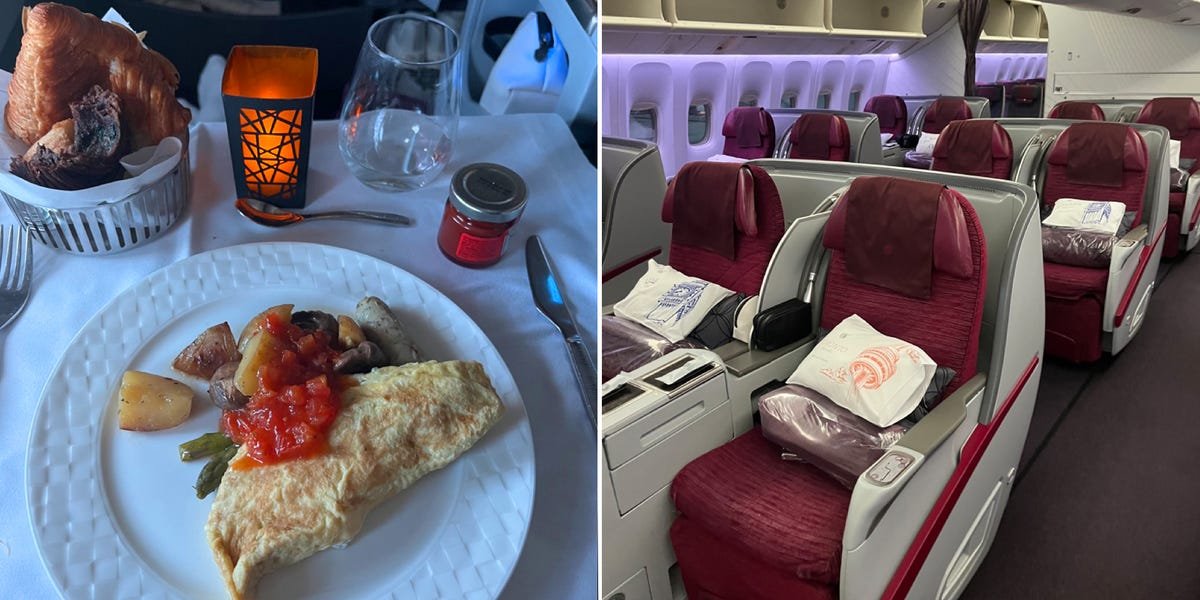
We flew from London Gatwick Airport rather than Heathrow because the flights were about $1,000 cheaper.
Arriving at Gatwick, it was a luxury to have a dedicated check-in counter with barely any queue and then fast-track through security too.
After that, though, I wasn’t super blown away.
Qatar Airways doesn’t have a dedicated lounge at Gatwick, so its business-class travelers can use the Plaza Premium Lounge, which anyone can pay to use. I found it to be quite busy and a bit underwhelming, with a rather uninspiring view.
However, it has a separate area for Qatar Airways customers where we could order from a small à la carte menu. I got a burger, and my husband had a goat-cheese sandwich — it was nice to have complimentary food.
We were also given “premium” drinks vouchers for certain beverages, such as prosecco, though Champagne would’ve cost extra.
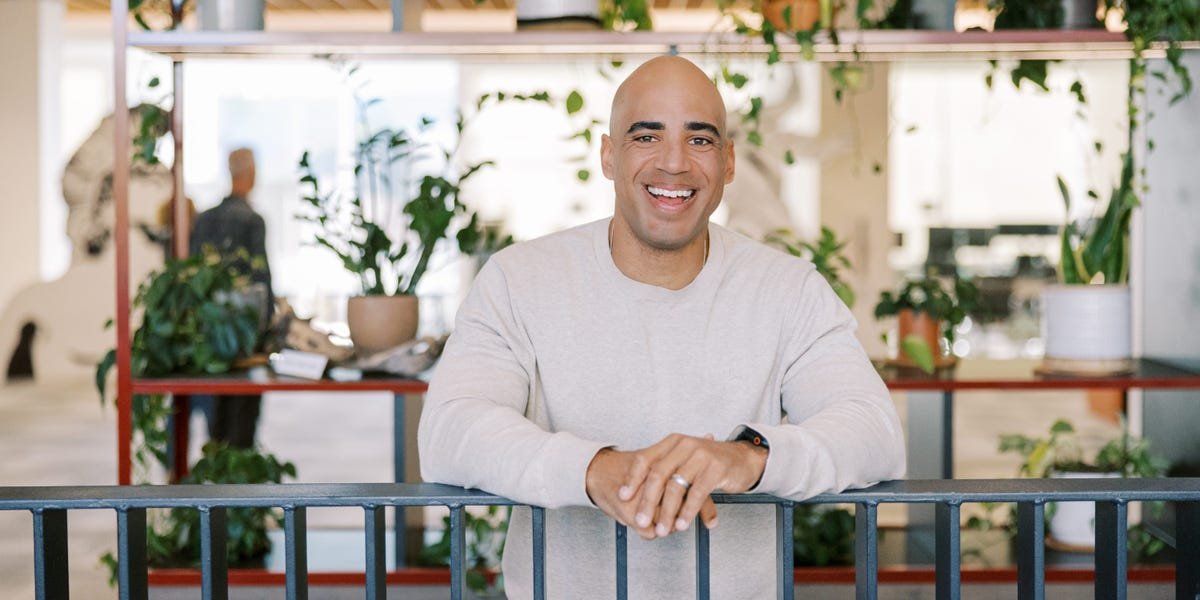
This as-told-to essay is based on a conversation with Tyler Smith, founder ofHundred Health. It has been edited for length and clarity.
I used to brag about how little sleep I got. It felt like a superpower: I could sleep just three or four hours a night, and still operate at a very high level.
That helped me get ahead early on. As a teen, I bused tables and sold firewood. By the time I was 19, I bought a house (which was possible because it was the subprime mortgage days). Having a mortgage gave me real responsibility at a young age.
It also got me thinking about a career. I couldn’t believe how much my real estate agent made on the sale. Her commission was about $13,000 — which seemed like $1 million to me at the time — and I thought she didn’t do a very good job. I realized that if I did good work in real estate, I could make even more.
I did well in real estate and developed software that took off
I dropped out of college to get into real estate. During the financial crisis, I found a niche helping banks sell foreclosures. In 2006 and 2007, I oversaw about 1,000 home sales a year and managed triple that number of properties.
I was working 14-hour days, seven days a week. It wasn’t a good life, but I was young enough that it didn’t matter. I fueled myself on energy drinks and embraced the fact that work was my life.
To help scale, I developed software to track my business’s transactions. Other brokerages inquired about what I was using, and soon I had clients paying $2,000 or $5,000 a month to use the software.
I was in the right place at the right time with the right product as real estate transactions went digital. By 2012, that software, SkySlope, was doing $12 million in annual revenue. In 2017, Fidelity bought a majority stake, valuing the company at more than $80 million.
I wanted to focus on my passion: health
That deal meant that I had enough money to never work again. I’m wired to build, though, so I planned to use my financial freedom to focus on something with purpose: a mission-driven business.
When I was 39, my wife and I were trying to have a child. I took a biological age test, which said my biological age was 47. That stopped me in my tracks, because my own father had died suddenly of a heart attack at 47.
The test showed me that what I was telling myself wasn’t true. I was working out and eating relatively healthy. I looked fit, but the data showed that what was happening inside my body didn’t match what was on the outside.
I spent over $1 million building a home wellness center
Once I saw that data, I couldn’t ignore it. I spent well over six figures hiring a top-notch healthcare team. My wife and I rented a 2,000 square-foot unit in Sacramento, which we transformed into our own personal wellness center. It had IV infusions, a hyperbaric chamber, a red light bed, cold plunges, massagers — basically anything you can name in the health and fitness world.
We were building a home in Napa and wanted to know which equipment we would actually use. We spent about $700,000 fitting out the Sacramento space, and eventually over $1 million building the wellness center in our home.
Today, I use the red light bed, oxygen therapy, and cold plunge almost daily. Other therapies — like massagers and bikes — didn’t make the final cut. I love the results of the hyperbaric chamber, but don’t like lying in it for an hour, so for now, that’s out of rotation.
I want to help others have more access to health information
I changed everything about my health and fitness, and because of that, everything in my life changed: my muscle mass and energy levels went through the roof, and my mood improved. I felt better than ever, and friends began to notice.
I know not everyone has the money and access I do. Most people have more data about their health than ever due to smart watches and wearable monitors, but they don’t have a team of doctors helping them use that information.
I started Hundred Health not only to provide data, but also to offer a personalized plan for what to do with it. I used to think that wealth was freedom, but now I know that health is — and I would like to help more people access that.
When I first found out I was pregnant, I frankly didn’t put much thought into long-term childcare plans. Living in New York City, my husband and I knew we wouldn’t have the traditional village available to us — my parents, while local and thrilled to get a first grandchild, are older and weren’t particularly eager to volunteer for solo babysitting, while his parents live thousands of miles away.
But we were in a uniquely lucky situation: We both happened to have flexible, largely remote jobs.
For the first few months of my surprisingly generous parental leave, my husband and I, cocooned in newborn bliss (and perhaps slightly delirious from sleep deprivation), didn’t stress about what would happen when I went back to work. I figured we could make it work through a combination of creative time management and strategically scheduled naps — at least until our daughter was eligible for 3-K, free schooling available in New York City for kids the year they turn 3.
My husband became the primary parent
Surprisingly, this plan ended up working, for the most part, and for just shy of a year, we managed a fairly even 50-50 split in parenting duties. As time went on and my own work ramped up and the baby potato turned into a sprinting toddler, it became clear that my husband would need to become the primary parent.
It wasn’t something either of us had considered before having a child, but it made the most sense: He found far greater fulfillment in being a father than he’d ever found in his career, whereas I had always defined myself by my work as a writer and editor. He kept his job but scaled back, working largely in the evenings and weekends so he could be free during the day for stay-at-home parenting.
As our daughter became a toddler, she blossomed under my husband’s full-time care, with constant adventuring and frequent playdates keeping her days busy. We didn’t need outside childcare — but as it turned out, she did.
I’d considered traditional childcare, but couldn’t stomach the cost
New York City has notoriously high childcare costs.
The author says traditional childcare was too expensive in New York City.
Courtesy of Michael Matassa
In the interim between our delicate balancing act and deciding my husband would drastically scale down his work, I considered a number of different options, from traditional daycares (upward of $2,500 a month in my neighborhood for full-time programs) to nanny-share arrangements with other local families (maybe slightly cheaper, but a pain to coordinate).
We were lucky in that we were able to avoid childcare costs, which would have effectively canceled out one of our salaries, though I still toyed with the idea of enrolling her somewhere part time to get her used to the idea in case our situation changed.
Enter Barnard College’s Center for Toddler Development.
I first heard about the program in a local moms’ book club I’d joined. One of our first reads was “How Toddlers Thrive” by Tovah P. Klein, a prominent child psychologist — and incidentally the then-director of the Toddler Center. Another mom in the book club with a daughter two years older than mine mentioned she was now applying.
I was frankly flabbergasted when she explained the details. It’s part research program, where the toddlers are minded by teachers and selected students from the college’s graduate program and observed for published research purposes from behind a one-way mirror, and part “school,” albeit an extremely part-time one, with each “class” of toddlers meeting only twice a week for two hours each day for the duration of the school year.
I was intrigued by the program’s unique “gentle separation period” and its said mission to help toddlers have a positive first school experience while supporting healthy social and emotional development through hands-on, child-guided play.
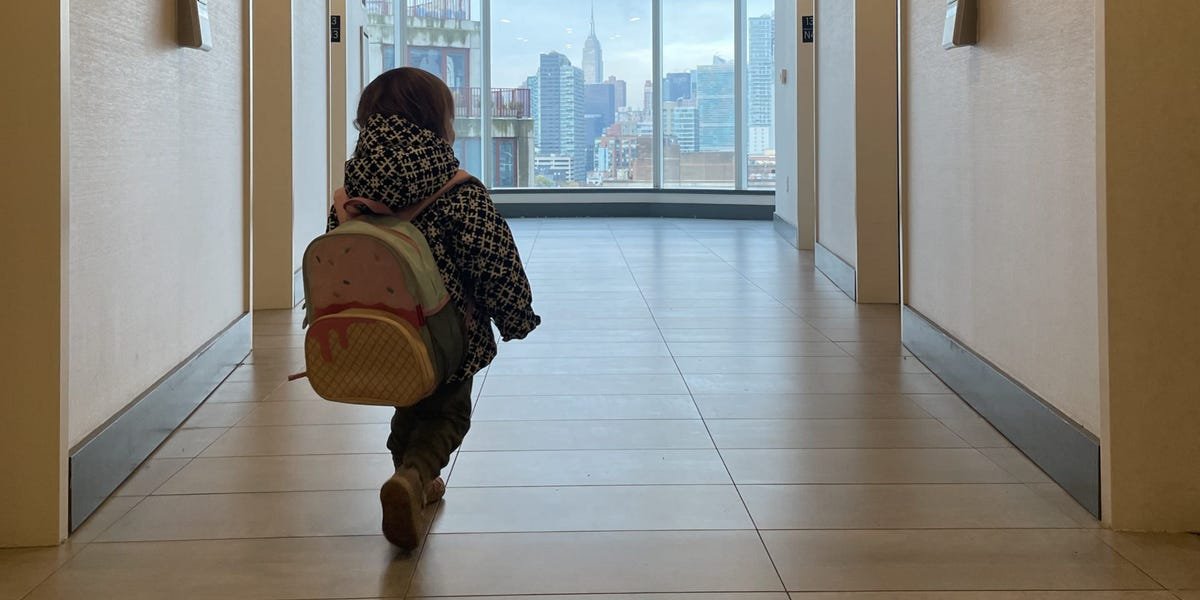
At that point, my daughter was only 18 months old (the halfway point to our 3-K end goal), but I’d already started to suspect that separation might be an eventual issue. With two working-from-home parents, she was used to having us around constantly — and had never had a babysitter.
The few times we’d tried to step out to grab a coffee and handed her to a grandparent, she would shriek like she was being abandoned. Over the next several months, she also grew more shy, coinciding with her stranger danger peaking.
We paid $7,500 for our 2-year-old
Convinced our future would be filled with school refusals and drop-off meltdowns, I hardcore pitched the Toddler Center to my husband for the coming school year. We didn’t need it for childcare, but I became convinced we did need it to help give our daughter the gentlest, most gradual introduction to being away from us. He was less convinced, sure she would grow out of it and be OK with separating by 3-K, but agreed in the end.
If the program details were mind-boggling, the price point was eye-watering. Though there isn’t a set, publicly announced tuition rate, the Toddler Center offers sliding-scale tuition and payment plans to make the program accessible to a broader range of the population. According to its website, a third of Toddler Center families pay tuition on a sliding scale (I assume the higher-profile alum parents like Amy Schumer, Sarah Jessica Parker, and Robert De Niro paid full sticker price for their kids to attend).
After submitting a sliding-scale tuition application, which required forking over the previous year’s tax returns to prove we were indeed not flush with cash, we landed on $7,500 as the final figure for our almost 2-year-old to take her first baby steps toward school.
At first, it was torturous
It did not go well.
The author says at first, her daughter wasn’t comfortable with either of her parents leaving.
Courtesy of Michael Matassa
The first few weeks of the program allowed the parents in the classroom, gradually moving us farther from it (a separate, no-toys-allowed room in the back, meant to be unappealing to the kids) to encourage the toddlers to ignore them and play in the main classroom area. That trick didn’t work on our daughter, who simply sat next to the chair of whichever of us had taken her in that day, chattering happily as we tried to gently encourage her to go away.
As I’d dreaded, the initial actual separation — when parents would bring their kids into the classroom and tell them they were leaving — was horrendous. The Toddler Center mandated that only one parent or caregiver drop off their child each morning.
For the first few weeks after separation, we could both sit in the observation room, where we were treated to a front-row show of our daughter sobbing hysterically and trying to reason with the grad students to open the door she was convinced we were right behind. It was excruciating, and plenty of tears were shed on our end as well.
There was virtually no improvement for months, which was far longer than I expected. And I felt an immense amount of guilt for having come up with this idea in the first place: Were we actually traumatizing her instead of helping her? Had I epically miscalculated this? Did I pay $7,500 to torture my toddler and myself?
I was wracked with doubt, and we debated withdrawing her from the program before the first semester had even finished. It was particularly hard on my husband, who, as the primary parent, was typically the one dropping her off and dealing with the meltdowns — and who also really missed her on school days.
Suddenly, though, and for no particular reason at all, it got better. A lot better.
Instead of sobbing by the door for a full hour and a half, she started interacting with the other kids. She found a favorite grad student she’d attach herself to. She played happily on the classroom slide. And eventually, she comforted the other toddlers during their hard separation days, assuring them their mommies or daddies would be back.
The Toddler Center was expensive, but extremely worth it for us
While it was difficult for my husband to be apart from his little buddy for the few hours a week she was at the program, they turned it into an opportunity for new adventures. In the spring semester, he began biking with her to school, stopping to pick up flowers on the way there and back. Another tradition became that he would bring her a blueberry muffin from a local café every day at pickup. These small rituals helped them bond even more.
The author says the $7,500 she spent was worth it.
Courtesy of Michael Matassa
I don’t pretend to have a handle on the intricacies of toddler psychology, and I can’t tell you what the flipped-switch moment was where it finally clicked for my kid that being left at school with her teachers didn’t mean we were gone forever. And yes, for the record, she still cried during drop-off the first few weeks of 3-K.
But I am convinced that completing the Toddler Center program drastically reduced her adjustment period for “real school.” Tossing her into the deep end for six hours a day, five days a week, was simply not the right option for our family.
In the end, I’m glad I listened to my gut, dug into our pockets, and toughed out the tears — and I’d like to think my daughter, somewhere deep down in her toddler brain, is too.
XAI cofounder Jimmy Ba said he left Elon Musk’s startup on Tuesday.
“It’s time to recalibrate my gradient on the big picture. 2026 is gonna be insane and likely the busiest (and most consequential) year for the future of our species,” Ba wrote on X.
Ba reported directly to Musk. He ran a large portion of the company until late last year, when several of his responsibilities were split between two other cofounders, Tony Wu and Guodong Zhang, people with knowledge of the move told Business Insider.
Ba also previously ran the team that oversaw more than a thousand AI tutors, according to an org chart from earlier last year. That role was given to Diego Pasini in September, Business Insider previously reported.
Ba is the second cofounder to depart the company in less than 48 hours. Wu announced he’d resigned from the AI startup on Monday night. Wu’s Slack account was deactivated shortly before the announcement, Business Insider previously reported.
Ahead of Wu’s departure, xAI underwent another restructuring, and several of his responsibilities were shifted under Zhang.
Musk launched the AI company in 2023 with 11 other founders. Six have now left the company — five of them within the last year.
In addition to his work at xAI, Ba is an assistant professor at the University of Toronto in the computer science department. He received his Ph.D. from the school while studying under Nobel Prize winner Geoffrey Hinton, often referred to as the “godfather of AI.”
Musk has said he built xAI as an alternative to what he’s called “woke” chatbots, like OpenAI’s ChatGPT. Over the past year, the company has become known for pushing the envelope. Last July, xAI launched a sexy digital avatar called “Ani,” and its Grok chatbot went on an antisemitic rant.
Most recently, xAI has come under fire after Grok began generating nonconsensual sexual images of real people in response to X user prompts. The backlash eventually prompted the company to restrict Grok’s image-generation features on X.
Last week, Musk announced that xAI would merge with his rocket company, SpaceX. The company is reportedly gearing up for an initial public offering this year that could value SpaceX at $1.5 trillion.
Ba and xAI did not immediately respond to a request for comment.
Do you work for xAI or have a tip? Contact this reporter via email at gkay@businessinsider.com or Signal at 248-894-6012. Use a personal email address, a nonwork device, and nonwork WiFi; here’s our guide to sharing information securely.