My-husband-and-I-work-from-home-and-try-to.jpeg

My husband and I work from home and try to follow a nutritious diet. Here are 10 of our favorite groceries to buy at Aldi.

  • As empty nesters who work from home, my husband and I love shopping at Aldi.
  • The Elevation energy bars and Summit Popz prebiotic sodas are good substitutes for pricier brands.
  • I love snacking on the Simply Nature coconut clusters and Southern Grove trail mix.

As empty nesters who both work from home, my husband and I try our best to choose nutritious food options while keeping our grocery costs low.

Luckily, shopping at Aldi helps us achieve both of these goals. Here are some of our favorite products to buy.

My husband enjoys the peanut butter Elevation energy bars.

Elevation energy bars are a great afternoon pick-me-up.

Amy Barnes

My husband recently stopped buying Clif Bars and replaced them with the more budget-friendly Elevation energy bars from Aldi.

These come out to just about $1 per bar, and he says the taste and texture are great.

He likes to enjoy them as a snack or an afternoon pick-me-up.

I love snacking on the Simply Nature coconut clusters.


Bags of Simply Nature coconut clusters on display at Aldi.

The Simply Nature coconut clusters are made with pumpkin, sunflower, and hemp seeds.

Amy Barnes

The Simply Nature coconut clusters satisfy my sweet tooth, with only 160 calories per serving.

These crunchy clusters are made with a mix of pumpkin, sunflower, and hemp seeds.

Southern Grove trail mix is great for when I’m hiking.


Boxes of Southern Grove trail mix on display at Aldi.

This Southern Grove trail mix is made with cranberries, sunflower kernels, almonds, edamame, chocolate, and peanuts.

Amy Barnes

Whenever I head to Aldi, I like to grab snack-size portions of trail mix. I especially love the Southern Grove version because it doesn’t include raisins.

Packed with cranberries, sunflower kernels, almonds, edamame, chocolate, and peanuts, this mix is easy to snack on at home or when we’re hiking with our dog.

I prefer Aldi’s egg bites to the Starbucks version.


Boxes of Whole & Simple omelet breakfast bites on display at Aldi.

The Whole & Simple egg bites are easy to heat up in the morning.

Amy Barnes

I’m always hunting for delicious protein options to start my day, and I often find myself craving the egg bites from Starbucks. However, my wallet doesn’t love them as much as I do.

So, I’ve switched to Aldi’s Whole & Simple version, made with bell peppers, uncured ham, and cheddar. I think they taste similar to the Starbucks version and they’re easy to heat up at home.

We love the Happy Farms spreadable cheese wedges.


Containers of Happy Farms spreadable cheeses on display at Aldi.

There are lots of different varieties of Happy Farms spreadable cheese.

Amy Barnes

Since we both work from home, my husband and I are always looking for quick lunch options. We like the Happy Farms spreadable cheese wedges, which cost less than $3 each, and taste great on their own or in wraps.

Simply Nature popcorn is great for movie night.


Bags of Simply Nature popcorn on display at Aldi.

Each cup of Simply Nature sea-salt popcorn contains 35 calories.

Amy Barnes

At only 35 calories per cup, I like to have Simply Nature popcorn with my lunch or as a movie-watching snack when the kids come back home. It’s also a good source of fiber and is gluten-free.

Aldi’s steamed vegetable medleys make dinner easy.


Bags of steamed vegetables on display at Aldi.

I love the Season’s Choice Asian-seasoned vegetable medley.

Amy Barnes

Whenever I take a trip to Aldi, I look for the Season’s Choice steamed vegetable medleys. These bags of brightly-colored veggies are reasonably priced and easy to make.

I like to season my veggies with Burman’s stir-fry sauces.


Bottles of Burman's sweet and sour stir-fry sauce on display at Aldi.

Burman’s stir-fry sauces are a great way to add flavor to steamed vegetables.

Amy Barnes

Instead of ordering take-out, I like to season my steamed vegetables with Burman’s orange or sweet and sour sauces. I just add some chicken to create an easy stir-fry meal.

Aldi sells a great substitute for brand-name probiotic sodas.


Cans of Summit Popz prebiotic soda on display at Aldi.

I love the Summit Popz prebiotic sodas.

Amy Barnes

Staying hydrated while working from home is a necessity, and I love sipping on the Summit Popz prebiotic sodas. I think they’re a great alternative to the more expensive Poppi sodas.

Click to keep reading Aldi diaries like this one.


Source link

My-husband-and-I-moved-in-with-my-grandparents-to.jpeg

My husband and I moved in with my grandparents to save money. The temporary adjustment period was worth it.

I grew up spending weekends, school breaks, and holidays in my grandparents’ home, but moving into it years later with a husband wasn’t something I ever pictured.

We moved into my grandparents’ basement not long after we got married in spring 2025. We both traveled as kids and have gone on a few short adventures as a couple, but we’d never done any long-term.

With our lease ending in the fall, it felt like the perfect time to make a big change, and we started looking at flights to Japan.

I eventually came across a deal on December plane tickets that we couldn’t pass up, but the opportunity left us with a two-month gap to fill before moving away.

Short-term rentals and Airbnbs were too expensive to commit to, especially with a big move ahead. So, when my grandparents suggested we stay in their basement, only 40 minutes away from where we’d been living, it was easily the most practical option.

Being back in my grandparents’ home reminded me how much of my childhood still lives here


Decorations at the writer's grandparents' house, including a fan from Japan, painted handprints, and Polaroids of the writer.

Moving in with my grandparents as an adult brought me right back to my childhood.

Alessa Hickman


Even before we started unpacking, the house instantly brought me back to my childhood. My grandparents have moved a few times over the years, but no matter the location, their home always feels the same.

The dishes and teacups I grew up using are still in the cupboards. The same family photos and decorations are on the fridge and walls, with new additions that have been layered in over the years.

Then there’s Crash, my grandparents’ herb-loving budgie bird, who has a habit of landing on people (and plates) without warning. They’ve only had him for a few years, but their home has always included animals, so even a new bird felt completely natural.

Being surrounded by the memories, familiar faces, and sense of home that shaped my childhood felt grounding during this period of change.

Moving here as an adult meant learning how to fit our lives together differently


The writer's husband with a blue bird on his shoulder.

We had to adjust to new routines, boundaries … and my grandparents’ budgie bird, Crash.

Alessa Hickman


Living with my grandparents came with a series of practical adjustments.

As my husband and I prepared to move abroad, we packed up or sold almost everything we owned, and now found ourselves living outside the city, setting up temporary workstations, and cooking for four instead of two.

Before long, the basement had boxes tucked into corners, the kitchen cabinets were full of our spices and small appliances, and my plant collection had completely taken over the front entrance table.

Moving in also meant navigating new boundaries and having conversations about topics that didn’t come up when I was younger — like finances, household responsibilities, and how much space to give each other.

One of the first conversations we had was about food. Cooking is one of my love languages, so even before we moved in, I told my grandparents that I wanted to take on the family meals.

After so many years of being cared for in their home, it felt important to give something back in a way that came naturally to me.

Because I work remotely, we also had to have conversations about my work-from-home schedule. I had work deadlines to meet and calls to take, which meant setting expectations around when I would be working and when I would be free.

That adjustment took some time on all sides, but those early conversations ultimately helped us find common ground.

This time with my grandparents gave me a chance to appreciate family in a new way


The writer and her grandmother posing for a selfie and smiling in her grandparents' house.

The experience turned into a meaningful chapter of my life.

Alessa Hickman


As I’ve grown older and gotten busier, my time with family has naturally become shorter and much more spread out.

Between work, different homes, relationships, and planning a move abroad, so many visits have been quick moments squeezed in on birthdays, holidays, or weekend check-ins.

Having a stretch of time with family like this isn’t something that comes up often, and it made the simple moments with my grandparents feel more meaningful — sitting down for dinner together, cooking a meal we used to eat when I was little, or laughing at the stories we’ve all heard a thousand times.

This in-between season has been filled with memories, lessons, and changes that taught me how much growth can happen in familiar spaces.

As we start this new chapter abroad, I’m grateful that this time with my grandparents was part of our journey. It reminded me to embrace the unexpected moments, make the most of every experience, and start our next adventure with an open mind.


Source link

My-husband-and-I-started-doing-adult-paint-by-numbers-to-get.jpeg

My husband and I started doing adult paint-by-numbers to get off our phones. The hobby’s benefited us more than we expected.

I’m stuck in a doomscrolling loop again.

My algorithm drags me down the rabbit hole of videos people posted to social media to declare 2026 as the year they … get off social media.

I see more and more videos with mass declarations to “go analog” and focus on screen-free activites. The irony is thick, but with the world on fire around me the sentiment has appeal.

I’m not naive enough to think this movement is new or will last in any meaningful way, but participating seems like a nice way to take a breath and find some good in the rubble.

As I watch another video and then one more, an idea starts to take root. What if I start a new hobby to get off my phone, even if just for a little while each day?

And what if my husband joins me?

Although it felt out of our comfort zone, we bought paint-by-number kits


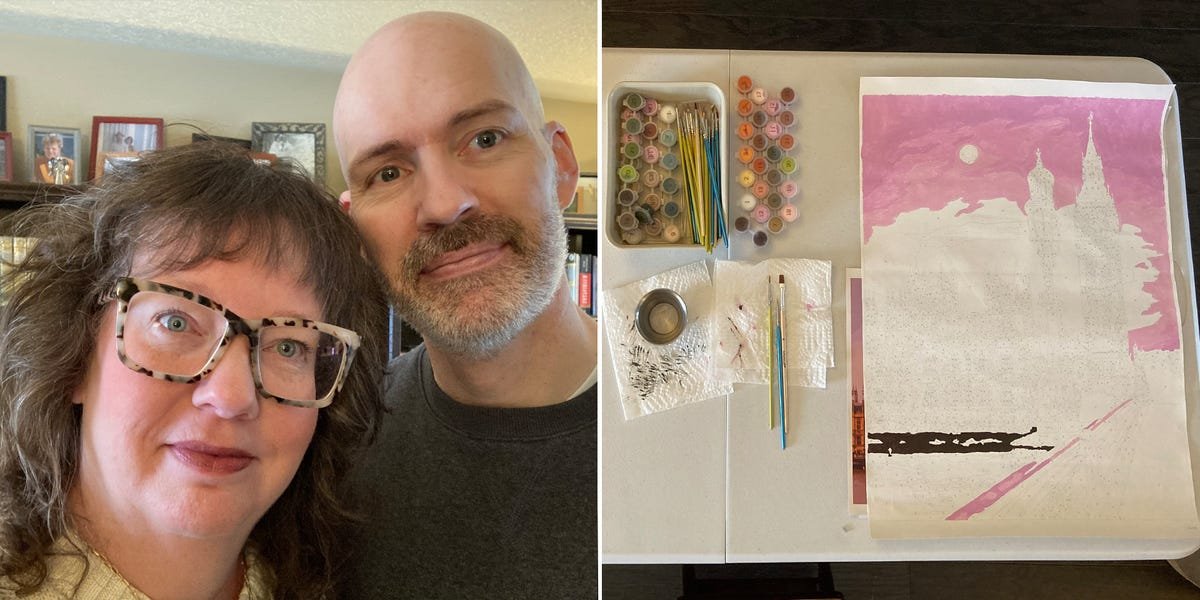
Table with paints, papers with partially painted artwork

I started doing paint-by-number canvases with my husband.

Tawnya Gibson


When I share this idea with my husband, he brings up the idea of buying paint-by-number kits that are designed for adults.

It’s far out of our comfort zone. But before either of us have a chance to talk ourselves out of this, we pop into an art store.

We both decide to buy larger canvases mostly to have a longer-term project, not because we are certain we have the right abilities. About $30 later, we’re still wondering what we are thinking.

When we get home, we bring down a folding table from our office. It’s just the right height to share as we sit on our loveseat, water, brushes, and paper towels between us.

Keeping our paints separated, we turn on reruns of “New Girl,” grab our reading glasses and glob the colors on our canvases — him a streetscape of Brooklyn, me a skyscape of London — both quietly hoping they’ll be nice enough to hang on our bedroom wall when we’re done.

These nights off our phone become our lifeline to feeling lighter, like when we were first married


Man and woman wearing hats, smiling

It’s nice that a simple hobby has helped us talk and laugh more.

Tawnya Gibson


Several things soon become clear. First, we may have overestimated our abilities and how difficult an adult paint-by-number could be.

Next, we are taking vastly different approaches to the task. I am starting with the larger areas, swirling my brush and not coming close to the canvas edge until the very last minute, desperate to not make a mistake.

My husband goes for the smaller details in the darkest color. He has read all the instructions. I’ve tossed mine straight into the recycle bin.

Our personalities are similar until they aren’t. I have a need to catastrophize before I build a plan. My husband is logical with a more black-and-white way of thinking. I feel these differences highlighted as we paint.

Over the span of two or three episodes of “New Girl,” I’ve delayed starting, given up, and restarted a dozen times. My sky looks terrible, punctuating my lack of artistic talents.

I declare total disaster in between every laugh, fret about running out of pink sky No. 12, and stop long before the last episode of the night comes to an end.

Still, we continue painting night after night.

The progress is slow and neither of us are sure when we’ll be done. But something happens on the nights we choose painting over retreating with phones in hands: Our home is kinder. We talk. We laugh.

The stress of getting the strokes within the lines is the lighter type of stress we used to have when our marriage was young.

On our way to bed, we stand up. Assess. Comment on our progress and sleep a little easier.

We’re remembering what it’s like to do something with no goal or agenda. We’re enjoying our time together less online.

Maybe when we’re all done, I’ll post a picture in a hazy filter and show off my pink-skyed London, mistakes on full display — a little analog badge to celebrating remembering how to live.


Source link

Amanda Goh

Barbara Corcoran, 76, says getting a second bedroom prompted her to love her husband ‘twice as much’

Barbara Corcoran, 76, swears by having separate bedrooms from her husband. She says couples should try it — even in small spaces.

“Well, they could get separate beds. They could put a wall up. They could sleep on the convertible couch,” Corcoran told The Wall Street Journal in an interview published on Monday.

While she acknowledged that the setup won’t work for everyone, Corcoran said many people living in small apartments could make better use of the space they already have.

“I don’t really have a solution, but there’s a lot of New Yorkers who have two bedrooms and one set up as a den or TV room. I think that’s a misuse,” she said. “When I got my second bedroom, I immediately loved my husband twice as much.”

The “Shark Tank” host and her husband, retired Navy captain and FBI agent Bill Higgins, have been married since 1988.

For Corcoran, protecting her alone time is key, including in the mornings.

“I always wake up at 5 o’clock. I make myself some coffee, sit on my chair and daydream for an hour. I try to stay off my cellphone and I usually succeed,” she said.

Despite her busy schedule, the business mogul says she doesn’t work on Mondays.

“I take Mondays off, and I always have. I will not work on a Monday. On Friday, I leave all my commands, all my notes, little Post-it Notes on everybody’s machines. Or now, it’s a lot of email,” Corcoran said.

This isn’t the first time that Corcoran has shared her views on sleep divorce. In a December 2024 appearance on “The Jamie Kern Lima Show,” Corcoran described having separate bedrooms as one of the secrets to her successful marriage.

“Well, I think there’s something to be said about your own private space. Yes, I lead a very busy life. I have a huge family that I’m always entertaining. I have very sincere, active friends, and so what I need more than anything else is a respite, and my husband is not relaxing,” Corcoran told podcast host Jamie Kern Lima.

She added that it’s difficult for her to muster the energy at the end of the day to listen to him and contribute meaningfully to the conversation.

Moreover, she and her husband have rules for entering each other’s bedrooms. “I have to invite him into my bedroom, and I like it that way,” Corcoran said.

Many other celebrities have also spoken about sleeping separately from their spouses. Carson Daly has called sleep divorce the “best thing” for his marriage, while Bette Midler has said she and her husband of over 40 years have slept apart since the start of their relationship.


Source link

I-met-my-husband-at-work-and-then-we-quit.jpeg

I met my husband at work, and then we quit our jobs to travel the world together. On that 18-month-long trip, we eloped.

My coworker and I were both single, and I was in the trenches of online dating. Stew and I took lunch at the same time, and over sandwiches eaten from Tupperware, we bonded over our shared love of cycling.

One lunch, he told me he was going to cycle the highest pass in Wales. My eyes widened, “I’d love to do that.” That’s when he told me to join him.

He picked me up that weekend, and we cycled Gospel Pass.

The next lunch break, Stew asked me out for dinner. I said yes. He stayed over and never went home. The rest, as they say, is history, and what a ride it’s been so far.

I joined his 24,000-mile cycling adventure

We were dating for about a month when Stewart said, “I’ve got something to tell you.” He continued: “I’m going to quit my job and cycle around the world. Do you want to come with me?”

“Yes!” I said without hesitation.

Stew had already planned a 24,000-mile turn-by-turn route across 32 countries.

He saved enough money that he could ride around the world for 18 months unemployed. His plan was to carry a tent and stay in cheap accommodations, like hostels and Airbnb rooms.

All I needed to do was save enough money to cover my flights. For a few months, we cut costs, but left ourselves with enough money to enjoy being a young couple; a meal out each month was a non-negotiable.

As we left our jobs, Stewart also organized the bikes: bright yellow steel-frame touring bikes that could manage long-distance cycling, as well as the additional weight of our luggage.

We explored countries together

When we left the UK, we waved goodbye to our families at Stewart’s mom’s house, and we wobbled down the driveway on the heaviest bikes we’d ever ridden.

I will never forget the feeling of freedom. We were unemployed, and everything we needed for the next 18 months was packed into six bright yellow panniers, which fit proudly on our bikes.

I was nervous, excited, and weightless.

There are many prominent moments as you cycle from one country to another. But the first one was leaving Georgia and arriving in Azerbaijan. The gorgeous greenery of Azerbaijan turned into flat desert landscapes.


Zoe Ashbridge and her husband marrying in New Zealand

The author and her husband eloped in New Zealand.

Courtesy of Zoe Ashbridge


Australia was similar. Across Nullarbor Plain, we rode desert flatlands with kangaroos and Wedge-Tailed Eagles. Service stations were over 100 miles apart. Then we reached New South Wales, home to green mountains and Bulli Pass.

At the top, there was a wedding venue overlooking the sea. We talked about weddings and all the things we didn’t want: first dances, speeches, and the pressure of invitations.

Planning an elopement in New Zealand

After Australia, our next stop was New Zealand. We flew to Queenstown and researched what it takes to get married there. You need a marriage license and a celebrant who will officiate the ceremony in front of two witnesses.

Our celebrant was someone we found online, named Sean. He was a lovely Irish gentleman with a steady voice, a calming presence, and an art for perfectly timed humor. He knew exactly when to drop a joke and when to let a moment breathe. He promised us two witnesses (his wife, Vee, and friend, Chris) for the price of two quality bottles of wine.

After one call with Sean, we stepped out into Queenstown, engaged-ish. We booked a date, bought New Zealand-gold wedding rings, and hired wedding attire.

Stew surprised me with a proposal and a placeholder ring, and of course, I said yes.

Our next bike ride was 500 miles from Queenstown to Christchurch, so we could marry. I’d love to tell you that it was straightforward, but on a cycling adventure, unforeseen challenges arise. At Haast Pass, there was a landslide. Delays meant we would miss our own wedding.

The beauty of an elopement? We only had ourselves to please. I called Sean, the hair salon, and the florist to change the date. The landslide was cleared, and we made our way to Christchurch.

The wedding was perfect

We married at The Sign of the Bellbird in the Port Hills. It was beautiful. Rolling hills with the yellowest of flowers looked stunning against the deep green mountains and gorgeous blue skies.

On that quiet hill, with only us to please, and nothing but birdsong and sunshine, we spoke our vows and became husband and wife.

There were no crowds, no pressure, and no expectations. It was just us, which was all we’d known in the year leading up to it as we cycled from the UK to New Zealand. What followed was an eight-month honeymoon cycling home via South America.


Source link

kelly burch

While I led my company through a $150 million acquisition, my husband handled the parenting. Here’s how we make it work in our house.

This as-told-to essay is based on a conversation with Tiffany Haynes, host of the Between Builds podcast and Substack. It has been edited for length and clarity.

I was entirely on my own when I was 19. While I was enrolled in college, I worked full-time at night in the call center of a fintech company, Jack Henry & Associates. It was a gritty, hands-on role, but an exciting time to be with the company, which was growing quickly.

I didn’t have a typical college experience. I worked a lot so I could pay for my car and home. At work, I put my hand up any chance I could. I was never the smartest person, but I worked really hard and was always willing to figure out problems. Even if I’d never done something, I would figure it out. I couldn’t afford to fail, personally or professionally.

That served me well. I gained a reputation as someone who could execute tasks with a high degree of excellence, while also operating with empathy. By the time I left Jack Henry in 2022, after 20 years, I had become a vice president.

My husband handled childcare while I worked in NYC

At that point, I was a wife, mom of five, and had been a foster mother to seven children. I live in Missouri, but my reputation was so strong that the team at Fingercheck, a New York-based HR platform, approached me about scaling the company with a goal of acquisition.

I started traveling a lot, and spending two weeks in Brooklyn at a time, with a week at home in between. My husband handled childcare, loading up the kids and bringing them to the school that they attended, where he was the superintendent.

Over three years, I helped scale Fingercheck. In October 2024, it was acquired for $150 million.


Tiffany Haynes wearing a white zip-up sweater and standing in a field.

Tiffany Haynes wants her kids to know the value of hard work.


Photo credit: Teresa’s PHOTOWORKS


After the acquisition, my husband and I founded a school

I stayed at Fingercheck until this July to help with the transition. After that, the plan was to take time to reorient myself and rest.

Yet, life had other plans. The school my husband led was affiliated with a local church. It grew so much that the church could no longer handle it, and this summer, we had a choice to make: let 100 kids find a new school community, or open our own.

It was a whirlwind four months, but we did it. I call myself the quiet cofounder of the school, and I’m not involved in day-to-day operations. Now, I’m doing some advising work and have a podcast called Between Builds. I’m also taking some time for myself to be whole, rather than hurried.


Tiffany Haynes and her husband

Tiffany Haynes and her husband connect every day over coffee.


Photo credit: Teresa’s PHOTOWORKS


We connect almost daily over coffee

My husband doesn’t take a salary — his work is our way of giving back. When he left his paying job 13 years ago to enter education, I became the breadwinner. We’ve had a lot of practice respecting one another’s domains.

The work I did with Fingercheck in New York was very fast-paced, urban, and growth-focused. The work he does here in Missouri is rural, quiet, and focused on community. It’s two different ends of the spectrum.

We appreciate each other’s different skill sets. I support the school, because he loves the school and I love him. He handled the family when I needed to travel for work, even if he didn’t fully understand the fintech world. We connect almost every morning over coffee, before the kids are up, and talk about how we can support each other. We aimed to do that even when I was working full-time, but it’s easier in the months since I left Fingercheck.

I want my kids to understand the joy that comes from hard work

I grew up poor, and I understand how privileged my family is today. We have more than enough, so we aim to give not only money but time. I try to be the advocate I never had growing up, both to my own kids and the children we foster. I’ve done a lot of work to process my own trauma from a difficult childhood, and I want my children to have a foundation of emotional intelligence and health.

I also want them to understand that it takes a lot of hard work and consistency to be excellent. They see YouTube influencers talking about making millions, and I worry that creates a short-sighted view of worth ethic and personal meaning.

I hope my kids understand the joy you get from doing hard things. I want a space where they can sit with frustrations and build resilience; I know that will serve them well in life.


Source link

My-husband-and-I-left-our-jobs-to-travel-full-time.jpeg

My husband and I left our jobs to travel full-time in our 30s. Transitioning back into the workforce has been hard.

When one of my favorite graduate school professors died just weeks into her retirement, it hit me: I didn’t want to spend my life working toward a future I might never get to experience.

I started my career in education as a high school counselor. My husband, Sam, was a self-published author who could work from anywhere, so we took full advantage of my school holidays and long summer breaks, jetting off to new places whenever we could. We created a travel blog, ForgetSomeday, to share our stories.

But the trips we took during school breaks left me yearning for more, and I approached my husband about taking a year off from our careers to travel full-time.

It didn’t take much convincing. We didn’t own a home and hadn’t yet started a family, so the timing seemed right.

I submitted a request for a year of leave, but it was denied due to pending budget cuts. We decided to move forward with our plan anyway, not wanting to wait until retirement to make this dream a reality.


Man in a campervan in Scotland.

The couple’s adventures included a road trip through Scotland.

Provided by Toccara Best


Time for an adventure

Over the next year, we slashed our spending and saved more than $30,000 by cutting out anything nonessential.

We sold our car for $5,000 and brought in a bit more by selling smaller items, storing the rest in a 10×10 unit because we thought we’d be gone for just a year.

By June 2015, we had about $40,000 in the bank, walked away from our lease, and flew to Prague on one-way tickets.

We ate our way through Central and Eastern Europe and Southeast Asia, partaking in bucket-list festivities like Oktoberfest in Munich and St. Patrick’s Day in Dublin along the way.


Two women doing crafts in Mai Chau Village, Vietnam.

Best visited more than a dozen countries, including Vietnam (pictured).

Provided by Toccara Best


We visited more than a dozen countries — island-hopping in Croatia, Thailand, and Portugal; exploring Cambodia’s temples; soaking in Hungary’s thermal baths; and driving 500 miles through Scotland in a campervan.

From hiking in Austria and Slovakia to swimming with seals in Sweden, the year became a crash course in adventure travel.

As our official gap year came to an end, our bank account was still surprisingly healthy, thanks to housesitting opportunities and blog partnerships that helped stretch our budget. And because I didn’t have a job to go back to, we decided to keep traveling.

Little did we know, our biggest adventure was right around the corner: 6 months later, we found out we were expecting.


Pregnant woman posing in Iceland with snow in the background.

Iceland was Best’s final stop before returning to the US.

Provided by Toccara Best


And then we were three

We returned to the US to have our son, but just a few months after his birth, we began traveling full-time again, this time exploring America.

By his third birthday, my son had already visited 27 states. Eventually, the pandemic put a halt to our full-time travels, and we took that as a sign to settle down.

We returned to California five years after the adventure started.

When we planned our gap year, it was supposed to be just that, a year. But as time went on, the gap on my résumé grew, and my motivation to return to the career I once loved began to fade. My husband was also trying to figure out what he wanted to pursue next.


Small boy walking down a trail at Quinault Rain Forest, Olympic National Park, Washington.

The couple continued to travel around the US after having their son.

Provided by Toccara Best


Reentering the workforce

We didn’t realize that our global adventure would end with such a hurdle — a career pivot after five years away, right in the middle of a global pandemic.

Maybe it was the break we both needed to reevaluate our next steps, but it has taken us both quite a while to get back in the saddle.

Once our son started preschool, I transitioned back into the workforce as an executive personal assistant for a busy entrepreneur, putting my organizational skills to good use.

When the executive moved out of state just over a year later, I quickly found a new role as operations manager at a nonprofit organization, where I’ve worked part-time for nearly four years. I’ve been searching for meaningful full-time employment for the past year and a half, which has been especially challenging in today’s competitive job market.

Was our gap year impulsive? Not exactly. We spent a year saving and planning. Was it risky? Definitely. More so than we imagined. Would we do it all over again? Absolutely.

That said, if we were to do it again, we’d probably just stick to a year.

Do you have a story about taking a gap year that you want to share? Get in touch with the editor: akarplus@businessinsider.com.


Source link