
Im-an-American-who-moved-to-a-small-French-village.jpeg

I’m an American who moved to a small French village. I tried to adjust, but learned I wasn’t built for country living.

Growing up in a remote California suburb, I spent most of my childhood counting down the days until I could leave for a big city.

When the time came to move to New York for college, I was prepared to say goodbye to country living for good. I spent six years in New York, and then another four in Berlin.

Although I loved my experiences in both cities, I was exhausted. Years of apartment hopping, navigating dirty subways, and dealing with nonstop hustle left me craving a reprieve — and wondering why I’d been so quick to swear off a quainter life in the country.

So, when my husband proposed that we move to a little village near his family in France, I surprised myself by agreeing to give it a try.

This was in 2021, when COVID-19 restrictions were making it challenging to live in Berlin, and we were both desperate for the benefits that such a relocation could offer — like more square footage, a yard, and, most importantly, proximity to our loved ones and their support.

The reservations I had about residing in the country were still nagging me, but I figured things would be different this time. I was older, wiser, and doing it in beautiful France, of all places.

I wish I had listened to my gut, though, because all my old qualms with country living ended up rearing their ugly heads — and we ended up leaving after two years.

Without a driver’s license, I felt isolated by the lack of public transit


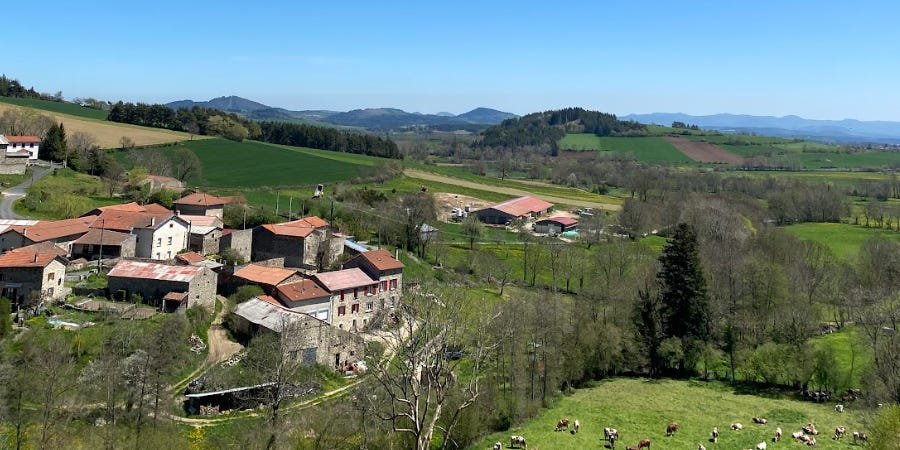
A shot of the French village where the author lived, featuring houses, fields, and a skyline.

I’d hoped my new home would be a bit more walkable.

Audrey Bruno


I never needed a driver’s license when I lived in cities, but that all changed when we moved to the French village. There, we simply couldn’t get around without a car — but we sure tried.

I knew going in that my public transportation options would be more limited than they were in a city, but I didn’t expect to be as isolated as we were.

When we first arrived, it took us over a month to work up the funds to buy a car. In the meantime, we attempted one very hilly bike ride, but had to call it quits before we’d even made it halfway to our destination.

Walking was no better — it took hours to get to the nearest shops, and sometimes they wouldn’t even be open when we finally arrived.

Even after we obtained a vehicle, I couldn’t navigate on my own without my husband, since he was the only one with a license.

He was always willing to drive me around, but I was frustrated by my newfound lack of independence. I considered getting a license of my own, but the cost of driving school was out of our budget at the time, so it really seemed like there was no way out of the situation I’d gotten myself into.

I wasn’t prepared for the demands of caring for a house after years of apartment dwelling


A snow-covered house in a French village.

Years of living in apartments didn’t prepare me for the hard work of cleaning and maintaining a house.

Audrey Bruno


Apartment life certainly has its drawbacks, but extra square footage comes with pitfalls, too.

We loved that our rental home gave us the newfound ability to stretch out and make noise without bothering each other. The downside, though, was that it was up to us to care for and maintain all that extra space.

It wasn’t just the house, either — it was also our responsibility to tend to the adjoining garden, barn, and the attached horse stables. It was a full-time job’s worth of work, and I started to miss the days when I could clean my whole apartment in just an afternoon.

Living without any takeout options was harder than I expected

Normally, I’m a proponent of cooking as much of my own food as possible, but I at least like to have the option of ordering in or eating out — especially on days full of chores and work.

Unfortunately, getting to the closest takeout restaurant took an hour round-trip, and delivery applications like Uber Eats didn’t service our small village.

What’s more, our dining options were severely limited compared to what we’d had in Berlin. I realized that I missed trying different cuisines and checking out new restaurants, and even when cooking,

I didn’t have access to the same wide variety of ingredients that I’d had in the city. One example was sesame oil — if I wanted to use this pantry staple in a recipe, I’d have to go to a big city to find it.

Connecting with neighbors wasn’t easy

Our village was extremely small — as of 2020, the population was under 400 — and many of the people I met were much older.

Needless to say, our rhythms and beliefs didn’t always match up. We often had debates over everything from politics to local initiatives — like what to do with all the feral cats — and it wasn’t always easy to argue my point in my then-limited French.

Since most folks in Berlin are fluent in English, I’d never been up against such a language barrier before. All that and more made it challenging to form true connections and further contributed to my feelings of isolation.

That said, there were things I missed about country life once I left


The writer standing outside, holding up lettuce she grew.

When I lived in the countryside, I got to grow my own fruits and vegetables.

Audrey Bruno


Despite all my frustrations, there were a few great things about living in the French countryside.

For starters, it really is beautiful, and being there allowed me to grow my own fruit and vegetables, forage wild blackberries in the forest, and perfect my French with the folks in town who were willing and patient enough to help me out.

After two years, we ended up moving to Lyon, the nearest city, because it offered the best of both worlds. At only 84 miles away, we’d have proximity to my husband’s family and access to nature, plus all the advantages of living in a major city.

I’ll always remember the beautiful memories from my time in the village — but I’ll also always prefer to reminisce about them from an apartment in a city.


Source link

Im-at-CES-in-Las-Vegas-to-check-out-the.jpeg

I’m at CES in Las Vegas to check out the latest in autonomous driving. Here’s what I’ve learned so far.

  • Robotaxis and autonomous cars once again have a large presence at CES 2026.
  • Several companies, including Amazon’s Zoox, are providing off-site demos.
  • Business Insider is providing an on-the-ground look at the latest in the advanced mobility space.

Business Insider is taking on CES 2026.

I’m on the ground in Las Vegas from Tuesday to Thursday, taking in all there is to know about the latest in the driverless space.

Robotaxis and self-driving cars have already had an outsize presence at the tech conference, especially in the previous hype cycle of the late 2010s and early 2020s.

Things have changed since then. The industry has largely moved on from mere concepts and technology validation to: How are we going to realistically scale autonomy?

It’s day one of the conference, and there’s already a lot to take in.

Nvidia CEO Jensen Huang unveiled the Alpamayo family, which will serve as an autonomous-driving stack for OEMs to deal with those stubborn edge cases — or the “long tail” of self-driving.

Uber and Nuro showed off an early look at the Lucid Gravity SUV that the companies hope public riders will be able to take by late 2026.

I’ll be spending less time at keynotes and speaker events and more on real-life demonstrations and meetings with industry leaders and commentators in autonomy

Think of this as my personal notebook, where I jot down everything I’ve learned and seen at the conference.

Check back in for more updates.

Amazon-backed Zoox is unlike any other robotaxi.

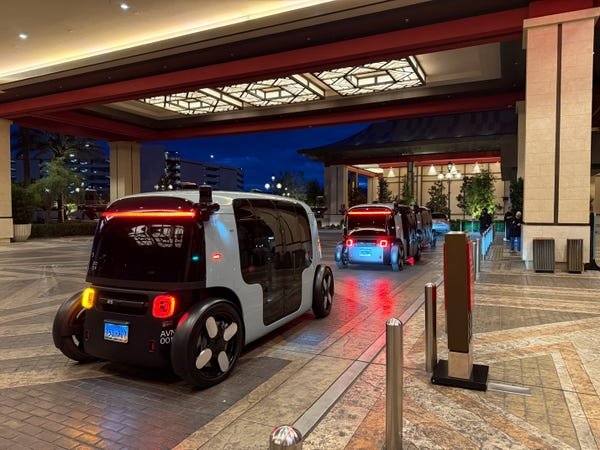
Zoox robotaxis line up in front of Resorts World Las Vegas

Lloyd Lee/BI

This is the first year Zoox, an Amazon-backed robotaxi company, will be giving live demonstrations of its service during CES.

I got to take a ride in one on Monday night in front of Resorts World. (The company tagline that I saw from an ad at the Harry Reid International Airport was: “Don’t just do the Strip. Zoox it.”)

My immediate thoughts were that Zoox feels unlike any other robotaxi or pseudo-robotaxi on the market. It felt more like I was on a theme park ride than in an everyday car we’re familiar with.

Unlike Waymo’s robotaxis, Zoox is not a regular car you could buy that’s been retrofitted with sensors. The Zoox car is bi-directional — meaning there’s no real front or back of the car — and the inside has no steering wheel, just seats.

The robotaxis were clearly a great tourist attraction from what I saw. My Uber driver wasn’t too happy about them.

Uber, Lucid, and Nuro have big plans to scale.


Uber, Lucid, Nuro

Left to right: Uber’s Sarfraz Maredia, Lucid interim CEO Marc Winterhoff, and Nuro cofounder Dave Ferguson.

Lloyd Lee/BI

Uber, Lucid, and Nuro had a swanky cocktail hour at Fontainebleau Las Vegas, where they quite literally wined and dined a room full of reporters, analysts, and investors: endless glasses of wine and an open bar, lobster tails, jumbo shrimp, too many appetizers to count, and a giant charcuterie board — the works.

Maybe understandably so? 2026 will be a big year for the three companies.

Uber’s plan is to roll out a robotaxi service by late 2026. The first market is San Francisco, where Uber will directly compete with Waymo. These two companies are partners in other markets, like Austin.

“We’ve been moving very, very quickly,” Nuro’s co-CEO and cofounder Dave Ferguson said. “We signed this partnership last July. We’re already testing the production-intent vehicles on public roads. And very soon, we’re going to have tens of thousands of them worldwide.”

Here’s a 60,000-pound John Deere combine for scale.


John Deere

John Deere’s X9 combine.

Lloyd Lee/BI

A quick image to get a sense of how big CES’s mobility division is at West Hall of the convention center: There’s a 60,000-pound combine from John Deere that’s sitting in the middle of the showroom.

The combine is one of the world’s largest on the market, according to Julian Sanchez, an engineer at the machinery company.

Even so, John Deere doesn’t even have the largest footprint on the floor. This year, it’s Hyundai.

The combine isn’t autonomous in the way we think about self-driving cars, Sanchez told me, but it is self-steering.

The world got a reality check on self-driving cars since the last hype cycle.


Tensor

Tensor aims to sell a personally-owned vehicle that will have Level 4 driving.

Lloyd Lee/BI

There’s a lot of talk of self-driving cars in the automotive industry, but the scope of what it can realistically achieve has narrowed down in the last decade or so.

Paul Costa, an ex-Apple veteran of 25 years who worked on the company’s abandoned self-driving car project, gave me a bit of interesting color from what he saw at CES in 2015 — when the driverless car hype was reaching its peak — and what’s different now.

“My sense at the time was that people really wanted to focus on Level 5 autonomy,” Costa, who now leads Ford’s electrical engineering team, told me. Level 5 is the highest level of autonomous driving set forth by the Society of Automotive Engineers. That means full autonomy in all weather conditions and no geofences. Waymo is currently Level 4.

The tone has been brought down to reality, according to Costa. The focus is on highly advanced driver assistance systems and eyes-off driving or Level 3 systems, he said.

“Now, I feel like here in 2026, L3 is extremely interesting,” Costa said. “It’s interesting for me to see how the industry — its focus has changed over the years.”

Signup Today: Connectivity and Tech Pro by Business Insider Intelligence


Source link

5-things-we-learned-from-the-latest-Epstein-files-drop.jpeg

5 things we learned from the latest Epstein files drop

The Justice Department’s long-awaited release of the Epstein files on Friday offered a deeper look at the jet-setting lifestyle of the late sex offender and financier Jeffrey Epstein — but few major revelations.

The data dump included thousands of files, mostly images, many of which were heavily redacted. The Justice Department released the documents to comply with the Epstein Files Transparency Act, which President Donald Trump signed into law last month.

The department, citing the task of ensuring no information included in the release could be used to identify victims, did not make public its entire database on Friday, as the law required. The department said it would turn over more files in the coming weeks.

In 2008, Epstein pleaded guilty to solicitation of prostitution and solicitation of prostitution with a minor under the age of 18. Nine years later, the financier was charged with the sex trafficking of minors. He died by suicide in 2019 while in federal custody.

Business Insider has been reviewing the latest files, which continued to roll out late Friday evening. Here are our biggest takeaways.


Epstein pictured with Richard Branson.

Jeffrey Epstein pictured with Virgin Group founder Richard Branson.

Department of Justice


1. Lots of famous faces

The files contained numerous images of celebrities and politicians, including former president Bill Clinton, pop star Michael Jackson, and British billionaire Richard Branson.

The photos are not evidence of wrongdoing.

Not all of the celebs were pictured with Epstein, and at least one photo — of Diana Ross with Bill Clinton and Michael Jackson — can be found on the professional photography service, Getty Images, suggesting it was not Epstein’s personal photo.

The context of many of the photos is also unclear, lacking dates, locations, and other identifying information.

Clinton featured prominently in the latest round of files, including several previously unseen photos.

Angel Ureña, a spokesperson for Clinton, said on X that the former president was unaware of Epstein’s criminal activity.

“There are two types of people here,” he wrote. “The first group knew nothing and cut Epstein off before his crimes came to light. The second group continued relationships with him after. We’re in the first. No amount of stalling by people in the second group will change that.”

Other famous figures seen in photos in the documents include actors Kevin Spacey and Chris Tucker, The Rolling Stones front man Mick Jagger, and Sarah Ferguson, the former Duchess of York. Business Insider reached out to them for comment.

Spacey had earlier called for the release of the Epstein files and said in a post on X in July that he has “nothing to fear.” In multiple interviews before the latest release, Tucker has denied any knowledge of criminal activity. Jagger has not responded publicly. Ferguson has said she cut ties with Epstein after his conviction.


Photo from Epstein files.

Former President Bill Clinton in a pool.

Department of Justice


2. Redactions draw criticisms

The Justice Department’s release drew criticism from some victims and Democrats for its heavy redactions and limited initial release.

In some cases, entire documents were obscured by black boxes, including one 119-page file. The DOJ has attributed its delay in producing all the documents by the December 19 deadline in part to its duty to safeguard the personal information of victims and other individuals.


Redacted documents from the Epstein files

Image with redactions from the Epstein files released on Friday.

Screenshot


3. 1996 complaint

The files shed some light on how long young women have been accusing Epstein of wrongdoing.

Among the thousands of documents was a 1996 FBI memo included in a complaint filed against Epstein by a woman whose name the Justice Department redacted. Business Insider confirmed the accuser was Maria Farmer, who has previously said publicly that she reported Epstein to the authorities.

In her original complaint, Farmer says Epstein stole pictures of her 16-year-old sister and is “believed to have sold them to potential buyers.” She says he once asked someone to take photos of young women at swimming pools.

“I feel redeemed. This is one of the best days of my life,” Farmer said in a statement to Business Insider shared by her lawyer.


1996 FBI complaint by Maria Farmer

A photo of the 1996 FBI complaint filed by Maria Farmer.

Screenshot


4. More files to come

The Justice Department was required by law to release the documents by December 19, but US Deputy Attorney General Todd Blanche said Friday that the files would be released in batches over the coming weeks. Four sets of files were released on Friday evening. The Justice Department posted an additional three sets late Friday, which included photos of evidence files.

The Justice Department’s delay in releasing all the files at once has led to criticism from lawmakers. Republican Rep. Thomas Massie said the move “grossly fails to comply with both the spirit and the letter of the law.”

Democratic Rep. Ro Khanna told CNN that he and Massie were now drafting articles of impeachment against US Attorney General Pam Bondi following the release.


Chain of custody evidence envelope

A chain of custody evidence envelope was found in the latest release.

Screenshot


Trump stays quiet

Trump is known to have socialized with Epstein in the 1990s and 2000s, and photos of the pair together have been well publicized in recent years.

He didn’t feature prominently in Friday’s document release. There was a photo of a messy desk that contained a photo of Trump inside a drawer. Trump has previously said he ended his ties with Epstein years ago.

Blanche told ABC News on Friday that there had been “no effort to hold anything back because there is the name Donald J Trump.”

Trump had not commented publicly on the files as of Saturday afternoon.


Source link