
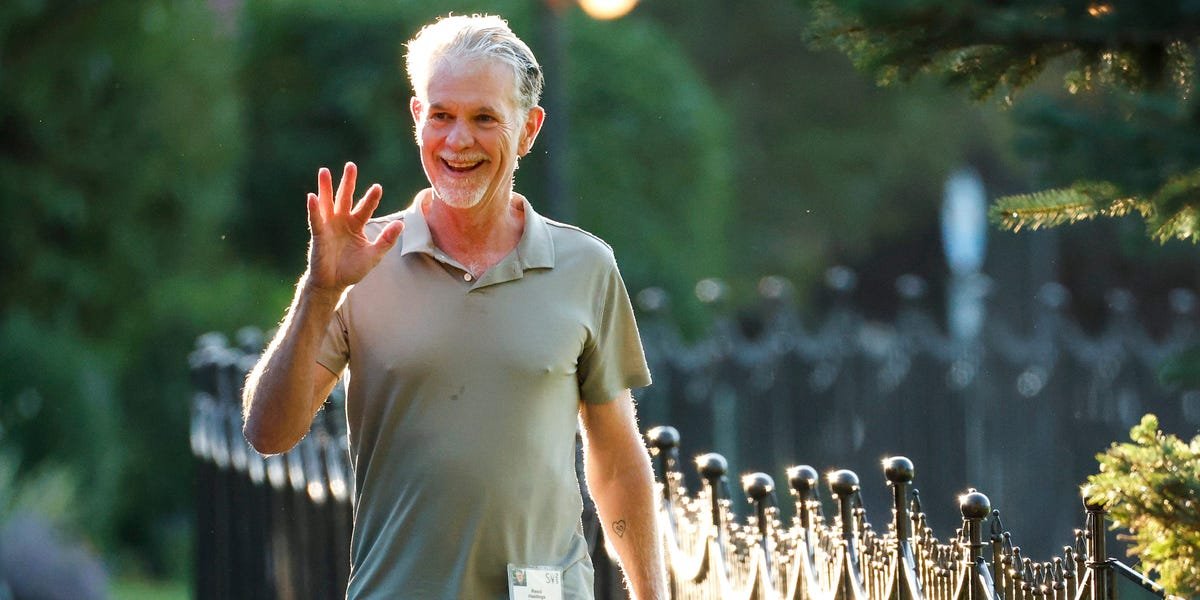
Billionaire-Netflix-cofounder-Reed-Hastings-is-leaving-the-company.jpeg

Billionaire Netflix cofounder Reed Hastings is leaving the company

Netflix cofounder Reed Hastings will soon leave the company he helped turn from a DVD rental business into a streaming TV giant.

Hastings won’t seek reelection to Netflix’s board and will split from the company in June, Netflix said on Thursday as it shared its first-quarter earnings report.

Hastings, who was Netflix’s CEO until 2023, will focus on “philanthropy and other pursuits,” the company said. The Netflix cofounder’s philanthropy includes giving $1.1 billion to the Silicon Valley Community Foundation, a large Bay Area charity, and helping launch the Hastings Initiative for AI and Humanity at Bowdoin College.

Hastings has also been heavily involved in developing the Utah ski resort Powder Mountain.

Forbes estimates Hastings’ net worth at $5.8 billion.

“Reed built a culture of innovation, integrity and high performance that defines who we are today,” Netflix said in its first-quarter shareholder letter. “His vision and leadership pioneered how the world is entertained, and his legacy and impact are not only felt by all of us at Netflix, but by audiences around the world.”

In the shareholder letter, Hastings, who cofounded the company in 1997, said his “real contribution at Netflix wasn’t a single decision.”

“It was a focus on member joy, building a culture that others could inherit and improve, and building a company that could be both beloved by members and wildly successful for generations to come,” Hastings said in the letter.

Hastings gave a shout-out to his successors, co-CEOs Greg Peters and Ted Sarandos, “whose commitment to Netflix’s greatness is so strong that I can now focus on new things.”

Peters said in the shareholder letter that “Reed will always be Netflix’s founder and biggest champion,” adding that “his vision, entrepreneurship, and steadfast commitment to our values have shaped every stage of our journey and continue to shape how Ted and I lead Netflix today.”

Sarandos said that Hastings “has modeled for Greg and me a selfless, disciplined leadership style that will continue to shape how we lead Netflix in the exciting times ahead.”

Netflix shares fell over 9.1% in after-hours trading following its first-quarter earnings report. Its second-quarter guidance came in lower than some investors anticipated.
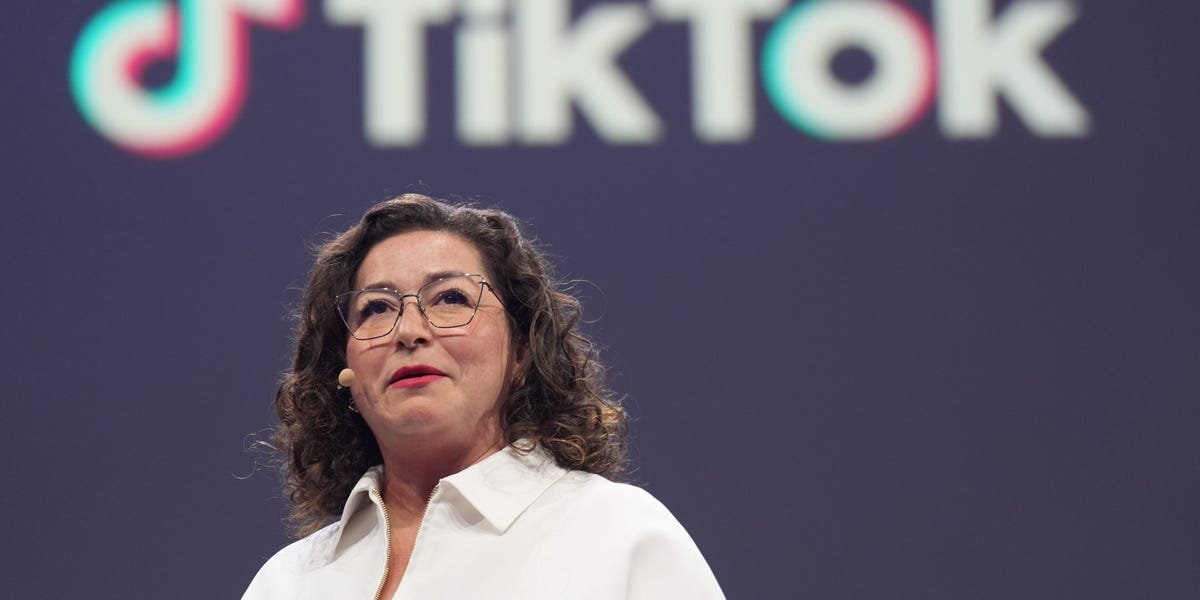



Source link

TikToks-global-marketing-head-is-leaving.jpeg

TikTok’s global marketing head is leaving

  • Sofia Hernandez, TikTok’s global head of marketing and commercial partnerships, is leaving.
  • Hernandez oversaw TikTok’s marketing strategy for brands, advertisers, and consumers.
  • Isobel Sita-Lumsden, another TikTok exec based in the UK, will take her place.

Sofia Hernandez, TikTok’s global head of marketing and partnerships, is leaving the company, according to a memo from global business solutions lead Will Liu.

Hernandez worked at TikTok and ByteDance for nearly six years. She initially focused on marketing related to the company’s advertising business before expanding her remit to include consumer marketing. Prior to joining TikTok, Hernandez served as chief customer officer at the consumer-insights platform Suzy. Before that, she worked at a creative agency within Publicis Groupe.

Hernandez is being replaced by Isobel Sita-Lumsden, an exec in the UK who has focused on off-platform marketing partnerships and social, according to the memo.

“Sofia played a defining role in shaping our global go to market approach,” Liu wrote in his memo. “This included expanding our presence across priority markets, and strengthening how brand, product and commercial teams work together.”

Hernandez is the latest in a string of US executives to leave TikTok in the past year. About a year ago, advertising executive Blake Chandlee, who previously oversaw global business solutions, stepped down. In January, Kim Farrell, TikTok’s global head of creators, left the company amid a reorganization of the company’s content division.

Hernandez’s exit comes at a moment of transition for TikTok, which recently split off parts of its US business into a joint venture. While some employees now work for a new US division overseen by managing investors like Oracle, Silver Lake, and MGX, advertising and marketing workers remain under the oversight of ByteDance.

TikTok and ByteDance did not immediately respond to a request for comment.


Source link

I-landed-a-dream-job-after-college-but-it-was.jpeg

I landed a dream job after college, but it was in Seattle, far away from my close-knit family. I felt guilty leaving them behind.

Growing up in the suburbs of southern California, I knew a few things to be true about my family. Most importantly, I knew that all we had were each other. Unlike my friends at school, we did not have any extended family. There were no big Thanksgivings, hangouts with our cousins, or sleepovers at our grandparents’ house.

It was just us four, navigating the differences between the Western culture we lived in and the Eastern culture of our roots.

I grew up in Los Angeles as the eldest daughter of an immigrant family. My parents had left their motherland in search of new possibilities in this one. The only family they would have here was the one that they would go on to create: my little sister and me.

But all that changed when I landed a job in a different city after college.

My parents encouraged me to move

When I received my acceptance letter to a university in Los Angeles, I was reassured that I would not be too far from home. When I was not on campus, I was back in my childhood living room, catching up with my little sister over our favorite boba orders and proudly taking pictures of her high school theater performances. I was playing Chinese checkers with my mom on our dining room table, followed by walking our family pup with my dad under the palm trees.

Meanwhile, in college, my life was actively progressing. By the end of my degree, I landed a dream job that would be the first building block of my future career.

It was based in Seattle.

All my life, my parents had encouraged me to go where the opportunity is. After all, that is what led them to America, where they were able to give their children the childhood they never had. In their eyes, if Seattle was where the opportunity was, that is where I should go.

“The flight is not too far,” my mom said, “but we will miss you.”

I couldn’t shake the guilt of leaving my family

I felt a continuous wave of internal conflict. On one hand, I was excited to experience something new. On the other hand, I felt guilty for leaving my already small family.

When I asked my friends if they ever felt guilty about moving away from home, I was surprised by their responses. For most of them, it never even crossed their minds. They chose to move because they never saw themselves living in the same area they grew up in, and they knew it would not provide the industries they needed.


Sherri Lu in front of mt rainier

The author decided to move to Seattle.

Courtesy of Sherri Lu


They took possibly never living near their parents again as a given part of adulthood. Their parents share this belief and, like mine, encouraged them to carve out the life path that best suits them.

Perhaps my guilt stemmed from the fact that I was choosing to leave a city that could potentially offer similar career prospects. Would I feel the same guilt about moving away if my family were located somewhere I did not feel as warmly about?

Eventually, I did talk myself into taking the job. As I settled into Seattle, I thought about how my grandparents felt when their daughter moved across the ocean from China to America. By comparison, my living just a few states away felt minor.

“How did you feel when Mom told you she was considering leaving home?” I asked my grandma over video chat.

“She needed to make her own decisions on what she thought was best for her life, but I did secretly cry about it,” she told me. “I made sure your mother never saw because I did not want it to influence her decision.”

I made the right decision

Beyond my career, living on my own gave me the space to understand myself more deeply. I began sharing my self-discovery journey online with “Eldest Daughter Club” and grew it into a community of other women doing the same. I found different forms of family as I bridged the distance between my own.

I called my family often and planned routine trips back home. Although our in-person time was now more limited, I made sure that a larger percentage of it was true quality time.

Guilt was the feeling that encompassed the discomfort of leaving behind the familial support system that I had always counted on. In the end, support transcends location.

We must all make the decisions on what we think is best for our lives. Guilt is just a signal of what you cherish, but it does not tell your whole story. That is for us to build, wherever we decide to call home.


Source link

Pranav Dixit

Meta’s metaverse is going mobile — and leaving VR behind

Meta is dialing back the metaverse to mean something far less futuristic: an app on your phone.

The company, which spent billions of dollars to build Horizon Worlds — an immersive, virtual hangout zone on its Quest virtual reality headsets — is “shifting focus” for Horizon Worlds “to be almost exclusively mobile,” according to a blog post published on Thursday.

Horizon Worlds is part of Meta’s Reality Labs division for VR products and smart glasses, a unit that has burned nearly $80 billion since 2020.

“Last year, we began to experiment with Worlds as a mobile platform, and we saw positive momentum,” wrote Samantha Ryan, Meta’s vice president of content at Reality Labs. “Now, to truly change the game and tap into a much larger market, we’re going all-in on mobile.”

The move signals how dramatically Meta has redrawn its VR ambitions.

Last month, Meta laid off roughly 10% of Reality Labs employees, closed three VR gaming studios it owned, and stopped releasing new content for Supernatural, a popular VR fitness app it acquired in 2023.

Meta said it is still committed to virtual reality hardware and supporting third-party developers who create games for it.

“We’re in it for the long haul,” Ryan wrote, and pointed to the company’s “robust roadmap of future VR headsets tailored to different audience segments.”

Meta invested nearly $150 million in VR developer platforms in 2025, Ryan wrote, and she said that popular games like “The Thrill of the Fight 2,” “Hard Bullet,” and “UG” had earned “millions” in revenue.

Still, she wrote that 86% of the time people spend in Meta’s headsets is in third-party apps, not its own. The pivot to mobile effectively pits Horizon Worlds against entrenched competitors like Roblox and Fortnite that cater to casual mobile gamers rather than VR enthusiasts with headsets.

On Meta’s latest earnings call, CEO Mark Zuckerberg pitched Horizon as the natural home for “immersive 3D” content: AI-generated scenes, objects, and mini experiences. Now, rather than putting on a headset, people could just spin up that content with a prompt and then share it straight into Instagram, Facebook, or Threads, he said.

Have a tip? Contact Pranav Dixit via email at pranavdixit@protonmail.com or Signal at 1-408-905-9124. Use a personal email address and a nonwork device; here’s our guide to sharing information securely.


Source link

A headshot of Insider's Pete Syme

Canadian airlines are pulling back from flights to the US, with one leaving the country entirely

Canadians are pulling back from visiting the US — and airlines are paying attention.

Montreal-based Air Transat will no longer fly to the US this summer, with its last flight across the border operating in early June.

In March last year, it operated nine routes to and from the US, but that number had dropped to three as of early 2026.

At the moment, Air Transat flies from Montreal to Orlando and to Fort Lauderdale, and from Quebec City to Fort Lauderdale.

Air Transat, which focuses on vacation travel, was named the world’s best leisure airline by Skytrax for the third year in a row in 2025.

An airline spokesperson told Business Insider that its presence in the US “remains very marginal today,” with only two of its 67 destinations in the US.

“This adjustment is part of a proactive management of our capacity, as we focus our efforts on markets where Air Transat is best positioned and that allow us to optimize the deployment of our resources,” they said.

The spokesperson added that its winter schedule “will be determined at a later date.”

WestJet, Canada’s second-biggest airline, is also slashing flights across the border for this summer.

It’s suspending 16 routes, including big city pairings like Boston to Vancouver and Los Angeles to Toronto.

The airline has reduced its “full-year transborder flying by close to 10%,” a spokesperson told Business Insider.

“We saw a notable decline in transborder travel demand throughout 2025,” they said.

“As such, WestJet has redeployed its fleet by increasing capacity on routes Canadians want to fly.”

Canadians’ travel demand has sunk since President Donald Trump took power early last year.

Last month, capacity was down 10% on flights from Canada to the US compared to a year earlier, according to data from Cirium, an aviation analytics firm.

Canadian residents made 1.6 million return trips from the US last month, down 24.3% from a year earlier, according to Statistics Canada.

Tensions flared when the US imposed a 25% tariff on imports from Canada and Mexico last March. It sparked a “Buy Canadian” movement and helped Prime Minister Mark Carney win last April’s elections.

Trump has also referred to Canada as the “51st state.” Following Canada’s trade talks with China earlier this year, he threatened a 100% tariff on Canadian goods and to block the opening of a bridge between Detroit and Ontario.


Source link

Anderson-Cooper-is-leaving-CBSs-60-Minutes-after-nearly-2.jpeg

Anderson Cooper is leaving CBS’s ’60 Minutes’ after nearly 2 decades

  • Anderson Cooper is leaving CBS’s “60 Minutes” after two decades in the gig.
  • The correspondent said he balanced his CNN and CBS jobs for 20 years.
  • Now, he’s quitting one gig to spend more time with his children.

Anderson Cooper has called it quits on CBS’s “60 Minutes” after nearly two decades with the show.

Cooper, who is a political commentator on CNN’s “Anderson Cooper 360” and a correspondent on “60 Minutes,” said on Monday that he would be leaving the latter job.

“Being a correspondent at 60 Minutes has been one of the great honors of my career,” he said in a statement to multiple news outlets.

“For nearly twenty years, I’ve been able to balance my jobs at CNN and CBS, but I have little kids now and I want to spend as much time with them as possible, while they still want to spend time with me,” he added.

Cooper, 58, joined “60 Minutes” in 2006 and has become one of its most recognizable hosts.

In a statement to Business Insider, a CBS spokesperson said, “For more than two decades, Anderson Cooper has taken 60 Minutes viewers on journeys to faraway places, told us unforgettable stories, reported consequential investigations and interviewed many prominent figures.”

“We’re grateful to him for dedicating so much of his life to this broadcast, and understand the importance of spending more time with family,” the spokesperson added. “60 Minutes will be here if he ever wants to return.”

This is a developing story. Please check back for updates.


Source link