
I-left-the-US-in-2015-and-have-since-lived.jpeg

I left the US in 2015 and have since lived around the world. Reverse culture shock hit me harder than leaving ever did.

This as-told-to essay is based on a conversation with Kat Smith, 35, who has lived abroad since 2015. Smith, the founder of Away Abroad, a website for female travelers, currently lives in Trieste, Italy, with her husband. This conversation has been edited for length and clarity.

I think people don’t always believe me when I say it, but living abroad has always felt more fun to me. I love the cultural challenges, the language barrier, the different food, and the process of figuring out the day-to-day.

I’m originally from Conyers, a small town just outside Atlanta. In high school, I moved to Athens, Georgia. It was a typical small, suburban place — there weren’t many people traveling internationally. Certainly, no one was moving abroad the way I eventually did.

When I was 18, between graduating from high school and starting at the University of Georgia, my parents basically forced a gap semester on me. They came home from a dinner party one night and were like, “Instead of going to college, you’re going to Guatemala.”

I did not want to go, but hindsight is 20/20.

Going to Guatemala was the best thing that could have happened to me. While I was there, I met a Peace Corps volunteer. Spending time with them and being in the country changed my perception of the world and opened my eyes to what was even possible.

When I got back and started university, I met with an advisor who had also served in the Peace Corps. After talking with him more, it just felt like the right path for me.

Living abroad changed me as a person

In 2013, almost exactly a month after I graduated from university, I joined the Peace Corps and left the US for Ecuador.

At the time I applied, you didn’t really have much say in where you went. I basically said, “Send me anywhere in the world,” and they sent me to Ecuador. During training, they placed me in a community based on my skill set and the community’s needs.

I ended up in Tumbaco for 3 months for training and then in Arenillas, a really small town in the southwestern province of El Oro, where I lived for about two years.

When my service ended, a friend of mine and I hitchhiked through the Peruvian Amazon and ended up working at an eco-lodge in the middle of the rainforest for a few months.


A man sits in a boat, bananas sit on the boat's floor, and a sunset looms in the background.

Smith’s boat ride on the Amazon River.

Courtesy of Kat Smith


Around that time, in 2015, my dad was like, “Okay, you haven’t been home in almost three years. I’m buying you a ticket—you’re coming to visit.” So, begrudgingly, I went back to the US.

I remember feeling reverse culture shock more intensely than I ever felt culture shock. It completely caught me off guard. All of a sudden, the US didn’t feel like home anymore. I felt like I didn’t fit in.

I also knew I wasn’t the same person I’d been when I’d left, which created an internal conflict. I don’t want to be that dramatic, but I had a different mindset, and trying to be the old me was hard.

I’ve traveled and lived all around the world

Over the years, I’ve lived in Panama City, been to Colombia, worked on a yacht in the South of France, and backpacked through Eastern Europe for a couple of months. I also backpacked between Vietnam and Thailand, and taught English in South Korea.


A man and woman, in wedding attire, stand in front of a bright pink wall in Colombia.

Smith and her husband, Rafael Tudela, in Cartagena, Colombia.

Courtesy of Kat Smith


Somewhere in the middle of all of that, I fell in love and got married in Colombia in 2018. Not long after, my husband and I moved to Vietnam, where we stayed for three years while I was teaching English, before leaving in 2021 because of COVID restrictions.

After Vietnam, we went back to the US for a while. We bought a van, converted it, and traveled up and down the West Coast. I loved nature, but after a few months, I was ready to leave again.


A woman sits in the back of an open van, mountains stand before her.

Smith inside of the van she traveled with across the West Coast.

Courtesy of Kat Smith


So we tried Albania next. We stayed for a couple of months, but it didn’t feel like the right long-term fit. Instead, we kept moving and spent time around the Balkans — traveling through Montenegro, Serbia, Bosnia, and Croatia.

My journey hasn’t been perfect

Looking back, I’ve made a few mistakes along the way.

One of the things I cringe about most is how I treated my friends and family back home. I was pretty insensitive about their choices — friends who just wanted to graduate, buy a house 10 minutes from where they grew up, and settle into a typical, structured, no-surprises kind of life. I think I judged that because I felt like what I was doing was so extravagant.

But honestly, I was a bit of a brat about accepting other people’s paths.

I did something similar with my family, too. I didn’t really consider what it meant for them when I left. I was so focused on what it meant for me, and not necessarily on how it was affecting everyone around me.


A group of friends walk down a street in Seoul, Korea.

Smith and friends exploring a neighborhood in Seoul.

Courtesy of Kat Smith


Italy is home — for now

In 2023, we moved to Italy for a job opportunity for my husband. He has an EU Blue Card — basically a work permit for skilled workers — and I’m on a family reunification visa linked to his.

We’ve been living in Trieste for the past 2.5 years. Trieste is fantastic, but it’s also an up-and-coming city that’s gotten really expensive, fast. Even in the short time we’ve been here, we’ve seen a big jump in costs. Our rent, for example, increased by $308 a month, which still feels crazy.

Our apartment is really nice: one bedroom, one bath, open floor plan, and close to everything. I’m really into nature, and we have a beautiful view of the sea and the hills. We were paying $1,423 a month, and now it’s $1,732.


A city view of Trieste.

The view from Smith’s apartment in Trieste.

Courtesy of Kat smith


That rising cost of living is one of the reasons we started looking at other places — just to get more for our money.

We ended up buying an apartment in Belluno for $260,955, and we’ll move in April. Belluno is a much smaller town, kind of a gateway to the Dolomites, and it sits north of Venice. We’re big mountain people, and the Dolomites are genuinely my happy place. Being closer to them means we can hike and snowboard more regularly without a long drive, which was a huge perk for us.

Although we didn’t choose Italy initially and only moved here for my husband’s job, there are a lot of reasons we’ve chosen to stay rather than move on like we typically do after a few years.

Italy has a strategic geographic position. I love living smack dab in the middle of the world. Not only is this exciting adventure-wise, but it’s also meant more people have been able to visit us, including our parents, who aren’t as keen on the long-haul flights.


A woman and her dog stand on a walking trail, sitting high above a city in Montenegro.

Smith and her dog on a hike in Montenegro.

Courtesy of Kat Smith


On top of that, the culture clicks for both of us. As an intercultural couple, we have different triggers, things we look for, and things we want to avoid. Northern Italy has provided the perfect balance for us.

I really hope Italy can be our home base, at least for the foreseeable future. But I also know myself: If, two years from now, it doesn’t feel right, we’ll pivot. I’m not setting a deadline; it’s more about whether it still feels like home. And right now, it does.



Source link

The-US-militarys-drone-defense-confusion-is-leaving-its-bases-vulnerable.jpeg

The US military’s drone-defense confusion is leaving its bases vulnerable, Pentagon watchdog finds

A Pentagon watchdog report is warning that gaps in Pentagon policy are leaving some US military bases vulnerable to drone threats.

The report, released Tuesday by the Pentagon’s Inspector General, said that the military lacks consistent guidance for defending sensitive “covered assets” US-based sites legally authorized to use certain counter-drone defenses — against offensive uncrewed aircraft, a problem exacerbated by jumbled, contradictory policies across the services.

While the Defense Department has issued multiple counter-UAS policies — rules governing how the military can detect, disrupt, or disable uncrewed aerial systems — those directives are not standardized, leaving some base leaders unaware that their installations qualify as “covered assets.” The term refers to locations within the US that deal with sensitive missions like nuclear deterrence, missile defense, presidential protection, air defense, and “high yield” explosives.

That lack of awareness derived from confusing policy risks leaving bases exposed to uncrewed threats, a growing concern.

The Inspector General report examines 10 military installations where drone incursions have occurred. The watchdog assessment found multiple examples of “covered assets” left uncovered due to unclear policies.

The Air Force base in Arizona where most F-35 pilots are trained, for instance, is not authorized to defend against UAS incursions because pilot training does not qualify as a “covered” activity under Pentagon policy, despite the Air Force describing the F-35 as “an indispensable tool in future homeland defense.”

Another Air Force facility in California that manufactures aircraft repair parts, conducts aircraft maintenance, and makes the Global Hawk, an ultra-advanced large surveillance drone that costs more than the F-35A, has also been left vulnerable, and the site experienced a series of drone incursions in 2024, the report said.

“Air Force officials told us that the government-owned, contractor-operated facility was denied coverage during the active incursions,” in 2024, the IG report says.

The problem extends beyond determining whether a site is covered. The process for obtaining counter-drone systems — and securing rapid legal approval to use them when needed — is complex and slow, reflecting legal restrictions on using electronic jamming or force inside the US, the report found.


A contractor hand-launches a drone at a counter-UAV training site in California in January 2020.

A contractor hand-launches a drone at a counter-UAV training site in California in January 2020.

PFC Gower Liu/US Army


The growing counter-drone problem

Concerns about drone threats to military installations have grown in recent years as small, inexpensive commercial drones have become dramatically more popular and easy to use. Such systems lower the barrier to entry on surveillance and precision strike from the state level to non-state actors and can create challenges for security personnel who are often constrained in their response options, or improperly trained and equipped to react.

In 2024, multiple bases within the US and abroad experienced strings of drone incursions, events that can involve one or more unmanned aircraft entering restricted airspace or operating close enough to installations to trigger alarms, even when the drones are not linked to foreign adversaries.

“In recent years, adversary unmanned systems have evolved rapidly,” a Department of Defense counter-drone strategy released in the final months of the Biden administration said. “These cheap systems are increasingly changing the battlefield, threatening US installations, and wounding or killing our troops.”

Efforts to address the drone problem have been in the works for years, though a Center for New American Security report released last September said the military’s efforts were “hindered by insufficient scale and urgency.”

Some units have received counter-drone tools such as portable “flyaway kits” — deployable systems meant to be moved quickly between sites — and the “Dronebuster,” a handheld electronic-warfare device that emits a signal to disrupt or disable an offending drone. The Army secretary recently questioned the latter system’s effectiveness, underscoring broader uncertainty about how best to defend US bases from the growing drone threat.

The US military is trying to catch up with the threat, to develop defenses as fast or faster than drone technology is currently developing, driven in large part by the drone-dominant Ukraine war. As he announced the creation of Joint Interagency Task Force 401 last August, Secretary of Defense Pete Hegseth said “there’s no doubt that the threats we face today from hostile drones grow by the day.”

“The challenge for airspace management is how to deter or defeat such incursions without endangering the surrounding civilian communities or legitimate air traffic. That rules out everything kinetic,” Mark Cancian, a defense expert and retired US Marine Corps colonel, told Business Insider in late 2024 during a series of incursions.

“This has become a huge problem for both military and civilian airfields and will get worse and drone usage proliferates further,” he said.


Source link

James Faris headshot

Paramount’s head of streaming product and tech is leaving the company. Read his Slack message to colleagues.

The head of Paramount Skydance’s streaming product and tech is leaving the company, Business Insider has learned.

Vibol Hou told colleagues in the company’s streaming tech Slack channel that he’s leaving Paramount at the end of January.

“After nearly 12 years of exhilarating work pushing our businesses to new heights, it feels like the right time to hand the torch to the next wave of leaders while I take a much-needed pause to rest, focus on my health (including some serious marathon training), and spend more time with my family before I jump into whatever comes next,” Hou wrote in the Slack message, which was viewed by Business Insider.

Hou’s exit has been anticipated within Paramount for months.

In Hou’s Slack message, he referenced a previous memo from Dane Glasgow, Paramount’s chief product officer, that hinted at the move.

“Vibol has expressed interest in exploring other opportunities, and while he will remain in his role with an anticipated transition early next year, we will continue to explore new projects together,” Glasgow wrote in a mid-October email viewed by Business Insider.

Hou was at Paramount or its subsidiaries for over a decade, including six years at its free streamer, Pluto TV. In that span, Paramount went through several corporate changes, from a ViacomCBS merger to the Paramount Skydance merger that closed in the summer of 2025.

“What we’ve built together across Pluto TV, CBS All Access/Paramount+, and Network Streaming was never easy,” Hou wrote in the Slack message. “But we built these products from the ground up, in tough environments that didn’t necessarily believe in our vision, with limited resources and non-existent technology where we often had to build our own, and under constant pressure to deliver.”

Hou’s Slack message was received warmly, with 118 “care” emojis, 67 classic “red heart” emojis, and 43 “thank you” emojis, among other signals of support as of early Thursday afternoon.

Since Paramount Skydance CEO David Ellison took over in early August, he’s made several noteworthy moves, like landing UFC rights in the US and hiring Bari Weiss to lead CBS News.

Ellison is now focused on buying Warner Bros. Discovery, which has rejected its takeover offer eight times.

Paramount did not immediately respond to a request for comment.

Read Hou’s Slack message to colleagues announcing the move:

@channel Team,

As Dane shared in his note, I’ll be transitioning out of my role and leaving the company at the end of January. After nearly 12 years of exhilarating work pushing our businesses to new heights, it feels like the right time to hand the torch to the next wave of leaders while I take a much-needed pause to rest, focus on my health (including some serious marathon training), and spend more time with my family before I jump into whatever comes next.

What we’ve built together across Pluto TV, CBS All Access/Paramount+, and Network Streaming was never easy — but we built these products from the ground up, in tough environments that didn’t necessarily believe in our vision, with limited resources and non-existent technology where we often had to build our own, and under constant pressure to deliver. Yet again and again, this team showed grit, creativity, and passion. Whether you came from Pluto or another part of Streaming, the story is the same: we took on impossible problems and innovated our way through.

The culture we live — being curious about everything, feeling that hunger to solve problems, caring deeply for others, iterating constantly, and innovating in everything we do — belongs to all of you now. You should be proud of what you’ve achieved, and you should be confident that this is a team that can handle anything thrown its way.

As to the future, I have a lot of confidence in Dane and the vision and strategic pillars he’s laid out for the year ahead. They set a strong foundation for where this organization can go over the next several years, and I’m excited to see what you all do together under his leadership.

I plan to hold my last open office hours next Friday so anyone who wants to drop in, ask questions, or just say hello/goodbye has a space to do that together. In the meantime, if you’d like to stay in touch beyond my time here, please feel free to connect with me on LinkedIn.

Serving alongside you has been one of the great privileges of my life, and I’ll be proudly cheering you on as you write the next chapter together.

Boldly go, always. ❤️

Vibol


Source link

Unjammable-drones-are-leaving-wires-everywhere-forcing-Ukrainian-troops-to.jpeg

Unjammable drones are leaving wires everywhere, forcing Ukrainian troops to move with caution

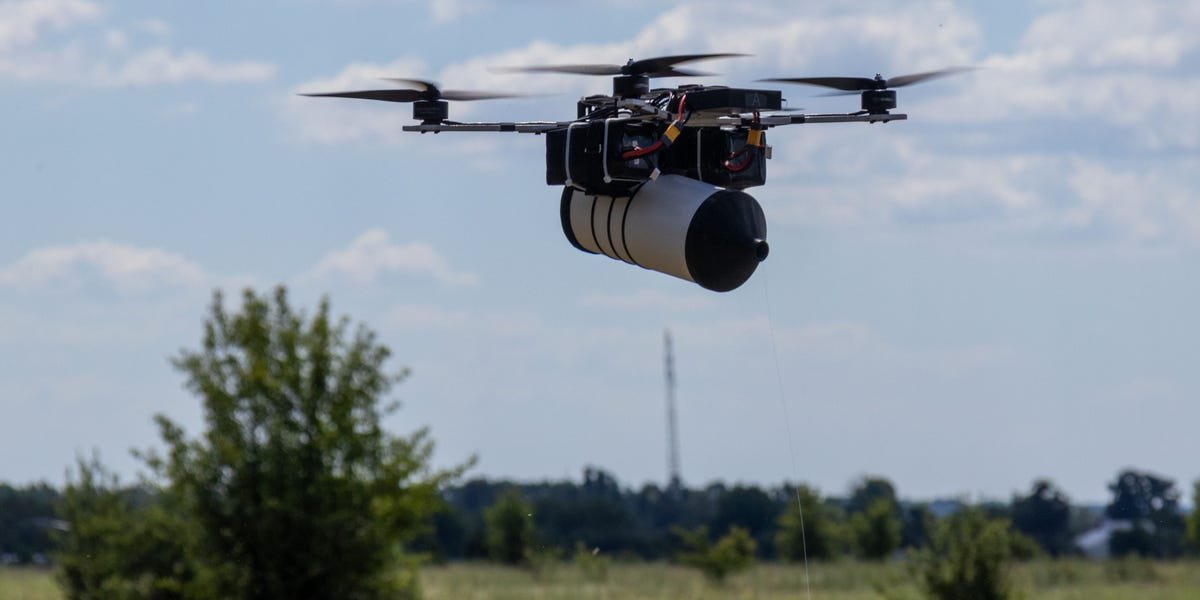
Small unjammable drones controlled by fiber-optic cables have become so integral to Russian and Ukrainian combat operations that they are leaving trails of cabling everywhere, turning areas of the battlefield into a tangled web.

As a counter to extensive electronic warfare, fiber-optic drones are becoming increasingly prevalent on both sides. And with sprawling cables stretched across the battlefield, soldiers are moving with greater caution.

“You see the little webs, and you never know — is it from the fiber-optic drone? Or it’s a part of a booby trap,” Khyzhak, a Ukrainian special operator who for security reasons could only be identified by his call sign (“Predator” in Ukrainian), told Business Insider. Mines and traps have also been prominent threats in this war.

Earlier in the war, first-person-view (FPV) drones — small quadcopter-style drones fielded by both Russia and Ukraine that often carry explosive warheads — relied on radio-frequency connections. However, both sides quickly figured out how to use signal jamming to stop them.

In response, Russia and Ukraine began developing fiber-optic FPV drones that connected to their pilots using spools of long, thin cables. The cables preserved a steady link and made the quadcopters resistant to traditional electronic warfare tactics.

The best chance that soldiers have to stop the fiber-optic drones is by shooting them out of the sky, but that requires precision, quick reaction times, and a lot of luck.


A drone armed with a warhead is flown as pilots of the 28th mechanised brigade of the Armed Forces of Ukraine test a fibre optic FPV drone with RPG munition on June 18, 2025 near Kostiantynivka, Donetsk Region, Ukraine.

Fiber-optic drones are connected to their operators by long, thin cables.

Kostiantyn Liberov/Libkos/Getty Images


The fiber-optic cables that provide these drones with their greatest advantage are also their greatest vulnerability, as they can get tangled in the environment and bring the flight to an abrupt stop. And even if they don’t get tangled, the cabling is still left draped across the battlefield after use.

Khyzhak, a soldier in the 4th Ranger Regiment, a Ukrainian special operations unit modeled after its US Army counterparts, said it is very common to see fiber-optic cables everywhere because there are more and more of these drones in use, and the cables frequently get stuck in trees and fields.

The 4th Ranger Regiment shared combat footage earlier this month showing Khyzhak, along with two other operators and their driver, narrowly avoiding a Russian fiber-optic drone strike while speeding back to base after a front-line mission.

The footage shows fiber-optic cables strewn in the field next to the road and even on Khyzhak’s gun.

“It was everywhere,” he recalled, speaking about the September incident, where the driver skillfully maneuvered out of the path of the Russian drone, which detonated on the side of the road.

Other video footage taken from the battlefield shows how fiber-optic cables crisscross like spider webs, sometimes only visible in direct sunlight or when viewed from a certain angle.

Khyzhak said the cables are particularly annoying during nighttime missions, when special operators can’t use a lot of light. He described them as a “tactical issue.”


Fiber-optic cables on the side of the road in Ukraine's Sumy region in September.

Fiber-optic cables are seen on the side of the road in footage shared by Ukrainian special operators earlier this month.

4th Ranger Regiment of the Special Operations Forces of Ukraine/Screengrab via X


Soldiers can’t always tell right away if it’s a harmless fiber-optic cable or something far more dangerous, like a booby trap. This forces them to think carefully about whether they should call an engineer, destroy the web with explosives, halt, or proceed forward.

It can definitely slow down the mission, Khyzhak said, and becomes a bigger concern the closer special operators get to the front lines, or if they’re working covertly in Russian-held territory.

Ukraine and Russia have expanded production of fiber-optic drones over the past year, and both sides are racing to develop variants that can fly farther across the front lines.

Russia, for instance, has begun to employ fiber-optic drones with a 50-kilometer (31-mile) range, which exceeds the distance that most known variants can travel. Cable length typically limits their range to between 10 and 25 kilometers (roughly 6 and 15 miles).

In Ukraine, fiber-optic drones have become such a threat to critical supply routes that soldiers have covered the roads with netting to protect vehicles from attacks, although it doesn’t always guarantee their safety.

Meanwhile, Ukraine’s defense industry is developing new countermeasures to defend against these drones. The innovations have also caught the attention of NATO leadership, which has been using lessons from the war to inform its own military planning.


Source link

John Giannandrea

Apple’s AI chief is leaving and being replaced by a former Microsoft exec


Steve Jennings/Getty Images for TechCrunch

John Giannandrea, senior vice president for Machine Learning and AI Strategy at Apple, is stepping down from his role, the company announced Monday.

Amar Subramanya, an AI researcher who most recently served as a corporate vice president of AI at Microsoft, is now Apple’s vice president of AI, the company said. Prior to his time at Microsoft, Subramanya was at Google.

Giannandrea will serve as an advisor before retiring in the spring.

This story is breaking. Check back for updates.


Source link