JetBlue increased its checked baggage fees at the end of March.
The price of a first checked bag for a domestic flight has risen to $39 from $35 on non-peak days, and to $49 from $40 on peak travel days.
In a previous statement to Business Insider, the airline did not directly reference rising fuel prices as the reason for the fee increase, though it did note that its operating costs are rising.
“As we experience rising operating costs, we regularly evaluate how to manage those costs while keeping base fares competitive and continuing to invest in the experience our customers value,” a spokesperson for JetBlue previously told Business Insider.
On Thursday, the Pentagon designated Anthropic a supply chain risk, effectively blacklisting the AI startup from doing business with the US government.
In a recent internal memo, obtained by The Information, CEO Dario Amodei said the Trump administration opposes the company because it hasn’t donated to the president or offered the kind of “dictator-style” praise he said competitors had.
Sometimes, the solution to a problem is right in front of you. If Dario wants to get off the Pentagon’s naughty list, he can just follow the lead of more experienced tech leaders who have managed to stay in the administration’s good graces — like Apple CEO Tim Cook.
There’s a serious point to this: many Big Tech CEOs think their jobs are to make money for shareholders. This involves making compromises. It’s tough sometimes, but other tech CEOs have done it, with Cook perhaps being the GOAT Trump whisperer.
Here’s a multi-step plan based on what’s worked for other Big Tech CEOs.
Watch that documentary
Melania Trump
SAUL LOEB / AFP
Go to the White House and watch the Melania documentary. Or otherwise be seen widely to be watching the Melania documentary. In January, Amazon CEO Andy Jassy, along with founder Jeff Bezos, Tim “Apple,” AMD’s Lisa Su, and Zoom’s Eric Yuan attended a screening. It’s only about two hours of your life, Dario.
Gong time
Apple CEO Tim Cook (left) giving President Donald Trump a gift at the White House
Fortune/Reuters
Give President Trump an obviously valuable gong thing. In August, Cook went to the Oval Office and presented President Trump with an inscribed piece of Apple-produced glass made in Kentucky that sits upon a 24k gold base made in Utah to celebrate the tech giant’s “American Manufacturing Program.” Apple has gotten tariff exemptions. It’s unclear if the gift influenced any decisions, but lemme put it this way: The gong probably didn’t hurt!
Praise, praise, praise
Nvidia CEO Jensen Huang
Patrick T. Fallon / AFP via Getty Images)/Reuters
Lavish praise on the president in a public way. During a keynote speech at a major Nvidia conference in October, CEO Jensen Huang effusively praised Trump, saying the President’s energy policies deserved credit for ensuring that massive AI data centers would have enough energy to power them.
Praise while dining
Google CEO Sundar Pichai (left) with Elon Musk at President Donald Trump’s inauguration
SHAWN THEW/POOL/via REUTERS
Attend a dinner or another event with Trump, and also praise him. In September, Google CEO Sundar Pichai attended a high-profile White House dinner hosted by the president, where the Google CEO thanked the administration for “constructive dialogue” in relation to the company’s antitrust case. And check out this recent video of SpaceX CEO Gwynne Shotwell praising Trump at a recent White House meeting to launch the president’s data center energy initiative, where AI companies pledged to pay for their own power.
Ding rivals
President Joe Biden speaks during a State of the Union address in Washington, DC.
Kent Nishimura/Los Angeles Times via Getty Images
If possible, slip in a dig at President Biden or President Obama, or both. At a tech conference in Taipei last year, Nvidia’s Jensen Huang criticized the Biden administration’s export controls on AI chips to China.
Unveil a big Trump-aligned initiative
OpenAI CEO Sam Altman stands next to President Trump to announce a $500 million plan to build data centers in the US.
Fortune/Reuters
Announce an Anthropic initiative that supports one of the president’s top priorities. If this project were something Anthropic would do anyway, don’t worry. Other tech companies have done that, too. Stargate was announced as a bold new $500 billion project in early 2025 at a White House event. But bits of the plan were already in motion as parts of tech companies’ existing data center buildout strategies.
Mar-a-Lago is calling
Meta CEO Mark Zuckerberg (left) and President Donald Trump (right)
Fortune/Reuters
Visit Mar-a-Lago. The weather in Florida right now is probably great. You can fly direct from SFO, business class, and make it back to San Francisco by the next day. Meta CEO Mark Zuckerberg made the trip in late 2024, after Trump was elected president for the second time. Trump once threatened to put Zuckerberg in prison, but not anymore.
$$$$$
OpenAI President Greg Brockman
Caroline Brehman / AFP via Getty Images
You mentioned this one in your own memo, according to The Information. Give money to Trump-related causes. OpenAI President Greg Brockman has donated to Trump, and just think of it as a small investment in Anthropic’s future. It doesn’t cost much, and I’m sure you have some spare cash, with Anthropic’s valuation soaring past $300 billion recently. Google, Meta, Microsoft, and other tech companies donated to Trump’s inauguration fund, for example, mostly giving $1 million each. That was a missed opportunity for you. There will be others.
Sign up for BI’s Tech Memo newsletter here. Reach out to me via email at abarr@businessinsider.com.
This story is available exclusively to Business Insider
subscribers. Become an Insider
and start reading now. Have an account? .
I packed for a seven-night Caribbean cruise with just a backpack and a carry-on suitcase.
I was on board Royal Caribbean’s Wonder of the Seas mega ship.
Look inside my suitcase and backpack, and check out my packing list, from clothes to sunscreen.
In April 2022, I packed my favorite backpack and carry-on luggage and took them from my home in New York City to Fort Lauderdale, Florida, for my first cruise.
The seven-night voyage aboard Royal Caribbean’s Wonder of the Seas took me to Honduras, Mexico, and the cruise line’s private island in the Bahamas.
Since I had to fly to Florida, I used a carry-on suitcase to avoid extra fees and the wait at baggage claim.
For a first-time cruiser, I think I packed pretty well.
When boarding the ship, my bag was checked and brought to my stateroom later that night, leaving me with just the backpack for my first day of cruising.
The author’s luggage was delivered to her stateroom. Joey Hadden/Business Insider
So I had to be thoughtful about what I packed in each bag.
Without access to my suitcase on day one, I also strategically packed my Brevite Jumper backpack.
The author’s camera backpack by Brevite. Joey Hadden/Business Insider
I like how my Brevite backpack holds and protects my camera gear while also being large and versatile enough to carry everything else I might need.
In the main pocket, I kept essentials like camera gear, sunglasses, and a swimsuit.
A peek inside the author’s backpack. Joey Hadden/Business Insider
I included a bathing suit in my backpack so I could swim on the first day of my cruise before my suitcase arrived at my stateroom.
I also stuffed a fanny pack full of medication in my backpack.
The author stored medicine in her fanny pack. Joey Hadden/Business Insider
I brought the fanny pack so I could have a smaller bag to carry around when I didn’t need the whole backpack. I stored medications in there to save space while traveling.
I used the front and back pockets of my backpack for my electronics, planner, and a notebook.
The author’s gear inside her backpack. Joey Hadden/Business Insider
I also stuffed my phone charger in the front pocket.
I used an Away carry-on suitcase for this trip.
The author’s packed suitcase. Joey Hadden/Business Insider
My Away carry-on luggage has a protective shell, and I think it’s roomier than any other carry-on suitcase I’ve used.
I used packing cubes for my clothing and bathing suits.
The author’s swimsuits in a packing cube. Joey Hadden/Business Insider
The packing cubes kept my belongings consolidated and organized.
I also packed toiletries and a pair of sandals that could get wet for the pool and beach.
The author’s toiletries. Joey Hadden/Business Insider
I didn’t pack shampoo, conditioner, or body wash because I knew these toiletries would be provided in my cabin.
For clothing, I packed versatile pieces so I could make multiple outfits with the same items.
Clothing in the author’s packing cube. Joey Hadden/Business Insider
I brought four pairs of shorts (to wear each pair twice), six shirts (to have a fresh one most days), nine pairs of underwear (so I always had extra), one dress for formal nights on the ship, and one pair of pants.
I also packed three bathing suits and a rash guard.
The author’s swimwear. Joey Hadden/Business Insider
I was glad I had multiple swimsuits since I had to let each dry for about a day before wearing it again.
In the zip pocket of my suitcase, I packed essentials like sunscreen and a magnet for my stateroom door.
The author made sure to pack a magnet for her stateroom door. Joey Hadden/Business Insider
The magnet helped me easily find my room in a hallway of identical doors.
I also packed a rain jacket.
The author’s rain jacket fit in her suitcase. Joey Hadden/Business Insider
While it didn’t rain during my cruise, the jacket came in handy on windy nights on the ship’s top decks.
I wore a pair of sneakers while traveling, on the ship, and at most port stops, so I didn’t have to pack them.
The author wears sneakers on the ship. Joey Hadden/Business Insider
I wore a light pair of canvas sneakers so my feet wouldn’t get too hot.
I also wore my sun hat during my travels.
The author poses at a port in front of the world’s largest cruise ship. Joey Hadden/Business Insider
Wearing my big, floppy hat saved space in my luggage and kept the brim from getting damaged.
I think I did a pretty good job packing for my first cruise, aside from a few items I missed.
The author didn’t think to bring more pants, earplugs, or a waterproof phone case. Joey Hadden/Business Insider
I longed for a waterproof phone case to take pictures underwater, earplugs to help me sleep, and more pants for cold mornings and evenings. I think these items would have fit in my suitcase — had I thought to bring them.
Here’s my full packing list for the cruise, which I thought worked well with limited space.
The author’s Caribbean cruise packing list. Joey Hadden/Business Insider
I’d use this packing list again to avoid having to check a suitcase at the airport.
When you buy through our links, Insider may earn an affiliate commission. Learn more.
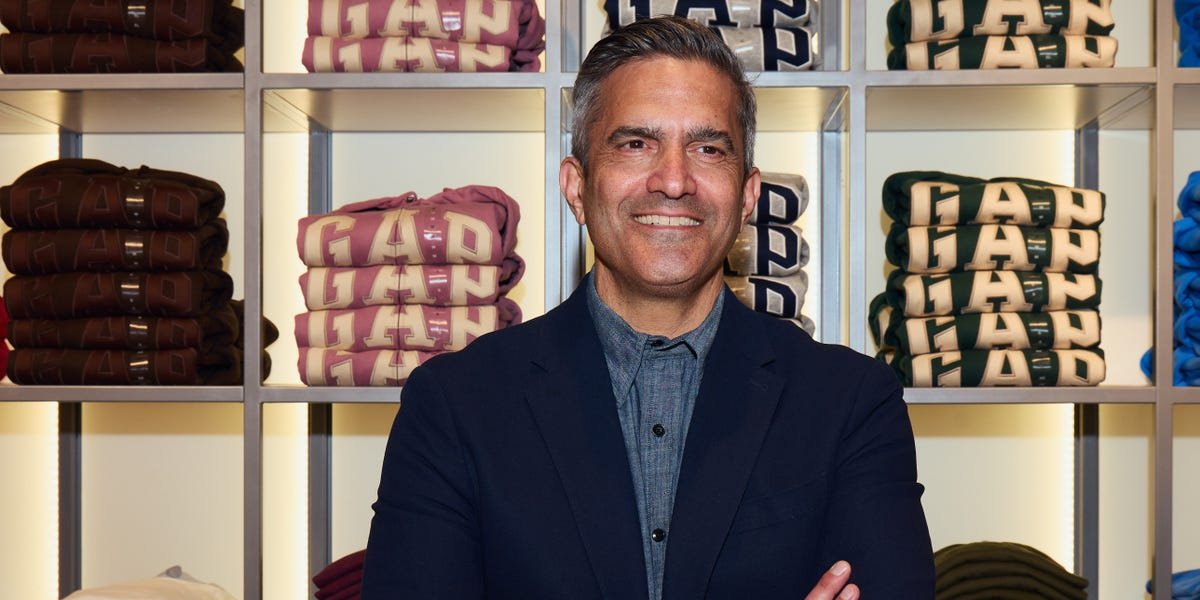
In an era of hyper-efficiency, leaders are taking a close look at the meetings on their calendars — and Gap’s CEO is no exception.
Since returning to lead Gap’s global brand in 2020, CEO Mark Breitbard told Business Insider he’s been focused on restoring the brand’s relevance, and part of that has included stripping away bureaucracy and unnecessary layers.
Meetings are often viewed as the pinnacle of corporate bureaucracy, — and Breitbard said he follows three rules to keep them in check.
The 3 rules
Breitbard said that if no one is sure why a recurring meeting is happening, it should be examined critically.
“If it’s a default meeting, like it happens every single week, then I feel like we need to question it,” Breitbard told Business Insider.
His second rule is to keep the invite list tight. Breitbard said it’s a red flag when he walks into a meeting, and someone asks, “Oh, are you in this meeting?”
“If you ask, the answer is ‘no.’ I clearly don’t need to be here if you have to ask,” Breitbard said, suggesting that the meeting shouldn’t be so big that people are invited without having a clear purpose for attending.
His third habit rule is to end on time — or early. He said when it’s near the end of a meeting, there often comes a time when people say something along the lines of, “Well, we have five more minutes…”
“We don’t have five more minutes,” Breitbard said. “We’re done now.”
Breitbard said that people often book 30-minute meetings, but he’s inclined to finish earlier if the purpose of the discussion has been accomplished.
“At minute 24, I say, ‘OK, good, this was great. Thanks, everyone,'” Breitbard said, adding that when people question if it’s really time to end, he says, ‘Yeah, we got what we needed.'”
Cutting down on meetings
The debate over meetings and how they should be run isn’t new. In 2018, Elon Musk said in an email that large meetings should be scrapped or kept “very short,” and billionaire investor Mark Cuban has similarly said they get in the way of his productivity.
But in today’s results-driven work culture, the push to rein in the amount of time spent in meetings in has taken on a new form of urgency.
Snowflake CEO Sridhar Ramaswamy told Business Insider in December that “meetings are like bureaucracies,” and he has four rules for managing his own, which involve keeping gatherings short, ensuring there’s a purpose, and making sure there’s an agenda and notes.
Instagram chief Adam Mosseri, also recently announced that recurring meetings would be canceled every six months and only re-added if “absolutely necessary.” He also encouraged making recurring one-on-ones biweekly “by default” and said workers should decline meetings that interfere with “focus blocks.”
Casey Wasserman announced on February 13 that he is selling his talent agency after his name appeared in the Epstein files, sparking a growing fallout.
Soccer player Abby Wambach and singer Chapell Roan earlier said they were parting ways with Wasserman’s agency.
Wasserman flew on Epstein’s jet with a group of people that included former President Bill Clinton. The files also show Wasserman and Ghislaine Maxwell exchanging racy and flirtatious emails in 2003, well before police began investigating Epstein, and over a decade before Maxwell’s arrest on sex-trafficking charges in 2020.
“Casey – I will be coming back to NY torn late afternoon,” Maxwell wrote in one email. “I shall be wearing a tight leather flying suit.”
Wasserman said in a statement that he regretted his messages with Maxwell, which took place “long before her horrific crimes came to light” and that he never had any personal or business relationship with Epstein.
Wasserman announced his intentions to sell his agency in a memo to staffers, which the agency shared with Business Insider.
“I’m deeply sorry that my past personal mistakes have caused you so much discomfort. It’s not fair to you, and it’s not fair to the clients and partners we represent so vigorously and care so deeply about,” Wasserman wrote. “The pain experienced by the victims of Jeffrey Epstein and Ghislaine Maxwell is unimaginable – and I’m glad, as I’m sure you all are, that those who helped them commit their crimes are rightly being held accountable.”
Wasserman wrote that he had “become a distraction.”
“That is why I have begun the process of selling the company, an effort that is already underway. During this time, Mike Watts will assume day-to-day control of the business while I devote my full attention to delivering Los Angeles an Olympic Games in 2028 that is worthy of this outstanding city,” he wrote.