I-thought-this-Tokyo-museum-would-be-a-major-tourist.jpeg

I thought this Tokyo museum would be a major tourist trap. It ended up being a highlight of my first trip to Japan.

TeamLab Planets quickly made a name for itself after opening its doors in 2018. It holds the Guinness World Record for the most-visited museum dedicated to a single group or artist, bringing in more than 2.5 million visitors from April 2023 to March 2024.

A popular second location in Tokyo, known as teamLab Borderless, focuses on digital art.

Both museums were launched by teamLab, an international art collective that includes artists, animators, engineers, mathematicians, and architects among its specialists. Together, they work to “explore the relationship between the self and the world,” according to the museum’s website, although global brand director Takashi Kudo said they have an even bigger goal.

“If these exhibitions cannot reach an emotional height, then we have failed,” he told The New York Times in 2024. “We have to reach people’s hearts.”


Source link

Pranav Dixit

Meta is weighing major layoffs as it pours billions into AI

Meta is gearing up for possible layoffs as it pours billions into AI, two senior employees familiar with the matter told Business Insider.

The sources said that some managers have been asked to prepare cost-cutting plans but were not told their scope or timing.

Reuters, which first reported about the potential layoffs on Friday, said that up to 20% of Meta employees could be let go. As of the end of 2025, Meta employed nearly 79,000 people, so a potential cut of 20% would mean roughly 16,000 jobs eliminated. That would be Meta’s most significant reduction since 2022, when it cut 11,000 jobs, and 2023, when it cut another 10,000. In January, Meta laid off 1,500 people in its Reality Labs division.

One person familiar with the company’s thinking told Business Insider the cuts could come as soon as a month.

“This is speculative reporting about theoretical approaches,” Meta spokesperson Andy Stone told Business Insider.

If Meta moves forward with these cuts, it would signal a broader shift in the tech industry, as companies pour massive amounts of capital into AI infrastructure and talent while trimming the workforces that once powered their growth during the pandemic.

In recent weeks, Atlassian announced plans to cut roughly 1,600 employees, or 10% of its staff, tying the move to AI and a push for efficiency. Block has also slashed jobs, with CEO Jack Dorsey saying new AI tools allow companies to operate with smaller teams and more efficiency. These cuts signal a new strategy in Silicon Valley: as AI becomes more capable, the biggest technology companies are betting they can build faster and cheaper with fewer people.

Meta has said it plans to invest roughly $600 billion to build out data centers by 2028. The company has also offered pay packages worth hundreds of millions of dollars over four years to lure top AI researchers to its new superintelligence team led by former Scale AI CEO Alexnadr Wang. Financing those bets, while satisfying Wall Street, means finding savings elsewhere. Head count is the most obvious lever.

On Meta’s January earnings call, CEO Mark Zuckerberg told investors the company is already “elevating individual contributors and flattening teams.” He added that he’s seeing “projects that used to require big teams now be accomplished by a single, very talented person.” Last week, Meta created a brand-new AI engineering organization, where teams will have manager-to-employee ratios of up to 1:50.

Given Meta’s size, a 20% reduction at Meta would dwarf many of its Big Tech peercuts in absolute terms, wiping out more jobs than the entire head count of many midsize tech companies.

Meta’s urgency around AI comes after a difficult stretch for its in-house model efforts. The company faced criticism that early versions of its Llama 4 models produced misleading benchmark results, and it ultimately shelved the largest version of that model, called Behemoth, which had been due out last summer.

Its Superintelligence team has since been working on a new model called Avocado and Mango, which have reportedly fallen short of internal expectations and been delayed until May.

Have a tip? Contact Pranav Dixit via email at pranavdixit@protonmail.com or Signal at 1-408-905-9124. Use a personal email address and a nonwork device; here’s our guide to sharing information securely.


Source link

A headshot of Insider's Pete Syme

Charts show how the Iran war has pushed ticket prices sharply higher on 3 major US airline routes

Your next flight could be twice as expensive because the Iran war is causing volatility in oil prices.

Brent crude is up more than 50% over the past month, to around $101 a barrel. Jet fuel costs are rising faster. The Argus US Jet Fuel Index is up 72% over the same period.

That spells difficulty for airlines because jet fuel is typically their biggest expense after labor. While many airlines around the world hedge against fuel costs, most American ones do not.

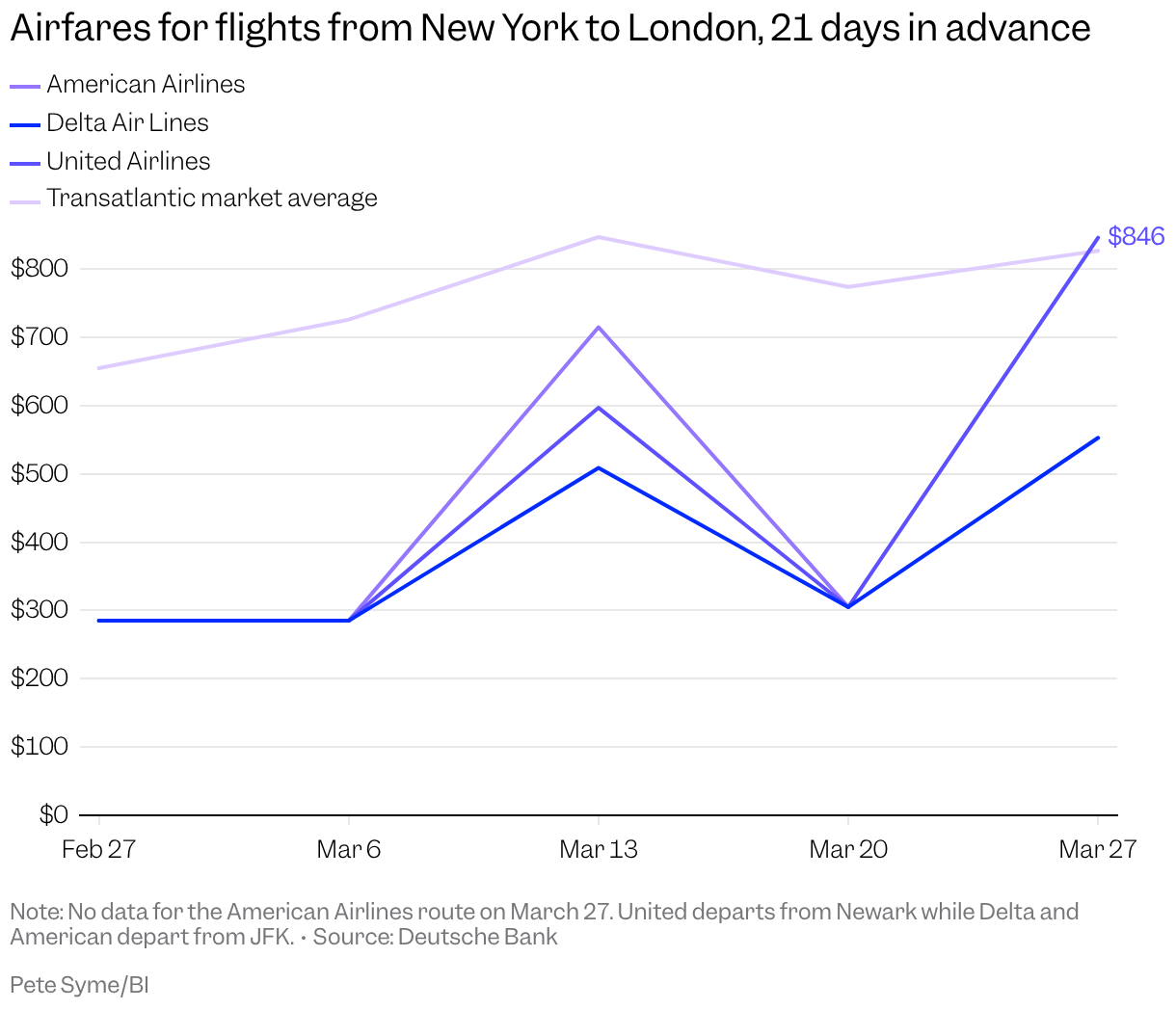
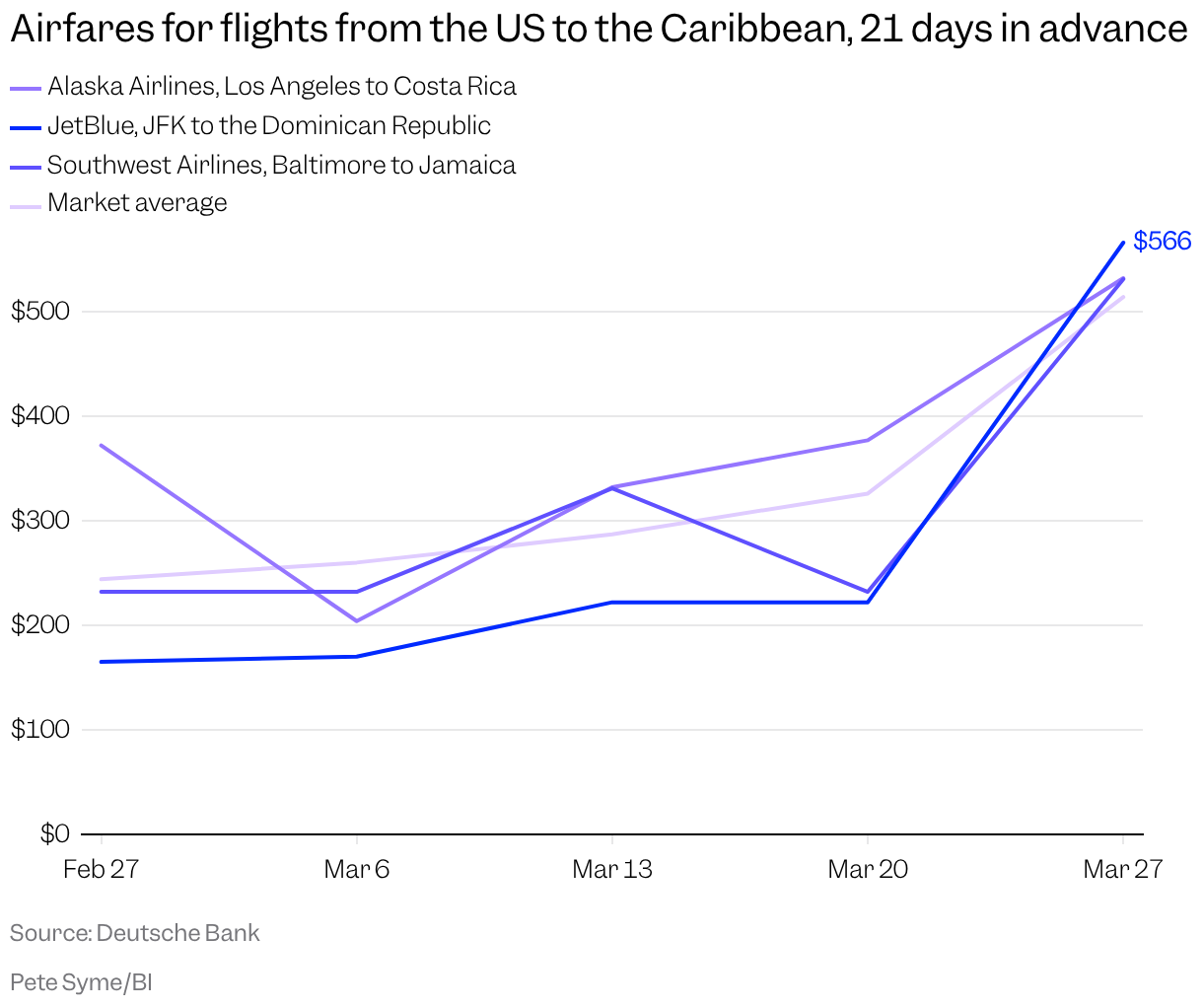
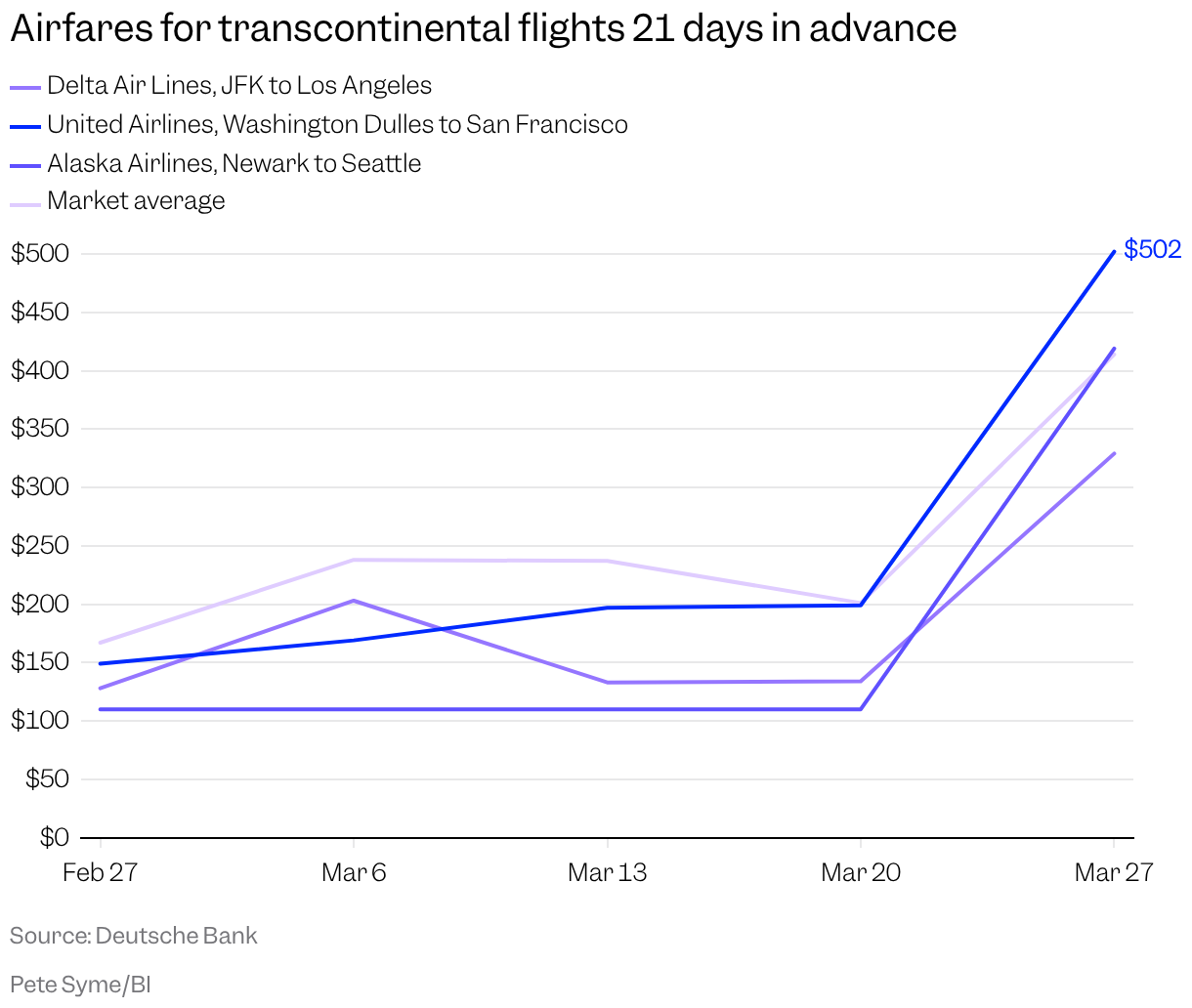
Using data from Deutsche Bank, Business Insider charted rising airfares in three major markets.

The data looks at the lowest available published fares 21 days in advance of the flights. The published fare doesn’t necessarily mean a ticket has been purchased for that amount, the Deutsche Bank research analysts said.

Cross-country flights, often known in the industry as transcontinental flights, have seen the biggest week-over-week spike — more than double, on average.

New York to Los Angeles is the country’s busiest domestic route, with a capacity of 3.4 million seats out of JFK Airport last year, according to OAG data.

The average price of a transcontinental flight has risen from $167 to $414, Deutsche Bank’s analysis showed. In the past week, the average has spiked 107%.

United Airlines is offering flights from Washington Dulles Airport to San Francisco for $502, up from $149 a month ago.

International business travellers are also seeing flight prices rise.

New York to London is the country’s most popular international route, and the 10th-busiest in the world. Nearly 4 million seats were scheduled on flights between JFK and Heathrow last year, per OAG.

While the average Transatlantic flight is some 40% more expensive than a month ago, there are bigger rises for the New York-London route. However, it also appears more volatile here with a big dip last week.

Delta Air Lines’ service is up from $285 to $553 over the past month, while United’s is up to $846. That’s a 177% rise compared to a week earlier, according to Deutsche Bank’s analysis.

There’s bad news for vacationers, too.

Flights to the Caribbean on March 27 are up 58% on average compared to a week before.

JetBlue’s flight from New York to Santo Domingo, Dominican Republic, has risen from $165 to $566 on March 27.

Compared to a year earlier, that’s a more than fourfold rise, Deutsche Bank found.

Southwest Airlines’ flight from Baltimore to Montego Bay, Jamaica, has more than doubled over the past week. And Alaska Airlines’ service from Los Angeles to San Jose, Costa Rica, is up 40% compared to a week earlier or 120% versus a year ago.


Source link

Major-US-trade-groups-pressing-Trump-to-give-tariff-refunds.jpeg

Major US trade groups pressing Trump to give tariff refunds ‘en masse’

US trade groups are pressing President Donald Trump and his administration to quickly pay tariff refunds to small businesses.

In a joint press release, the Consumer Technology Association and the US Chamber of Commerce said they had filed a brief on Wednesday in V.O.S. Selections, Inc. v. Trump, a lawsuit by small businesses seeking refunds from Trump’s sweeping tariffs.

“The brief argues that an efficient, orderly process to deliver refunds is in the best interest of all parties — the Administration, the courts, and American businesses,” the press release wrote.

“On behalf of the hundreds of thousands of businesses, especially small businesses, that are now owed refunds, the Chamber and CTA are asking the court to establish an efficient, orderly process to deliver refundsen masse,” Neil Bradley, the Chamber’s executive vice president,  said in the release.

He added that the trade organizations were concerned that other parties might try to benefit from the refund process, and “the last thing our system needs is for the trial bar to be profiting off refunds owed to small businesses.”

“While this matters for every American company, refunds are existential for the many smaller businesses and startups who shouldered the tariff burden,” Ed Brzytwa, CTA’s vice president of international affairs, said in the release.

The trade groups’ filing comes after the Supreme Court ruled, in a 6-3 decision in February, that Trump’s tariffs were illegal and that his justification for invoking the International Emergency Economic Powers Act was invalid.

And on Wednesday, Judge Richard K. Eaton of the US Court of International Trade ruled that US businesses that were subjected to tariffs are “entitled to the benefit” of the Supreme Court ruling.

Even before Eaton’s ruling, companies had started demanding refunds. Major companies like Costco, Toyota, BYD, and FedEx filed lawsuits against the administration, seeking billions of dollars in tariff duties since they were imposed last April.

Representatives for the Trump administration did not respond to a request for comment from Business Insider.


Source link

Trump-says-US-has-started-major-combat-operations-against-Iran.jpeg

Trump says US has started ‘major combat operations’ against Iran as strikes hit Tehran

President Donald Trump announced early Saturday that the US had begun “major combat operations in Iran.”

“Our objective is to defend the American people by eliminating imminent threats from the Iranian regime, a vicious group of very hard, terrible people,” he said in a video statement posted on Truth Social.

The US and Israel carried out airstrikes against Iran on Saturday, following months of tensions between Tehran and Washington.

The Israeli government first announced the airstrikes, which were carried out in broad daylight, as “preemptive.”

“The government of Israel has carried out a preemptive strike against the Islamic Republic to eliminate threats against the country of Israel,” Israeli Defense Minister Israel Katz said in a statement carried by government channels.

“As a result, a missile and drone attack against Israel and its civilian population is expected in the near future,” he added.

A US official confirmed to Business Insider that American forces were involved, adding that the strikes were ongoing.

Footage circulating on social media appeared to show explosions and plumes of smoke in Iran.

The attack marks the second time that the Trump administration has taken military action against Iran. In June 2025, the US bombed the country’s nuclear facilities as part of Operation Midnight Hammer, and Trump said at the time these had “obliterated” Iran’s nuclear sites.

This new round of strikes comes on the heels of negotiations between the US and Iran, part of the Trump administration’s efforts to pressure Tehran into a deal that would severely limit its nuclear and military capabilities. It also follows the withdrawal of Western diplomats from several Middle East countries.

In recent weeks, as Trump has issued repeated threats and warnings to Iran, pushing it to make a deal, the US has built up a large military footprint in the Middle East and nearby European waters.

The Pentagon has surged hundreds of fighter jets, aerial refueling tankers, reconnaissance planes, support aircraft, and warships into the region.

One complicating factor has been public resistance from US allies to operations against Iran. The UK barred the US from using its nearby bases, and Jordan said its bases couldn’t be used for attacks on Iran, despite imagery showing the US has shifted cargo planes and F-35 stealth fighters to one of its bases.

The significant US naval presence on station or taking up position in the area includes at least two aircraft carriers, more than a dozen guided-missile destroyers, and three littoral combat ships, which are designed for near-shore operations.

The two aircraft carriers — USS Abraham Lincoln and USS Gerald R. Ford — are each equipped with dozens of embarked fighters, electronic attack jets, early warning planes, and helicopters. The Lincoln’s air wing includes F-35 stealth fighters.

On Friday, a day after the Trump administration’s negotiations with Iranian officials in Geneva, White House official Dan Scavino posted a photograph on social media of eight B-2 Spirit stealth bombers on a runway, suggesting these aircraft could be used to strike Iran again.

This story is breaking. Please check back for updates.


Source link

Dan Geiger

Eric Schmidt-backed data center venture is negotiating a major deal with Google

Bolt Data and Energy, a data center development firm that was cofounded late last year by former Google CEO Eric Schmidt, is negotiating a deal that would allow it to begin construction on a large data center project it is planning in West Texas.

Schmidt’s firm is in discussions with Google, his former employer, according to two people with direct knowledge of the talks. The tech giant, one of the leaders in the race to develop and commercialize artificial intelligence, is considering a commitment of 250 megawatts, according to one of the people. The other person said it was too early to characterize the exact size of the potential transaction because it was still under discussion.

The sources spoke on the condition of anonymity because the potential transaction is still being arranged and the talks are confidential.

“We don’t comment on rumors,” a Google spokeswoman told Business Insider, declining to comment further. Google announced last year that it plans to build $40 billion of cloud and AI infrastructure in Texas by 2027.

The potential deal highlights how Big Tech is racing to secure the power, physical infrastructure, and land needed to fuel AI, even as the costs and financial risks of those bets loom.

In December, Bolt completed its first funding round, raising $150 million from investors, including $50 million from Texas Pacific Land Corporation, a public company that owns large tracts of land in West Texas. As part of the investment from TPL, Bolt will develop data centers on land in TPL’s portfolio.

A presentation detailing Bolt’s development plans, shared with Business Insider, said that TPL’s land would give it access to abundant power and water for cooling. These commodities have become increasingly strained as data center development has boomed around the country.

The presentation states that Bolt’s development would begin with an “initial 250 megawatt facility” and expand in 250-500 megawatt increments into a 5 gigawatt campus.

Bolt’s plan is one of several large-scale projects that have been envisioned in Texas to cater to the AI race. Fermi, a public company co-founded by former Texas governor and US Energy Secretary Rick Perry, has plans for an 11-gigawatt campus in Amarillo.

In December, Business Insider revealed that Amazon had pulled back a $150 million cash advance it had pledged as part of a preliminary deal to anchor the project. Fermi’s disclosure of the reimbursement of that advance caused its stock to fall by 50%. Fermi’s CEO, Toby Neugebauer, told Business Insider that although Amazon had reclaimed its advance, the negotiations for it to take space with Fermi were still ongoing.

Major bank lenders who extended $38 billion to finance the construction of data center campuses in Shackleford County, Texas, and Port Washington, Wisconsin, for Oracle and OpenAI, meanwhile, have had difficulty selling off pieces of the huge loan to other banks and investors. Those troubles stem, in part, from worries about whether Oracle’s credit will be strained by its massive AI spending.

To help allay concerns, Oracle announced it would raise as much as $50 billion in debt and equity in 2026 to continue to pursue its AI buildout while also maintaining “a solid investment-grade balance sheet.”

Last week, Alphabet, Google’s parent company, revealed in its fourth-quarter earnings report that it plans to spend between $175 and $185 billion on capital expenditures in 2026, roughly double its outlay in 2025. The spending is being done largely to pay for AI equipment and infrastructure.

A record wave of spending has been announced by big technology companies on AI this year, including Amazon’s disclosure during its earnings last week that it would spend $200 billion alone this year.




Source link