How-an-international-UNC-student-landed-an-AI-summer-internship.jpeg

How an international UNC student landed an AI summer internship after changing her major

This as-told-to essay is based on a conversation with Vivienne Hnin, a junior at the University of North Carolina at Chapel Hill who will be interning at AI-native startup Utilyst this summer. Her employment and identity have been verified by Business Insider. The following has been edited for length and clarity.

I came to Chapel Hill in 2023 as an international student enrolled in pre-med.

My country, Burma, was on the travel ban list last year, so I couldn’t go home and had to find a summer job. As a biology major, I didn’t have a lot of options for summer internships. That made me reevaluate my major because I felt medical school might be difficult as an international student with all the policy changes.

So, I started exploring other options. Part of the reason I decided to pivot into computer science is because of AI. In the past, people who went into computer science had been coding since they were very young. They knew the fundamentals coming in.

I didn’t have robotics or computer science classes growing up. With AI, you can learn at a much faster pace. UNC was also really accommodating and helped me switch majors and explore my interests without locking me into a major that I chose freshman year.

It was hard to adapt and get an internship this cycle because I started late, so I tried a bunch of tactics. Here’s what worked:

1. I started building projects and posting about them.

Over winter break, I pivoted and started building projects with AI.

These are essentially assignments you make yourself. A lot of juniors, especially those without internships secured, have personal projects. I learned that it’s important to have a good front-end that’s accessible because recruiters who review these projects aren’t always technical.

I made videos and posted about them on LinkedIn. That garnered some traction. Some recent alumna also started reaching out to me about coffee chats.

I decided to cater all of my projects toward one or more major coding languages so hiring managers would see that I was proficient in all the major coding languages. I also launched the projects, which showed that I was able to make it a full-stack project.

2. I attended hackathons.

I started going to hackathons because they were a great way to learn new technologies and work with people.

I also practiced a lot of technical concepts through self-studying.

3. I networked a lot.

I got LinkedIn Premium for a month and started cold DMing people. I had a lot of LinkedIn connections, and a lot of important people were either my first or my second connections at the time, so I was able to message them. I think it’s really important to keep upping your connection count on LinkedIn. If you’re a student looking for a job, I recommend getting Premium for a month.

I searched for founders from UNC. I got ignored a lot, as one would expect when they beg for an internship in a LinkedIn DM. However, I received responses from two alumni, and both led to offers.

One of the professors I reached out to actually got me an AI engineering internship at Utilyst, which I’ll be working at this summer and fall.

4. I used Handshake and career fairs.

There are a lot of scam job postings. I found Handshake more reliable because it’s affiliated with schools. Career fairs are also great because if you can convince the recruiter that you’re worth their time, you may be able to skip the line and get an interview.

5. I didn’t listen to the noise.

One thing that computer science and pre-med majors have in common is that they want to be the one person crossing the finish line. There’s a lot of sabotage, and people are very business-minded.

When you go on Reddit, you’re going to see a lot of bad advice. For example, I was told to focus only on my grades, and that personal projects are useless because people can now build with AI, so they won’t help you stand out.

I have never been asked about my GPA, transcript, or even my courses. I have been asked primarily about my projects. Also, most of the interviews I’ve done actually accommodate the use of AI. Whether it’s in real life or online, sometimes the advice is not accurate.

People also make the industry seem more competitive than it is. Part of my decision to enter CS was out of spite. I was talking with one of my fellow international students who’s a CS major, and he told me I switched too late and I wouldn’t be able to get an internship. That made me want to start applying.


Source link

Pranav Dixit

Meta is weighing major layoffs as it pours billions into AI

Meta is gearing up for possible layoffs as it pours billions into AI, two senior employees familiar with the matter told Business Insider.

The sources said that some managers have been asked to prepare cost-cutting plans but were not told their scope or timing.

Reuters, which first reported about the potential layoffs on Friday, said that up to 20% of Meta employees could be let go. As of the end of 2025, Meta employed nearly 79,000 people, so a potential cut of 20% would mean roughly 16,000 jobs eliminated. That would be Meta’s most significant reduction since 2022, when it cut 11,000 jobs, and 2023, when it cut another 10,000. In January, Meta laid off 1,500 people in its Reality Labs division.

One person familiar with the company’s thinking told Business Insider the cuts could come as soon as a month.

“This is speculative reporting about theoretical approaches,” Meta spokesperson Andy Stone told Business Insider.

If Meta moves forward with these cuts, it would signal a broader shift in the tech industry, as companies pour massive amounts of capital into AI infrastructure and talent while trimming the workforces that once powered their growth during the pandemic.

In recent weeks, Atlassian announced plans to cut roughly 1,600 employees, or 10% of its staff, tying the move to AI and a push for efficiency. Block has also slashed jobs, with CEO Jack Dorsey saying new AI tools allow companies to operate with smaller teams and more efficiency. These cuts signal a new strategy in Silicon Valley: as AI becomes more capable, the biggest technology companies are betting they can build faster and cheaper with fewer people.

Meta has said it plans to invest roughly $600 billion to build out data centers by 2028. The company has also offered pay packages worth hundreds of millions of dollars over four years to lure top AI researchers to its new superintelligence team led by former Scale AI CEO Alexnadr Wang. Financing those bets, while satisfying Wall Street, means finding savings elsewhere. Head count is the most obvious lever.

On Meta’s January earnings call, CEO Mark Zuckerberg told investors the company is already “elevating individual contributors and flattening teams.” He added that he’s seeing “projects that used to require big teams now be accomplished by a single, very talented person.” Last week, Meta created a brand-new AI engineering organization, where teams will have manager-to-employee ratios of up to 1:50.

Given Meta’s size, a 20% reduction at Meta would dwarf many of its Big Tech peercuts in absolute terms, wiping out more jobs than the entire head count of many midsize tech companies.

Meta’s urgency around AI comes after a difficult stretch for its in-house model efforts. The company faced criticism that early versions of its Llama 4 models produced misleading benchmark results, and it ultimately shelved the largest version of that model, called Behemoth, which had been due out last summer.

Its Superintelligence team has since been working on a new model called Avocado and Mango, which have reportedly fallen short of internal expectations and been delayed until May.

Have a tip? Contact Pranav Dixit via email at pranavdixit@protonmail.com or Signal at 1-408-905-9124. Use a personal email address and a nonwork device; here’s our guide to sharing information securely.


Source link

A headshot of Insider's Pete Syme

Charts show how the Iran war has pushed ticket prices sharply higher on 3 major US airline routes

Your next flight could be twice as expensive because the Iran war is causing volatility in oil prices.

Brent crude is up more than 50% over the past month, to around $101 a barrel. Jet fuel costs are rising faster. The Argus US Jet Fuel Index is up 72% over the same period.

That spells difficulty for airlines because jet fuel is typically their biggest expense after labor. While many airlines around the world hedge against fuel costs, most American ones do not.

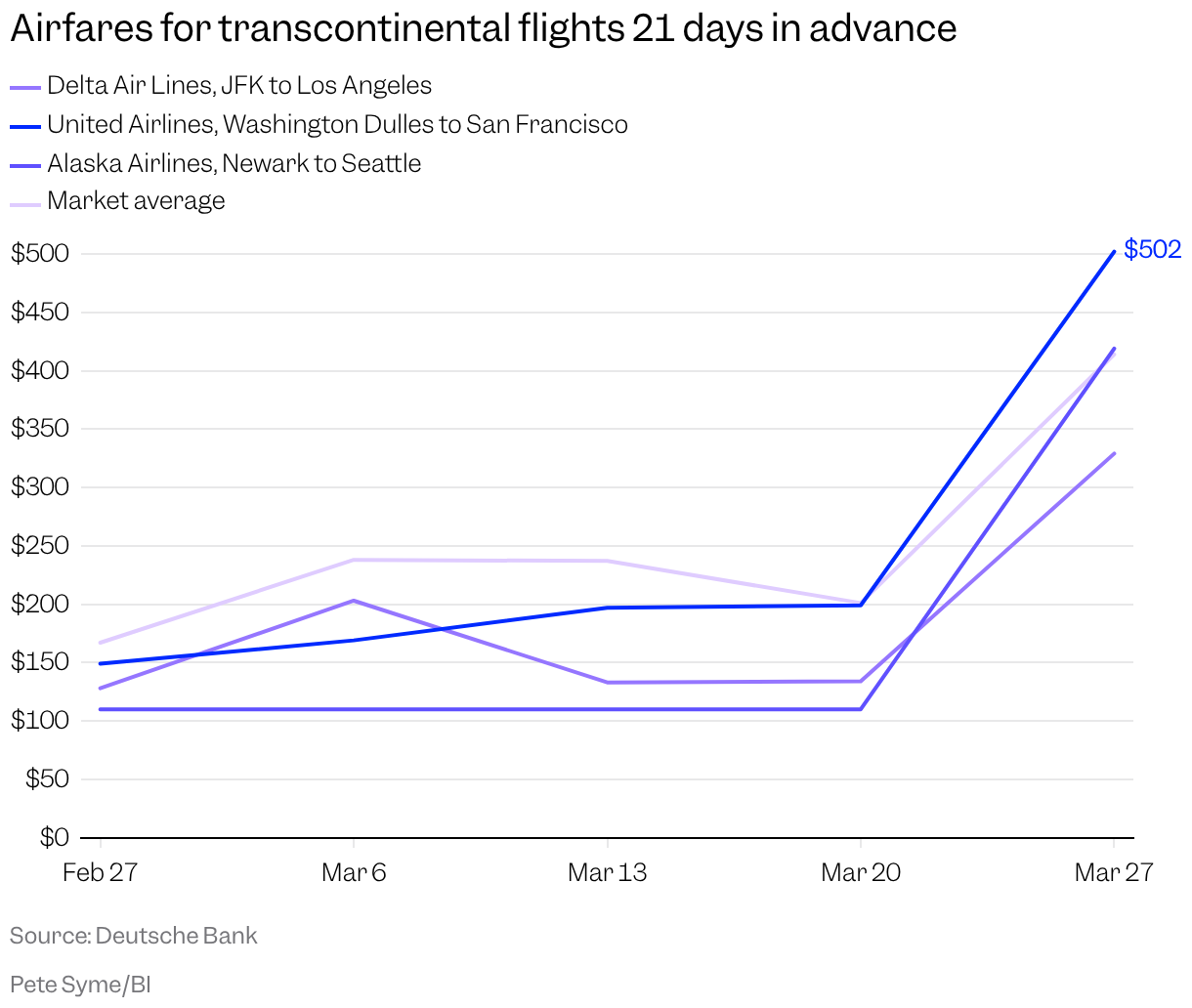
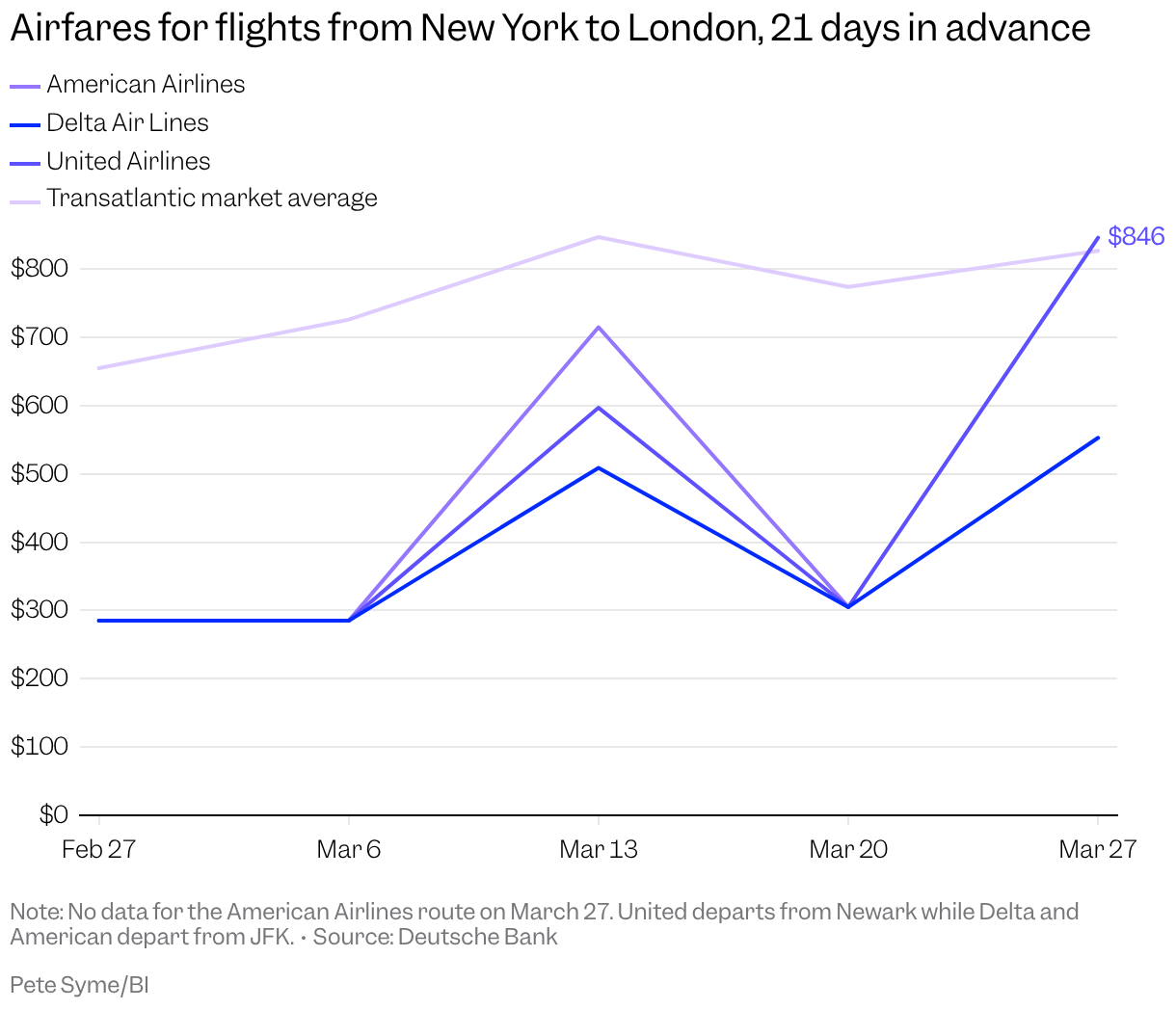
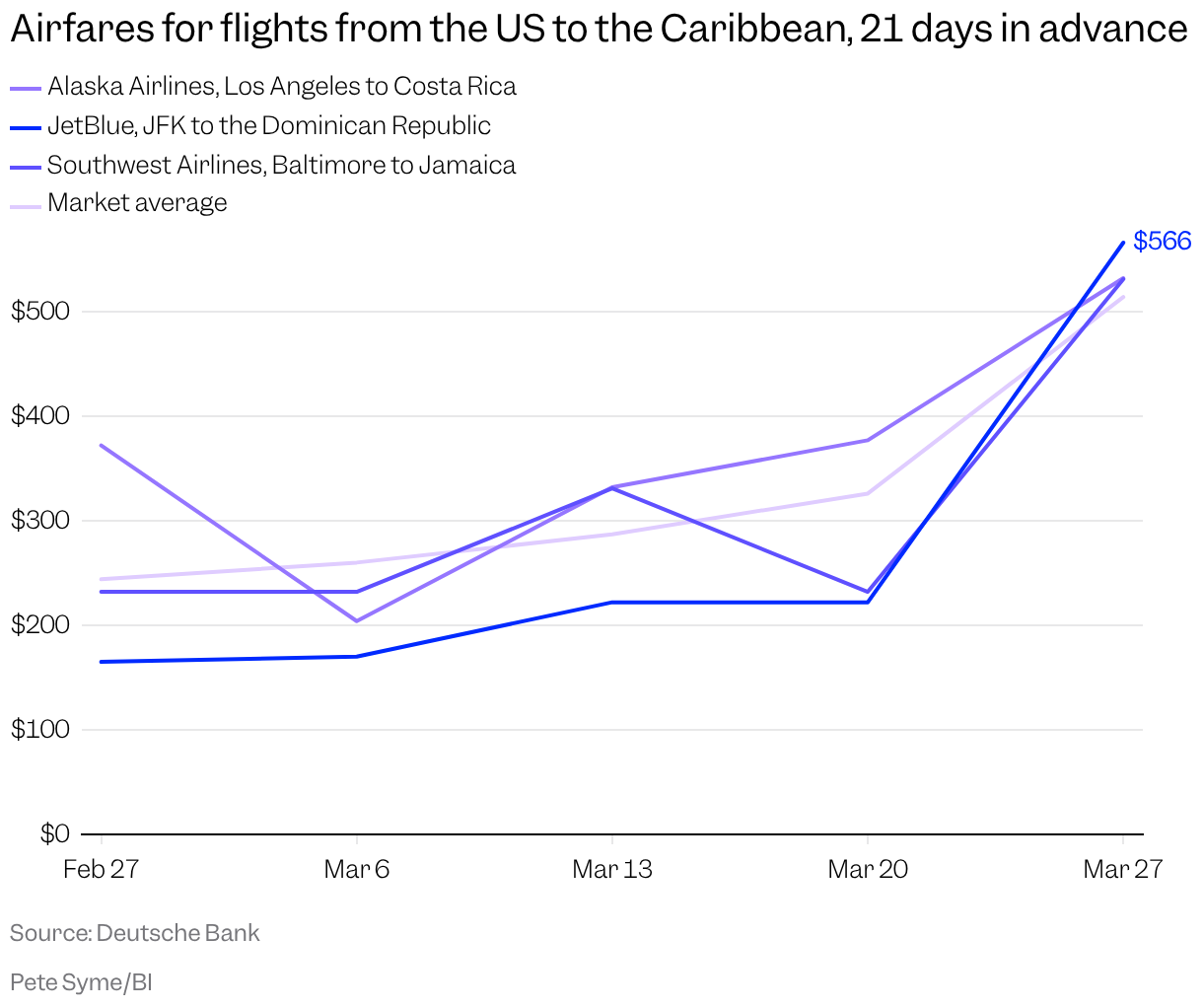
Using data from Deutsche Bank, Business Insider charted rising airfares in three major markets.

The data looks at the lowest available published fares 21 days in advance of the flights. The published fare doesn’t necessarily mean a ticket has been purchased for that amount, the Deutsche Bank research analysts said.

Cross-country flights, often known in the industry as transcontinental flights, have seen the biggest week-over-week spike — more than double, on average.

New York to Los Angeles is the country’s busiest domestic route, with a capacity of 3.4 million seats out of JFK Airport last year, according to OAG data.

The average price of a transcontinental flight has risen from $167 to $414, Deutsche Bank’s analysis showed. In the past week, the average has spiked 107%.

United Airlines is offering flights from Washington Dulles Airport to San Francisco for $502, up from $149 a month ago.

International business travellers are also seeing flight prices rise.

New York to London is the country’s most popular international route, and the 10th-busiest in the world. Nearly 4 million seats were scheduled on flights between JFK and Heathrow last year, per OAG.

While the average Transatlantic flight is some 40% more expensive than a month ago, there are bigger rises for the New York-London route. However, it also appears more volatile here with a big dip last week.

Delta Air Lines’ service is up from $285 to $553 over the past month, while United’s is up to $846. That’s a 177% rise compared to a week earlier, according to Deutsche Bank’s analysis.

There’s bad news for vacationers, too.

Flights to the Caribbean on March 27 are up 58% on average compared to a week before.

JetBlue’s flight from New York to Santo Domingo, Dominican Republic, has risen from $165 to $566 on March 27.

Compared to a year earlier, that’s a more than fourfold rise, Deutsche Bank found.

Southwest Airlines’ flight from Baltimore to Montego Bay, Jamaica, has more than doubled over the past week. And Alaska Airlines’ service from Los Angeles to San Jose, Costa Rica, is up 40% compared to a week earlier or 120% versus a year ago.


Source link

Major-US-trade-groups-pressing-Trump-to-give-tariff-refunds.jpeg

Major US trade groups pressing Trump to give tariff refunds ‘en masse’

US trade groups are pressing President Donald Trump and his administration to quickly pay tariff refunds to small businesses.

In a joint press release, the Consumer Technology Association and the US Chamber of Commerce said they had filed a brief on Wednesday in V.O.S. Selections, Inc. v. Trump, a lawsuit by small businesses seeking refunds from Trump’s sweeping tariffs.

“The brief argues that an efficient, orderly process to deliver refunds is in the best interest of all parties — the Administration, the courts, and American businesses,” the press release wrote.

“On behalf of the hundreds of thousands of businesses, especially small businesses, that are now owed refunds, the Chamber and CTA are asking the court to establish an efficient, orderly process to deliver refundsen masse,” Neil Bradley, the Chamber’s executive vice president,  said in the release.

He added that the trade organizations were concerned that other parties might try to benefit from the refund process, and “the last thing our system needs is for the trial bar to be profiting off refunds owed to small businesses.”

“While this matters for every American company, refunds are existential for the many smaller businesses and startups who shouldered the tariff burden,” Ed Brzytwa, CTA’s vice president of international affairs, said in the release.

The trade groups’ filing comes after the Supreme Court ruled, in a 6-3 decision in February, that Trump’s tariffs were illegal and that his justification for invoking the International Emergency Economic Powers Act was invalid.

And on Wednesday, Judge Richard K. Eaton of the US Court of International Trade ruled that US businesses that were subjected to tariffs are “entitled to the benefit” of the Supreme Court ruling.

Even before Eaton’s ruling, companies had started demanding refunds. Major companies like Costco, Toyota, BYD, and FedEx filed lawsuits against the administration, seeking billions of dollars in tariff duties since they were imposed last April.

Representatives for the Trump administration did not respond to a request for comment from Business Insider.


Source link

Trump-says-US-has-started-major-combat-operations-against-Iran.jpeg

Trump says US has started ‘major combat operations’ against Iran as strikes hit Tehran

President Donald Trump announced early Saturday that the US had begun “major combat operations in Iran.”

“Our objective is to defend the American people by eliminating imminent threats from the Iranian regime, a vicious group of very hard, terrible people,” he said in a video statement posted on Truth Social.

The US and Israel carried out airstrikes against Iran on Saturday, following months of tensions between Tehran and Washington.

The Israeli government first announced the airstrikes, which were carried out in broad daylight, as “preemptive.”

“The government of Israel has carried out a preemptive strike against the Islamic Republic to eliminate threats against the country of Israel,” Israeli Defense Minister Israel Katz said in a statement carried by government channels.

“As a result, a missile and drone attack against Israel and its civilian population is expected in the near future,” he added.

A US official confirmed to Business Insider that American forces were involved, adding that the strikes were ongoing.

Footage circulating on social media appeared to show explosions and plumes of smoke in Iran.

The attack marks the second time that the Trump administration has taken military action against Iran. In June 2025, the US bombed the country’s nuclear facilities as part of Operation Midnight Hammer, and Trump said at the time these had “obliterated” Iran’s nuclear sites.

This new round of strikes comes on the heels of negotiations between the US and Iran, part of the Trump administration’s efforts to pressure Tehran into a deal that would severely limit its nuclear and military capabilities. It also follows the withdrawal of Western diplomats from several Middle East countries.

In recent weeks, as Trump has issued repeated threats and warnings to Iran, pushing it to make a deal, the US has built up a large military footprint in the Middle East and nearby European waters.

The Pentagon has surged hundreds of fighter jets, aerial refueling tankers, reconnaissance planes, support aircraft, and warships into the region.

One complicating factor has been public resistance from US allies to operations against Iran. The UK barred the US from using its nearby bases, and Jordan said its bases couldn’t be used for attacks on Iran, despite imagery showing the US has shifted cargo planes and F-35 stealth fighters to one of its bases.

The significant US naval presence on station or taking up position in the area includes at least two aircraft carriers, more than a dozen guided-missile destroyers, and three littoral combat ships, which are designed for near-shore operations.

The two aircraft carriers — USS Abraham Lincoln and USS Gerald R. Ford — are each equipped with dozens of embarked fighters, electronic attack jets, early warning planes, and helicopters. The Lincoln’s air wing includes F-35 stealth fighters.

On Friday, a day after the Trump administration’s negotiations with Iranian officials in Geneva, White House official Dan Scavino posted a photograph on social media of eight B-2 Spirit stealth bombers on a runway, suggesting these aircraft could be used to strike Iran again.

This story is breaking. Please check back for updates.


Source link