These-airlines-are-sending-special-flights-to-the-Middle-East.jpeg

These airlines are sending special flights to the Middle East to rescue stranded travelers

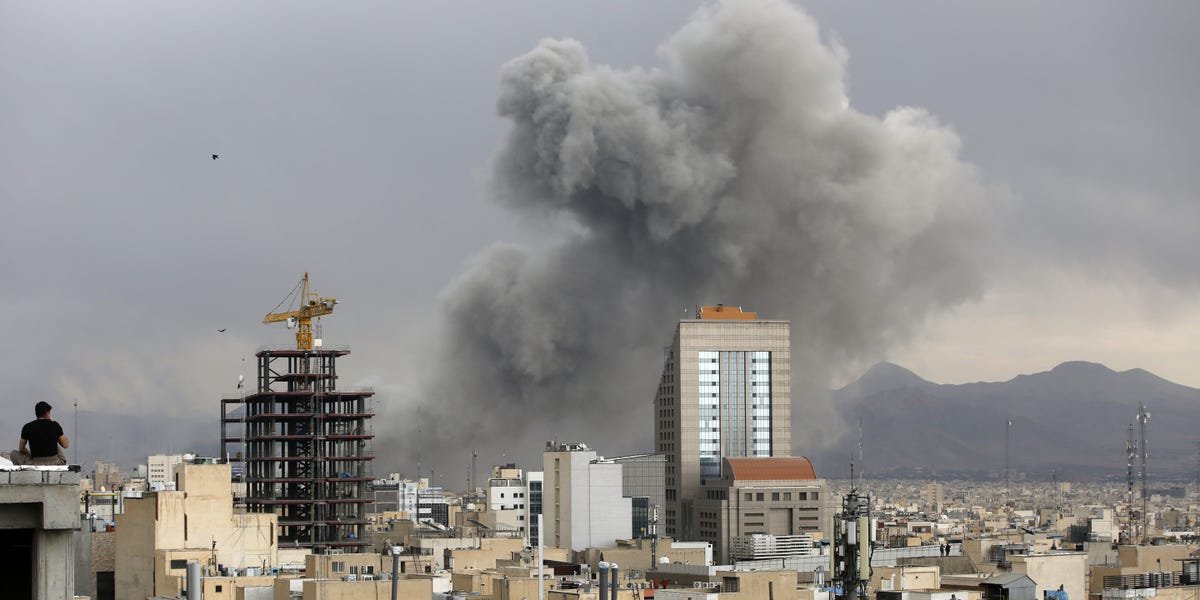
It’s been a confusing six days since missile attacks across the Middle East stranded travelers and planes in airports across the world.

Things are still far from normal as of Wednesday, but some travelers are getting home.

There is a slow-growing recovery in the United Arab Emirates, which has partially opened its skies and designated “safe” corridors for rescue planes to use.

There are a lot of people to move: cities like Dubai and Abu Dhabi host large expat populations and tourists, and their hubs usually handle tens of thousands of transit passengers a day.

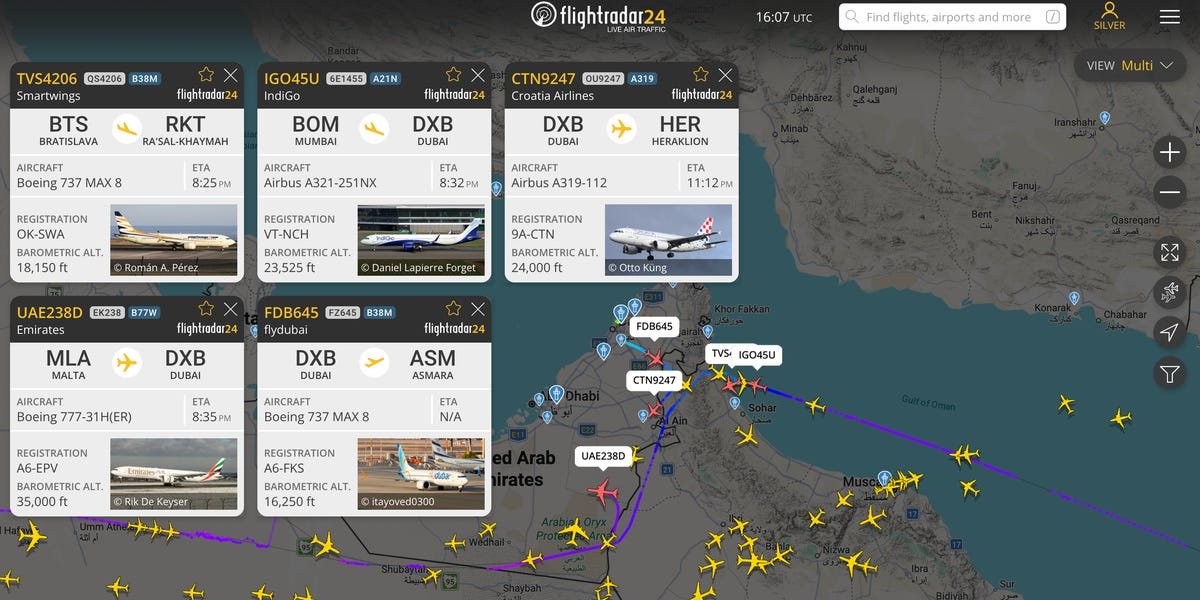
Working with local officials, Emirates, Flydubai, IndiGo, and Etihad Airways were among the first airlines to depart the UAE with passengers, crews, and cargo. Over 100,000 people followed these aircraft live on the aviation tracking website Flightradar24.

Even as Iranian threats continue to disrupt flying — forcing diversions, holds, and U-turns — airlines are still transporting passengers to destinations across Europe, Asia, and Africa.

Fortunately, Emirates and Etihad have big planes: many of their Airbus A380s, capable of carrying up to 615 passengers, have flown to cities such as London, Istanbul, Jeddah, Singapore, Paris, and Düsseldorf.

Although these flights don’t always take travelers all the way home, they offer a crucial escape from limbo — getting people into countries with open airspace and far more onward flight options.

Flightradar24 data shows several other carriers have joined the crowd: Air India, Air Arabia, Uzbekistan Airways, Kenya Airways, Morocco’s Royal Air Maroc, Saudi airline Flynas, Royal Jordanian, and India’s SpiceJet are all flying from Dubai to their respective hubs.


People hugging at an airport after being stuck in Dubai.

Passengers on a Kenya Airways rescue flight from Dubai arrive back home.

Thomas Mukoya/Reuters


European carriers, including Lufthansa, Swiss International Air Lines, Prague-based Smartwings, Aegean Air, and British Airways, are running special rescue flights from neighboring Muscat, Oman. Smartwings and Croatia Airlines are running select flights from Dubai.

Air France scheduled a repatriation flight from Dubai to Paris on Thursday evening, but suspended the plan shortly after the announcement due to “the ongoing security situation.”

Russian carriers Aeroflot and S7 Airlines have similarly departed with passengers, though their flights to Moscow are taking up to three hours longer because they have to fly the long way around closed airspace rather than fly directly over it.

Still, most airlines’ regular schedules to and from much of the Middle East remain suspended until at least the weekend, and they have asked passengers not to go to the airport unless they have been specifically notified.

No US airlines have sent rescue planes as of Thursday. Mark Dombroff, an aviation attorney with the law firm Fox Rothschild, told Business Insider that even if US carriers like United or American wanted to help, they legally can’t.

“The decision-making resides with the Federal Aviation Administration,” he said. “If the FAA says you can’t fly there as a US certificated carrier, that’s it. And in a sense, it’s no different than any other restricted airspace in this country, like Washington, DC.”

Some Americans have gotten home with the help of the State Department; it previously told those in over a dozen Middle Eastern countries to evacuate. The agency said it flew a charter flight to the US on Wednesday, and that more will be “surged across the region.”

It added that, as of Wednesday, “nearly 18,000 Americans have safely returned to the US,” including 7,300 helped by the State Department. It said thousands of others made it to Europe and Asia and are in transit back, and told those still stuck to get in touch for help by calling +1 (202) 501-4444 or filling out this form.

Some airlines remain effectively frozen. Qatar Airways has not flown a plane since Saturday due to Qatar’s airspace closure, leaving practically no options for those in Doha except to wait or drive hours to Saudi Arabia and fly out from there.

Flight options are still extremely limited

While some flights are better than none at all, special airline operations remain limited to certain routes and airports.

Flightradar24 data shows that Dubai International has seen just 100 takeoffs and landings since Saturday. Operations ramped up from Monday to Tuesday — but that was still less than 10% of the roughly 1,200 flights in and out on a usual day.

Rescue flights are largely restricted to the UAE, Oman, and Saudi Arabia: the skies over Iran, Kuwait, Iraq, Syria, Israel, Qatar, and Bahrain remain closed.


An Emirates A380 landing in Germany.

An Emirates A380 ferried hundreds of stranded people back to Germany.

Andreas Rentz/Getty Images


Aviation analytics Cirium estimates there are normally about 900,000 daily seats to, from, and within the Middle East; it said about 4.4 million seats in and out of the Middle East have been canceled since Saturday.

While airlines are actively adding flights to the schedule — despite the on-and-off missile threats in the region — there are nowhere near enough rescue seats yet to accommodate the tens of thousands of stranded travelers. British Airways said on social media on Wednesday that the rescue flights it planned through Saturday are already full.

Some wealthy travelers have abandoned commercial flying altogether, instead paying hundreds of thousands of dollars to charter private jets. Flightradar24 data shows a number of business aircraft flying to and from Oman, Saudi Arabia, and the UAE since Sunday.

Those with less deep pockets have chosen to travel by bus to Oman and Saudi Arabia, hoping to secure seats from airports still operating flights as normal.

But the drives are hourslong, and Oman Air warned Muscat-bound travelers crossing in from the UAE to arrive 12 hours early as traffic backs up for miles.


Source link

Paramount-ally-RedBird-says-using-Middle-East-money-to-help.jpeg

Paramount ally RedBird says using Middle East money to help buy Warner Bros. could be a good idea

  • Last year, Paramount said it would use $24 billion in funding from Saudi Arabia, Abu Dhabi, and Qatar to help buy WBD.
  • Now that Paramount has won that deal, it won’t say whether that’s still the plan.
  • A key Paramount backer suggests that Gulf money would be a good thing for this deal.

We still don’t know if Paramount intends to use billions of dollars from Gulf states like Saudi Arabia to help it buy Warner Bros. Discovery.

But if Paramount does end up doing that, it wouldn’t be a bad thing, says a key Paramount backer.

That update comes via Gerry Cardinale, who heads up RedBird Capital Partners, the private equity company that helped finance Larry and David Ellison’s acquisition of Paramount last year and is doing the same with their WBD deal now.

In a podcast with Puck’s Matt Belloni published Wednesday night, Cardinale wouldn’t comment directly on Paramount’s previously disclosed plans to use $24 billion from sovereign wealth funds controlled by Saudi Arabia, Abu Dhabi, and Qatar to help buy WBD.

Instead, he reiterated Paramount’s current messaging on the deal’s financing: The $47 billion in equity Paramount will use to buy WBD will be “backstopped” by the Ellison family and RedBird — meaning they are ultimately on the hook to pay up. The rest of the $81 billion deal will be financed with debt.

Cardinale also acknowledged what Paramount has disclosed in its current disclosure documents: It intends to sell portions of that $47 billion commitment to other investors: “We haven’t syndicated anything at this time,” he said. “We do expect to syndicate with strategic, domestic, and foreign investors. But at the end of the day, that alchemy shouldn’t matter because it’ll be done in the right way.”

And when asked about concerns about Middle Eastern countries owning part of a media conglomerate that includes assets like CNN, Cardinale suggested that could be a plus.

“I think we want to be a global company,” he said. “You look at what’s going on right now geopolitically. What’s going on right now geopolitically out of the Middle East wouldn’t be, the positives of that would not be happening without some of those sovereigns that you’re referring to.”

He continued:

“The world is changing. We can stick our head in the sand and pretend it’s not, or we can embrace globalization and the derivative benefits both geopolitically and otherwise that come from that. Content generation coming out of Hollywood is one of America’s greatest exports.
I firmly embrace the global nature and orientation that we bring to this from a capital standpoint, from a footprint standpoint, etc. At the end of the day, I do understand some of the concerns that you’ve raised, but that will work itself out between signing and closing because at the end of the day, worst-case scenario, Ellison and RedBird are 100% of this thing.”

All of which suggests to me that Paramount still intends to use money from Gulf-based sovereign wealth funds to buy WBD.

What I don’t understand is why the company won’t say that out loud. Does that mean it’s still negotiating with potential investors? Or that it’s reticent to disclose outside investors, for whatever reason, until it has to? A Paramount rep declined to comment.


Source link

The-State-Department-says-its-boosting-flights-across-the-Middle.jpeg

The State Department says it’s boosting flights across the Middle East to get Americans home

US embassies in the Middle East are changing their language about helping US citizens evacuate from the region.

Previously, multiple embassies said they were unable to assist citizens in leaving, urging them to evacuate by commercial means. The embassy in Jerusalem said in a notice on Tuesday: “The US Embassy is not in a position at this time to evacuate or directly assist Americans in departing Israel.”

However, they are now issuing notices telling Americans that government assistance is available.

In an X post late on Wednesday, the US Department of State said, “Today, a Department of State charter flight of American citizens departed the Middle East in route to the United States, as part of our ongoing efforts to assist Americans return home.”

It added that “additional flights will be surged across the region.”

The post did not say which Middle Eastern country the charter flight on Wednesday had departed from. The State Department post included photos showing consular staff standing next to US Embassy banners at an airport, with the country’s name blurred on the signage.

The embassy in Jerusalem said in a late Wednesday notice that the US government is “ready to help Americans leave the Middle East if you choose to take advantage of the options available.”

A security alert by the US embassy in Kuwait communicated the same message.

In the notice, the embassy added a link to a crisis intake form, which included the option, “I am seeking U.S. government departure assistance.”

The US embassy in Riyadh, Saudi Arabia, said in an X post on Wednesday that “Americans trying to get home from Israel, Saudi Arabia, the United Arab Emirates, or Qatar,” should fill out the crisis intake form.

The Wednesday notice from the embassy in Doha, Qatar, however, said it’s “currently exploring options to assist U.S. citizens in reaching a safe destination,” but did not provide a link to the crisis intake form.

The State Department said on Monday that Americans in the following countries should vacate: Bahrain, Egypt, Iran, Iraq, Israel, the West Bank and Gaza, Jordan, Kuwait, Lebanon, Oman, Qatar, Saudi Arabia, Syria, the United Arab Emirates, and Yemen.

In a Monday X post, the US Department of State Consular Affairs shared three steps for US citizens in the region to follow:

1) Enroll in http://step.state.gov for security updates from the nearest US Embassy.

2) Follow @travelgov on social media or the WhatsApp channel “U.S. Department of State – Security Updates for U.S. Citizens.”

3) For emergency assistance, call:

  • +1-202-501-4444 from overseas
  • +1-888-407-4747 from the US and Canada

Air travel remains disrupted

Meanwhile, commercial air travel remains disrupted. Most airports in the region, such as Dubai International Airport and Zayed International Airport in Abu Dhabi, are telling customers not to come unless their airlines have confirmed their flights. Travellers in the region spoke to Business Insider about feeling stranded and terrified.

Some Emirates flights have resumed, prioritizing travelers with earlier bookings. The airline said in a Wednesday X post that it continues to operate a “limited flight schedule,” and data from FlightRadar24 shows that Emirates has scheduled flights on Thursday to Warsaw, San Francisco, Chicago, Tokyo, and other destinations.

Representatives for the State Department did not respond to a request for comment from Business Insider.


Source link

What-US-companies-are-telling-their-Middle-East-based-employees-during.jpeg

What US companies are telling their Middle East-based employees during the war in Iran

  • Several Gulf nations were hit by retaliatory Iranian strikes over the weekend.
  • US companies with employees and clients in the region told Business Insider that safety was the priority.
  • JPMorgan, Goldman Sachs, and Citigroup have told employees in the region to work from home.

Global US companies with Middle East operations are advising their employees to work from home following a weekend of regional escalation, as US and Israeli military strikes on Iran triggered retaliatory attacks across several Gulf states.

Photos and videos showed missiles streaking across the sky in Dubai on Saturday and Sunday.

Fallout from intercepted missiles caused fires and other problems across the region. Amazon Web Services said Sunday that connectivity from one of its data centers in the United Arab Emirates was down after the facility was “impacted by objects” that created “sparks and fire.”

Abu Dhabi and Dubai in the United Arab Emirates have become increasingly popular destinations for some Western professionals attracted by the lifestyle, the lack of income tax, and business opportunities in the region.

This is what major US companies in the region are telling their employees during the Iran conflict.

Goldman Sachs

Goldman Sachs has implemented a number of measures to support the safety of its people and resilience of its business, a company spokesperson told Business Insider.

The US bank has told its employees across the region to work from home and to follow the advice of local officials, the spokesperson said.

Goldman is also staying close to clients in the region as the situation unfolds and has made safety a top priority, they added.

Citigroup

Citigroup has told its employees to work from home until further notice, a Citi spokesperson told Business Insider.

“The safety of our employees is our number one priority, and we are continuing to take measures to help keep our employees and their families safe,” the spokesperson said.

“We are continuing to serve our clients and we have robust contingency and resilience plans in place for that purpose,” they added.

JPMorgan

JPMorgan has also advised its employees in parts of the region to work from home, a person familiar with the matter told Business Insider. The US’s largest bank has offices in Abu Dhabi and Dubai, and, across the wider region, in Beirut, Cairo, Doha, Manama, and Riyadh.

JPMorgan is assessing the situation regularly to adjust guidance as needed, the person added.

FedEx

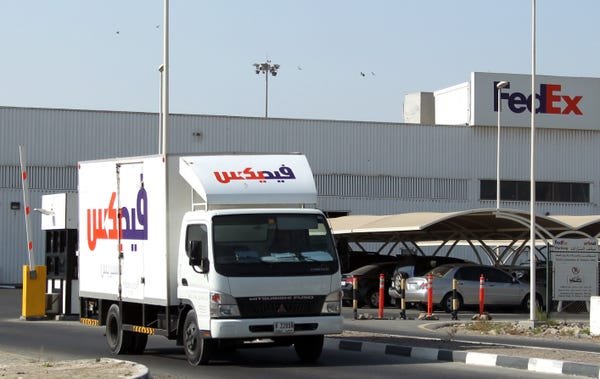
FedEx established its first operations in the Middle East in 1989.

credit should read KARIM SAHIB/AFP via Getty Images

FedEx’s central operations hub for the Middle East, Indian subcontinent, and Africa is based in Dubai World Central Airport.

The global freight and transport company told Business Insider it was focused on minimizing disruption to its services.

“The safety and security of our team members is our top priority. We are closely monitoring the situation in the Middle East and have implemented contingency measures to ensure business continuity,” FedEx told Business Insider.

Customers with questions about their shipments can visit fedex.com or check the FedEx Service Alerts page for the latest updates, FedEx said.

Airbnb

Airbnb has no offices and just a handful of employees in the region, but their safety is paramount, a company spokesperson told Business Insider.

The vacation rental company’s global corporate security team is checking in with those employees and assessing their needs, the person added.

Hosts and guests in affected areas qualify for the major disruptive events policy, which allows them to cancel or receive refunds, the spokesperson said.

BlackRock

BlackRock, the world’s largest asset manager, said that it is focused on employee and client safety following Iran’s retaliatory strikes. The Larry Fink-led company opened its first office in the Middle East in 2009 and today has offices in Dubai, Riyadh, Abu Dhabi, Doha, and Kuwait.

“We’re currently focusing on making sure our staff and clients are safe and have the assistance they need,” a BlackRock spokesperson told Business Insider.

Google


Google Middle East

Google launched a cloud region in Doha, Qatar, in 2023.

Noushad Thekkayil/NurPhoto via Getty Images

A Google spokesperson told Business Insider that the company had safety measures in place for employees in the region. The company was advising staff to follow guidance from local authorities, the spokesperson said.

“The situation in the Middle East is evolving rapidly and we are monitoring it carefully,” Google said in a statement to Business Insider. “Our focus is on the safety and well-being of our employees in the region.”

Google has several offices across the region, including Dubai and Tel Aviv. It opened a new Google Cloud office in Riyadh in 2024. While the exact number of employees in the region could not be learned, LinkedIn suggests Google has several hundred staff in the UAE.

Amazon


amazon logo

Amazon employees in the Middle East have been asked to work remotely.

Matthias Balk/picture alliance via Getty Images

Amazon runs a variety of facilities across the region, including corporate offices, fulfilment centers, delivery stations, and quick-commerce outlets.

Corporate employees in the Middle East have been asked to work remotely and follow guidance from local authorities, Business Insider has learned.

“We are adjusting operations in response to the evolving situation, including temporary pauses where necessary,” an Amazon spokesperson told Business Insider.

“The safety of our employees and partners remains our top priority, and we are working closely with local teams and local authorities to ensure they are supported,” the spokesperson added.


Source link

Multiple-US-embassies-are-telling-Americans-they-cannot-evacuate-or.jpeg

Multiple US embassies are telling Americans they cannot evacuate or help them get out of the Middle East

American citizens across the Middle East are attempting to follow official advice and evacuate as conflict escalates in the region following US and Israeli attacks on Iran on Saturday.

But multiple US embassies have said they are unable to help citizens trying to leave.

“The U.S. Embassy is not in a position at this time to evacuate or directly assist Americans in departing Israel,” the US Embassy in Jerusalem said in a post on X on Tuesday.

The embassy shared that the Israeli Ministry of Tourism was operating shuttles to a border crossing between Egypt and Israel at the town of Taba.

“If you choose to avail yourself of this option to depart, the US government cannot guarantee your safety,” said the US embassy, adding that they were sharing the information “as a courtesy to those wishing to leave Israel.”

President Donald Trump was asked in the Oval Office on Tuesday why evacuations hadn’t been planned beforehand, and whether he would charter planes to evacuate Americans from the region.

Trump largely didn’t address the question, other than to note how quickly the conflict broke out.

“It happened all very quickly,” Trump said. “I thought we were going to have a situation where we were going to be attacked.”

In Qatar, where Iranian retaliatory strikes have hit key energy facilities, the country’s US embassy issued a travel advisory on Tuesday, also warning American citizens they were unable to help them evacuate, saying that they should “take advantage of commercial transportation options.”

The US embassy in Qatar advised Americans who chose to stay to create a contingency plan, but said that “these alternative plans should not rely on the US government for assisted departure or evacuation.”

Most US embassies in the region have suspended normal operations as staff shelter in place, and some have shut down entirely due to heightened security risks.

On Tuesday, the US Embassy in Saudi Arabia issued a stark warning to citizens to stay away from its consulate in Dhahran, a coastal city in the east of Saudi Arabia, due to “a threat of imminent missile and UAV attacks” over the city.

“Do not come to the US Consulate,” the US Embassy in Saudi Arabia said.

On Monday, the US embassy in Jordan announced that all its personnel had temporarily departed the Embassy compound “due to a threat.” It did not specify the threat.

Iran has launched a barrage of retaliatory missiles against US allies in the region, hitting sites including US military bases, Dubai’s Burj Al Arab hotel, and the US embassy in Riyadh.

The list of countries Americans are being urged to depart from immediately is as follows: Bahrain, Egypt, Iran, Iraq, Israel, the West Bank, and Gaza, Jordan, Kuwait, Lebanon, Oman, Qatar, Saudi Arabia, Syria, the United Arab Emirates, and Yemen.

Iran, Iraq, Kuwait, Bahrain, and Qatar have closed their airspaces.

As of Tuesday, Dubai International has resumed limited flight services but continues to instruct travelers not to come to the airport unless their flight has been confirmed.

Wealthy travelers and expats in the UAE have turned to private jets and chauffeured drivers to help them flee the region, but many have been caught up in lengthy border crossings amid the rush to Saudi Arabia and Oman, where some flights were still departing.

Monica Marks, a professor at NYU Abu Dhabi, posted on X, wondering how Americans are supposed to leave the Middle East without government help.


Source link

Line chart

The Middle East crisis isn’t just about tankers — oil output could be forced offline next

Oil traders are bracing for disruptions to the Strait of Hormuz after the US and Israel struck Iranian targets over the weekend, putting at risk the waterway that carries about one-fifth of the world’s oil.

A longer disruption would shift the risk onshore, because storage tanks across the Gulf can only be filled for only so long.

If the conflict drags on and export routes remain blocked, producers could be forced to halt production as storage fills up, Daan Struyven, the head of oil research at Goldman Sachs, said on Goldman Sachs’ “Exchanges” podcast published Monday. This could send prices sharply higher.

“If the Strait of Hormuz is closed for a very long time, you cannot draw inventories forever, and the market may have to rebalance by incentivizing prices to such high levels that you generate demand destruction,” Struyven added.

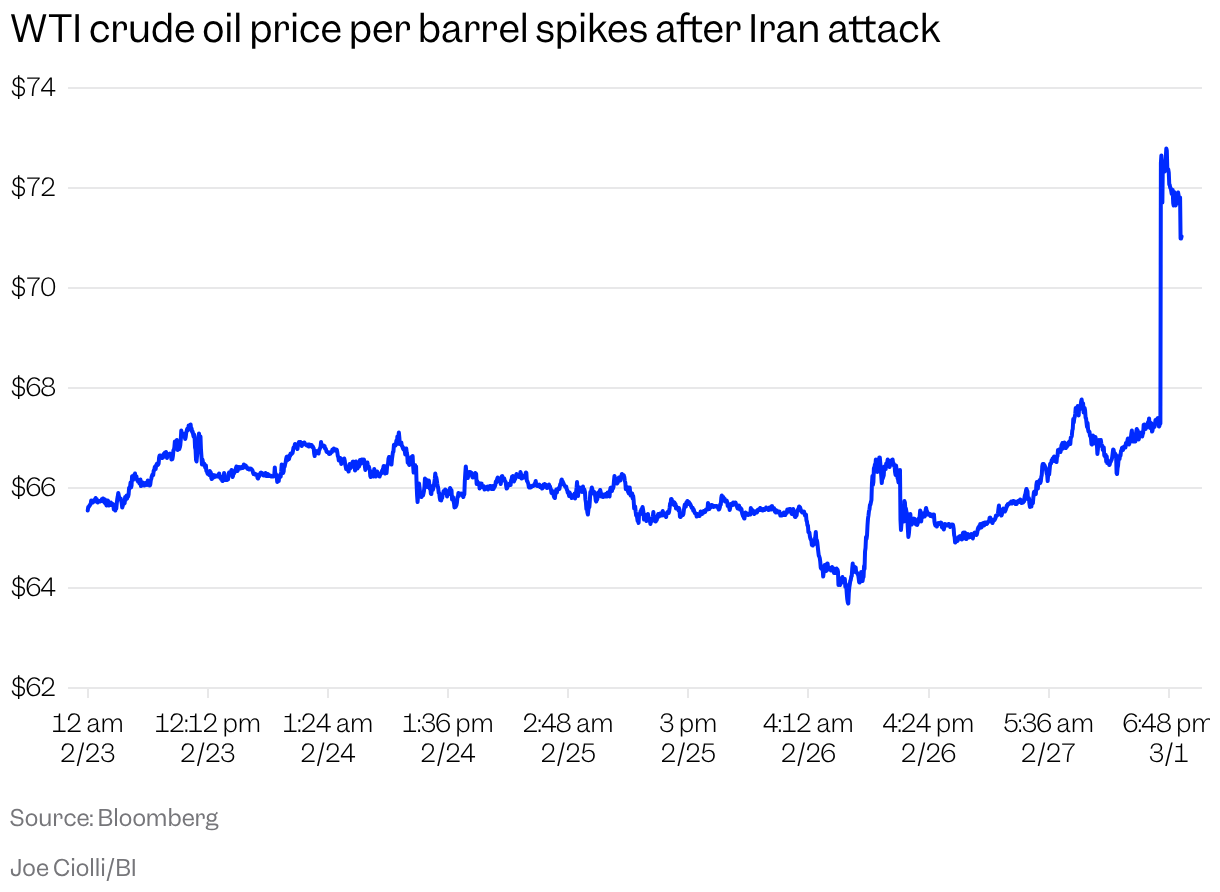
Oil prices are already sharply higher this year on the back of heightened geopolitical risks.

International benchmark Brent and US West Texas Intermediate crude oil futures are 3% and 2.4% higher at around $80 and $73 per barrel, respectively, in early trade on Tuesday. Both grades are up about 30% this year.

The Middle East accounts for about one-third of the world’s seaborne crude.

“Gulf producers do have storage capacity, pipelines, and tanker alternatives, but these are not unlimited,” wrote Chris Weston, the head of research at Pepperstone, in a Tuesday note.

“With the Strait of Hormuz temporarily constrained, the longer the disruption persists, the greater the risk that additional facilities and infrastructure across the Gulf region may be forced offline,” Weston added.

JPMorgan analysts have also warned that if the strait is effectively closed for more than 25 days, storage constraints could push major Middle East producers to suspend output altogether.

‘A supply shock of historic proportions.’

Iran’s Revolutionary Guards said on Monday that the Strait of Hormuz is closed and they will attack any ship trying to cross the waterway.

Major lines are rerouting or suspending services and adding war-risk fees, while some marine insurers have canceled war-risk cover for vessels operating in and around Iranian waters.

Apart from oil, Qatar’s state-owned energy company has halted liquefied natural gas production after reported damage to facilities, underscoring how quickly disruptions can spill beyond crude into wider energy markets.

The macro consequences could be severe, wrote analysts at ING on Monday, as even a partial disruption to the Hormuz would produce “a supply shock of historic proportions.”

However, because the US is a major oil producer, higher oil prices benefit shale producers and improve the domestic energy industry.

Still, inflation could tick up for American consumers, so “that balance is politically awkward to explain and economically insufficient to compensate for the broader damage,” wrote ING analysts.


Source link

Some-Middle-East-flights-resume-amid-confusion-from-Iran-attacks.jpeg

Some Middle East flights resume amid confusion from Iran attacks

Some flights from the Middle East resumed in the wake of the strikes on Iran — but the process hasn’t been without confusion.

Twelve Etihad Airways flights departed Abu Dhabi as of about 5 p.m. local time on Monday, even as the airline said operations remain suspended. Emirates in neighboring Dubai also announced it would operate a “limited number of flights.”

However, more apparent missile threats in the area forced two Etihad cargo flights headed to Abu Dhabi to divert to Muscat, Oman, early Tuesday morning local time, according to Flightradar24 data.

An Emirates A380 passenger jet from Mumbai was holding off the coast and eventually turned around, but it ended up doing a double U-turn and landed in Dubai at about 3:00 a.m. local time.

Reported attacks on the US embassy in Riyadh have sparked disruptions at an airport that had largely been running flights as normal. Flightradar24 shows at least six flights holding or turning back.


The flights near Riyadh holding or turning back.

Screenshot of Riyadh-bound flights holding or turning back early Tuesday morning.


Flightradar24


The US State Department has urged Americans to evacuate over a dozen countries in the Middle East, including the UAE and Saudi Arabia, via commercial means — but it’s unclear how easy that will be amid the latest attacks and closed airports and airspace.

The developments come after the UAE partially reopened its airspace for certain flights, giving travelers hope they’d finally be able to escape after days of waiting. Some did get out.

The first flight carrying passengers to leave the UAE since the attacks, an Etihad Airbus A380 headed for London Heathrow, took off at 2:39 p.m. local time.

It was soon followed by 11 wide-body jets bound for cities in Europe, Asia, and Africa. They were:

  • Flight 41 to Amsterdam
  • Flight 33 to Paris
  • Flight 843 to Moscow
  • Flight 294 to Karachi, Pakistan
  • Flight 204 to Mumbai
  • Flight 300 to Islamabad, Pakistan
  • Flight 216 to New Delhi
  • Flight 555 to Riyadh
  • Flight 611 to Jeddah, Saudi Arabia
  • Flight 571 to Dammam, Saudi Arabia
  • Flight 713 to Cairo

About an hour earlier, Etihad Airways had said in an X post that “all flights to and from Abu Dhabi are suspended” until Tuesday afternoon.

Meanwhile, a notice on the airport’s website told passengers to check directly with their airline before heading there, “due to the temporary closure of UAE airspace.”

However, the site also showed several flights available for check-in.

In a statement shared with Business Insider following the departures, Etihad said that flights returning people to their home countries — or delivering cargo or repositioning the airplane — could operate “subject to strict operational and safety approvals.”

A flight from Islamabad to Abu Dhabi landed around 11:00 p.m. Monday. Another from Riyadh landed shortly after.

“All scheduled commercial flights to and from Abu Dhabi remain cancelled,” Etihad said.

Interest in the flights was high among aviation enthusiasts, with over 100,000 people tracking both the first Etihad and Emirates flights out of the UAE on Flightradar24.

Other airlines are similarly revving back up.

At 9:12 p.m. local time, the same Emirates Airbus A380 that landed from Mumbai took off from Dubai heading for the Indian city. Around 15 minutes later, another departed for Chennai. Further Emirates flights to Hyderabad and Bengaluru in India departed Dubai on Monday night.

Other carriers, including Saudia, AirSial, Fly Jinnah, and Flynas, used the UAE’s airspace to fly between cities in Saudi Arabia and India on Monday night.

Meanwhile, IndiGo, Royal Jordanian, Flydubai, and Air India planes took off from Dubai around the same time. Though all of the destinations were blank on Flightradar24.

It’s unclear whether these flights carried passengers or were specially approved. The airlines didn’t immediately respond to a request for comment from Business Insider.


Emirates Airbus A380 double decker passenger aircraft spotted flying in the air between the blue sky and the clouds, on final approach for landing on the runway of London Heathrow Airport LHR

An Emirates Airbus A380.

Nicolas Economou/NurPhoto via Getty Images


On Sunday, a Nepali national was killed, and seven people were injured by debris after an Iranian drone targeting Abu Dhabi airport was intercepted, officials said.

Abu Dhabi International Airport did not immediately respond to requests for comment.

All flights from Qatar, Bahrain, and Kuwait remained suspended on Monday.

A Lufthansa Airbus A380 also took off from Abu Dhabi earlier on Monday, bound for Munich. The enormous airplane can carry over 500 passengers, but an airline spokesperson told Business Insider that there were only two pilots on board.

That’s because the jet arrived in Abu Dhabi for maintenance three months ago, which has now been completed.

The spokesperson said Lufthansa reviewed the possibility of flying passengers, but it would require at least 17 flight attendants who can’t be flown in “due to the current massive restrictions on air traffic in the United Arab Emirates.”

They added that airport accessibility for any potential passengers is “unclear and difficult to organize.”

“Reliable planning of check-in, security checks, and boarding cannot be guaranteed under these circumstances.”


Source link

Amazon-says-3-data-centers-damaged-by-drone-strikes-in.jpeg

Amazon says 3 data centers damaged by drone strikes in Middle East

Amazon said three of its data centers in the Middle East were damaged by drone strikes due to the US-Iran conflict in the region.

Two facilities in the United Arab Emirates sustained direct hits, while a third facility in Bahrain was damaged by a drone strike “in close proximity,” the company said in an update on its AWS cloud service dashboard on Monday afternoon.

“These strikes have caused structural damage, disrupted power delivery to our infrastructure, and in some cases required fire suppression activities that resulted in additional water damage. We are working closely with local authorities and prioritizing the safety of our personnel throughout our recovery efforts,” the company added in the update.

Have a tip? Contact this reporter via email at ekim@businessinsider.com or Signal, Telegram, or WhatsApp at 650-942-3061. Use a personal email address, a nonwork WiFi network, and a nonwork device; here’s our guide to sharing information securely.


Source link

Wealthy-people-are-chartering-planes-and-hiring-drivers-to-evacuate.jpeg

Wealthy people are chartering planes and hiring drivers to evacuate the Middle East

Six-figure private charter flights, chauffeured drives, hours-long waits to cross borders: Some wealthy travelers and expats in the UAE are doing whatever it takes to evacuate the Gulf region amid air strikes and the possibility of escalation.

“Demand is definitely increasing,” Glenn Phillips, a PR and advertising manager at global charter firm Air Charter Services, told Business Insider, adding that “there are an increasingly limited number of aircraft willing and able to fly to and from the area.”

On Monday, two days after the start of the US and Israel’s war against Iran, flights out of the United Arab Emirates — whose two main airports were damaged by Iranian air strikes — were still few and far between, and major hubs, including Qatar, Bahrain, and Kuwait, had to shut down due to airspace restrictions.

That left wealthy people in financial hotspots like Dubai and Abu Dhabi — hubs for monied tourists and Western expats in recent years — scrambling to reach Oman or Saudi Arabia, two countries that had open airspace through Monday. They spent hours in the car to reach the airports, as border-crossing waits increased by the day.

It may soon get harder for travelers to reach functioning private jets. Some commercial flying had resumed from the UAE on Monday evening, but that appears to have slowed amid new missile threats. Reported attacks on the US embassy in Riyadh have similarly forced several flights to turn around or divert from the Saudi city.

In what appears to be a warning of escalating tensions that could further snowball the conflict, the US State Department on Monday night urged Americans to evacuate over a dozen Middle Eastern nations — including those that still had their airspace open to commercial and private flights, like Oman and Saudi Arabia.

Flights out for $200,000+

Charter flights can cost as much as $200,000, Jay Smedley, the owner of luxury concierge firm Dubai Key, told Business Insider. The company has arranged short-haul private charter flights to Istanbul, Cairo, and the Maldives for clients since requests began to increase on Saturday.

Flights to Europe can cost even more, with Ameerh Naran, the CEO of Vimana Private Jets, saying the firm is pricing the flights between $175,000 and $235,000.

Air Charter Services has arranged “a number” of evacuation flights — and has more scheduled on Tuesday — out of Muscat, Oman, largely for people looking to leave Dubai, Phillips said.

The trip involves a five-hour drive, plus an additional three- to four-hour wait at the Hatta border crossing, which he expects will increase.

The demand to leave the region began last week, Naran told Business Insider, adding that there was “a noticeable increase in enquiries from Friday onwards.”

“Expect long waiting queues and security check delays,” Camille d’Harambure, a general manager at luxury travel firm Lightfoot Travel, told Business Insider.

Mike D’Souza, the operations coordinator for Dubai-based chauffeur service Indus Chauffeurs, told Business Insider that the “demand appears precaution-driven rather than panic-driven.”

“There has been a clear emphasis on speed and certainty of departure, with many clients prioritizing the earliest viable routing rather than specific aircraft types or traditional preferences,” Naran said. “We have also seen increased demand for coordinated ground support to facilitate access to airports where airspace remains open.”

Phillips echoed that clients just want to get out and are not all that concerned about where “out” is.

Prices have increased with demand, Phillips added — and in some cases, even those wealthy enough to pay their way out of the Middle East are looking twice at the price tag of departure.

“Many people are taking shorter flights to places out of the region and then picking up scheduled connections for the rest of their journey to reduce full journey costs,” he said.


Source link

A map of the Middle East, showing the Strait of Hormuz in the Persian Gulf, with Iran highlighted and markers on Dubai and Tehran.

Tons of goods are stuck around the Middle East amid shipping and air chaos

Global supply chains are on edge after the US and Israel launched military strikes on Iran on Saturday, triggering widespread disruption across one of the world’s most critical trade corridors.

The fallout is hitting more than oil tankers moving through the Strait of Hormuz.

Container ships loaded with consumer goods, auto parts, electronics, and food are being rerouted or delayed, while air cargo networks are fracturing under sudden airspace closures.

“Ocean container services in the Persian Gulf have continued unaffected by the recent build-up of military forces in the region, but the escalation in conflict through military strikes means ships will now avoid the area, but for as short a time as possible,” said Peter Sand, the chief analyst at freight-rate analytics platform Xeneta.

On Sunday, MSC — the world’s largest container shipping line by capacity — said it had suspended all bookings for cargo to the Middle East until further notice.

Danish shipping giant Maersk paused Red Sea and Suez Canal sailings amid fears the Iran escalation could spill over into key shipping lanes. The company is rerouting vessels around the Cape of Good Hope in South Africa.

French shipping giant CMA CGM announced Monday it will impose an “Emergency Conflict Surcharge” effective Monday, citing rising security risks. The surcharge will add between $2,000 and $4,000 per container on shipments to and from Gulf and Red Sea countries.

On Saturday, CMA CGM ordered vessels inside or bound for the Gulf to “proceed to shelter.” It also suspended sailings through the Suez Canal and rerouted ships to the Cape of Good Hope.

German shipping giant Hapag-Lloyd introduced a $1,500 per standard container war risk surcharge and suspended vessel transits through the Strait of Hormuz.

Sailing around Africa, rather than through the Suez Canal, absorbs roughly 2.5 million 20-foot container units’ worth of global container capacity, according to Xeneta’s Sand.

Read more about the US-Iran conflict

Air cargo rates may rise

Air freight is also under strain.

Several Middle Eastern airspaces have been closed or restricted, disrupting passenger and cargo flights.

Parcel delivery giant FedEx suspended flights to and from markets including Bahrain, Israel, Qatar, Saudi Arabia, Kuwait, and the UAE, and halted pickup and delivery services in several Gulf countries.

Qatar Airways Cargo temporarily suspended operations due to the closure of Qatari airspace.

DSV, a Danish logistics company, said in an advisory that airspace restrictions are forcing carriers to suspend services or divert flights and lengthen routings.

With less cargo space available on key Asia-Europe and Middle East routes, air freight rates are likely to rise, space will tighten, and airlines may make short-notice schedule and pricing changes, according to DSV.

Ryan Petersen, the CEO of Flexport, wrote on X that conflict in the Middle East has removed 18% of global air freight capacity from the market.

If carriers begin omitting Gulf port calls, containers may be discharged at alternative hubs and trucked onward, wrote Xeneta’s Sand.

The broader concern, however, is what the escalation means for global trade flows through the Red Sea this year. The conflict comes after more than two years of disruption caused by Iran-backed Houthi attacks on commercial shipping.

“The repercussions of the joint military operation by the US and Israel against Iran and subsequent retaliatory action will see the further weaponization of trade and shatter hopes of a large-scale return of container shipping to the Red Sea in 2026,” wrote Sand.


Source link