Line chart

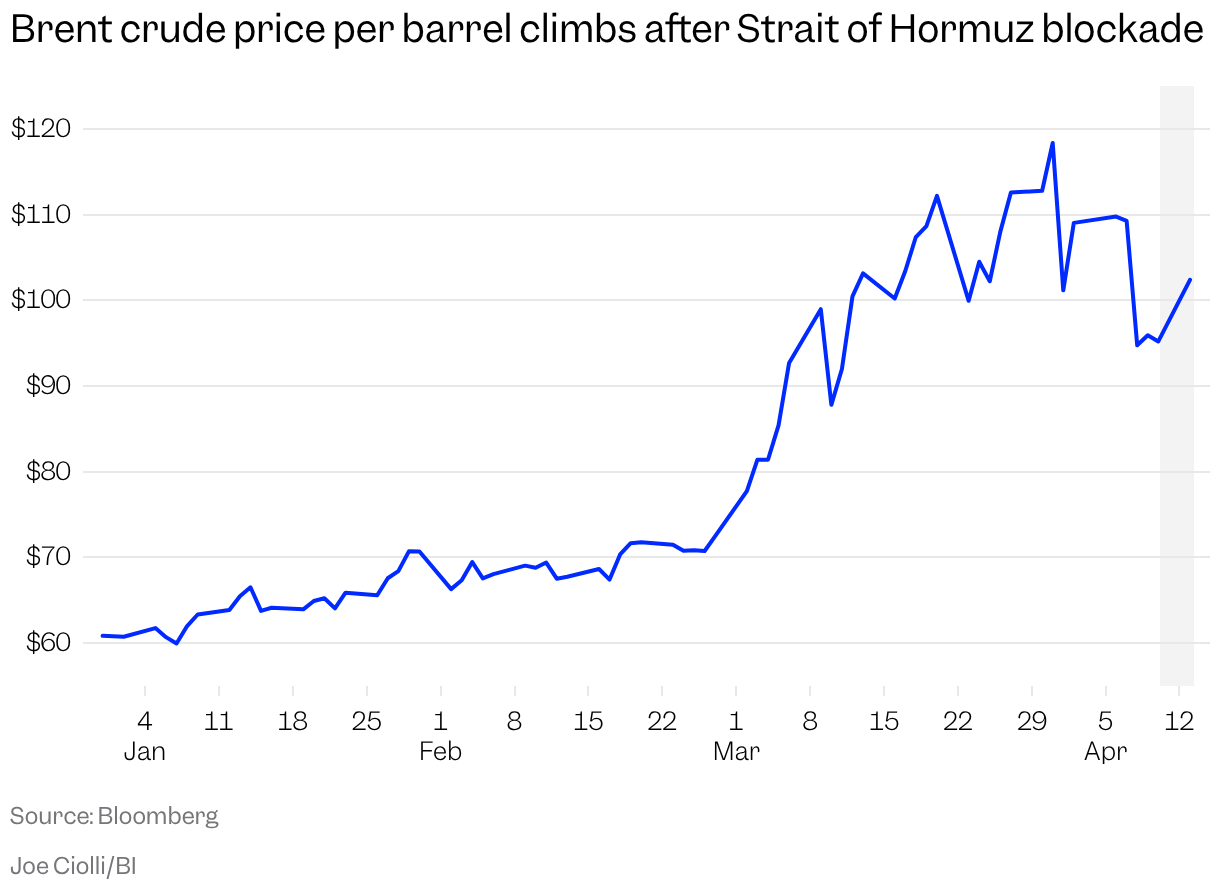
Oil prices spike after failed US-Iran peace talks and Trump’s blockade of the Strait of Hormuz

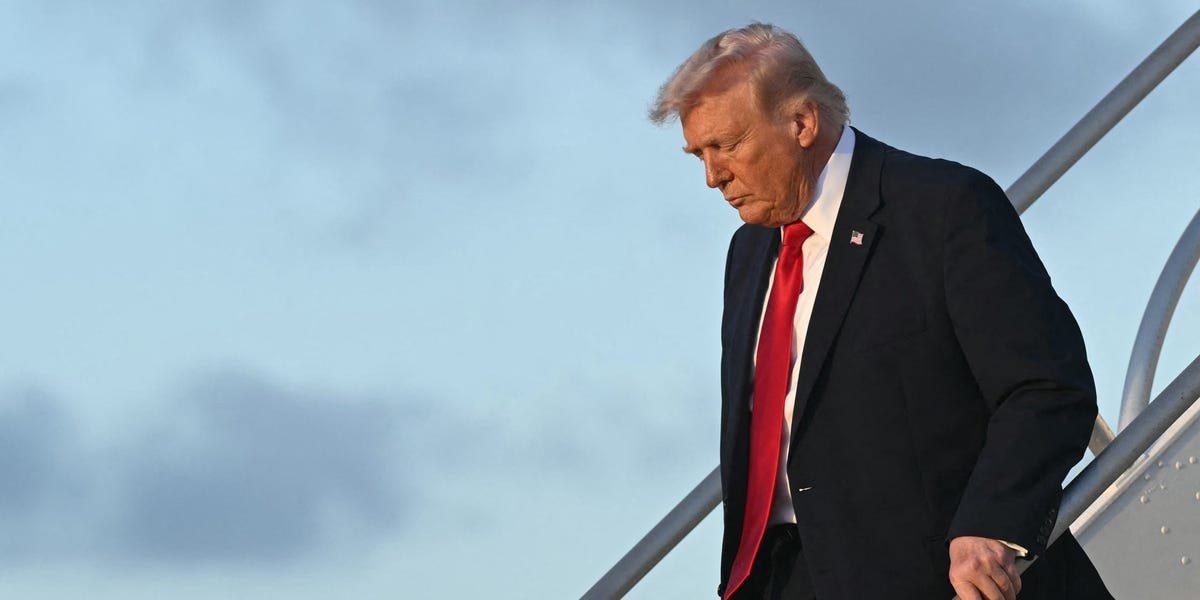
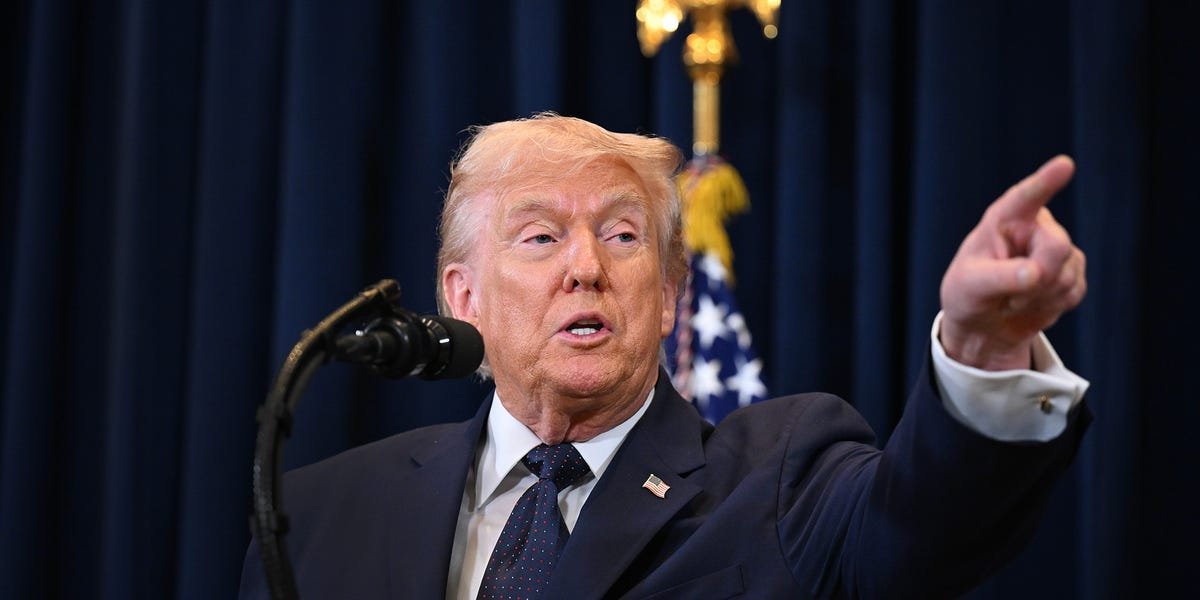
Oil prices spiked past $100 per barrel after President Donald Trump imposed a blockade of the Strait of Hormuz in response to failed peace talks between Iran and the US.

Brent crude oil futures reached $102 per barrel on Sunday evening, up $7 from the previous close price. West Texas Intermediate also rose $7 to reach $104 a barrel.

Oil prices have skyrocketed globally since the US and Israel’s war on Iran began in February. Iran retaliated by effectively closing traffic through the Strait of Hormuz. Around 20% of the world’s oil supply and liquefied natural gas passes through the waterway off Iran’s coast.

Major oil hubs across the Middle East have also been damaged amid the ongoing military conflict, further compounding the oil supply chain. The fallout is being felt globally, prompting some countries to shorten workweeks and implement other energy-saving tactics. The national average price of gas surpassed $4 in the US in late March.

Trump agreed to a two-week ceasefire on April 7, dependent on Iran immediately reopening the Strait of Hormuz. However, as the war approaches its seventh week, there is no end in sight.

US Vice President JD Vance traveled to Pakistan on Saturday to engage in peace talks with Iran. After nearly 24 hours, though, the two countries failed to reach an agreement.

In response, Trump said the US will enact a blockade of the Strait of Hormuz in a Truth Social post on Sunday.

“Effective immediately, the United States Navy, the Finest in the World, will begin the process of BLOCKADING any and all Ships trying to enter, or leave, the Strait of Hormuz,” Trump wrote.


Source link

Oil-prices-climb-as-the-US-and-Israels-war-on.jpeg

Oil prices climb as the US and Israel’s war on Iran enters its 3rd week

Oil futures climbed in early trading on Sunday as the US and Israel’s war with Iran entered its third week, disrupting the global supply chain.

Brent oil reached $106.33, up nearly $3 from when the market closed on Friday. West Texas Intermediate hit $101.19 on Sunday.

For Americans, surging oil prices mean spending more at the pump. The national average price for gasoline hit $3.69 on Sunday. Gas prices have surpassed $3 in all 50 US states for the first time since 2023.

The International Energy Agency said last week the war has caused the largest oil market disruption in history, and that global oil supply will drop by 8 million barrels per day in March.

Kevin Hassett, the US director of the National Economic Council and a top aide to President Donald Trump, said Sunday on CBS News’ “Face the Nation” that the US is working to minimize the fallout for American consumers.

“The big problem right now would be energy prices, and we’re watching and monitoring closely,” Hassett said.

Much of the instability in the oil market stems from the near-closure of the Strait of Hormuz, which Iran controls and through which about 20% of the world’s petroleum passes. Trump has called on other nations to help secure the strait, but has so far received either lukewarm replies or none at all.

Attacks on major oil hubs are also likely driving up prices. Trump said late Friday that the US had “totally obliterated” military targets on Iran’s Kharg Island, where refineries process almost all of the nation’s oil exports.

The president threatened to target oil infrastructure on the island if Iran continued to prevent ships from passing through the Strait of Hormuz. An attack on the key Iranian oil center would further destabilize the global oil market.

In response, Iran said that ports, docks, and “American hideouts” in the United Arab Emirates could be targeted. Fire later broke out near the Port of Fujairah in the United Arab Emirates, the only multipurpose maritime facility on the UAE’s east coast and a major oil depot, on Saturday. The local government said an intercepted drone caused the fire.

Any end to the conflict, meanwhile, appears to be a long way off. Iran’s foreign minister, Abbas Araghchi, said on Sunday that there has been no discussion of a ceasefire.

“We are only defending our people from this act of aggression,” Araghchi said on “Face the Nation.”We don’t see any reason why we should talk with Americans, because we were talking with them when they decided to attack us, and that was for the second time.”


Source link

Photos-show-a-major-fire-at-a-key-UAE-oil.jpeg

Photos show a major fire at a key UAE oil port, a day after the US struck a major Iranian depot

  • A fire broke out near a key oil port in the United Arab Emirates on Saturday.
  • Officials said debris from an intercepted drone caused the fire and that operations were suspended.
  • The US attacked Kharg Island, a major oil depot in Iran, on Friday.

Fire erupted at a critical oil hub in the United Arab Emirates on Saturday amid the ongoing military conflict in the Middle East.

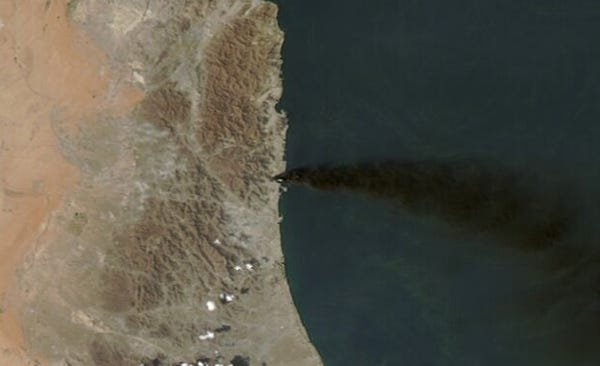
Plumes of dark black smoke billowed around the Port of Fujairah, the only multipurpose maritime facility on the UAE’s east coast. The Fujairah government’s media office said debris from an intercepted drone caused the fire. No injuries were reported.

The fire comes after Iran said it would retaliate against the US for attacking Kharg Island on Friday. Kharg Island, located about 300 miles from the Strait of Hormuz, is key to Iran’s oil industry and has refineries that process nearly all of the country’s oil exports.

President Donald Trump said the US had “totally obliterated” military targets on Kharg Island in a Truth Social post on Friday. In a Truth Social post on Sunday, Trump said he hoped other countries affected by the Strait of Hormuz closure would send warships alongside the US to help secure it.

War broke out in the Middle East last month when the US and Israel launched joint strikes against Iran. In response, Iran has targeted US military bases in neighboring countries like Qatar, Bahrain, Kuwait, and the UAE. The ongoing military conflict has shuttered airspaces and halted most traffic through the Strait of Hormuz. US strikes on Kharg Island and damage to the UAE’s Port of Fujairah could impact oil prices, which again surged past $100 on Friday, driving up gas prices around the world.

Smoke from the coast of Fujairah spread over the Gulf of Oman.

NASA MODIS satellite image of Fujairah on Saturday.

NASA Modis satellite image, November 14, 2026.

A satellite image taken on Saturday showed smoke from the fire spreading over the Gulf of Oman. The Port of Fujairah exported an average of 1.7 million barrels of crude oil and refined fuels each day in 2025, Reuters reported.

Some operations at the Port of Fujairah were suspended on Saturday.


Fujairah in the UAE on March 14, 2026.

Fire broke out in Fujairah on Saturday.

AP Photo/Altaf Qadri

Local outlets reported that some oil-loading operations were suspended on Saturday following the intercepted strike.

The Fujairah Oil Industry Zone can store millions of barrels.


Oil facility in Fujairah in the UAE on March 14, 2026.

The Fujairah Oil Industry Zone in Fujairah on Saturday.

AP Photo/Altaf Qadri

The Fujairah Oil Industry Zone, located near the port, is home to the largest commercial storage facility for refined oil products in the Middle East. The hub can store about 70 million barrels of oil.

The military conflict has sent oil prices skyrocketing.


Fujairah in the UAE on March 14, 2026

Oil prices have risen globally since the US and Israel launched attacks against Iran.

AFP/Getty Images

The ongoing war has disrupted the oil supply chain, sending oil prices over $100 a barrel this week. The International Energy Agency said it will release 400 million barrels from reserves in response, marking the largest coordinated release in the IEA’s history.

The International Energy Agency said the war has caused the largest oil market disruption in history.


Fujairah in the UAE on March 14, 2026.

Fujairah in the United Arab Emirates on Saturday.

AFP/Getty Images

The International Energy Agency said global oil supply will drop by 8 million barrels a day in March.

“Disruptions are not limited to upstream production and exports, with several refineries and gas processing facilities shut down due to attacks or for safety concerns,” the agency said in its monthly markets report. “The closure of the Strait is also forcing export-oriented refineries to cut runs or shut completely as product storage tanks top up.”

The UAE said it intercepted nine missiles and 33 drones launched from Iran on Saturday.


Fujairah in the UAE on March 14, 2026.

Iran launched over 30 drones at the UAE on Saturday, according to the UAE’s military defence.

AP Photo/Altaf Qadri

The UAE Defense Ministry said it intercepted nine ballistic missiles and 33 uncrewed aerial vehicles launched from Iran in an X post on Saturday.

“Since the onset of the blatant Iranian aggression, UAE air defences have engaged 294 ballistic missiles, 15 cruise missiles, and 1,600 UAVs launched from Iran,” it said.


Source link

Trump-says-the-US-has-totally-obliterated-military-targets-on.jpeg

Trump says the US has ‘totally obliterated’ military targets on Kharg Island, the center of Iran’s oil empire

  • President Donald Trump said the US has destroyed military targets on Kharg Island.
  • The island, located off the coast of Iran, is central to the country’s oil empire.
  • Trump said the strikes did not damage the island’s oil infrastructure.

President Donald Trump said late Friday that the US had “totally obliterated” military targets on Kharg Island, an island off the coast of Iran that is central to its oil empire.

“Moments ago, at my direction, the United States Central Command executed one of the most powerful bombing raids in the History of the Middle East, and totally obliterated every MILITARY target in Iran’s crown jewel, Kharg Island,” Trump wrote.

“Our Weapons are the most powerful and sophisticated that the World has ever known but, for reasons of decency, I have chosen NOT to wipe out the Oil Infrastructure on the Island,” he added.

“However, should Iran, or anyone else, do anything to interfere with the Free and Safe Passage of Ships through the Strait of Hormuz, I will immediately reconsider this decision,” Trump continued. “Iran has NO ability to defend anything that we want to attack — There is nothing they can do about it!”

Representatives for CENTCOM and the White House did not immediately respond to requests for comment from Business Insider.

What is Kharg Island?

Kharg Island is a small island in the Persian Gulf, located roughly 300 miles from the Strait of Hormuz, which is known for its significance to Iran’s oil production.

Refineries on the island process nearly all of the nation’s oil exports. Disruption to the facilities there could have a significant impact on the global oil shortage, further driving up costs.

This is a developing story. Please check back for updates.


Source link

The-US-is-temporarily-lifting-sanctions-on-Russian-oil-a.jpeg

The US is temporarily lifting sanctions on Russian oil, a key pressure point for the Kremlin’s war chest

The US Treasury Department is lifting Russian oil sanctions until April 11, as the Trump administration seeks to relieve global crude supplies choked by war in the Middle East.

A notice issued by the department’s Office of Foreign Assets Control on Thursday laid out a roughly four-week window authorizing the “sale, delivery, or offloading of crude oil or petroleum products” from Russia.

The move eases a yearslong effort by the US and its allies to squeeze Russia’s finances in response to its full-scale invasion of Ukraine in 2022.

Moscow, however, has still benefited from its energy trade — taxing the industry typically accounted for nearly half of its federal budget revenues before 2022 — by quietly transporting it via what the West has called a “shadow fleet” of third-party tankers.

An analysis from Urgewald, a German NGO, showed Russia’s fossil fuel export revenues averaged 510 million euros, or $587 million per day in the week following the strikes — 14% higher than the daily average in February daily average.

Treasury Secretary Scott Bessent said on Thursday that Russia stood to benefit from the temporary lifting of sanctions, but described the gains as limited in scale.

“This narrowly tailored, short-term measure applies only to oil already in transit and will not provide significant financial benefit to the Russian government, which derives the majority of its energy revenue from taxes assessed at the point of extraction,” he wrote in a post on X.

Brent crude oil prices were 0.6% higher at $101.07 per barrel at 11:16 p.m. on Thursday while US West Texas Intermediate was 0.4% higher at $96.15 per barrel.

The US and Israel launched a massive airstrike campaign against Iran on February 28, attacking over 5,500 targets with land, sea, and air assets. Iran has, in turn, vowed to block the Strait of Hormuz, the critical waterway serving the Persian Gulf, which accounts for about a fifth of the world’s crude oil.

Traffic in the strait has plummeted in the past week amid over a dozen reports of commercial vessels being attacked in its vicinity.

Despite sweeping Western sanctions imposed after the invasion of Ukraine, Russia has reoriented much of its energy exports away from Europe and toward alternative partners in Asia, notably China and India, where discounted Russian crude has become a major source of demand.

Last week, the US granted a temporary 30-day waiver to allow Indian refiners to purchase Russian oil.

Ukraine and its allies have long raised concerns about Russia’s ability to muster resources from its global energy trade to feed its war manufacturing industry. The Kremlin is now spending record amounts of its federal budget on defense, reaching 6.3% of its GDP in 2025.

Daily revenues of $610 million would be the equivalent of 12,000 to 30,000 of Russia’s Shahed-136 one-way attack drones, based on estimates that the loitering munitions cost $20,000 to $50,000 each.

President Donald Trump has repeatedly warned Iran that continuing to impede traffic along the strait would incur further US military action.

But Tehran has maintained a defiant posture, retaliating with drone and missile attacks on its neighbors and US forces in the region. Reports say it’s also begun to sparsely lay mines along the strait, which would further delay an opening of the strait by forcing the US and its allies to meticulously sweep for and clear explosives.

On Thursday, the new Iranian supreme leader, Mojtaba Khamenei, issued a statement through a newscaster that his government would continue blocking the strait.

Source link