Stocks emerged unscathed from a wild day in the oil markets. Can it last?
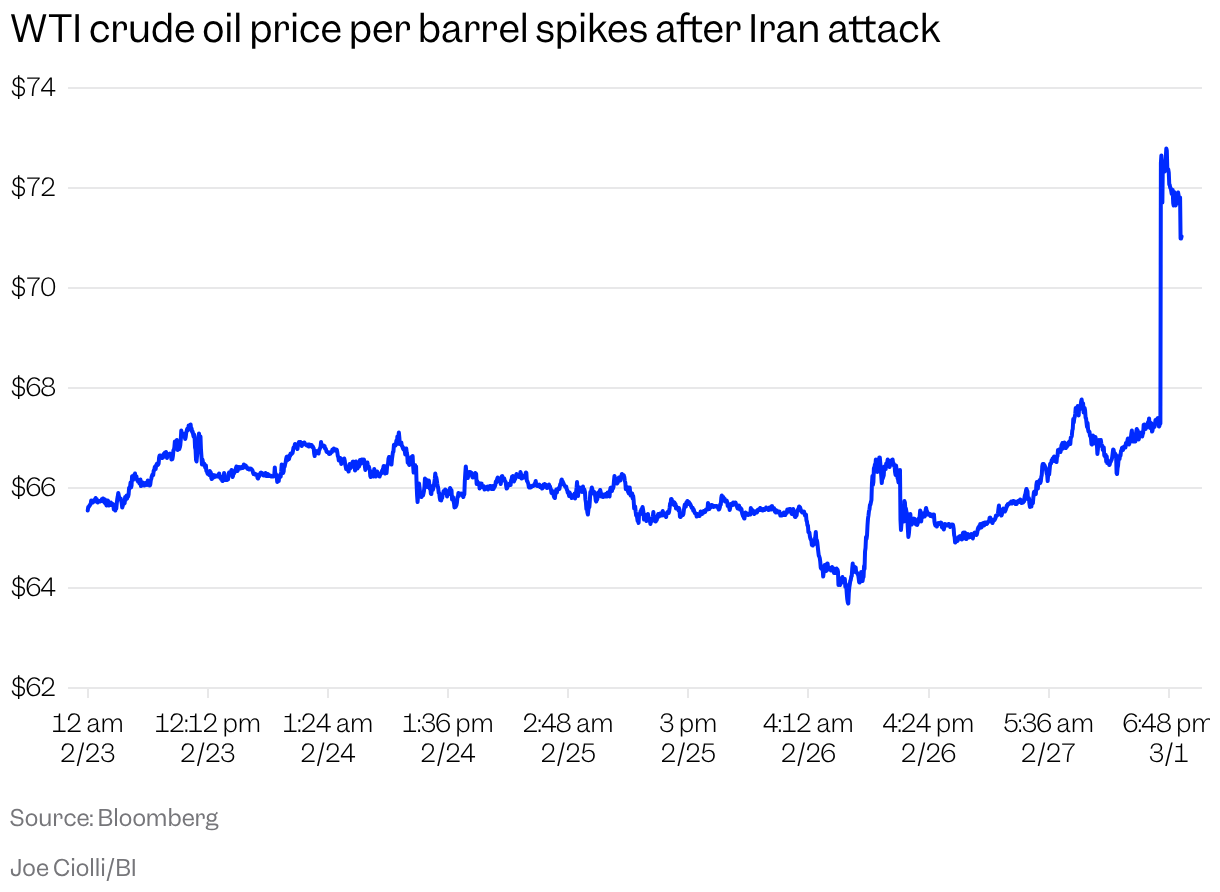
The price of oil eclipsed the all-important $100-a-barrel benchmark, and everyone got really nervous. (Here’s a roundup of what a bunch of smart people said.)
But G7 countries pledged to release strategic oil reserves if needed, easing oil prices. President Donald Trump’s insistence the war is “very complete” was another boost. By market close, major indexes actually finished the day in the green as oil prices dropped.
At least, for now.
Wall Street vet Ed Yardeni, who is typically bullish, raised the chances of a stock meltdown from 20% to 35%. He also mentioned the dreaded s-word — stagflation — in a nod to the 1970s oil crisis that gave investors headaches.
Every time Dan publishes a story, you’ll get an alert straight to your inbox!
Stay connected to Dan and get more of their work as it publishes.
Others are less fearful. Pantheon Macroeconomics said in a note to clients on Monday that fears over oil prices spiking inflation are overblown. The reason? The US labor market is too weak to support large price spikes.
“Higher inflation expectations will be meaningless if employers still hold the cards in wage setting and their customers retrench,” wrote Samuel Tombs, Pantheon’s chief US economist.
Ultimately, what matters most is how long this oil crisis lasts.
An extended closure of the Strait of Hormuz will be a lot harder for the markets and economy to shake off than just a one-off price spike.
“While market and survey-based inflation expectations can be sensitive to oil at high frequency, history suggests only marked and persistent spikes in the price of crude trigger persistent inflationary cycles,” BofA analysts wrote.
That’s not stopping some people from preparing for the worst.
Governments are offering suggestions to help people mitigate the impact of oil price spikes, from cutting out non-essential travel to offering more flexible work.
As useful as some of that advice might be, it’s not always actionable for Americans. With so many US cities suffering from subpar public transportation, avoiding the gas pump won’t be easy.
Oil prices have surged after fresh conflict in the Middle East raised fears of supply disruptions through the Strait of Hormuz — a move that would normally be a windfall for Russia.
But this time, it may not be enough, according to an analyst.
“The current temporary spike, filtered through sanctions discounts and an unfavorable exchange rate, is unlikely to change the fundamental arithmetic,” wrote Alexander Kolyandr, a senior fellow at the Center for European Policy Analysis, in a Wednesday post.
International benchmark Brent crude and US West Texas Intermediate were more than 3% higher, trading around $84 and $77.50 per barrel respectively late on Wednesday. Both grades are around 35% higher this year.
Russia is one of the world’s largest energy exporters, and its federal budget — and by extension President Vladimir Putin’s war in Ukraine — relies heavily on oil and gas revenue.
Every time Huileng publishes a story, you’ll get an alert straight to your inbox!
Stay connected to Huileng and get more of their work as it publishes.
Yet Moscow does not receive international benchmark prices for its crude. Its Urals oil trades at a sanctions-driven discount, and the strong ruble means each dollar of oil revenue converts into fewer rubles for the budget.
As a result, Brent above $80 does not automatically deliver the revenue Russia needs.
Oil and gas revenues plunged 50% in January from a year earlier, falling to levels last seen during the pandemic shock in 2020. Meanwhile, the federal budget ran a deficit of 1.72 trillion rubles — about 0.7% of GDP, according to Russian Finance Ministry data.
“Unless oil prices stay higher for longer and the ruble weakens significantly, the Kremlin’s budget problems are here to stay,” Kolyandr wrote.
Kolyandr’s analysis comes as investors weigh whether the latest Middle East escalation will trigger a sustained oil shock, particularly for Asian countries that are reliant on heavily reliant on Middle Eastern energy.
China and India — now two of the biggest buyers of Russian crude — still source a large share of their oil from the Middle East, leaving both exposed to disruptions in the Strait of Hormuz.
Any prolonged disruption in the Strait of Hormuz could shift trade flows, potentially increasing scrutiny on whether Asian importers turn further to discounted Russian oil.
Markets have been volatile following the US and Israeli attacks on Iran over the weekend. On Wednesday, stocks in Asia slumped on energy security fears before rebounding on Thursday.
Oil traders are bracing for disruptions to the Strait of Hormuz after the US and Israel struck Iranian targets over the weekend, putting at risk the waterway that carries about one-fifth of the world’s oil.
A longer disruption would shift the risk onshore, because storage tanks across the Gulf can only be filled for only so long.
If the conflict drags on and export routes remain blocked, producers could be forced to halt production as storage fills up, Daan Struyven, the head of oil research at Goldman Sachs, said on Goldman Sachs’ “Exchanges” podcast published Monday. This could send prices sharply higher.
“If the Strait of Hormuz is closed for a very long time, you cannot draw inventories forever, and the market may have to rebalance by incentivizing prices to such high levels that you generate demand destruction,” Struyven added.
Oil prices are already sharply higher this year on the back of heightened geopolitical risks.
International benchmark Brent and US West Texas Intermediate crude oil futures are 3% and 2.4% higher at around $80 and $73 per barrel, respectively, in early trade on Tuesday. Both grades are up about 30% this year.
The Middle East accounts for about one-third of the world’s seaborne crude.
“Gulf producers do have storage capacity, pipelines, and tanker alternatives, but these are not unlimited,” wrote Chris Weston, the head of research at Pepperstone, in a Tuesday note.
“With the Strait of Hormuz temporarily constrained, the longer the disruption persists, the greater the risk that additional facilities and infrastructure across the Gulf region may be forced offline,” Weston added.
JPMorgan analysts have also warned that if the strait is effectively closed for more than 25 days, storage constraints could push major Middle East producers to suspend output altogether.
‘A supply shock of historic proportions.’
Iran’s Revolutionary Guards said on Monday that the Strait of Hormuz is closed and they will attack any ship trying to cross the waterway.
Major lines are rerouting or suspending services and adding war-risk fees, while some marine insurers have canceled war-risk cover for vessels operating in and around Iranian waters.
Apart from oil, Qatar’s state-owned energy company has halted liquefied natural gas production after reported damage to facilities, underscoring how quickly disruptions can spill beyond crude into wider energy markets.
The macro consequences could be severe, wrote analysts at ING on Monday, as even a partial disruption to the Hormuz would produce “a supply shock of historic proportions.”
However, because the US is a major oil producer, higher oil prices benefit shale producers and improve the domestic energy industry.
Still, inflation could tick up for American consumers, so “that balance is politically awkward to explain and economically insufficient to compensate for the broader damage,” wrote ING analysts.
In 1987, when Donald Trump was first flirting with running for president, he told an audience in New Hampshire that the United States should attack the “horrible, horrible country” of Iran, “and take over some of their oil.” In the years since, Trump talked about grabbing control of the natural resources of Venezuela, Iraq, Syria, Kuwait, and Libya, too.
For a long time — including during Trump’s first term — this smash-and-grab idea to corner the global energy supply was treated as something of a joke by outside analysts and political opponents. In this second administration, a version of it has become a building block of American power projection, both at home and abroad.
That policy is one of the reasons why the US captured Venezuela’s president. It’s the same reason why this White House now feels like it can choke Cuba so hard that Havana might cough up its leaders. And it’s why the Trump administration was bragging in the run-up to this past weekend’s massive American-Israeli assault on Iran that it could do so without upending the global economy.
The policy hasn’t received much attention, though it’s been hiding in something like plain sight. It goes by an almost comically-macho name, “energy dominance.” To vastly oversimplify, the plan boils down to three steps: maximize America’s share of the world’s energy supply, especially its fossil fuels; leverage the hell out of ’em; and then make rivals both foreign and domestic bend the knee.
Or, as President Trump put it in a speech he gave in Corpus Christi, Texas the day before he ordered this new attack on Iran, he’s “cementing America’s status as the number one energy superpower by far anywhere on earth.” The offensive includes strikes on a hospital and on a girls’ elementary school that left at least 60 dead, and possibly as many as 115, The New York Times reported.
Previous presidents from both parties encouraged more and more and more drilling, all in the name of weaning America off others’ fossil fuels. Now the US produces so much gas and oil — more oil than Russia and Saudi Arabia combined, according to the Energy Department — that it can turn that dynamic on its head. American-controlled fossil fuels can be used to try to push other countries into compliance with our petrostate.
American-controlled fossil fuels can now be used to try to push other countries into compliance with our petrostate.
“Our oil, our gas, our minerals, our coal,” Rich Goldberg, who last year helped set up the administration’s National Energy Dominance Council (NEDC), tells me. “If you can unlock those assets, that’s trillions of dollars and an incredible amount of power projection and leverage over our adversaries.”
Take Iran. Before the president ordered the bombing of Tehran’s nuclear facilities last year, he got a little jumpy. Iran had repeatedly threatened the global energy market, with its mines and drones and fast-moving attack boats stationed around the strategically-located Strait of Hormuz. “EVERYONE, KEEP OIL PRICES DOWN,” he posted on his social media site. “DRILL, BABY, DRILL!!! And I mean NOW!!!”
Trump’s advisers told him not to worry. The US and its allies now controlled so much of the world’s oil, Iran couldn’t make that much of an impact. Sure enough, crude didn’t rise too high for too long, peaking at $79 per barrel before settling back down to $66 two days later. In part, that was because of all of that cheap American and allied crude on the market. Energy Secretary Chris Wright later chalked it up as “perfect evidence of Trump’s energy dominance agenda, you know, growing production in the United States” — and a sign that the US could keep on attacking Iran with minimal economic blowback.
“It’s not going to change the price of the pump, because guess what? The US, we don’t get any oil anymore out of the Strait of Hormuz,” Secretary of the Interior Doug Burgum, considered one of the administration’s leading voices on energy, said last fall. “We didn’t have to worry about it. Other people in the world did. And this is the degrees of freedom and power that you have.” (We’ll see how long the optimism holds this time; almost all energy analysts are predicting a short-term bump in prices, with some foreseeing a jump to $100 per barrel.)
Then there’s Venezuela. When American forces grabbed Caracas’ dictator Nicolas Maduro in early January, Trump declared that the US was going to “run the country.” He wanted to do it by controlling Venezuela’s oil: where it flowed, and who profited from it. Wright and other US officials locked arms with Maduro’s business-friendly deputy, Delcy Rodríguez, rather than Edmundo González, the opposition leader the US recognized as the president-elect after the 2024 vote.
“CO2 was never a pollutant,” US Secretary of the Interior Doug Burgum said earlier this month.
ANNABELLE GORDON / AFP via Getty Images
Caracas’ oil was immediately cut off to what had previously been Venezuela’s closest ally, the communist government in Cuba. That deepened an economic crisis so severe that talk of another regime change in Latin America is now in the air. “If I lived in Havana, and I was in the government,” Secretary of State Marco Rubio said in January, “I’d be concerned.”
Oil isn’t the only explanation for Trump’s increasingly belligerent actions across the globe, though it explains a lot, as I noted in an essay for The New York Timesa few months back. “Since day one, President Trump has been unleashing American energy dominance to ensure the United States is not reliant on geopolitics and tensions around the world. This has resulted in record-high oil and gas production as well as stabilized oil prices,” Taylor Rogers, a White House spokeswoman, says in an email.
This drive towards energy dominance shows few signs of slowing down. Venezuela is one of 12 members of OPEC, the global oil cartel which has held sway over world’s energy prices for decades. One top analyst, David Doherty of Bloomberg New Energy Finance, laid out a scenario for me in which Trump leverages Venezuela to gain backdoor control of — or at least serious influence over — OPEC, which accounts for about half of all of the oil on the international market. Trump may already have some of that leverage. Immediately after the new round of attacks on Iran, the OPEC countries agreed to open their spigots a bit, a move that traditionally helps cool prices. Russia, Iran’s traditional ally, even agreed to up production by 62,000 barrels per day. “That’s like the ultimate energy dominance, right?” Doherty says. “Because it’s not just America’s energy anymore. It’s the world’s.”
But that dominance is not total, and the Trumpists see China as the biggest threat to it. Beijing’s solar, wind, and battery tech has become so efficient and cheap that it’s undercutting the appeal of US-controlled fossil fuels. What makes it all so galling, the Trump team says, is that the Chinese are doing so while dressing themselves as global good guys, working to stave off a planet-wide climate emergency. Beijing is now at the center of international climate talks, even as it continues to be the world’s polluter-in-chief. China exported more than $222 billion in cleantech last year. Its carmakers exported 2.6 million electric vehicles, worth more than $70 billion. US automakers sold about half of that — at home and abroad.
Goldberg, now with the Washington-based Foundation for the Defense of Democracies, calls Beijing’s play a “psyop” — a way for China to appear like a savior, all while connecting the world’s grid to its unreliable and possibly hackable equipment. “You couldn’t invent a better way to defeat the United States.”
If it’s a psyop, it’s a strange one, because the Chinese are simultaneously pulling it on themselves. While China continues to build coal plants — as much as 95% of the world’s new coal construction is happening there — renewable power is coming online in China even more quickly. China’s emissions have been flat or falling for the last 21 months straight. Bloomberg New Energy Finance expects solar to make up more than 30% of China’s power generation by 2030.
These are the kinds of changes Burgum used to celebrate, back when he was governor of North Dakota. In 2020, he boasted that more than a quarter of the state’s power was coming from wind; in 2021, he pledged his state would be “carbon-neutral” by the end of the decade.
These days, Burgum makes fun of people who worry about carbon dioxide as a greenhouse gas. “CO2 was never a pollutant. When we breathe, we emit CO2. Plants need CO2 to survive and grow. They thrive with more CO2,” he told Fox Business in February.
Burgum was the keynote speaker at a Foundation for the Defense of Democracies event in Washington the day after his Fox appearance celebrating the one-year anniversary of the National Energy Dominance Council. He was giddy about another event happening across town: Trump and his Environmental Protection Agency chief, Lee Zeldin, announcing the end of the EPA’s so-called “endangerment finding,” which declared greenhouse gases like carbon dioxide to be a public health threat, and formed the bedrock of two decades of climate regulation.
President Donald Trump signs an executive order directing the military to purchase electricity from coal-fired power plants during a “Champion of Coal” event at the White House in February.
SAUL LOEB / AFP via Getty Images
“Imagine if you could use AI to build the world’s largest house of cards, and then the president and Lee Zeldin both have one little finger, and they go like this today,” Burgum said, making a flicking motion.
Now, Burgum added, the National Energy Dominance Council would be freer than ever to do its work — cutting deals to further expand America’s oil and gas exports, sawing through the regulatory crust keeping the United States from building out its energy and power infrastructure. In January, for instance, the council announced an agreement to add $15 billion in power-generation projects to the mid-Atlantic grid.
Brittany Kelm, a former Shell and Valero Energy staffer now with the NEDC, said on a podcast last summer that the council acts as a “concierge, white-glove service” for energy companies looking to overcome the bureaucratic inertia that can overtake large-scale developments. Like the massive, 800-mile Alaska natural gas pipeline, stuck in planning and permitting limbo for decades, that’s now on track to be built before the end of Trump’s term, and will eventually supply 3.5 billion cubic feet of natural gas per day. I talked to a solar energy supplier’s rep who had good things to say about the NEDC, despite the administration’s overall hostility towards renewables.
“We’re not here to talk,” NEDC executive director Jarrod Agen, said at the Foundation for the Defense of Democracies event in Washington. “We are here to get deals done.”
Energy dominance is a blueprint for rewiring the American economy for the age of AI before China can do the same.
And they have to be done in a hurry, the Trumpists insist, because energy dominance is more than simply an instrument of geopolitical leverage. It’s a blueprint for rewiring the American economy for the age of AI before China can do the same. AI data centers require massive amounts of power, and the only way to reliably supply it at the scale required, the administration has claimed, is with fossil fuels. Wind and solar power are too susceptible to the elements.
“We can take Pennsylvania natural resources like gas, turn it to electricity, turn it to intelligence, and that intelligence lifts every single industry, not just one industry, not just the company that owns the data center,” Burgum told a gathering of AI and energy executives in Pittsburghlast July.
Big Tech is only kinda-sorta on board with that vision. These companies are plowing an unimaginable pile of cash into data centers and have jumped on the Trump administration’s narrative of an energy competition with the People’s Republic of China with both feet. In a late October letter to the White House, for example, OpenAI’s chief global affairs officer Chris Lehane warned of a widening “‘electron gap’ with the PRC” that could jeopardize the “greatest national economic opportunity since electricity drove the latter half of the Industrial Age.”
The fossil-fuels-or-bust part — that’s where the AI giants hop off. Renewables are just too cheap to pass up, even if they can’t operate 24/7/365. Natural gas plants take too long to build, with wait times of up to seven years for the turbines required. New nuclear operations take even longer. That’s why OpenAI is investing in both “natural gas and solar projects,” Lehane wrote. In February, Google signed up for another gigawatt of solar capacity in Texas. Microsoft just announced that it identifies renewable sources for all of its electricity consumption worldwide. According to Trump administration statistics, 93% of all utility-scale electrical generation in this country will come from renewables this year. Wind, hydropower, and solar already account for 27% of data centers’ global energy supply, according to the International Energy Agency. Such power sources will continue to grow, the agency predicts, as will a resurgent nuclear industry.
The Trump administration’s reactions to this trend towards renewables have been, for the most part, predictably hostile. At a February meeting in Paris, Wright gave an ultimatum to the International Energy Agency, which has provided authoritative data and policy guidance for a half-century. Either the agency stops focusing on “climate stuff,” or the United States quits, Wright demanded. Months earlier, the Trump administration was reportedly accused of threatening Asian and Caribbean diplomats as part of its successful campaign to torpedo a 100-nation agreement curbing emissions from cargo ships.
In fact, the demands to comply with Trump’s energy dominance agenda started before he took office. “I told the European Union that they must make up their tremendous deficit with the United States by the large scale purchase of our oil and gas. Otherwise, it is TARIFFS all the way!!!” he posted in December 2024. Washington has since elbowed out Moscow as Europe’s leading natural gas supplier.
The production site of Offshore Oil Engineering in China. Beijing is now at the center of international climate talks, even as it continues to be the world’s polluter-in-chief.
Costfoto/NurPhoto via Getty Images
Foreign allies weren’t the only ones getting the Biff Tannen treatment. In December,the Trump administration froze work on a wind farm off Long Island, until New York Gov. Kathy Hochul OKed a local natural gas pipeline. Burgum then announced the Trump administration was blocking it again, this time for “national security” reasons. The rationale was never quite spelled out. The NEDC team is looking to revive a second pipeline project, this one connecting New York to Pennsylvania’s gas country. New York and other northeastern states get too much of their gas from “foreign sources,” the NEDC’s Agen says, and by foreign, he means Canada. “You could make a national security case” that dependency presents a serious risk to the region, he adds.
“If that’s your policy priority, to build natural gas pipelines in this country so that we can deliver low-cost natural gas to all parts of the country as needed — and you have a blue state government that stands in the way — now you have to find ways to pressure the blue state governor,” says Goldberg. As the NEDC cleared the way for more fossil fuel projects, Burgum had been holding up federal approvals on hundreds of solar and wind farms that are designed to power millions and millions of homes.
Burgum claims this combination of AI-driven demand and politically-constricted supply hasn’t hurt consumers one bit. “No one’s electric bill has gone up because of a data center. It’s gone up because of the climate fantasy versus the energy reality,” he told Fox News. A recent Bloomberg analysis concluded the opposite: Electricity costs in areas near major data centers are up as much as 267% over the last five years.
Trump bragged during the State of the Union about forcing the “ratepayer protection pledge” he’s forcing tech firms into accepting, one that pushes the companies to “provide for their own power needs.” On the same day, the White House said that it had “jumpstarted the US nuclear sector,” to provide “clean, reliable baseload power.” Greenwire then reported that Burgum is beginning to review six of the “utility-scale” solar projects that the Interior Department previously held up. MAGA figures like Elon Musk and former White House official Katie Miller are touting solar as the cost-effective energy of the future. Meanwhile, there’s an effort underway to, shall we say, reinterpret the president’s previous blanket hostility towards renewables. Because the vision of energy dominance that centers around fossil fuels is colliding with the reality of spiking prices.
Despite the administration’s strongarming, and despite the favors Team Trump is doing for Big Oil, the economics of US fossil fuel production are unlikely to change, not in a way that’s transformative enough for the AI future. Prices are too low to make new oil drilling worth it. While America’s natural gas supply is increasing, according to the Energy Department, the amount of crude produced in the United States is slated to go down over the next few years. Coal is cratering much, much faster. Trump may have “thought that if he gave the industry everything they’d been asking for, then “new supply would pretty quickly follow, along with lower prices,” says Clay Siegle, a long-time energy market analyst now with the Center for Strategic and International Studies,” That one was never really in the cards… because it’s not really policy that sets us oil supply. It’s Wall Street and the capital markets.”
The impact of the Trump administration’s energy policies on the economy could take years to unwind, says Democratic Rep. Sean Casten, who spent decades in the sector before going to Congress. “It’s hugely slowing down people’s willingness to invest in the United States,” he adds. “Even if Trump was gone tomorrow, if you’re [the energy company] Orsted, and you went through all these headaches with the offshore wind operations — billions of dollars of investments in the US and thousands of jobs — why would you do that again?”
Burgum, who spent decades in business himself, is surely aware of at least some of this. Which makes some analysts wonder whether he is just doing this to please his boss, who has publicly expressed his opinion that windmills are “killing all your birds,” causing “cancer,” and ruining the views from his golf course in Scotland. Some outside experts wonder whether this whole energy dominance thing isn’t just a collection of Trump impulses: the kooky windmill conspiracies; the promotion of “clean, beautiful coal”; the attempts to undermine electric cars; the very understandable desire to hold down gas prices; the longtime impulse to seize other countries’ oil. “It’s pandering to the president. That’s clearly it,” says Ed Hirs, the Houston-based energy economist.
Perhaps so. But at a time when the Trump administration is openly contemplating decapitating more governments, pushing one-time allies towards America’s biggest rival, sabotaging projects that could supply power to millions, and upping the chances of a climate catastrophe — all in the name of energy dominance — maybe it doesn’t matter how coherent the theory of the case is. Maybe all that matters is how dangerous it’s proving to be.
“I’ve got a lot of things going on now. We have a big decision to make,” Trump said in Corpus Christi, the day before the attacks that have killed hundreds of Iranians, including the top tier of their political leadership. “I’d rather do it the peaceful way, but they’re very difficult people. I want to tell you that. They’re very dangerous people.”
In front of Trump were a pair of placards. They read: “America’s energy dominance.”
Noah Shachtman is a contributing editor at WIRED and a veteran reporter on global security issues. He previously served as the editor-in-chief of Rolling Stone and The Daily Beast.
Business Insider’s Discourse stories provide perspectives on the day’s most pressing issues, informed by analysis, reporting, and expertise.
This story is available exclusively to Business Insider
subscribers. Become an Insider
and start reading now. Have an account? .
Russia’s state-owned Roszarubezhneft says its Venezuelan oil assets belong to the Russian state.
Roszarubezhneft holds stakes in oil joint ventures with Venezuela’s state-owned PDVSA energy giant.
President Trump has talked about US control and investment after the January 3 military operation.
Russia’s state-owned oil company Roszarubezhneft sought to draw a line around its oil holdings in Venezuela after a US military operation on January 3 reshaped the South American country’s political landscape.
“All assets of Roszarubezhneft JSC in Venezuela are owned by the Russian state,” the company said in a statement carried by Russian news agency TASS on Tuesday.
Roszarubezhneft took over Rosneft’s Venezuelan holdings in 2020 after US sanctions forced the oil giant to exit. It now holds stakes in five joint ventures with Venezuela’s state oil company PDVSA.
The company — owned by a unit of the Russian Ministry of Economic Development — said on Tuesday that the assets were acquired at full market value and approved by Venezuelan regulators.
Roszarubezhneft’s statement came as Venezuela’s oil sector faces fresh uncertainty after the recent US raid that resulted in the capture of deposed Venezuelan President Nicolás Maduro.
After the operation, President Donald Trump said the US could run Venezuela and touted plans for American oil companies to invest in the South American country’s vast but rundown oil sector.
Russian President Vladimir Putin has not commented publicly on the operation in Venezuela. Moscow’s relationship with Caracas includes deep energy ties — a key pillar of Russia’s economy — alongside defense and diplomatic cooperation.
The Russian foreign ministry has called for Maduro’s release and for dialoguebetween the US and Venezuela.
Investors are watching whether the tensions spill over into energy flows.
Global oil prices have been weighed down in recent years by ample supply and slowing demand growth.
But analysts say geopolitical risks are rising, with Venezuela and renewed tensions involving Iran back in focus.
Some analysts warn that the risk of an oil price shock — a sudden surge in prices that can ripple through markets and the global economy — is increasing as geopolitical conflicts intensify.
Investors are scrambling to identify potential winners from the US capture of Venezuelan leader Nicolás Maduro and President Donald Trump’s plan to “run” the nation and deliver an oil boom. Berkshire Hathaway is one contender thanks to its large bet on Chevron, the only US oil major still operating in Venezuela.
Berkshire — now led by Greg Abel following Warren Buffett’s recent retirement as CEO — is Chevron’s largest corporate shareholder with a 6% stake worth about $19 billion, assuming Berkshire hasn’t altered the wager since its latest portfolio update.
The conglomerate counted the oil major as its fifth-largest stock position at the end of September 2025, representing about 7% of the total $267 billion value of its US stock portfolio.
Berkshire poised to profit
Greg Abel took over as Berkshire Hathaway CEO at the start of 2026.
Kevin Dietsch/Getty Images
Venezuela has the world’s largest proven crude oil reserves, but decades of underinvestment in its oil infrastructure mean it only produces about 1% of global oil output.
Chevron has secured short-term exemptions to US sanctions on Venezuela, allowing it to produce and export limited amounts of the country’s oil.
Every time Theron publishes a story, you’ll get an alert straight to your inbox!
Stay connected to Theron and get more of their work as it publishes.
Rivals, including Exxon Mobil and ConocoPhillips, left Venezuela years ago following the nationalization of the country’s oil industry and government seizures of foreign-owned assets.
Trump said over the weekend that he envisions large US oil companies coming to Venezuela, fixing and modernizing its pipelines and refineries, and supercharging the country’s oil production.
Excited investors piled into oil stocks on Monday. Chevron shares surged as much as 6.3% on the day to a nine-month high of about $166, briefly valuing Berkshire’s stake at over $20 billion. They retreated on Tuesday but are still up nearly 3% so far in 2026.
Chevron already has stakes in five production projects in Venezuela, thanks to partnerships with affiliates of the country’s state oil company.
On an earnings call in August, CEO Mike Wirth highlighted Chevron’s deep foothold in the country. He said it has been operating in Venezuela for more than a century, and has “played an important role in regional energy security, as well as maintaining American economic interests.”
Chevron’s presence in Venezuela means it “stands to benefit from any reopening,” Maurizio Carulli, a global energy analyst at Quilter Cheviot, said in a Tuesday note.
The oil major has the personnel, licenses, and oil fields “ready to ramp up immediately,” Charles-Henry Monchau, CIO of Syz Group, also said in a note on Tuesday.
Not an overnight winner
Industry analysts have warned it will take years and huge sums to revitalize Venezuela’s oil sector, and US companies won’t want to invest heavily until they’re confident they won’t have assets seized or contracts changed down the line.
That suggests Venezuela won’t be an overnight game changer for Chevron or Berkshire.
Berkshire has further exposure to the oil industry via Occidental Petroleum, its next-largest stock holding after Chevron. It owns more than a quarter of the energy explorer and producer — a stake worth $11 billion today.
A Chevron spokesperson told Business Insider in a statement: “Chevron remains focused on the safety and wellbeing of our employees, as well as the integrity of our assets. We continue to operate in full compliance with all relevant laws and regulations.”
Not all American energy companies stand to benefit from a potential revival of Venezuela’s oil industry following the US’s capture of Venezuelan leader Nicolás Maduro.
Energy stocks rose on Monday as investors priced in potential gains from renewed US access to Venezuela’s massive oil reserves. But analysts say smaller companies could struggle to benefit from a recovery in the country’s energy sector.
Additional Venezuelan oil supply over the coming years could be “negative for shale producers” that don’t have a footprint in Venezuela, Daan Struyven, the head of oil research at Goldman Sachs, said on the firm’s “Exchanges” podcast, published on Tuesday.
That’s because prices and volumes could come under pressure if supply growth over the next five to 10 years comes from Venezuela rather than from US shale, he added.
The potential strain on shale reflects a key difference in oil quality. Venezuelan crude is heavy and sulfur-rich, while US shale production is dominated by lighter oil. Many US Gulf Coast refineries were originally designed to process heavier crude, making Venezuelan barrels a better fit.
Greater access to Venezuelan crude could therefore benefit refiners while undermining demand for lighter shale barrels.
While light shale oil and heavy crude like Venezuela’s are not directly interchangeable, increased supplies of heavy oil can still reshape refinery demand and pricing across the broader market. That kind of change would indirectly pressure US shale producers, who have long been the engine of America’s shale revolution.
“In the US, the first casualties would likely be some oil producers, particularly smaller shale firms with high debt and thin margins,” Philippe Le Billon, a professor at the University of British Columbia who studies the political economy of natural resources, wrote in The Conversation on Sunday.
Furthermore, oil prices have already been under pressure in recent years due to ample supply and sluggish demand growth.
US benchmark West Texas Intermediate crude futures are trading around $56 a barrel, while Brent futures are around $60 a barrel. Both are down around 2% so far this year after falling 20% last year.
Even an increase in Venezuela’s oil production in the medium term could put downward pressure on oil prices, making it harder for higher-cost US shale producers to justify new drilling, researchers at Columbia University’s Center on Global Energy Policy said in a Sunday post.
That dynamic could intensify the pressure on US shale producers.
“This complicates the notion that the US would unambiguously ‘win’ from a Venezuelan oil revival. Energy geopolitics creates winners and losers on all sides,” wrote Le Billon.
This story is available exclusively to Business Insider
subscribers. Become an Insider
and start reading now. Have an account? .
President Donald Trump announced a plan to import over 30 million barrels of Venezuelan oil to the US market.
Venezuela’s interim president, Delcy Rodríguez, has not commented on Trump’s proposal.
Trump is considering subsidizing oil companies to expand their operation to Venezuela.
President Donald Trump said he’s wasting no time when it comes to oil in Venezuela.
In a post on Truth Social on Tuesday, Trump said that the interim president of Venezuela will “be turning over” between 30 and 50 million barrels of sanctioned oil, and that the oil would be sold at market prices, with the revenue overseen by him as president to ensure it benefits both Venezuela and the US.
“It will be taken by storage ships, and brought directly to unloading docks in the United States,” Trump wrote on Truth Social.
He added that he directed Energy Secretary Chris Wright to carry out the plan “immediately.”
It is unclear if the plan will face legal hurdles, and further details are unknown. The White House did not immediately respond to a request for comments.
The current interim leader of Venezuela is Delcy Rodríguez, who was sworn in as acting president on January 5, 2026, after the US captured and detained the country’s former President Nicolás Maduro, alongside his wife. Rodríguez is a longtime Maduro loyalist and originally served as the Vice President of Venezuela. She has so far not spoken out on whether she would cooperate with Trump’s plan.
Trump’s comments build on his previous remarks that he would “take back” Venezuela’s oil reserves and revive the country’s battered energy sector, which has faced sanctions and mismanagement.
Trump also previously said in an interview with NBC News that the US could reimburse American oil companies for expanding their operations in Venezuela, but he did not have an estimate on how much the subsidy would cost.
Even though a larger supply could lead to lower costs for American consumers, the downward pressure on prices could disincentivize large oil companies from investing in Venezuela. It could also take years to build functioning infrastructure.
Venezuela’s oil production currently accounts for less than 1% of the global oil output, despite possessing the world’s largest known oil reserves.