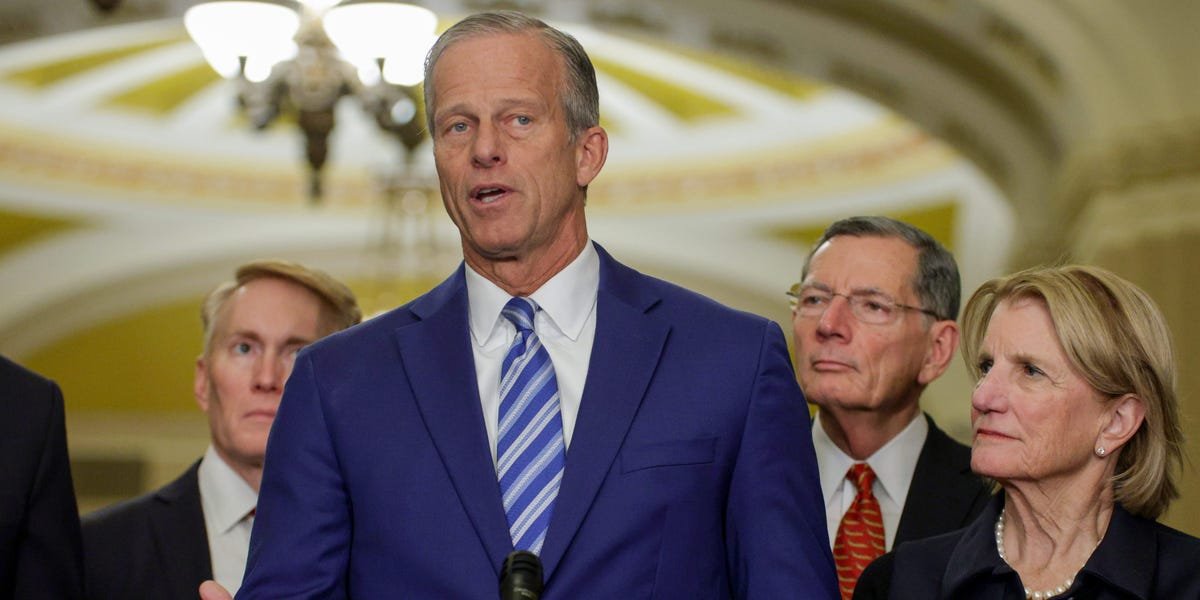
The Senate has moved forward with a deal to free up funding for the Department of Homeland Security, teeing up legislation for the House to end the shutdown.
On March 27, lawmakers voted to move forward without a filibuster on a proposal to end the partial shutdown by funding all of the department. The deal includes airport TSA workers, but excludes funding for immigration operations — a point that has been core to the dispute.
Next up will be a vote to officially pass the bill in the Senate, and then it will go to the House of Representatives before heading to President Donald Trump’s desk.
The partial shutdown began at midnight on February 14after lawmakers failed to reach an agreement on guardrails for immigration enforcement.
The shutdown has left essential workers at TSA, FEMA, and the Coast Guard without pay.
The deal came as travelers nationwide have experienced harrowing wait times at TSA checkpoints as TSA workers called out sick en masse or quit entirely. Delta Air Lines, citing the government shutdown, also suspended some specialty services for members of Congress as of March 24.
Ha Nguyen McNeill, the top TSA official, testified in Congress on March 25 that staffing shortages have led to the “highest wait times in TSA history” and that the agency has lost more than 480 officers since the shutdown began.
Lawmakers in the Senate were close to reaching a deal, which excludes funding for ICE’s enforcement and removal operations division, on March 25. The plan fell apart on the same day after it failed to clear an initial vote.
Trump also said on March 24 that he does not approve of any deal that does not include the SAVE America Act, a bill that would overhaul the federal elections system and is unrelated to DHS.
“I think any deal they make, I’m pretty much not happy with it,” Trump said.
This as-told-to essay is based on a conversation with Marc Bowker, owner of Alter Ego Comics, a comic book shop in Lima, Ohio, after the Supreme Court overturned some of President Donald Trump’s tariffs. This story has been edited for length a clarity.
My first reaction to the Supreme Court decision was, “This is awesome and long overdue.” The second was, “Okay, what’s next?”
Then I saw the president say there would now be a new 10% global tariff and that the Supreme Court justices who ruled against him are unpatriotic and unloyal. So it feels like this is going to drag on forever and ever until he gets his way. It’s like death by a thousand paper cuts.
I think there are more questions remaining than answers. I appreciate the Supreme Court siding with Americans and American businesses, but it feels like it’s going to be a tug-of-war that may go on throughout this entire administration.
This administration has created a level of uncertainty in the small business landscape that I haven’t seen in 23 years of owning my store.
Every time Kelsey publishes a story, you’ll get an alert straight to your inbox!
Stay connected to Kelsey and get more of their work as it publishes.
In addition to being a small-business owner in America, I’m a consumer in America, so I’m paying more for everything that my family consumes, from food to physical products. It’s a one-two punch for us.
I’ve already paid thousands, and there’s still uncertainty
I’ve kept a spreadsheet of every shipment that had a tariff charge, and as of today, we’ve paid over $12,000 since Trump started all of this.
We’ve had to pass on a percentage of that to our customers, and as a result, we’ve seen a slowdown in orders. Some are taking a wait-and-see mentality, or they just don’t want to pay the extra fee.
Comics themselves — a lot of which are printed in Canada — have not been impacted by tariffs. But for me and for other comic book stores, action figures, board games, and comic book supplies, like storage items, are being impacted. Action figures account for about 65% of my shop’s revenue, and they are made in China.
A lot of these orders are made far in advance, too. We were being charged tariffs on items ordered in 2023 and 2024. There’s stuff I need to order next week that ships in June of 2027. Is the tariff going to be 6%? Is it going to be zero? Is it going to be 100%? I have no idea.
Marc Bowker and his family in front of his store.
Marc Bowker
It’s unclear if small businesses will get refunds or what will happen next
As for the tariff costs small businesses have already paid, are we getting that back? Probably not. Are the corporations that paid the bulk of the tariffs going to be reimbursed? Where does that come from? I feel like this is just going to cause more paperwork, more red tape, more headaches. I don’t know what the next step is.
If I could wave a magic wand, yes, there would be some reimbursement of the fees that all American businesses have had to pay. If I had to settle for something, it would be that, effective today, there are no more of these Trump tariffs.
It’s hard to be excited about the Supreme Court ruling when, within hours, the White House says it’s going to push back with more tariffs.
The administration is throwing so much at us every day that we can’t make any progress. It’s hard to see what the future will look like.
I would hate to see this stretch on the next three years of the administration. It’s going to take all this extra time that could be spent running our businesses and serving our customers, just trying to stop the government from getting its hands in our pockets.
It really feels like our elected officials are not listening to us. Historically, the Republican Party has been promoted as the party of business in the United States. If they truly were, they would be listening to constituents who are saying these tariffs are hurting our businesses.
This story is available exclusively to Business Insider
subscribers. Become an Insider
and start reading now. Have an account? .
We booked the least expensive suite on a Seabourn ultra-luxury cruise for about $9,000.
After crunching numbers and seeing high-end resort prices, this felt reasonable for a family trip.
We loved getting to see lots of new places and not worry about having to plan our meals.
I paid $9,000 for what was technically the cheapest room on an ultra-luxury cruise — a price that initially felt steep until I compared it with alternatives.
My family had been planning a multigenerational trip to the Caribbean during the busy period between Christmas and New Year’s Eve, which is also one of the most expensive travel weeks of the year.
We wanted something that felt indulgent without becoming logistically exhausting or financially disproportionate once all the extras were added up.
At first, we looked at high-end beach resorts, but they were commanding eye-watering rates. I saw a few in Barbados and St. Barts charging over $4,000 a night for a room, and that price doesn’t even include food, drinks, and gratuities.
The costs seemed like they could really add up. As we ran the numbers, an all-inclusive cruise began to make more sense.
Plus, we liked the idea of exploring Caribbean destinations we hadn’t visited before without having to deal with multiple hotel check-ins, flights, and transfers. A port-heavy itinerary could allow us to sample several places while unpacking just once.
So, our group settled on a 12-night Caribbean cruise aboard the Seabourn Ovation.
Our family booked two rooms and spent about $20,000 on the cruise.
Our group of five set sail on the Seabourn Ovation. David Morris
We traveled as a group of five: my mother, my brother and sister-in-law, their 7-year-old son, and me.
In total, we booked two entry-level suites — one for my mother and me, and another for my brother, sister-in-law, and their son — bringing the combined cruise fare to just over $20,000 for five people across 12 nights.
This figure includes accommodations, all meals, a selection of soft drinks and alcoholic beverages, and gratuities. We saved some money on my 7-year-old nephew’s fare thanks to the cruise line’s third-guest-at-half-price policy.
By booking through a preferred travel advisor, I also received $400 in onboard credit, plus an additional $250 referral credit (which my brother’s family also received).
Our cabin felt like part of a boutique hotel.
A wide shot of our suite’s interior on the Seabourn Ovation. David Morris
Our suite measured 302 square feet, plus a 68-square-foot balcony.
Its decor was pretty minimal, but it felt a bit elevated with accents of marble, dark wood, and glass.
Despite being the cheapest option on the ship, this room felt more like it was part of a boutique hotel than just a standard cruise cabin.
The walk-in closet was a pleasant surprise.
We could fit a lot of clothes in here. David Morris
The base-category suite felt thoughtfully laid out, with a seating area, a couch, a table, two beds, and a generously sized walk-in closet. Our clothes and bags easily fit inside with space to spare.
In the other suite, a sofa bed was set up as a dedicated sleeping space for my nephew.
The bathroom had dual sinks, a tub, and a compact but functional shower.
The bathroom felt spacious enough. David Morris
The bright-white bathroom featured dual vanities, a soaking tub, and a glass-enclosed shower. My only critique was the shower size, which felt slightly tight compared to ones in some newer ships we’ve sailed on.
Our room’s minibar was stocked exactly to our preferences.
Before sailing, we submitted drink preferences to the Seabourn crew. David Morris
We were delighted to find our room’s minibar stocked with complimentary ginger beer, juices, and the spirits we requested prior to our sailing.
Since all of our meals, standard beverages, and gratuities were included in the cost of the cruise fare, we didn’t have to budget or crunch numbers during our trip.
We had most of our dinners in the ship’s main dining room, which was so easy. It felt quite formal, and the rotating menus kept things interesting across the 12-night itinerary.
Passengers also had access to The Patio, a poolside eatery with laid-back fare, and The Colonnade, a more casual spot serving buffet breakfasts and lunches, plus seated themed dinners.
We also enjoyed our opportunities for specialty dining.
The food at Solis really impressed me. David Morris
Options for specialty dining included a sushi restaurant and a Mediterranean eatery called Solis, which was a standout for me.
The menu featured steak, lobster, and whole grilled fish deboned tableside. I particularly loved its post-dinner affogatos
Pools, hot tubs, and quieter outdoor spaces were easy to find.
The main deck was lit up at night. David Morris
The ship has a large main pool surrounded by lots of loungers, though we preferred the smaller hot tubs in other areas.
Quieter spots, like the hot tub at the bow with incredible views of the ocean, quickly became our favorites.
My favorite area on board was The Retreat.
The Retreat was one of the best places to get work done. David Morris
Located on the top sundeck, The Retreat was my favorite area on the ship.
The space offered shaded cabanas, a noticeably calmer atmosphere than the main pool deck, and attentive, unhurried service.
To access it, passengers had to pay an additional $150 per day on port days or $250 on sea days.
Booking it on sea days felt especially worthwhile. The quiet setting made it easy to relax or catch up on a bit of remote work on my laptop without feeling out of place.
Excursions cost extra, but they felt well-organized and fairly priced.
We embarked on some excursions at the ports. David Morris
We mostly booked excursions through the cruise line for peace of mind.
Our favorite was in Saint Lucia, where a packed day included a catamaran ride, volcano hike, mud bath, and snorkeling.
The excursion ran late, but the ship waited for us as it had been booked through them.
Holiday surprises added to the experience.
We spent the holiday on a beach. David Morris
On Saint Kitts, the crew arranged a private Christmas Day beach party with grilled lobster and drinks. Later, Santa Claus arrived by Jet Ski to serve caviar and Champagne in the surf.
The cruise’s overall cost felt reasonable considering everything it included.
The cruise meant we could visit new places without planning out flights and hotels. David Morris
Ultimately, our cruise averaged out to about $333 per person, per night. That felt surprisingly fair considering how much was included in our 12-night trip.
We also really enjoyed the ship’s intimate size. Compared to other mega-ships carrying thousands of people, this 600-passenger vessel felt calm, navigable, and personal. We never felt overwhelmed by crowds, even on sea days.
Although children aren’t typically the target audience for ultra-luxury cruises, my nephew genuinely had a great time alongside the mostly older guests. His sailing also felt like a great value, considering he was charged half price as a third guest and still had his own proper bed.
For a multigenerational holiday trip that combined ease, variety, and consistent service, the value ultimately justified the price.
All in all, we enjoyed the trip enough to book another Seabourn voyage (at a discounted price) before disembarking.
This as-told-to essay is based on a conversation with Cheska Hull, 40, a British reality TV star and PR professional who relocated to Phuket. Her words have been edited for length and clarity.
My move to Phuket was about choosing a fabulous place to live while continuing my freelance career.
I feel like I’ve been part of the island’s community for years. I’d visit annually for a couple of weeks at a time, maintain friendships, and get to know local business owners.
Every trip had me dreaming about potential jobs and interesting opportunities. I’m a PR specialist who has always worked in the luxury sector, across food, beverage, and hospitality. In London, I specialized in private members’ clubs.
That work also led me into radio and television, where I starred in the reality show “Made in Chelsea” for nearly four years. It helped me understand the evolving world of influencers and celebrities. Having lived on both sides of the PR and fame spectrum, I gained a deep understanding of that industry.
Every time Andre publishes a story, you’ll get an alert straight to your inbox!
Stay connected to Andre and get more of their work as it publishes.
In May 2011, Hull was a member of the original cast of the reality show “Made in Chelsea.”
Provided by Cheska Hull
I happened to be born in Thailand
My parents lived in Phuket in the 1980s, when my dad was head of Standard Chartered Bank for Phuket, which is why I was born here. We moved back to England when I was young.
Being born in Thailand didn’t simplify moving back as an expat. I still had to go through all the same steps as everyone else.
Initially, I came on a DTV digital nomad visa while freelancing for my UK clients. I told all of them, “I want to live in Thailand. That’s my dream.”
I wanted the best of both worlds.
There were a few reasons for the move
I’ve always been drawn to the famous Thai “sabai sabai” — take-it-easy — lifestyle. But when it comes to business, I’m driven. I could never just move to Phuket and not work.
Even between projects, I was constantly networking, talking to people, and pushing for collaborations with brands I’d worked with before. Now, I get to do what I’ve always loved in a place I love.
My son was also at the right age for a big change. As a single mom, the stress came from knowing how significant the move was and wondering, “Have I made the right decision?” My main priority in life is his happiness.
If he hadn’t been happy, I don’t think we would have stayed. But he’s 8, and he was able to fit in quickly — learning some Thai at school and thriving.
There was another catalyst, too. At the time, I was engaged to be married and realized that wasn’t the path for me anymore. Once I called off the wedding, the door felt wide open.
Nothing was holding me back.
She says her 8-year-old son is learning Thai at school and has fit in quickly.
Provided by Cheska Hull
Finding my career groove in Thailand
Browsing jobs in Phuket started as a guilty pleasure. Through meeting people and networking, someone told me about a new opening at Anantara, a hotel I already knew well. It seemed perfect. And so now, as cluster director of public relations, I have a work permit.
I’ve had to quickly learn Thai workplace customs, like addressing colleagues respectfully using “khun” before names or navigating the widespread use of nicknames. It’s about understanding a different culture and being respectful within it.
One of my favorite rituals happens every Friday during my team’s morning meeting. We go outside to a huge tree in front of the hotel with two spirit houses. We all take incense, make a prayer, and privately speak to the spirits. It’s so different and unique, I find it special.
It’s a meaningful part of their culture that I’ve come to love. I can’t imagine trying to get everyone in London to do that, they’d laugh.
She plans to stay in Phuket.
Provided by Cheska Hull
Thailand is my long-term plan
There haven’t been many hard parts to settling in. The main challenge of living on a small, seasonal island like Phuket is traffic. You get used to a calm pace, and then suddenly there’s a massive influx of people. But that comes with the territory in hospitality and tourism, which is ultimately what we want here.
My move to Thailand is long-term. Looking back, there was an element of risk. I came with a bit of an “Eat, Pray, Love” vision. I knew I loved it here and wanted it to work, but I also told myself, “If it doesn’t, you can just go back.”
For me, the quality of life, the people, the food, the weather — just about everything about Phuket — makes it a place I want to call home forever. Island life simply couldn’t be better right now.
Do you have a story to share about living abroad? Contact the editor at akarplus@businessinsider.com.
When I first found out I was pregnant, I frankly didn’t put much thought into long-term childcare plans. Living in New York City, my husband and I knew we wouldn’t have the traditional village available to us — my parents, while local and thrilled to get a first grandchild, are older and weren’t particularly eager to volunteer for solo babysitting, while his parents live thousands of miles away.
But we were in a uniquely lucky situation: We both happened to have flexible, largely remote jobs.
For the first few months of my surprisingly generous parental leave, my husband and I, cocooned in newborn bliss (and perhaps slightly delirious from sleep deprivation), didn’t stress about what would happen when I went back to work. I figured we could make it work through a combination of creative time management and strategically scheduled naps — at least until our daughter was eligible for 3-K, free schooling available in New York City for kids the year they turn 3.
My husband became the primary parent
Surprisingly, this plan ended up working, for the most part, and for just shy of a year, we managed a fairly even 50-50 split in parenting duties. As time went on and my own work ramped up and the baby potato turned into a sprinting toddler, it became clear that my husband would need to become the primary parent.
It wasn’t something either of us had considered before having a child, but it made the most sense: He found far greater fulfillment in being a father than he’d ever found in his career, whereas I had always defined myself by my work as a writer and editor. He kept his job but scaled back, working largely in the evenings and weekends so he could be free during the day for stay-at-home parenting.
As our daughter became a toddler, she blossomed under my husband’s full-time care, with constant adventuring and frequent playdates keeping her days busy. We didn’t need outside childcare — but as it turned out, she did.
I’d considered traditional childcare, but couldn’t stomach the cost
New York City has notoriously high childcare costs.
The author says traditional childcare was too expensive in New York City.
Courtesy of Michael Matassa
In the interim between our delicate balancing act and deciding my husband would drastically scale down his work, I considered a number of different options, from traditional daycares (upward of $2,500 a month in my neighborhood for full-time programs) to nanny-share arrangements with other local families (maybe slightly cheaper, but a pain to coordinate).
We were lucky in that we were able to avoid childcare costs, which would have effectively canceled out one of our salaries, though I still toyed with the idea of enrolling her somewhere part time to get her used to the idea in case our situation changed.
Enter Barnard College’s Center for Toddler Development.
I first heard about the program in a local moms’ book club I’d joined. One of our first reads was “How Toddlers Thrive” by Tovah P. Klein, a prominent child psychologist — and incidentally the then-director of the Toddler Center. Another mom in the book club with a daughter two years older than mine mentioned she was now applying.
I was frankly flabbergasted when she explained the details. It’s part research program, where the toddlers are minded by teachers and selected students from the college’s graduate program and observed for published research purposes from behind a one-way mirror, and part “school,” albeit an extremely part-time one, with each “class” of toddlers meeting only twice a week for two hours each day for the duration of the school year.
I was intrigued by the program’s unique “gentle separation period” and its said mission to help toddlers have a positive first school experience while supporting healthy social and emotional development through hands-on, child-guided play.
At that point, my daughter was only 18 months old (the halfway point to our 3-K end goal), but I’d already started to suspect that separation might be an eventual issue. With two working-from-home parents, she was used to having us around constantly — and had never had a babysitter.
The few times we’d tried to step out to grab a coffee and handed her to a grandparent, she would shriek like she was being abandoned. Over the next several months, she also grew more shy, coinciding with her stranger danger peaking.
We paid $7,500 for our 2-year-old
Convinced our future would be filled with school refusals and drop-off meltdowns, I hardcore pitched the Toddler Center to my husband for the coming school year. We didn’t need it for childcare, but I became convinced we did need it to help give our daughter the gentlest, most gradual introduction to being away from us. He was less convinced, sure she would grow out of it and be OK with separating by 3-K, but agreed in the end.
If the program details were mind-boggling, the price point was eye-watering. Though there isn’t a set, publicly announced tuition rate, the Toddler Center offers sliding-scale tuition and payment plans to make the program accessible to a broader range of the population. According to its website, a third of Toddler Center families pay tuition on a sliding scale (I assume the higher-profile alum parents like Amy Schumer, Sarah Jessica Parker, and Robert De Niro paid full sticker price for their kids to attend).
After submitting a sliding-scale tuition application, which required forking over the previous year’s tax returns to prove we were indeed not flush with cash, we landed on $7,500 as the final figure for our almost 2-year-old to take her first baby steps toward school.
At first, it was torturous
It did not go well.
The author says at first, her daughter wasn’t comfortable with either of her parents leaving.
Courtesy of Michael Matassa
The first few weeks of the program allowed the parents in the classroom, gradually moving us farther from it (a separate, no-toys-allowed room in the back, meant to be unappealing to the kids) to encourage the toddlers to ignore them and play in the main classroom area. That trick didn’t work on our daughter, who simply sat next to the chair of whichever of us had taken her in that day, chattering happily as we tried to gently encourage her to go away.
As I’d dreaded, the initial actual separation — when parents would bring their kids into the classroom and tell them they were leaving — was horrendous. The Toddler Center mandated that only one parent or caregiver drop off their child each morning.
For the first few weeks after separation, we could both sit in the observation room, where we were treated to a front-row show of our daughter sobbing hysterically and trying to reason with the grad students to open the door she was convinced we were right behind. It was excruciating, and plenty of tears were shed on our end as well.
There was virtually no improvement for months, which was far longer than I expected. And I felt an immense amount of guilt for having come up with this idea in the first place: Were we actually traumatizing her instead of helping her? Had I epically miscalculated this? Did I pay $7,500 to torture my toddler and myself?
I was wracked with doubt, and we debated withdrawing her from the program before the first semester had even finished. It was particularly hard on my husband, who, as the primary parent, was typically the one dropping her off and dealing with the meltdowns — and who also really missed her on school days.
Suddenly, though, and for no particular reason at all, it got better. A lot better.
Instead of sobbing by the door for a full hour and a half, she started interacting with the other kids. She found a favorite grad student she’d attach herself to. She played happily on the classroom slide. And eventually, she comforted the other toddlers during their hard separation days, assuring them their mommies or daddies would be back.
The Toddler Center was expensive, but extremely worth it for us
While it was difficult for my husband to be apart from his little buddy for the few hours a week she was at the program, they turned it into an opportunity for new adventures. In the spring semester, he began biking with her to school, stopping to pick up flowers on the way there and back. Another tradition became that he would bring her a blueberry muffin from a local café every day at pickup. These small rituals helped them bond even more.
The author says the $7,500 she spent was worth it.
Courtesy of Michael Matassa
I don’t pretend to have a handle on the intricacies of toddler psychology, and I can’t tell you what the flipped-switch moment was where it finally clicked for my kid that being left at school with her teachers didn’t mean we were gone forever. And yes, for the record, she still cried during drop-off the first few weeks of 3-K.
But I am convinced that completing the Toddler Center program drastically reduced her adjustment period for “real school.” Tossing her into the deep end for six hours a day, five days a week, was simply not the right option for our family.
In the end, I’m glad I listened to my gut, dug into our pockets, and toughed out the tears — and I’d like to think my daughter, somewhere deep down in her toddler brain, is too.
This as-told-to essay is based on a conversation with Kristen Boelen, the founder of Lunch Break Vintage. It has been edited for length and clarity.
I have been thrifting since the moment I could drive. Back then, I was into higher-end things that were out of my budget, and I’d go thrift shopping to find similar items that I could afford. That habit carried on through college and beyond, including when I was most recently working as an art director for a wine and spirits company. While working there, I’d thrift on my lunch breaks.
I’d find stuff for myself, as well as one-of-a-kind items that didn’t fit. I wanted someone to take that stuff. So I began selling items on Whatnot.
I’d thrift on my lunch break from work, and then on the weekends I’d go live and sell my pieces. My business grew from there, and I named it Lunch Break Vintage, which I began full time in February 2025.
I scored a luxury designer bag during a recent shopping trip
In December 2025, I was at a thrift store in the San Francisco Bay Area. It was a normal Wednesday, which is the day this particular thrift store opens for the week, and when I always try to go. It was very empty that day.
Kristen Boelen thrifts three times a week every week.
Courtesy of Kristen Boelen
Two woven leather bags caught my eye. You see woven leather bags all the time. There are so many Bottega Veneta dupes. I didn’t really think much about it, just that one of them looked exceptionally nice.
I first noticed the hardware, then the leather slouching and hanging. I could tell it was soft leather. When I picked it up, it was heavy — designer leather bags have a weight to them because of the hardware. I opened it up and saw the logo. You can see in the video that I posted that’s the moment my jaw drops. The leather inside was really soft and buttery too; that’s always a sign a bag is legitimate.
I know they sort through and send a lot of the higher-end pieces to an online audience. It seemed unrealistic that someone wouldn’t have set it aside. I thought, if they had put it out there, it must not be real.
I used technology to help confirm my suspicions
I took a photo of it and put it into Google Lens, and found on Vestaire Collective there was the exact same bag and color. That clued me into the style name and that it had been retired. There’s a video of me going, “Oh my God, oh my God, oh my God,” once I figured out where the serial tag was. I got out of there as quickly as possible, paying $8 for the bag.
Kristen Boelen found a $3,000 purse for $8.
Courtesy of Kristen Boelen
I later had it authenticated through an app I use called Authentic Detective. It will give you a certificate of authenticity. Online research says the bag is valued at around $3,000.
I’m keeping the bag for myself. It’s something that will be passed down for generations. I had so many comments on the video saying that the bag was ugly, but I love it.
Scoring finds at the thrift store takes a little skill — and luck
I thrift all the time because I now do this for a living, but I think consistency is key. I thrift at least three times a week, every week. It’s also important not to just pick up what is trending. A good secondhand item has to check all the boxes for me, and I really care about quality, always looking for natural fibers. I focus on what makes people feel elevated and the kinds of secondhand pieces they can keep in their closets forever.
Don’t believe that middle-of-nowhere places are garbage. Some of my best, coolest, most unique pieces have come from middle-of-nowhere stores.
A favorite tool of President Donald Trump has been costing Americans, according to new study.
The brunt of US tariffs — 96% — have been paid by US buyers, research from the Kiel Institute for the World Economy, a German think tank, found, while about 4% of the tariff burden was paid by foreign exporters.
“American importers and consumers bear nearly all the cost,” the researchers said of the tariffs.
The study, published Monday, said that the $200 billion increase in customs revenue that the US government raised in 2025 was a “tax paid almost entirely by Americans.”
The research contradicts Trump’s messaging that tariff costs would not be paid by Americans, but by other countries and overseas exporters. The president’s aggressive tariff policy launched last year placed additional duties on dozens of trade partners, including China, India, and the European Union.
Every time Kelsey publishes a story, you’ll get an alert straight to your inbox!
Stay connected to Kelsey and get more of their work as it publishes.
The Kiel Institute study examined more than 25 million shipment records, worth nearly $4 trillion, between January 2024 and November 2025. The researchers found that there was a “near-complete pass-through” of the tariffs.
“US import prices rise nearly one-for-one with tariffs, while trade volumes contract,” the study said.
The findings echo other research that has found Americans are paying for tariffs, including from Harvard Business School and The Budget Lab at Yale. Analysts at Deutsche Bank and Bank of America also said last year that Americans were the ones paying for the tariffs.
The Kiel study said American importers and wholesalers are first hit by the tariff cost, followed by manufacturers and retailers, all of which must choose whether to absorb the tariff or pass it on to their customers. American consumers are then hit by increased prices, both on imported goods or American-made products that use foreign inputs. There’s been more limited availability of goods in the US, the researchers found.
Trump has continued to use tariffs, saying on Saturday that he would impose additional tariffs on Denmark and other European countries unless they agree to a deal that would transfer Greenland to the US.
Many of Trump’s tariff policies could also be undone. The Supreme Court is expected to rule soon on the legality of a host of Trump’s tariffs that were instituted under an emergency national security law. Trump has said the US would be “screwed” if the tariffs are overturned.
At 25 years old, Molly Graham was thriving in Facebook’s HR department when a senior executive urged her to transfer out of her stable role and help build a mobile phone instead.
She took the risk — and it could have derailed her career.
But Graham, who later became a C-suite executive at some of America’s biggest companies and philanthropies, now views that risky bet as one of the most important moves she ever made.
“It just felt like falling off a cliff,” Graham, now the founder of Glue Club, said in a recent interview on Lenny Rachitsky’s podcast. “Taking risks, accepting the terrible fall and that experience of falling has been more than worth it.”
Graham described the experience as part of what she calls the “J-curve” — a career trajectory where a risky move leads to an initial drop before eventually producing outsized gains. Visually, she describes it as standing on a ledge, stepping off, sinking briefly, and then rising far higher than where you started — just like the shape of the letter J.
The concept, which she has also written about in her Lessons Substack, challenges the idea of a steady career ladder that steadily moves up and to the right.
Instead of climbing rung by rung with promotions every two to five years, Graham argues that some of the most valuable professional growth comes from jumping into roles you aren’t ready for and surviving any setbacks.
Graham’s own J-curve began when billionaire investor and “All-in” podcast host Chamath Palihapitiya, then Facebook’s vice president of growth, recruited her to help develop a smartphone, encouraging her to make the move by sketching out the J-shaped trajectory on a whiteboard.
He brought her on despite her having no experience in product development, dropping her into rooms filled with engineers and phone specialists with deep subject matter expertise. She recalled feeling like an “idiot” for much of her first six months.
Molly Graham, the former Facebook and Google executive and writer of the Lessons Substack.
Molly Graham
At her midyear review, Palihapitiya delivered what Graham called the worst performance evaluation she had ever received. But the new experience eventually expanded her expertise.
“Slowly, I remember I had been doing all these trips to Taiwan because we were actually working on hardware and I, at some point, came back from Taiwan and I like drew on a whiteboard for him the layout of a mobile phone, trying to explain to him kind of like why something he wanted to do was not possible,” Graham said. “And I so vividly remember walking out of that meeting being like, ‘Oh like I actually know things.’ And slowly then over the following three years I became an expert in mobile.”
Palihapitiya did not respond to Business Insider’s request for comment.
“The phone itself was a giant failure — a massive, costly failure for Facebook,” Graham told Rachitsky on the podcast. “But it was not a failure for me.”
She credits the experience with teaching her that she could operate far outside her comfort zone — a lesson that later helped her take on senior leadership roles, including serving as COO of Quip, which Salesforce acquired for $750 million, and overseeing operations at the $7.4 billion Chan Zuckerberg Initiative.
The J-curve, Graham said, is especially common at fast-moving companies like Meta, Alphabet, Nvidia, and SpaceX, where leaders value employees who are willing to take big risks early and learn quickly. In those environments, proving adaptability can matter more than checking every qualification box.
Not everyone supported Graham’s decision at the time. She said Facebook COO Sheryl Sandberg, then the number two at the tech giant, advised against the move — as did her father.
“When wiser, more experienced people questioned the job offer, it definitely made me pause,” Graham told Business Insider in a follow-up email. “But my gut felt really strongly that I needed to take the risk.”
That instinct, she said, ultimately helped her discover what kind of work she didn’t want to do, and where her strengths lay. She didn’t want to sift through mock ups of hardware design and argue about a button’s placement. Instead, she sharpened her management skills and prepared to help lead large organizations.
“The much more fun careers are like jumping off cliffs,” Graham told Rachitsky. “They can take you to places that you never could have imagined.”
When I bought my Volvo XC90 in 2017, I was thrilled to get a safe, third-row vehicle. With three kids between the ages of 3 and 8, the extra space meant fewer fights and more room, and reassured me that the car’s safety features would help me drive through snowy roads and city traffic.
Almost a decade later, that same Volvo has over 112,000 miles on it. I still remember when my family and I sat on the front porch, excited, as we watched the car get delivered from the truck.
The author’s family was excited to see their car be delivered.
Courtesy of the author
These days, my kids have been asking me when I’m going to get a new car, and my answer remains the same — I love my car and I’m going to keep driving it.
The car is still reliable — and I trust it
Aside from regular maintenance and tire changes, the car has been reliable. Before the warranty expired, we purchased an extended warranty on the vehicle. Now that the extended warranty has expired due to mileage, I am still in awe at how reliable the car has remained.
Years ago, we appreciated that the trunk could hold the double stroller, and that the built-in booster seat allowed us to drive car pools with small children. These days, we appreciate the third-row flexibility that allows us to fit our skis, snowboards, soccer gear, backpacks, and all the other essentials my kids need.
I spend a lot of time in the car driving people around, and I am thankful for a car I can rely on.
The author spends a lot of time in her car and finds it reliable.
Courtesy of the author
My mom used to say that the best car is one that reliably gets you from point A to point B. I still agree with this statement.
I appreciate the small safety features that I now take for granted. From the computer technology to the warning lights on the mirrors and back-up cameras, the car has helped keep my family safe on numerous occasions and helped me avoid some near accidents.
The car is part of our family. We have taken it on adventures to national parks, ski resorts in the Rockies, and even to an alligator farm. The vehicle has had its share of muddy shoes, candy wrappers, and dog hair. It also has dings from when I backed the car into the garage.
The economics don’t make sense for a new car right now
When my car is in the garage, the dealer provides me with a loaner car — a brand-new version of my current vehicle. I get tempted and think about how nice it would be to get a new car. The latest vehicles have more power, fewer scratches, are cleaner, and have that new-car smell.
I’ve crunched the numbers. After years of car payments, my car is now paid off. Every month that goes by without a car payment means more money toward saving for the future. More money for food, utilities, saving for college, and the occasional splurge. Saving money now means more financial freedom for tomorrow.
Buying a new car is expensive. Borrowing money for car payments these days costs more than it did in the past. Even yearly vehicle registration costs less for an older car.
Part of me feels proud to keep driving my older car
We live in a world that tells us that newer is better, that we should want more. Although external validation of a new car is nice, I am focusing on the internal satisfaction that comes from knowing I am saving money by driving an older car.
My car may not turn heads in the school pick-up line, but I view the scratches and door dings much like wrinkles- a sign of a good life.
I will continue to drive my older car, and I am thankful for a safe and reliable vehicle that has served my family well.