
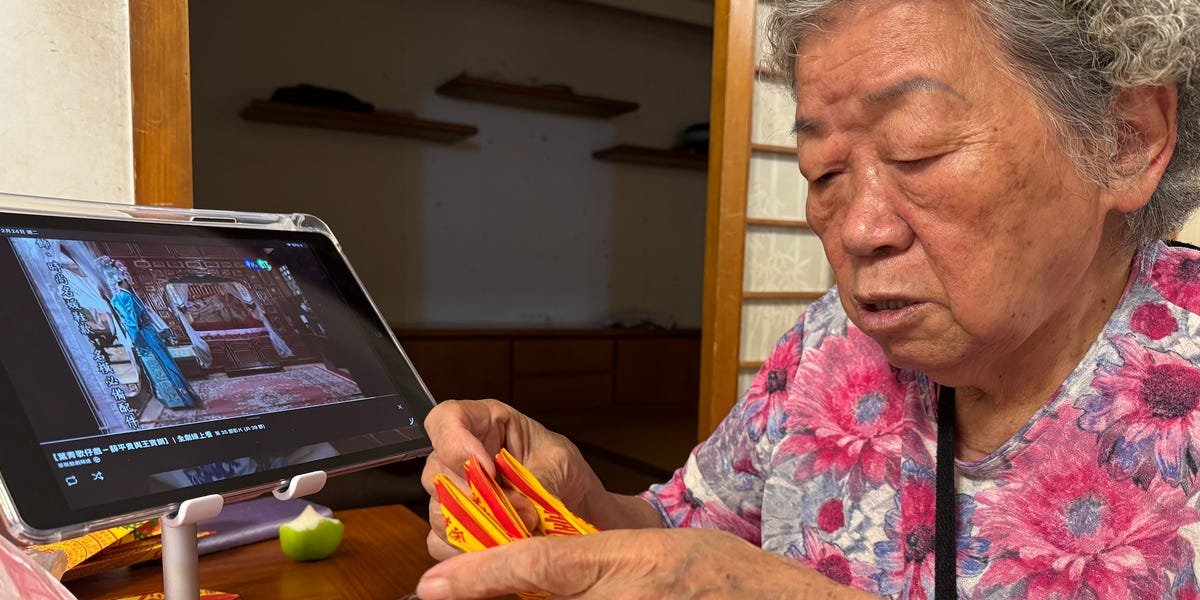
We-gave-my-grandma-an-iPhone-when-she-was-80.jpeg

We gave my grandma an iPhone when she was 80. I learned a lot about her from what she started watching on YouTube.

On the day my Taiwanese grandma A-Ma turned 80, she complained about a lingering dizziness.

When she got up from the floor mat, she fainted. Though the blackout lasted only two seconds and the doctor ruled the trigger to be temporary low blood pressure, my aunt was worried enough to dust off an old iPhone in case of an emergency.

Being illiterate, it took my grandma a full week to master punching in the four-digit passcode. I was worried during my entire visit home in Taiwan.

My cousin helped her figure out her phone

Everything changed when my 6-year-old cousin came home from kindergarten with a new obsession with Minecraft videos. Not having a phone to his name, A-ma became my cousin’s easy target. He downloaded YouTube onto her phone. A thread of over-the-top romance videos popped up on my grandma’s feed. She clicked on one after another.


Grandma and little boy

The author’s grandma learned about YouTube through the author’s cousin. 

Courtesy of TING WANG


Turns out, my grandma’s taste in entertainment was 30-second dramatic YouTube Shorts with ridiculous premises filmed on a low production budget: a housekeeper starved by her boss, who eventually fell in love with her. A college senior slept with dad’s best friend, who has a BDSM lair. A high school girl endured bullying, then revealed she is an heir to a kingdom. Everything that made me cringe made her giggle.

Then the effects of her phone permeated into real life. The family store she started with my grandpa in 1975 began seeing her less. Instead of stocking the shelves with my aunt in the morning, she opted for a long breakfast: two boiled eggs dipped in soy sauce with an endless side of YouTube Shorts.

The situation briefly looked up when A-ma’s friend, who ran a sticky rice shop, stopped by the store with some fresh gossip. The friend brought hot-off-the-press news about a local’s son and daughter. My grandma played the attentive listener, given that she did not have the skills to scour the market for scandals. Yet, not even 20 minutes in, I noticed A-ma started glancing at her phone. No longer a top-tier audience, the friend retreated to the sticky rice shop, defeated.

I noticed she was paying less attention

As a writer in New York who used my phone sparingly, I flew back to Taipei every three months to see family. Each time, I noticed her attention span suffered more than the last.

Her dining table was once the place I brought her behind-the-scenes anecdotes of working in a New York City ad agency, but not anymore. Last time we ate together, her eyes were glued to her screen. I sighed and threw my finished plates into the sink. She glanced at me, then back to her original program, completely mesmerized by the content.

Instead of being angry, I caught a glimpse of A-ma blushing from the corner of my eye. Like a girl reading a coming-of-age story, her cheeks flushed pink. Then she turned the screen toward me, relaying the plot of a cringey romance. Her smile stretched up to her eyes.

I finally understood her

That was when I realized it was not YouTube Shorts with horrible storylines she was watching. It was a window into what young adulthood could’ve been like if she were given the chance to be a normal girl.

As my mother told me, A-ma grew up in a war-torn time in Taiwan, where her childhood consisted of running into bunkers during air-raid drills. By 15, she was at the fishing port helping her family haul fresh catches into the local market. Years later, her parents arranged for her to marry the neighborhood boy. Then, together, they had six kids. They took a leap of faith, left the village, and set up shop in Taipei City, selling handmade beef jerky and pork floss.

Never having the chance to go to school, dress up for a party, or sneak out at night to steal a kiss from a cute boy — she didn’t get to live, not like a young girl. Before anyone or herself knew, she became an adult.

I realized, 65 years later, after a brief health scare, A-ma got this iPhone that served as a portal into a world she never had access to. Filling a void she didn’t know existed.

Last time I visited, I showed her how dictation works. With her callused thumb, she hit the microphone button and uttered: “Young. Stories.”

However, her accent, thick with a dialect, was too much for Siri to understand. For the first time, I felt like I did.


Source link

Trump-says-US-has-started-major-combat-operations-against-Iran.jpeg

Trump says US has started ‘major combat operations’ against Iran as strikes hit Tehran

President Donald Trump announced early Saturday that the US had begun “major combat operations in Iran.”

“Our objective is to defend the American people by eliminating imminent threats from the Iranian regime, a vicious group of very hard, terrible people,” he said in a video statement posted on Truth Social.

The US and Israel carried out airstrikes against Iran on Saturday, following months of tensions between Tehran and Washington.

The Israeli government first announced the airstrikes, which were carried out in broad daylight, as “preemptive.”

“The government of Israel has carried out a preemptive strike against the Islamic Republic to eliminate threats against the country of Israel,” Israeli Defense Minister Israel Katz said in a statement carried by government channels.

“As a result, a missile and drone attack against Israel and its civilian population is expected in the near future,” he added.

A US official confirmed to Business Insider that American forces were involved, adding that the strikes were ongoing.

Footage circulating on social media appeared to show explosions and plumes of smoke in Iran.

The attack marks the second time that the Trump administration has taken military action against Iran. In June 2025, the US bombed the country’s nuclear facilities as part of Operation Midnight Hammer, and Trump said at the time these had “obliterated” Iran’s nuclear sites.

This new round of strikes comes on the heels of negotiations between the US and Iran, part of the Trump administration’s efforts to pressure Tehran into a deal that would severely limit its nuclear and military capabilities. It also follows the withdrawal of Western diplomats from several Middle East countries.

In recent weeks, as Trump has issued repeated threats and warnings to Iran, pushing it to make a deal, the US has built up a large military footprint in the Middle East and nearby European waters.

The Pentagon has surged hundreds of fighter jets, aerial refueling tankers, reconnaissance planes, support aircraft, and warships into the region.

One complicating factor has been public resistance from US allies to operations against Iran. The UK barred the US from using its nearby bases, and Jordan said its bases couldn’t be used for attacks on Iran, despite imagery showing the US has shifted cargo planes and F-35 stealth fighters to one of its bases.

The significant US naval presence on station or taking up position in the area includes at least two aircraft carriers, more than a dozen guided-missile destroyers, and three littoral combat ships, which are designed for near-shore operations.

The two aircraft carriers — USS Abraham Lincoln and USS Gerald R. Ford — are each equipped with dozens of embarked fighters, electronic attack jets, early warning planes, and helicopters. The Lincoln’s air wing includes F-35 stealth fighters.

On Friday, a day after the Trump administration’s negotiations with Iranian officials in Geneva, White House official Dan Scavino posted a photograph on social media of eight B-2 Spirit stealth bombers on a runway, suggesting these aircraft could be used to strike Iran again.

This story is breaking. Please check back for updates.


Source link

I-started-drinking-when-I-was-14-When-I-finally.jpeg

I started drinking when I was 14. When I finally got sober, I lost 100 pounds and saved over $55,000.

This interview is based on a conversation with Emily Susman, 42, a chef and cookbook author from Tulsa, Oklahoma. It has been edited for length and clarity.

I don’t blame anyone else for my alcoholism — it was all on me — but I grew up in a family where beer, wine, and liquor were part of the culture.

I’m half Lebanese, and every holiday and other social occasion centered on eating and drinking.

At 14, my grandfather handed me a vodka and tonic and said, “This is the way to drink responsibly, surrounded by your family in the safety of home.”

I dealt with stress by reaching for the bottle

In college, I joined a sorority where we partied hard. During rush season, our older sisters presented us with bottles of hard liquor covered with ribbons.

I was never far away from alcohol, whether I was working for my uncle as a bartender or establishing my own successful restaurant and catering firm in Dallas in my thirties.

But the bad habits really set in after I sold the business and started working with my husband, Drake, 43, at his gas-and-oil brokerage. I was in charge of the books and dealt with the ongoing financial stress by reaching for the bottle.


A woman in a sombrero taking a shot of tequila.

Susman was an emotional drinker who spent an average $30 a day on alcohol.

Courtesy of Emily Susman.


It got to the point where I was getting through a large bottle of vodka every few days. I’d hide the evidence in the pantry because I didn’t want Drake to see how often it was happening.

I’d use any excuse to drink, whether it was to celebrate the good times or commiserate with myself when something went wrong.

The tell-tale signs were there. I was overweight from all the wasted calories and my habit of eating more when I was drunk. I’d experience crushing hangovers, get the shakes, and vomit the morning after.

My family started to get on my case. “This is a problem for you,” they would say. “You need to get your act together.” Every time, I’d make an excuse. I’ll tell them that I’d cut down after Thanksgiving or give up entirely on New Year’s Day.

I tried fad diets and didn’t exercise

Inevitably, I’d be back drinking by Blake’s birthday in the middle of January.

Things got even worse when the pandemic began in March 2020. I was often confined to the house and passed the time drinking. I disregarded the needs of my body by not exercising and trying fad diets that weren’t sustainable.

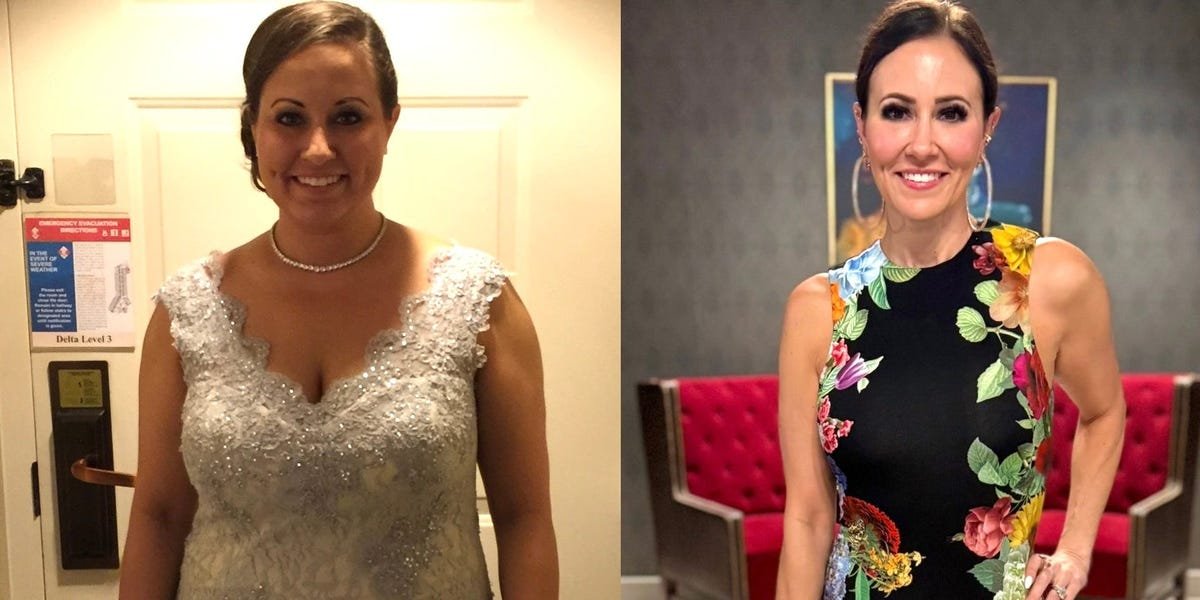
Then, a month into 2021, I awoke from a particularly bad episode and stared at myself in the mirror. At 5ft 8in, I was 230 pounds and a size 16. I bawled my eyes out because I was so miserable.


A before-and-after photograph of a woman who lost 100 pounds in weight

Susman before and after she quit drinking and lost almost half of her body weight.

Courtesy of Emily Susman


Something changed. I came downstairs and said to Blake, “I can’t do this anymore.” I sought therapy and had my last drink in early February.

I realized the all-or-nothing approach that fueled my alcoholism could be redirected to something positive.

It was a simple process without frills. I took pride in reaching each milestone: five days, then 30 days, then 120 days, and so on.

My weight-loss journey was slow and steady

Distractions made all the difference, whether I was using adult coloring books, painting with acrylics, or even sucking on lollipops when I craved sugar or the oral fixation of drinking.

Best of all, I reignited my love of cooking. I relied on my professional culinary background to make nutritious, balanced meals, which broke the cycle of binge-eating, restricting, and guilt.

My sensible diet, combined with simple exercises such as walking and strength training, helped me lose 100 pounds. I did it slowly and surely — losing around one pound a week — and now weigh 126 pounds.


A man and woman holding two dogs in front of the ocean.

Susman with her husband, Blake, and their Pomeranians, Bonnie and Clyde.

Courtesy of Emily Susman.


I’m a size zero to two and no longer hide my figure in baggy clothing. I’ve been sober for five years.

Another benefit is the amount of money I’ve saved. I found an app that took my average spending on alcohol of $30 a day to calculate that I’ve saved nearly $55,500 since 2021.

Meanwhile, I launched my company, Emma Claire’s Kitchen, the same year I got sober. It offers practical, tasty recipes and products, such as spices and, soon, mocktail powders.

I’m so grateful to my husband and my family

I’m a completely different person from the wreck I saw in the mirror that terrible morning. I love and value myself and am so grateful to Blake and the rest of my family for staying by my side.

It’s scary to think that I nearly lost everything — including my life — to alcohol. I’ll never go back to what passed as an existence, just getting through the day.

I have a bright future ahead of me now.


Source link

I-started-a-business-with-AI-and-no-tech-background.jpeg

I started a business with AI and no tech background. Here’s what it still can’t replace.

This as-told-to essay is based on a conversation with Tim Desoto, a 49-year-old founder and CEO, based in San Francisco. The following has been edited for length and clarity.

I’ve been working on my startup, an AI-powered shopping platform, since late 2024. With all the advancements in the tech industry, people might think of AI as a hammer, treating everything else as a nail, and in my experience, that just doesn’t work.

I don’t have a tech background, and since starting my business, I’ve learned a lot about where to leverage AI, and where not to. I’m always trying to be flexible about when to switch from AI to human intervention, and vice versa.

Over time, it’s become clearer to me where and where not to use AI for my business.

I rely on my network and social media to help me decide which AI tools to use

I’m fortunate to live in San Francisco. I go to meetups to hear what people are using, and I’ve attended some developer conferences. My ears always perk up when I hear that a new tool or version of something is working for somebody else in my network.

Right now, there’s a strong focus on agentic workflows. OpenClaw generated buzz as an open-source autonomous agent project, and Moltbook amplified that attention by making agent-to-agent interaction visible in a social environment. Claude Cowork is also gaining traction, particularly among teams looking for enterprise-ready agent workflows with clearer guardrails.


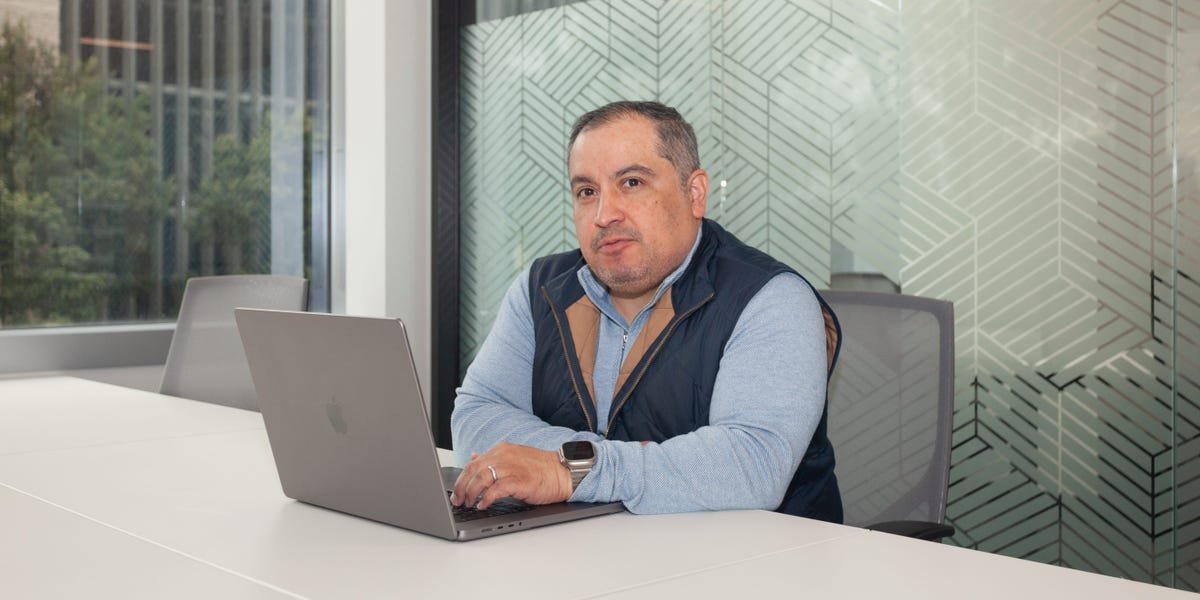
Tim Desoto

Desoto’s startup, Goodlife, is an AI-powered shopping platform.

Zachary Fineberg for BI


Beyond the agents themselves, the focus is moving from “what can agents do?” to “how do we run them reliably and securely at scale?”

Whether I’m looking at X, LinkedIn, or other platforms, there’s a lot of really great work being done to share these updates.

I use AI for all the typical time-saving tasks

My paid stack includes business plans for models such as Claude Max, Gemini Ultra, and ChatGPT Business, along with AI-powered development and productivity tools such as Cursor, Figma Make, Notion AI, Superhuman Ask AI, and Lovable.

Gemini’s image models have become incredible. The latest updates to the new model have really improved everything. I noticed faster performance, more stable reasoning, and stronger multimodal capabilities, especially in image generation. I was impressed by how consistent the images remained during modifications. I’ve even noticed some improvements in the responses it gives about real-time information.


Tim Desoto

Desoto uses AI models like ChatGPT and Gemini every day to help him run his business.

Zachary Fineberg for BI


I divvy up which tools I’m using based on where the latest developments are, and use them either as they’ve been designed or as I think I can use them in my current operational flow. For example, I use Lovable, an AI website builder, to make slide decks.

My ‘AI conveyor belt’ exercise helps me test different AI models

Usually, I start with a written prompt, then go multimodal, talking out loud to the model. I’ll talk back and forth with it about my idea and try to get the agent to push back because I know that some AI models tend to be more agreeable.

Once I get an output that I’m happy with, I use a different model to get a different view. For long-form analysis and structured insights, I lean toward Claude and Gemini. Gemini’s inline source linking is particularly useful for verification and deeper research. For structured reasoning and formal writing, I primarily use ChatGPT and Claude.

Sometimes, I’ll push a document out to multiple models at the same time and see what comes back simultaneously. For creative exploration and multimodal work, I use both Gemini and ChatGPT to generate early-stage concepts, mockups, and visual inputs. Some models are better than others at certain tasks, but I’m always getting a more well-rounded perspective by feeding content to multiple models.

The process can take as little as 15 minutes, or higher-impact decisions can span several hours to a couple of days, depending on complexity.

I eventually needed human developers


Tim Desoto

Desoto vibe coded the alpha of his product before bringing in developers to speed up production.

Zachary Fineberg for BI


When I was vibe coding the alpha version of my product, I would hit spots where 30 or 40% would be wrong. I didn’t know what exactly the problem was. I would have multiple screens running the code to figure it out, and I’d continue to use AI against AI until I could get to about 95% confidence.

I contracted a few developers to help move my product forward. Now I have a product developing at a faster, much more robust, and scalable rate.

As much as I can do with AI, it’s amazing what technical people can do with AI tools that a non-technical person can’t.

The human perspective is still irreplaceable in my business

I reached out to a lot of informal mentors and friends in the space who could be helpful early on in my process, but recently I formalized having advisors to bounce things off of. That has been a huge feather in my cap.

These advisors have their own expertise to draw on, and they know many smart people in this space working on projects that have helped us identify potential blind spots. It’s helped me connect with potential partners in ways that I think would be more difficult as a solo founder.


Tim Desoto

AI does a lot for Desoto, but it can’t replace human judgment.

Zachary Fineberg for BI


I feel like I have a clearer view now of what I can trust AI for, compared to what I thought at the beginning of my journey. While issues like hallucinations and agreeability can be mitigated, long-term strategic judgment and taste still require human oversight.

AI can generate possibilities, but choosing the right direction remains a human responsibility.

Do you have a story to share about running an AI-powered business? Contact this reporter, Agnes Applegate, at aapplegate@businessinsider.com.


Source link