Lloyd Lee

Anthropic’s lawyer says government is ‘pressuring’ companies to ditch the AI startup, go to competitors

Anthropic’s lawyer said the US government is “pressuring” the startup’s customers to go to rival AI providers amid an escalating fight between the Claude developer and the Department of Defense.

During a status conference on Tuesday, Michael Mongan, an attorney for Anthropic, said the Defense Department’s decision to effectively blacklist the startup from working with the US military is bringing “real and irreparable harm” to the company each day.

Mongan said customers have begun “expressing doubt” about working with Anthropic and that the government has been on a pressure campaign to get Anthropic’s customers to drop the provider and go to competing AI companies.

“We’ve had university systems and business-to-business companies that have switched to competing AI companies,” Mongan said. “And this is all the predictable result of the defendant’s actions and the uncertainty they’ve created, as well as the fact that defendants have been affirmatively reaching out to our customers and pressuring them to stop working with Anthropic and switch to other AI companies.”

Last month, after contract negotiations with the AI startup fell apart, Defense Secretary Pete Hegseth announced that Anthropic was a “supply chain risk” and framed the move as extending beyond direct military work.

“Effective immediately, no contractor, supplier, or partner that does business with the United States military may conduct any commercial activity with Anthropic,” Hegseth said in an X post on February 27.

The scope of the supply chain risk label is in dispute. Microsoft previously told Business Insider that its lawyers concluded the company can still use Anthropic for non-military-related work. The company also filed an amicus brief, urging the federal court to temporarily block the government’s supply chain risk designation.

The issue centers on Anthropic’s stance that its frontier model, Claude, cannot be deployed for autonomous weapons and mass surveillance of US citizens. Defense officials have said in response that a private company cannot dictate what the military can and cannot do.

Anthropic CEO Dario Amodei said in a blog post on February 26 that the company could not accede to the government’s demand for unrestricted, lawful use of its model. A day later, Hegseth formally designated Anthropic a supply chain risk.

Anthropic sued the government on Monday, seeking a temporary restraining order to continue doing business with the government as the case proceeds. The company said in the suit that the Defense Department did not provide adequate grounds to label it a national security risk.

In addition, the company said the designation has never been applied to an American company and that the move was retaliatory, violating the company’s First Amendment rights to express its views on AI safety and limitations.

The fallout from Anthropic’s blacklisting has been swift, according to legal filings.

Krishna Rao, Anthropic’s chief financial officer, said in a declaration filed on Monday that the DoD had contacted several “portfolio companies about their use of Claude” and that those clients have “grown worried and uncertain” about their ability to use the model.

The CFO said the government’s action could reduce Anthropic’s 2026 revenue by “multiple billions of dollars.”

Spokespeople for Anthropic and the Pentagon, as well as Anthropic’s lawyer, did not respond to a request for comment.

Source link

Yann-LeCuns-startup-has-a-new-CEO-—-and-1.jpeg

Yann LeCun’s startup has a new CEO — and $1 billion

Yann LeCun’s AI startup has raised more than $1 billion in seed funding and appointed a new CEO.

In a post on X on Tuesday, entrepreneur and former Facebook researcher Alex LeBrun said he is joining LeCun and the founding team of Advanced Machine Intelligence (AMI) Labs, also known as AMI Labs, as CEO.

“We have secured a $1.03 billion USD seed round to fuel our mission to build intelligent systems capable of truly understanding the real world—a long-term scientific endeavor,” LeBrun said.

AMI Labs said in an X post on Tuesday the round was co-led by Cathay Innovation, Greycroft, Hiro Capital, HV Capital, and Bezos Expeditions, alongside other investors.

The startup added it is building a team of researchers and engineers across Paris, New York, Montreal, and Singapore.

AI researcher and New York University computer science professor Saining Xie also said in a post on X on Tuesday that he has joined the founding team. Xie, who serves as cofounder and chief science officer, wrote that “AMI isn’t a conventional lab.”

“We don’t intend to become one,” he added.

AMI Labs is recruiting engineers, scientists, and researchers across its four global hubs, according to the company’s job postings.

LeCun revealed plans to launch the startup in November after departing Meta, where he spent 12 years leading its AI research efforts.

AMI Labs will focus on building world models, a type of AI system designed to better understand and reflect how the real world works. LeCun had said that the startup will be among the few frontier AI labs that are “neither Chinese nor American.”

Speaking at an event in Paris in December, LeCun said Meta would partner with the new venture, though it would not invest in the company.

“This new architecture is a project that Mark Zuckerberg really likes. He thinks maybe that’s the future,” LeCun said.

In an interview with MIT Technology Review published in January, the AI pioneer said he disagreed with some of the decisions made by Zuckerberg, including the shutdown of the robotics team inside FAIR.

LeCun also took aim at Alexandr Wang, the former CEO of Scale AI, after Wang briefly became his boss following Meta’s AI reorganization.

“There’s no experience with research or how you practice research, how you do it. Or what would be attractive or repulsive to a researcher,” LeCun said in an interview with the Financial Times in January.

“You don’t tell a researcher what to do,” LeCun said. “You certainly don’t tell a researcher like me what to do.”


Source link

The-AI-boom-is-minting-startup-multimillionaires-at-an-unprecedented.jpeg

The AI boom is minting startup multimillionaires at an unprecedented speed

One of the wildest stories in tech right now is what’s happening at Anthropic. New data from Levels.fyi shows how some employees at this AI startup have effectively become multimillionaires about a year after joining.

One engineer who started in late 2024 got 60,000 stock options at a $13 strike price, when Anthropic was valued around $18 billion. At the time, the equity penciled out to roughly $200,000 a year on paper.

Fast forward to a recent share sale valuing Anthropic near $350 billion. Even after estimated dilution and other factors, this employee probably owns about $4 million to $5 million in vested stock now. The full equity grant, which typically vests in quarters over four years, is likely worth about $18 million to $20 million, according to Levels.fyi estimates.

Other examples, based on real compensation packages submitted to Levels.fyi by Anthropic employees: A senior software engineer with about $1.6 million in vested stock after a year; a more senior staffer with roughly $8 million after 18 months; and a business operations leader with at least $9 million after two years.

Tax can take a big chunk of this value, especially if you live in California. Still, outcomes like this used to take five to 10 years and an IPO. In frontier AI, it’s happening a lot faster now — as long as you get hired by the right startup.

“The biggest variable in maximizing your compensation will almost always be the company you work at, even beating out things like your job title,” said Hakeem Shibly, a data guru from Levels.fyi.

Sign up for BI’s Tech Memo newsletter here. Reach out to me via email at abarr@businessinsider.com.


Source link

A-57-billion-AI-startup-wants-to-help-cut-government.jpeg

A $5.7 billion AI startup wants to help cut government benefit fraud. Experts aren’t so sure.

An AI startup in SF focused on identity verification has set a lofty goal: securing government contracts.

Daniel Yanisse, the CEO of Checkr, told Business Insider that the company wants to help the government reduce “fraud and waste” by not only screening new employees but also verifying people’s eligibility for benefits such as Medicare and Social Security.

Though Yanisse said the company isn’t ready to make any product announcement yet, he said a frictionless government assistance system may be just years away.

AI and safety experts, however, told Business Insider that there are legal and technical hurdles for any company to undertake the task of automating benefit and welfare systems with AI.

Checkr primarily uses AI to run background checks and surface information such as criminal records and motor vehicle reports. The company has major contracts with Uber and Lyft to screen new drivers, and is valued at more than $5.7 billion after raising $120 million in funding in 2022. In 2025, Checkr reported over $800 million in revenue and surpassed 120,000 customers.

When asked what Checkr wants to do for the government, Yanisse said that for Medicare and other programs, “there’s a lot of fraud happening and just bad actors getting the government dollars instead of the right people who need help,” adding that it’s very hard for the government to actually verify people’s employment status and income.

The Medicare Fee-for-Service program estimated that there were $28.83 billion in “improper payment” in 2025 at a rate of 6.55%, though not all such cases are the result of intentional fraud. Payments made to individuals who did not submit sufficient documentation and have unverified income levels are also considered improper by Medicaid.

“With AI, unfortunately, there’s going to be even more fraud, identity theft, and scams,” said Yanisse. “It’s a lot of friction, it’s a lot of repetition, and now there are also deepfakes.”

Checkr’s spokesperson told Business Insider that the company’s potential involvement in government is “still conceptual at this point.”

The company also pointed toward a study by Middesk, a business identity verification platform, that out of $1.09 trillion in Medicaid payments that went to around 1.6 million providers between 2018 and 2024, $563 million in payouts went to providers that are blacklisted from federal healthcare programs for criminal activity or misconduct.

Automating identity verification can be challenging

Stuart Russell, professor of computer science at UC Berkeley and an AI pioneer, told Business Insider that he is “not optimistic” that the plan to use AI to determine benefits eligibility will work as advertised.

“An AI system of this kind, some version of an LLM, is incapable of producing veridical explanations of its decisions, making it impossible to challenge false decisions,” Russell said.

Russell also cited the General Data Protection Regulation in the European Union, which bars decisions with significant legal effects on individuals from being made entirely by automated systems.

Baobao Zhang, the Maxwell Dean associate professor of the politics of AI at Syracuse University, told Business Insider that though she cannot assess exactly how good Checkr’s verification system is right now, past government attempts to mix people’s benefits with an automated system are cautionary tales.

“If the federal government or other state governments are trying to contract with a vendor to automate welfare fraud detection, they need to have a serious evaluation in the real world before they deploy it, because the stakes are high, as history has proven,” said Zhang.

In Indiana, an attempt to streamline and automate its welfare eligibility system by outsourcing a contract to IBM ended in a legal battle in which the state sued the company for $1.3 billion for the scrapped project in 2010. Based on court records, the Indiana Family and Social Services Administration said that processing errors from IBM led to faulty benefits denials that brought harm to the needy.

In Australia, an automated government plan called Robodebt, designed to detect fraud, told welfare recipients to repay benefits and sent letters claiming they owed thousands of dollars in debt, based on an incorrect algorithm. A royal commission, which is Australia’s highest form of public inquiry, found that at least three people died by suicide after being falsely told to pay back debt they don’t owe by Robodebt. The system was ruled illegal by a court in 2019.

Ifeoma Ajunwa, the founding director of the AI and the Future of Work Program at Emory University, told Business Insider that if any government agency is to adopt AI, there should be an advisory council made up of technologists and social scientists, and affected constituencies should be given a say.

“I think we need to move cautiously when delegating governmental functions to AI technologies,” said Ajunwa. “While these tools are touted to increase efficiency and lower costs, we also need to establish guardrails for their use to protect citizens.”


Source link

From-strangers-to-lovers-How-this-startup-is-simulating-the.jpeg

From strangers to lovers: How this startup is simulating the ‘meet-cute’ with AI

It’d be nice to meet someone the old-fashioned way: Passing by them on the street, meeting at a restaurant, or sharing an exchange at a party.

However, apps dominate the modern dating experience, replacing kismet meet-cutes with scrolling and DMs.

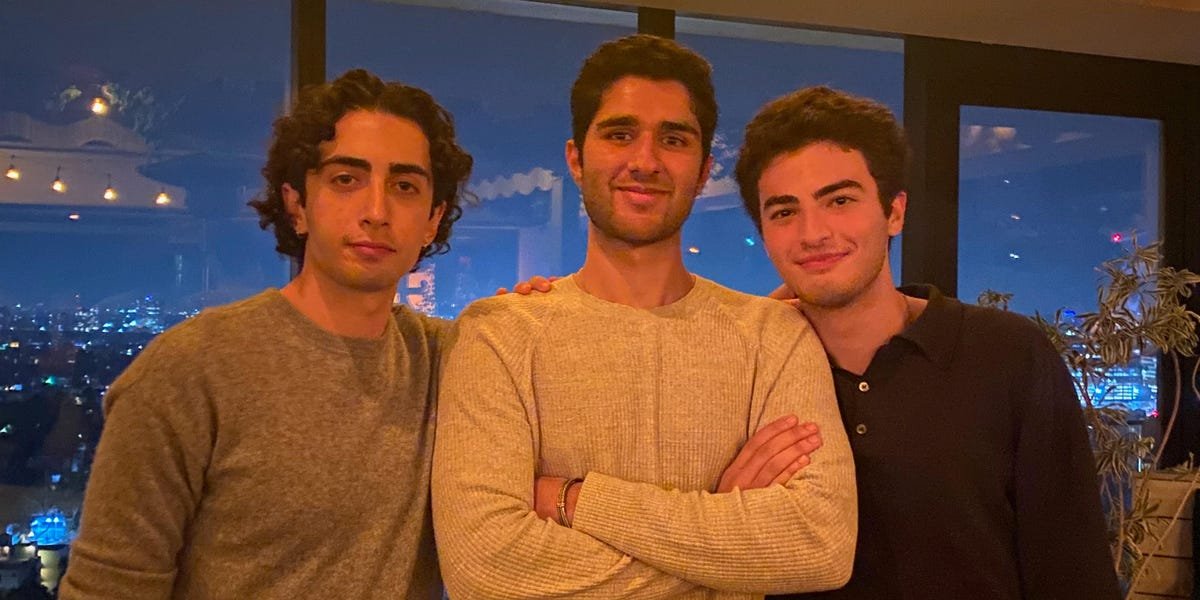
222, a startup focused on relationship building with the help of AI, thinks it can bring back the spontaneity of making a new friend — or falling in love.

“We’re trying to get as close as possible to you walking into someplace with other people there, and connection just naturally happens,” CEO Keyan Kazemian told Business Insider.

At a high level, 222 matches people with strangers for experiences like dinner or a night out after they take a robust personality quiz, using machine learning models trained by its team and open-source AI models.

“When you walk in, all of those people are people we predict you’re going to be able to have a good conversation with, and you’ll like,” COO Danial Hashemi said.


222 app description

222 launched its app in 2024 and has since added more features.

222/Screenshot/Apple


When 222 launched in 2021, it began as a dinner series in Los Angeles for young adults emerging from the COVID-19 pandemic, helping them meet new people. Then the project grew into a company. It was accepted into Y Combinator, raised capital, moved to New York City, and launched a mobile app to spur in-real-life (IRL) socializing.

While people who join 222 are often new to a city, Kazemian said, today they’re pretty evenly split along why they’re using the platform: they’re either looking for new friends or potential romantic connections.

Since putting out its app in 2024, the 222 experience has evolved. It’s no longer just about meeting strangers, having a fun night, and forming new relationships.

“We’re very focused on going beyond that,” Kazemian said.

The platform is now digging deeper into connecting people after the first encounter that 222 initiates. It’s helping plan follow-up hangs with friends and kindling a romantic connection by setting people up on a date if the feeling is mutual.

Simulating the meet-cute

After a 222 experience, the platform follows up to ask attendees whether they want to hang out or go on a date with anyone they met.

Once two people say they’d like to go on a date, “we fully set up the next date for them,” Hashemi said — reservation and all.

“If you think about just before dating apps, before all this stuff, how would people meet each other?” Hashemi said. “It would be you’re in the same physical space with no preconceived notions of who this person is going to be.”

Hashemi said that some of the “joy” of navigating how you feel about someone new in your life has “gone away because of dating apps.”

Meeting in a way that feels more organic, such as a social gathering or through friends, has staying power. A 2025 survey of 7,000 US adults by health company Hims found that 77% of Gen Z met their partners IRL. Even Partiful, the Gen Z replacement for Facebook Events, is getting in on the IRL event-to-dating pipeline.


222 ofice

At 222’s New York City office, they have a prop newspaper called “The Serendipity Times” on display.

Sydney Bradley/Business Insider


222 thinks AI can make the meet-cute more accessible.

What 222’s founding team has zeroed in on is “labeled data,” Kazemian said, which comes from its users’ feedback after they meet people.

The startup knows its first pairings may not be the ultimate match, which is why it encourages its subscribers — who pay $22 a month — to try multiple experiences. Its AI, in return, can curate better matches from 222’s network.

There are layers of factors that contribute to that, 222’s CTO Arman Roshannai said, such as similar music tastes or hometowns.

“The signal that we’re training on is after you meet this person, you spend two hours getting dinner with them, and then you hang out for a few hours afterwards, were you guys actually a good match for each other?” Roshannai added.

Kazemian added that training on this proprietary data from user feedback is a “painstakingly difficult and long process,” but gives the startup a “technical moat” to stand out from some competitors.

AI’s new role in relationships

222 isn’t the only startup — or public company — betting that AI can improve how we connect.

Several startups have launched with this premise and are raising millions, pitching matchmaking solutions that use AI to set people up. Meanwhile, Bumble, Tinder, and Facebook Dating are testing the AI waters and reimagining the swipe. Hinge’s founder recently left the Match Group-owned dating app to build an AI dating alternative.


222 office

The startup’s new office is in the buzzy NYC SoHo neighborhood.

Sydney Bradley/Business Insider


After raising another $10.1 million from venture capital investors in 2025 — bringing the startup’s total raised to $13.7 million — 222 is doubling down on hiring and expanding its product with tools that keep relationships going.

222’s next undertaking is to provide avenues for its users to reach their “next offline moment” together, so they can deepen those relationships.

The startup wants to be in the business of both creating relationships and maintaining them.

“They need to show up at the same place together,” Kazemian said, be it a hangout, a date, or a restaurant reservation. “We can help them figure out what that place is.”


Source link

I-worked-14-hour-days-at-a-startup-A-cancer-diagnosis.jpeg

I worked 14-hour days at a startup. A cancer diagnosis changed how I succeeded at Netflix and Meta.

This is an as-told-to essay based on a conversation with David Ronca, a retired video systems engineer. He spent 12 years at Netflix and six years at Meta. This story has been edited for length and clarity.

My time at a startup in the early years of my engineering career was like a really bad relationship.

I joined a company that specialized in video playback around 2000. I loved working on video. I consider those seven years like going to school, and I came out with a Ph.D. in practical video systems. But it was the hardest seven years I’ve ever had in terms of work demands.

I was told when I joined that it would be really important that you’re seen around here a lot. So I would work until 7, 8, 9 — sometimes until 10 p.m. Then we started hitting delivery schedules, and I was getting to work around 10 in the morning and going home sometimes at 2:30 in the morning. We’re talking 14-hours days, six to seven days a week. Eighty hours a week would’ve been a break.

We didn’t have good direction. We’d be four or five months into solving a hard problem before leadership would stop us and say, “Go work on this instead.” It was madness.

We were using work hours to compensate for really bad decisions.

In January 2004, I started feeling ill. On a Sunday, I didn’t feel so good, and by midweek, I got worse.

On Friday night, January 17, my wife took me to the emergency room. The doctor told me, “This is likely colon cancer.” After the first surgery, he said, “There’s no way you have a tumor like this and it’s not cancer.”

Two weeks earlier, I had been running and feeling great. Within a week, I was in a hospital bed on machines.

It took another week before doctors could do the full surgery. And you spend that time with no idea what they’re going to find. That was a very dark week.

My mother died of breast cancer when she was 48. I was 16. Now, I’m in the hospital at 44. I remember thinking, “History doesn’t repeat, but it rhymes.”

My wife would bring the three kids. My oldest, who was seven, would sit quietly in the room with me. My youngest was two years old. He didn’t really know me.

I was looking at my young son, thinking he’s going to grow up without a dad.

After surgery, they told me it was stage 3 colon cancer. They removed 60% of my colon. There was lymph node metastasis. My five-year survival prognosis was about 25%.

‘I will not work like this’

I went back to work part-time at first.

I was told that I had used up all my sick leave and vacation and was put on California disability, which is around $200 a week.

By that time, this was a company I had spent four years working 24/7 for.

I told my boss, “I’m sorry, I will not do this. I still want to work here, but if I have to leave, I will quit. Because I will not work like this.”

From that point on, I didn’t. And that was the irony of it all.

I feel like I did some of my best engineering after that. The real change was that I was no longer wasting my brainpower and my thinking on junk.

You don’t do good work after 12 hours. You can’t work sustained all-nighters and be productive. The quality of your work is going to suck. I don’t care who you are. For most mere mortals, you try to work those hours, you’re just not going to be doing good work.

I also started making intentional decisions for life, not just work.

I coached soccer for all three of my kids. I went to their games. My daughter did ballet, and we were there all the time. We started planning and taking family vacations — hiking in the mountains, RV road trips, and Maui.

I realized you have to work to have a life, but you have to have a life to work. So you want to stand in the middle of those things.

Hours worked are not a performance metric

In 2007, after several clean scans, I joined Netflix. I delayed accepting the offer until I got my scan report. I didn’t want to change jobs yet because if you have positive liver metastasis, you’d be lucky to get two years.

In my interview, Patty McCord, the chief talent officer at the time, told me, “We don’t value 24/7 work. You won’t be successful here working all the time.”

That was almost foreign to me. But it also didn’t mean we didn’t work hard.

At Netflix, I was part of the early streaming team — maybe 12 to 16 people. We made aggressive schedules, and we didn’t miss them. We launched a Netflix app on the original iPad on Day One within two months.

The culture at the company was: If you have to work 24/7 for us to be successful, you’ve got a problem, and we’ve got a problem, and we’re going to fix it.

Even at Meta, my favorite poster had a silhouette of a rocking horse that said, “Don’t mistake motion for progress.”

In other words, high performance is not measured by how much work you do. It’s measured by how impactful your results are.

This is not to say that it’s wrong to work more than eight hours. Instead, you should understand why you’re working more hours. It should be intentional. Intentional exceptions.

If I were to tell my younger self anything, it would be to make work-life balance part of your DNA. Learn to take time off.

Don’t wait until you have cancer or some other near-death experience to realize this.


Source link

Sales-reps-at-11-billion-AI-startup-ElevenLabs-have-to.jpeg

Sales reps at $11 billion AI startup ElevenLabs have to bring in 20 times their base salary, or they’re out — VP says

At $11 billion AI startup ElevenLabs, the message to sales reps is simple: Hit 20x your base salary, or you’re out.

Speaking on the 20VC podcast on Friday, Carles Reina, VP of sales at the voice-cloning startup, talked through its “ruthless” quotas.

“So if I pay you $100,000 a year, your quota is $2 million. That’s it. If you don’t achieve your quota, then you’re going to be out, right?” Reina said. “And we’re ruthless on that end.”

ElevenLabs — which was recently valued at $11 billion after closing a $500 million funding round — operates in micro-teams of five to ten people each, according to CEO and cofounder Mati Staniszewski, who spoke on a separate 20VC podcast episode in September.

Reina said he prefers to operate in smaller teams that hit their quotas, and pay them more.

Small teams have become a growing trend in tech, with AI startups touting their ability to scale with far fewer employees by working alongside AI agents.

LinkedIn cofounder Reid Hoffman wrote in January that a team of 15 people using AI can rival a team of 150 who aren’t.

Meanwhile, Mark Zuckerberg said on a Meta earnings call in July that he has “gotten a little bit more convinced around the ability for small, talent-dense teams to be the optimal configuration for driving frontier research.”

Reina said the “ruthless” quota has been successful at ElevenLabs, saying on the 20VC podcast that more than 80% of reps hit their sales quota.

ElevenLabs did not respond to a request for a comment.

He added that the firm compensates both the account executive and customer success manager if they upsell a company within the first 12 months.

“I’m paying double, but I don’t care,” Reina said. “It makes perfect sense because then I have these two people busting their ass to make sure that they actually can make more money, which is fantastic for me as a company.”

The push for higher performance isn’t limited to AI startups.

In April, Google said it was restructuring its compensation structure to increase rewards for top performers. “High performance is more important than ever,” Google’s head of compensation told staff at the time.


Source link

Katherine Li, West Coast breaking news reporter at the Business Insider.

An identity verification AI startup is having all employees try vibe coding

If you work for a San Francisco startup and don’t know how to code, you could soon be asked to get creative with vibe coding.

Checkr, an AI-powered background check company, gave Business Insider a glimpse of how employees are actually using AI.

Checkr CEO Daniel Yanisse said that the company is going “all in” and trying everything to encourage its employees to fully embrace AI — including staff that don’t work in engineering roles.

“We really pride ourselves on using AI to the maximum possible amount,” said Yanisse. “We gave every employee a monthly stipend to try AI tools, and we did AI days and demos. After one year, 95% of the employees use prompting daily.”

“This year, we’re going to level up and move to building with AI, as in vibe coding,” Yanisse added. “I’m working with all of our teams now, and we’re going to do our AI days soon in March, where we’re going to make every non-technical person vibe code their own business apps.”

Yanisse said that many employees who have no idea how to code, who work in finance, legal, and HR, are already vibecoding apps to automate their workflows and problem-solve, such as building tools that help clean up large spreadsheets.

While Checkr is evaluating a variety of builder tools like Lovable, Replit, and Claude Code, Yanisse said Cursor is a clear standout and “has amazing adoption” among both engineers and non-technical staff, but Lovable is the best place to start for people with no coding experience.

“Probably, we’re going to buy all of them and just use the right tool for the right person,” Yanisse said of different AI coding tools.

“We have AI solution engineers who are available to actually partner and help, so they would come and help you and unstuck you if you have a problem, and take you all the way to success,” Yanisse added. “And then you’re on your way because then we share success stories with everyone in the company.”

AI adoption in some companies can be complicated

In practice, data shows that AI adoption can be complicated in a large enterprise. Competence with AI tools can be very uneven across the board, and security risks can mount without clear guidelines on AI usage.

According to a survey published in November by Moveworks, an AI-powered platform that automates IT and HR support, most executives said that non-technical employees are playing a bigger role in driving AI use, and that 78% have seen successful AI projects originate directly from support staff looking to solve daily challenges.

The National Cybersecurity Alliance also wrote in its Annual Cybersecurity Attitudes and Behaviors Report that AI adoption has surged to 65% globally as of the end of 2025, but more than half of these AI users never received any training in privacy and security risks. The report surveyed over 6,500 workers worldwide.

“A few years ago, most businesses were still debating whether AI was something they really needed,” Louis Riat-Bonello of Optisearch, an AI-powered marketing platform that specializes in SEO, told Business Insider.

“The businesses getting the best results aren’t blindly chasing automation. They’re using AI to support smarter decisions, move faster, and free up teams to focus on strategy and creativity,” Riat-Bonello added. “That balance is what will matter long after the hype fades.”

Yanisse said that in the age of AI, the company is looking for creative and adaptable people, because while AI will eliminate some roles, it will create others.

“We are constantly training and helping people update their skills and careers,” said Yanisse. “The job of the product designer and the job of the marketer are all completely shifting right now.”

“We’re over 900 people, so we’re not a small startup, but I’m a startup guy, and I’m a builder,” Yanisse added. “The people who come here need to be OK with uncertainty, be self-driven, adaptable, flexible, willing to do new things, and solve new problems without too much guidance or structure.”


Source link

This-startup-uses-AI-to-get-you-on-a-date.jpeg

This startup uses AI to get you on a date — fast. Read the pitch deck it used to raise $9.2 million.

Allen Wang and Eric Liu, two UC Berkeley dropouts, think they can help college students find love using AI.

Their dating startup, Ditto, leverages AI to match people based on the data users input into the service. It then plans the date for them.

“We’re bringing people back to in-real-life interactions,” Wang, 23, told Business Insider.

After users make a profile, they directly message Ditto’s AI chatbot via text— no app required — about their type and dating preferences. On Wednesdays, users get a text about a potential match. After each date, Ditto follows up for feedback and uses that information as additional data for future matches.

“People are tired of being trapped behind the apps,” Wang said.

Ditto will announce on Tuesday that it has raised $9.2 million in seed funding, led by venture capital firm Peak XV, with participation from firms like Alumni Ventures, Gradient, and Scribble Ventures.

The seed funding will primarily be spent on hiring talent across AI and growth, Wang said, as well as toward Ditto’s marketing. The company has 10 staffers and has raised a total of $9.5 million to date. Ditto launched its product in early 2025.

Ditto isn’t the only AI dating app gaining momentum right now.

Other startups like Sitch, Known, and Amata have raised millions for similar products that pitch AI-powered matchmaking as the new alternative to swiping through profiles. Dating app mainstays like Tinder and Bumble, meanwhile, are also testing the AI waters to reignite user interest.

Ditto’s AI tries to determine whether two people would be a good match by using profile details, such as users’ hobbies or interests, to simulate a date, Wang said.

“Would you guys have a good conversation? Do you guys have matched humor level? Do you guys have similar vibes and values?” Wang said.

Finding love as a college student

The dating startup world has a history of targeting college students as early users. For instance, Tinder’s early success came in part from its marketing on college campuses.

“College kids are very adaptive to new technology,” Wang said.

The app now has about 42,000 people signed up across several college campuses in California. With its recent funding, Ditto plans to expand to more college campuses.

One tactic that helps get college-aged users on board: parties.

Ditto plans to host several yacht parties across the US, beginning with a Valentine’s Day party in Los Angeles (it hosted its first yacht party this summer). At the parties, 100 college students will sign up for Ditto and then get paired into 50 couples.

For now, Ditto is free.

“We are prioritizing growth over monetization,” Wang said, adding that the startup is interviewing users about what price they’d be willing to pay for dates from the service.

Read the 12-page pitch deck Ditto used to raise $9.2 million:

Note: Some details have been redacted.

Ditto introduces itself as an ‘AI social agent’


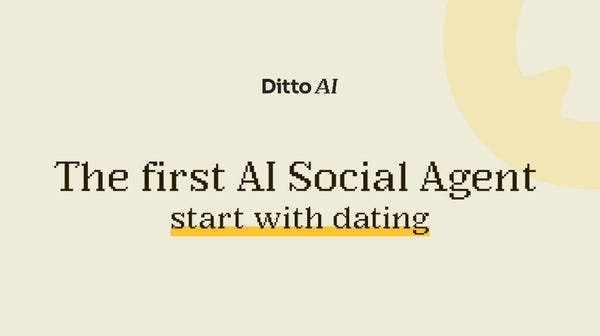
The first AI Social Agent
                                start with dating


Ditto

The deck kicks off with a little dating app history


Dating App's Paradigm Shifts Every Decade
                                DUE TO NEW TECH INNOVATION AND GENERATIONAL DEMOGRAPHIC


Ditto

Dating apps have a “paradigm shift every decade,” the slide says.

In the 1990s and 2000s, online dating websites emerged. Then in the 2010s, mobile dating apps took over. Ditto pitched investors that AI is the next frontier.

Ditto explains AI agents and what it says Gen Z wants


AI Social Agent Network
                                
                                TECH INNO
                                AI AGENTS TURNED STATIC PROFILES ALIVE


Ditto

The slide describes Ditto as an AI social agent network where “AI turns profiles into live agents that can interact on their own.”

“Gen Z is tired of swiping and chatting online,” the slide says. “They prefer ‘coffee chat vibe check’ style social: IRL, genuine, light.”

Ditto says dating apps like Tinder are ‘primitive’


AI Social Agent Network
                                
                                TECH INNO
                                AI AGENTS TURNED STATIC PROFILES ALIVE


Ditto

The slide also incorporates some old-school video game aesthetics, inspired by Super Mario Bros.

It says that AI agents setting up dates ‘is the future’


Ditto is the future
                                
                                An AI Agent that directly set up your dream dates


Ditto

Then, the deck explains how Ditto works


Tell Ditto Your type
                                
                                (On phone UI:)
                                Tell us about your type 1/2
                                When dating, what are red flags for you?
                                Type your answer here…


Ditto

On a website, users fill out a questionnaire and tell Ditto about their “type.” Then, Ditto will start texting users directly.

Ditto texts a date invite after finding a match


AI customized date invite


Ditto

The text includes a collage of the user’s photos.

Then, Ditto sets up a date and follows up for feedback


Direct to IRL Date


Ditto

Ditto pitches vibe-based matchmaking


Vibe is all you need
                                CONNECT BASED ON REASONING


Ditto

It includes a flow chart explaining how its agentic system works


How our agentic system works
                                
                                User Data


Ditto

Ditto takes user data and feeds it into an analysis agent, which performs image analysis, attractiveness analysis, and profile tagging.

Then, in the “pre-date reasoning” phase, a matchmaking agent does a “vibe check” and “hobby match” before running a “date simulation.” The date simulation agent then runs through things like “first impression” or “conversation flow” before presenting a user with a match.

Ditto’s deck concludes with a collage of testimonials from college students


People Love Us


Ditto


Source link

Ashley Stewart Business Insider

Amazon execs say layoffs are part of turning the company into the ‘world’s largest startup’

Internal memos from Amazon executives explained the company’s decision to lay off 16,000 corporate workers as necessary to become the “world’s largest startup,” according to the messages viewed by Business Insider.

“Our ambition is to be the world’s largest startup,” Amazon executives wrote in two such memos viewed by Business Insider. “That means doubling down on a culture of ownership, speed, and experimentation — which requires us to continue evolving how we’re structured.”

The “world’s largest startup” has become a common refrain under Amazon CEO Andy Jassy, who repeatedly referenced the company’s ability to operate like a startup in his latest shareholder letter.

The memos viewed by Business Insider, written by Amazon Web Services vice president Prasad Kalyanaraman and senior vice president Colleen Aubrey, include other similarities, providing insight into how Amazon likely directed its top executives to communicate about the layoffs:

  • Notifications within the teams in the US and Canada have been completed.
  • Identical language stating, “Please take care of yourselves and each other,” and that “the Employee Assistance Program (EAP) is available 24/7 for free and confidential support.”
  • Acknowledging that changes are difficult and ending with a forward-looking statement about what remaining teams can accomplish.

Greg Pearson, another AWS VP, also addressed layoffs in a memo and urged staff to “use technology to simplify work,” Business Insider previously reported. Amazon also shared more information for laid-off employees in an FAQ and emails from Amazon HR chief Beth Galetti.

Internal Slack messages viewed by Business Insider suggest affected teams include those within the company’s AWS cloud unit, such as the AI cloud service Bedrock, the cloud data warehouse service Redshift, and the ProServe consulting team, as well as retail business teams such as the Prime subscription service and the last-mile Delivery Experience team.

Amazon did not immediately respond to a request for comment from Business Insider.

Read the memos below:

Prasad Kalyanaraman, VP of AWS Infrastructure:

Team,
I want to provide an update on the organizational changes that Beth Galetti shared in her A to Z post earlier today. As Beth noted, these decisions are part of our ongoing effort to position the organization for the future while staying nimble and focused on delivering for our customers. Our ambition is to be the world’s largest startup. That means doubling down on a culture of ownership, speed, and experimentation—which requires us to continue evolving our structure.
The notifications to impacted colleagues in our organization who are based in the U.S. and Canada, have now been completed. In other regions, we are following local processes, which may include time for consultation with employee representatives and possibly result in longer timelines to communicate with impacted employees.
First and foremost, I want to thank the impacted colleagues who have worked tirelessly for our customers. I want to acknowledge that changes like this can be hard on our entire team. These decisions are difficult and are made thoughtfully as we position our organization for future success. Changes like these are difficult, especially when they affect colleagues we value. These decisions don’t diminish what we’ve built together; rather, they’re about positioning us to sustain and extend that impact as we continue to build the foundation for the future.
I also want to recognize what our team has accomplished this past year as we’ve made tremendous progress on scaling to meet unprecedented customer demand. These results reflect the talent, dedication, and collaboration across the breadth of our very diverse organization that must work together seamlessly — and those are qualities that will remain our foundation as we move forward.
Please take care of yourselves and each other. Remember that the Employee Assistance Program (EAP) is available 24/7 for free and confidential support.
Thank you for your resilience and continued focus on delivering for our customers. I’m confident in our team’s ability to navigate this transition and emerge stronger.
I’m looking forward to what we’ll accomplish together in the months ahead.
Prasad

Colleen Aubrey, SVP of Applied AI Solutions:

Hi,
I wanted to follow up on Beth Galetti’s post about organizational changes to A to Z earlier today. As Beth noted, this is a continuation of the work we’ve been doing for more than a year to strengthen the company by reducing layers, increasing ownership, and removing bureaucracy, so that we can move faster for customers. Our ambition is to be the world’s largest startup. That means doubling down on a culture of ownership, speed, and experimentation—which requires us to continue evolving how we’re structured.
Our organization plays a critical role in putting AI to work for our customers, transforming how companies deliver value to their customers, and these changes will help us sharpen our focus. I’ve seen how this team innovates and collaborates to solve real-world business challenges through applied Al. These strengths will be essential as we move forward with focus and clarity.
The notifications to impacted colleagues in our organization who are based in the U.S., Canada, and Costa Rica have now been completed. In other regions, we are following local processes, which may include time for consultation with employee representative bodies and possibly result in longer timelines to communicate with impacted employees. Changes like this are hard on everyone. These decisions are difficult and are made thoughtfully as we position our organization and AWS for future success. Please take care of yourselves and each other. The Employee Assistance Program (EAP) is available 24/7 for free and confidential support.
Thank you for your continued focus on delivering for our customers. I’m confident in our team’s ability to navigate this transition and emerge stronger, and I am positive that we’ll accomplish great things together in the months ahead.
Colleen

Have a tip? Contact Ashley Stewart via email at astewart@businessinsider.com or Signal at +1-425-344-8242. Use a personal email address and a nonwork device; here’s our guide to sharing information securely.


Source link