Lloyd Lee

This ‘driverless car’ startup is doing the one thing robotaxi companies don’t want to be caught doing

In the world of robotaxis, there’s a stigma around remote driving. Are you really “driverless” if there’s a person — even remotely — at the wheel?

One startup is fully embracing it.

Vay is a Berlin-based startup founded by two engineers and a former Zoox employee.


Vay co-founders

Vay cofounders Fabrizi Scelsi, Thomas von der Ohe, and Bogdan Djukic

Vay


The company is taking a somewhat contrarian approach to what it calls a “driverless car.”

Instead of automating the ride-hailing service, which can be technically challenging and costly to scale, Vay wants to rethink how we rent cars.

To do so, Vay wants to leverage remote-driving technology and, eventually, autonomy to deliver cars without humans inside to people who need a private vehicle for less than a day.

Thomas von der Ohe, cofounder and CEO of Vay, told Business Insider that the goal is to be cheaper than an Uber and more convenient than a traditional brick-and-mortar rental program.

“It’s basically by far the most affordable A to B transport,” von der Ohe, a former technical program manager during the early days of Zoox, said. “It’s half the price of Uber and half the price of robotaxis. How it works: We just bring the car, you then drive, and then when you’re done, you don’t have to park.”

Autonomy’s shifting timelines

Von der Ohe spent less than two years at Zoox when the company was just 60 people large and had yet to be acquired by Amazon. The Vay cofounder said he oversaw some of the first public testing of Zoox cars when there were safety drivers inside the vehicle.

At the robotaxi company, von der Ohe said he saw a goal with an ever-shifting timeline.

“It always felt like it was three years out,” he said of autonomous driving. “And then every year it shifted by a year. So we wanted to have self-driving cars everywhere in 2020 at Zoox. And then it was 2021 and so forth.”

Von der Ohe left Zoox in 2018. Instead of fixating on robotaxis, von der Ohe wanted to stay in mobility but work on something that could be faster to bring to market and easier to scale with less capital. Vay was born.

How it works

Customers order a car the same way they hail an Uber or Lyft through Vay’s app. To rent a car, users have to upload a driver’s license and a photo of themselves.


Vay app

Users can order a Vay rental car through a proprietary app.

Lloyd Lee/BI


Vay proposes that users can get a car delivered to them without a driver within minutes, as long as they’re within the service area or geofence. If you’re out of the service area, then you’re out of luck.

Once the car is delivered, the renter takes over.

The startup services Las Vegas, where it manages a fleet of 100 Kia Niros, a compact, all-electric SUV. Each Kia is retrofitted with four cameras. There are no other sensors, von der Ohe said.

The Vay cofounder told Business Insider that the service area is about twice the size of San Francisco.

Inside Vay’s Vegas office, there are about eight driving stations, in which a trained human operator remotely controls Vay’s vehicle fleet. The setup looks like a video game simulation with three computer screens and a disembodied driver’s seat.

A large red button to the left of the driver’s seat activates an emergency protocol during which the car pulls over to the side of the road.


Vay driver simulation

Vincent Reddy, an operations lead for Vay, remotely drives a car.

Lloyd Lee/BI


Vincent Reddy, an operations lead for Vay, said that there are several criteria a remote driver needs to meet, including completing about 1,000 kilometers of remote driving. Reddy remotely drove Business Insider during a demo ride.

“It’s similar to kind of like a high-grade racing sim,” Reddy said of the driving experience. “The thing that feels the most different is not having the feedback of what it feels like driving over bumps and things on the road because the seat doesn’t move. There’s no G-force, or you don’t get the feeling of accelerating or braking.”

To deliver the cars, Vay only uses the remote-driving technology on local roads and stays under 25 mph. The car can go on the highway once the customer takes over the vehicle.

There were no notable incidents during a 10-minute driverless ride around the block of Vay’s Vegas office.

50% cheaper than an Uber

Vay’s value proposition to customers is that the service is cheaper and more flexible than hailing an Uber.

Von der Ohe told Business Insider that the service should be about 50% cheaper than the average Uber ride.


Vay

Vay hands out business cards that advertise a “driverless car” that’s half the price of hailing an Uber.

Lloyd Lee/BI


Users are charged by the minute, with a decreased price if they are parked, in case they, for example, need to grab groceries or hit the gym.

When Business Insider viewed the app, the pricing was at $0.35 per minute while driving and $0.05 per minute while parked. At those prices, a 30-minute drive to and from a destination, including an hour-and-a-half stop, would cost around $25.

When asked if the pricing will change based on demand, von der Ohe said the company doesn’t yet have a pricing mechanism, such as surge pricing, in place, but expects there will be changes to the structure.

The CEO said he can keep the costs low because Vay’s vehicle fleet doesn’t have a complex sensor suite, and the remote operators manage multiple cars.

Von der Ohe said that as of January 2026, there is one remote operator for every 10 vehicles. However, that doesn’t mean a remote driver is operating 10 vehicles at the same time. Instead, a remote operator can deliver one car and immediately move on to the next vehicle.

“So I have much more cars and remote drivers, and that’s why we make it half the price,” he said.

Vay’s future

Vay employs about 200 people and raised more than $200 million, including a $60 million investment from Grab Holdings, the Singaporean tech company that owns Grab, the super app of Southeast Asia.


Vay Kia Niro

Vay’s vehicle fleet is currently made up of 100 Kia Niros.

Lloyd Lee/BI


While von der Ohe told Business Insider that building a fully autonomous ride experience like Waymo is not on Vay’s road map, the CEO said his startup will gradually add autonomous driving features.

“We’re not in competition with them,” von der Ohe said of robotaxi operators.

Since its founding, Vay has provided 35,000 trips, according to the CEO.

He said the service has especially seen high demand during the Consumer Electronics Show.

When Von der Ohe opened the app, the wait time to get a car was 31 minutes.

“It’s extremely busy today already,” he said. “It’s a long way. It should be five.”


Source link

What-is-Manus-the-Chinese-founded-AI-startup-Meta-is-buying.jpeg

What is Manus, the Chinese-founded AI startup Meta is buying for over $2 billion?

Manus is back in the spotlight.

The Chinese-founded artificial intelligence startup is being acquired by Meta in a deal reported to be worth more than $2 billion — one of the most high-profile instances of a US tech giant buying an Asian AI company.

Manus grabbed headlines in March when it unveiled an AI agent designed to autonomously execute tasks like résumé screening and stock analysis.

The startup was founded in China and moved its headquarters to Singapore in mid-2025.

What does Manus do?

Launched in March by the Chinese AI product studio Butterfly Effect, Manus has been pitched by its creators as the world’s first “general” AI agent — a system designed to carry out tasks independently.

Since its launch, the startup has continued to expand what the agent can do, rolling out features that allow users to use Manus for design work, slide creation, and completing tasks directly through a web browser.

Manus can independently execute complex tasks, such as market research, coding, and data analysis, Meta said when it announced the acquisition on Monday.

Business Insider tested the tool in its early stages in March and found it ambitious but uneven in execution, including instances where it hallucinated data.

Earlier this month, Manus said it had surpassed $100 million in annual recurring revenue, with its total revenue run rate — including usage-based fees and other income streams — exceeding $125 million.

The company in April raised $75 million in funding led by Benchmark, at a valuation of about $500 million, Bloomberg reported. Manus said in an update this month that it now employs about 105 people across Singapore, Tokyo, and San Francisco, and plans to open a Paris office soon.

Who are its founders?

Manus was founded by Xiao Hong, a Chinese entrepreneur and software engineer who is also the CEO of Butterfly Effect.

Known as “Red” in China’s tech circles, Xiao was born in 1992 and studied software engineering at Huazhong University of Science and Technology in central China.

After graduating, Xiao founded Nightingale Technology in 2015, where he developed enterprise productivity tools, including the Yi Ban assistant for WeChat, which gained millions of users in China.

In 2022, he launched Butterfly Effect and rolled out Monica, an AI-powered browser extension that aggregates multiple large language models. Following the acquisition, Xiao will take on a vice president role at Meta.

Xiao was joined at Manus by co-founder Ji Yichao, also known as “Peak Ji,” who was chief scientist at Butterfly Effect. Ji leads technical and infrastructure development at Manus.

The 32-year-old Ji was the public face of Manus at launch, introducing the AI agent in its debut video in March. Ji has a long track record of building consumer technology products, and was named to MIT Technology Review’s Innovators Under 35 list this year.

The founding team also includes Zhang Tao, who leads product at Manus. He was head of global product at ByteDance from 2022 to 2023 and has held multiple product roles, including serving as a product manager at Tencent, according to his LinkedIn profile.

Why did Meta buy Manus?

Meta said the acquisition is part of its effort to scale general-purpose AI agents across its apps and services.

The company said in its announcement on Monday that it plans to keep Manus running as a stand-alone product while integrating its technology into Meta’s wider AI offerings.

Manus said the deal would not be disruptive for its customers and that it would continue to sell and operate its subscription service. The company will also continue to operate from Singapore.

“Joining Meta allows us to build on a stronger, more sustainable foundation without changing how Manus works or how decisions are made,” said Xiao.

Buying Manus could give Meta an AI revenue boost and give it a distribution advantage, Business Insider’s Hugh Langley wrote.

What about Manus’ ties to China?

Manus’s links to China have drawn scrutiny.

In May, Sen. John Cornyn questioned US investment in Manus in a post on X. He asked whether American capital should back AI companies with ties to China as competition with Beijing intensifies.

In a statement to Business Insider on Tuesday, a Meta spokesperson said the deal would fully sever Manus’s remaining ties to China.

“There will be no continuing Chinese ownership interests in Manus AI following the transaction, and Manus AI will discontinue its services and operations in China,” the spokesperson told Business Insider. This includes shutting down the AI assistant, Monica, and relocating relevant employees.

Manus employees who join Meta will not have access to customer data, and Meta will continue to geo-block access to its AI models, the spokesperson added.


Source link

Henry Chandonnet is pictured

I worked at Tesla and Waymo. Here are the leadership lessons I bring to my startup.

This as-told-to essay is based on a conversation with Spencer Penn, the 33-year-old founder of LightSource, who lives in San Francisco. It’s been edited for length and clarity.

I moved to California 10 years ago, back when Tesla was a boutique car business. We were making 1,000 vehicles a week.

My friends and family were telling me it was a big career mistake to work at Tesla. They said it would never be someone’s main car, that it’s a tech toy, that it’s an iPad with wheels on it. But I was just excited to see what this Elon guy was up to.

My interactions with Elon were always very positive, but I’m not a fanboy. There were some things that were very notable about his leadership style.

Tesla is a very flat organization. When I was there, even relatively young and out of college, it was two levels between Elon and me. That’s very unusual to have such close proximity so early in your career.

Just because it’s a flat org structure, doesn’t mean it’s a horizontal power dynamic. Elon is the king. What he says goes. If you wanted to get something done, you really did have to go through Elon.

The drawbacks were that the guy didn’t have that much time. In 2017, he was running three different companies: Tesla, SpaceX, and Neuralink. He was just getting started with OpenAI. He had two and a half days a week to really focus on Tesla exclusively. You’d have to get things approved in that period of time.

But he was also very focused on the product. He would get involved in the way that things felt. If you wanted to change a texture on a paint, you’d want to get his buy-in.

Many CEOs go the opposite direction. They let themselves get so far removed from the product. Elon always felt the product was the thing, and the innovation would be what drives the company forward.

I like to embody that here at our company. I still do demos. If you take your hands off the wheel, things might veer in a direction you don’t like.

Elon has a knack for setting overly ambitious goals. There are benefits and drawbacks. Sometimes, you lose credibility. Certain products like the new Roadster were unveiled back when I was an employee, and they’ve yet to be delivered.

But there are certain things where you shoot for the moon and you do hit the stars. Nobody thought Starlink would be as successful as quickly as it has been.

If you apply the right amount of pressure, you can see where the leaks are. That kind of ambition is everything.

That’s the final thing Elon does: he’s really a risk taker. He’s bet the company multiple times; he always keeps putting the chips back on red. I think about that a lot. Sometimes it can be hard for professional management to take the risks they need to. Sometimes you can sleepwalk into a long-term, uncompetitive position.

There was some internal signaling. People knew that Elon was in the factory. They knew that he was going to stay there until the issues were fixed. Elon works about as hard as any human on earth possibly can.

There’s a hotel right across the street from the Fremont factory. Part of me always felt like, instead of setting up pillows in a conference room, I would like our CEO to be well-rested and go to the hotel five minutes away. But the signaling was very potent.

I try to embody that to some degree here, too. I like to come into the office five days a week. I want people to know that I’m coming in early and I’m staying late. I unload the dishwasher in the office. I’m assembling IKEA furniture.

How I found Waymo compared

Waymo was a very different organization. It’s a very vertical org structure. Google is a large organization with lots of levels, and that translated directly to Waymo, which is a much smaller business.

Even though it’s a very vertical org structure, it’s a horizontal power structure. It’s like it’s rotated 90 degrees from Tesla.

Some people compared the org to slime mold. It starts to spread and find all the crevices on its own. Individual contributors could construct their own ideas.

There are benefits and drawbacks. There is the possibility that there are duplicative teams doing the same things in different ways. But it also leads to a lot of creativity.

At Tesla, it was very clear that Elon and his lieutenants were driving a lot of the decisions. The decisions that the more junior people made would be incremental. At Google, I found that a lot of the best ideas come from the individual folks in the business, because they’re given the freedom to roam.

In a startup, you have limited resources. You have to be focused, but a lot of the best ideas come from experimentation.

We had an engineer who asked if he could move his start date by a month. He was like, “I want to spend a month before I get into work catching up on everything that’s happening in AI.” He came to the table, and he had so deeply immersed himself that he had a lot of new and fresh ideas. Many of those ideas have become product features.

I have to delegate innovation to folks on the team to find those opportunities. That’s something I learned from Google.


Source link

The-US-is-taking-a-stake-in-a-chip-startup.jpeg

The US is taking a stake in a chip startup led by Intel’s ousted CEO

The US government is poised to become a shareholder in a semiconductor startup chaired by Pat Gelsinger, who ran Intel until his resignation last year.

The Commerce Department said on Monday that the Trump administration signed a nonbinding letter of intent to invest up to $150 million in xLight, a startup trying to build a more advanced and cost-effective way to manufacture chips.

The investment would come from the CHIPS and Science Act and would be structured as equity, giving the federal government direct ownership in the company.

The deal — a first from the Trump administration’s CHIPS Research and Development Office — signals Washington’s effort to regain leadership in chipmaking. Most advanced semiconductors are manufactured outside the US, led by TSMC in Taiwan and Samsung in South Korea — areas where China’s influence looms large.

Intel warned in July that it may halt development of its next-generation chip, 14A, due to financial reasons. If Intel gives up on 14A, this could be a death blow to US chip manufacturing, Business Insider’s Alistair Barr wrote in a July report.

“For far too long, America ceded the frontier of advanced lithography to others. Under President Trump, those days are over,” said Commerce Secretary Howard Lutnick in Monday’s press release.

“This partnership would back a technology that can fundamentally rewrite the limits of chipmaking. Best of all, we would be doing it here at home,” Lutnick added.

The Palo Alto-based startup, founded in 2021, is developing free-electron laser technology, “an alternative light source” for extreme ultraviolet (EUV) lithography machines that power cutting-edge chip production, the press release said.

xLight said on its website that its systems would enhance Dutch firm ASML’s machines, “the undisputed global leader in EUV lithography systems.” EUV systems are only produced by ASML. xLight’s technology will “transform semiconductor fab capabilities and dramatically reduce capital and operating expenses,” it added.

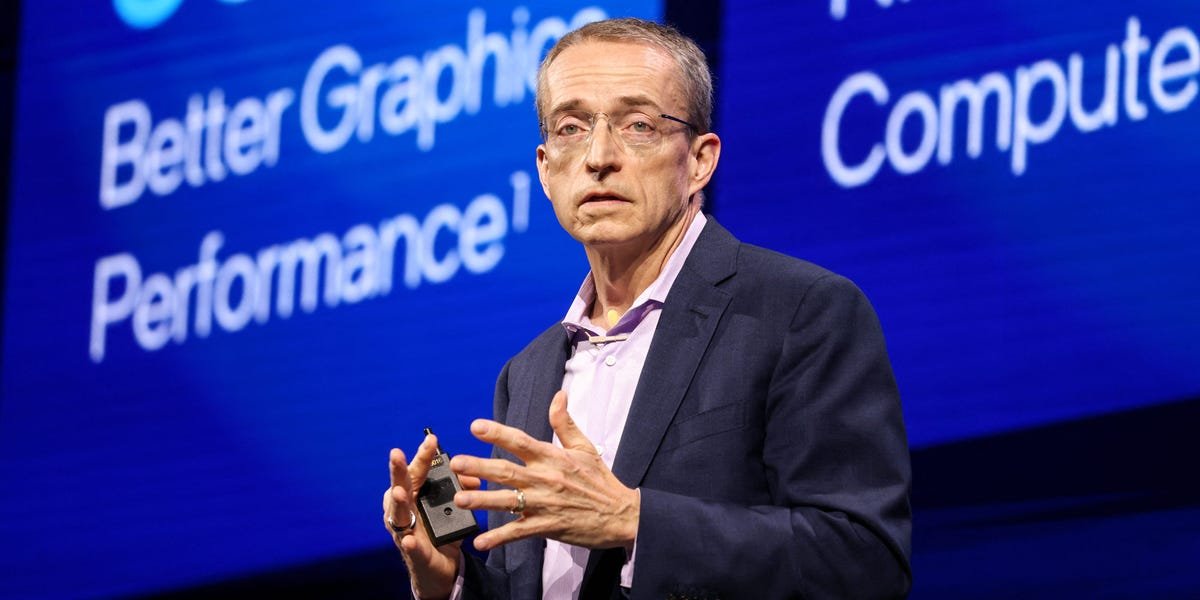
Pat Gelsinger, who was pushed out as Intel CEO late last year after the company struggled with weak earnings and fell behind in the AI chip race, became xLight’s executive chairman in March. He is also a general partner at Playground Global, the venture firm that led xLight’s $40 million Series B round in July.

Gelsinger, who was CEO of Intel from 2021 to 2024, said in an interview with CNBC’s “Squawk Box” in October that Intel “made a set of bad decisions over 15 years” and that technical leadership wasn’t “led by technologists for many years.”

“We were late on AI as well,” he added.

Gelsinger spent decades rising through the ranks at Intel and became one of the most influential voices behind the 2022 CHIPS Act, a landmark manufacturing legislation that reshaped America’s chip strategy.

xLight has the potential to “drive the next era of Moore’s Law, accelerating fab productivity, while developing a critical domestic capability,” said Gelsinger in a Monday press release.


Source link