
Tesla-owners-in-Europe-celebrate-getting-FSD-—-but-some.jpeg

Tesla owners in Europe celebrate getting FSD — but some say they’re still waiting

After years of delays and missed deadlines, Tesla’s full self-driving tech has finally launched in Europe — and owners are celebrating.

Last week, the RDW, the Netherlands auto regulator, approved the driver-assist system that Tesla says allows its EVs to drive themselves almost anywhere under human supervision.

It marked the culmination of a long campaign that saw Tesla navigate what Elon Musk described as a “layer cake of bureaucracy.” Until now, European owners have been stuck with a more limited version of Tesla’s driver-assist software that can’t handle intersections or change lanes on its own.

For Tesla’s European fans, some of whom have been waiting nearly a decade to get access to FSD, the excitement of taking the tech for a spin for the first time was high.

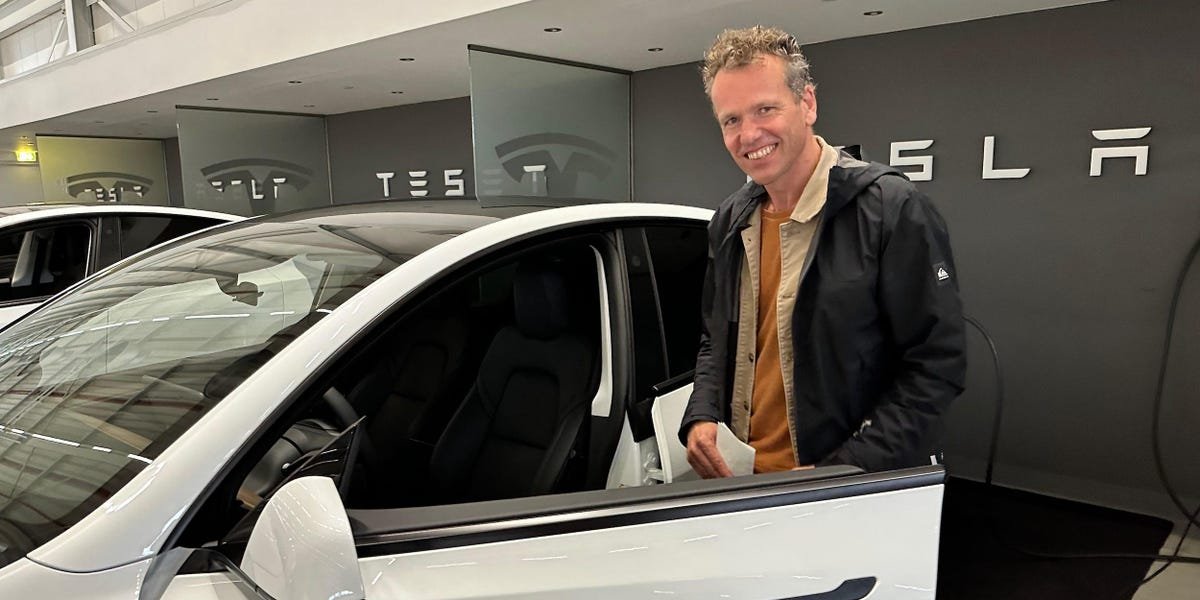
“It’s like stepping into the future. It’s amazing,” said Tim de Kraker, a venture developer from Zutphen in the Netherlands, who used his FSD first test-drive to take his son to school.

Navigating the tight streets of Amsterdam and other Dutch cities — where bike lanes, tram routes, and pedestrian crossings interweave into a tangled web that can flummox experienced human drivers — poses perhaps the toughest challenge yet for FSD.

While all four drivers Business Insider spoke to said they encountered no safety issues or major interventions, some said FSD was still getting used to the local quirks of Dutch roads, such as complex roundabouts, which are rare in the US but ubiquitous in Europe.

Patrick Sannes, a Model Y owner who lives near the city of Gouda in the Netherlands, said that when he encountered a roundabout while FSD was driving him home from work on Monday, the software became confused by roadworks on the side of the road — and failed to exit the roundabout.

“I did three turns on the roundabout, and then I decided to drive off myself,” he said.

Sannes said his FSD-equipped Tesla has otherwise handled roundabouts, country lanes, and highway driving almost flawlessly, with only a few minor interventions due to overly hesitant driving.

Having waited seven years for FSD to launch in Europe, he said he was thrilled to finally surrender the wheel to the AI driver.

“It’s worth the wait, but I would’ve loved it to be faster,” Sannes said.

Alex Nichiporchik, CEO at video game developer tinyBuild and a Tesla owner for 10 years, told Business Insider that he had been impressed with FSD so far — even if the technology occasionally struggled with roundabouts, and had a tendency to frustrate other drivers by always giving way to bicycles, regardless of whether they have right of way or not.

“I’d say that in the US right now, FSD drives much better than I do. But here you can tell that it’s still learning,” Nichiporchik, who lives in the Netherlands and the US, said.

Unlike their US counterparts, European FSD owners downloading the software for the first time are asked to watch a video and complete a two-question quiz before they can begin using it.

This quiz — which asks drivers to identify when FSD is active and confirm they are responsible for supervising it — is likely a response to European regulations that require manufacturers to educate consumers about the limits of driver-assist tech.

Nichiporchik also said that instead of speed profiles such as sloth, chill, hurry, and “Mad Max,” the European version of FSD instead allows drivers to set a maximum speed that specifies how far over the limit they want it to drive.

“The rules here are much stricter than in the US, especially where I live in Florida,” Nichiporchik said, adding he thought having FSD in Europe would be “life-changing.”

Speaking over the phone while being driven by FSD, entrepreneur and founder Thijs van Schadewijk told Business Insider he had immediately put the software to the test by driving through the busiest parts of Amsterdam.

“There were tourists walking around your car, bicycles and cars everywhere,” he said.


Thijs van Schadewijk Tesla

Thijs van Schadewijk has owned four Teslas since buying his first in 2015. 

Thijs van Schadewijk


Van Schadewijk’s Model Y handled the congested canal-side streets with ease, he said, bar one moment where he had to take over after it tried to reverse out of a busy intersection.

“I’m very excited that we now have it. And this is the worst version of FSD we will ever have,” he said.

Some Tesla owners miss out

Even as many Tesla owners celebrate FSD’s long-overdue arrival, some are missing out.

The rollout appears to be limited to Tesla owners with more recent versions of the company’s hardware — known as Hardware 4 — with vehicles built before 2023 not receiving the update.

In the US, Tesla vehicles with pre-2023 hardware — known as Hardware 3 — can only access a more limited version of FSD.

Musk previously acknowledged it’s possible that these older vehicles may not have the hardware to handle fully “unsupervised FSD,” and said Tesla would provide physical upgrades to all Hardware 3 owners if that is the case.

Mischa Sigtermans, an executive at Amsterdam-based Ryde Ventures who bought his Model 3 in 2019, feels like he’s waited long enough.

After FSD began rolling out in the Netherlands without Hardware 3 support, he started a website to gather European Tesla owners to explore potential legal action over what he says are the company’s broken promises.

“At some point, I lost trust in Tesla,” Sigtermans told Business Insider.

Tesla did not respond to a request for comment.


Mischa Sigtermans Tesla

Mischa Sigtermans with his Tesla Model 3. 

Mischa Sigtermans


The Model 3 owner, who bought FSD in 2019, said that Tesla’s marketing material at the time explicitly stated that his vehicle’s hardware would be capable of supporting Full Self-Driving in the future.

Speaking on Wednesday, Sigtermans said he now had around 500 verified Tesla owners sign up to potentially participate in the collective claim via the website. That number has now grown to around 1,900, per a tracker on Sigtermans’ site.

“You can’t keep this up for seven years. I would rather hear them say something like, ‘yeah, we can’t make this promise’ and communicate about it,” he said.

Tesla owners in Europe can transfer FSD from one vehicle to another, according to the company’s website. Tesla removed this option in the US in March.

Sigtermans said he shouldn’t have to buy a new car to access software he paid 6,800 euros ($8,050) for years ago, and pointed to Musk’s history of making overly optimistic promises on Tesla’s FSD rollout.

“It’s just the promise of this specific car that they made that they can’t deliver. And it’s honestly not my problem to get a new car to get FSD working. That’s their promise and their problem,” he said.


Source link

EV-owners-are-taking-a-victory-lap-as-gas-prices.jpeg

EV owners are taking a victory lap as gas prices skyrocket: ‘I had no idea, I drive a Tesla’

Tickers above American gas stations are flashing higher prices.

EV owners, meanwhile, are plugging in — and laughing about it online.

Across social media, electric-vehicle drivers are touting their savings as fuel costs climb during the US and Israel’s military interventions in Iran.

Many have posted meme-filled victory laps about the price of “filling up.”

One shared a compilation of a mustached Tom Selleck turning toward the camera with a smug grin in Magnum P.I.” Others are posting screenshots of their cheap charging sessions. Some are sharing gleeful TikToks while plugging their EVs into a home charger.

Juicy J — the cofounder of Three 6 Mafia and a producer of the Academy Award-winning song “It’s Hard out Here for a Pimp” — also weighed in, saying it was “time to go full electric.”

Gas prices have surged as military strikes in the Middle East disrupted oil production and heightened fears about tanker traffic through the Strait of Hormuz — a key artery for an estimated 20% of global oil and liquified natural gas shipments.

Brent crude climbed over $100 a barrel Sunday night as traders reacted to the instability. By Monday afternoon, the price had dropped back to the low $80s.

American drivers are paying more at the gas station. On February 21 — before tensions escalated — the average price of a gallon of regular gas in the US was $2.93, according to AAA.

By Monday, it had risen to $3.48, an 18.7% jump in 15 days.

In some areas, the increases have been even steeper. A Los Angeles gas station advertised prices above $8 a gallon, according to local ABC affiliate KABC.

Public EV charging rates, by contrast, have risen far less.

Over the same period, the national average price per kilowatt-hour at public charging stations increased from $0.39 to $0.42 — a 7.6% bump, according to AAA data.

And most EV owners charge at home, where electricity rates are typically lower and less directly tied to crude oil prices than gasoline.

“I had no idea,” one driver wrote on X about oil prices. “I drive a Tesla.”

Some users on X pointed out that charging costs vary widely by state and utility provider.

In regions where electricity generation relies heavily on natural gas, power prices could rise if energy markets remain volatile.

For example, in Kansas, EV charging costs about $0.30 per kilowatt-hour, according to AAA. In Louisiana — where charging stations are more sparse — the average is $0.47.

The online gloating comes at a complicated moment for the EV market. Even as gas prices heat up, sales of electric vehicles have cooled.

In January 2026, sales of EVs at American dealerships fell by 53.5% compared to the same month last year, per CarGurus’ data shared with Business Insider.

Even as EV sales shrink, Americans who have traded in the gas tank for the battery are taking this time to bask in their money-saving glory.

“Who’s glad to have an EV during this time of high gas prices?” one person wrote on Reddit. “I guess not having to deal with the ups and downs of gas prices is one of the benefits of owning an EV.”

Are gas prices affecting your daily travel? We want to hear from you. Contact Ben Shimkus at bshimkus@insider.com or Signal at bshimkus.41. Use a personal email address and a nonwork device; here’s our guide to sharing information securely.


Source link

Elon-Musk-dodged-cameras-ahead-of-courthouse-testimony-Snubbed-photogs.jpeg

Elon Musk dodged cameras ahead of courthouse testimony. Snubbed photogs blamed a ‘decoy’ Tesla.

It all happened in a flash.

A “decoy” Tesla distracted a scrum of photographers trying to get a good shot of Elon Musk as he entered a San Francisco courthouse on Wednesday, two cameramen on the scene told Business Insider.

“100% a decoy. 100%,” said David Morris, a frustrated yet impressed Bloomberg News photographer. “They had us. It was done very well, actually.”

The Tesla CEO was expected to arrive at the San Francisco federal courthouse on Wednesday to testify in a trial over a lawsuit brought by former Twitter shareholders. They alleged the billionaire violated securities laws in 2022 by driving down the share price of Twitter before he bought it and renamed it X. Musk has said he complied with the law in his communications about the social media company.

According to two photographers on a stakeout outside the courthouse, a Tesla pulled up on the curb, and security guards stepped out to surround it.

As soon as the group of news photographers coalesced around the Tesla — anticipating Musk would step out — an SUV that had been parked a short distance away pulled up right in front of the courthouse door, the photographer said. Musk and his security team ran out of the car and up the courthouse steps, they said.

“He was like probably at least a hundred feet away from us,” Morris said. “And then we noticed that. And it was like three seconds — out of the car, in the door.”


Elon Musk san francisco courthouse water

Elon Musk, center, arrives for a Twitter shareholder trial at the US District Court for the Northern District of California, Wednesday, March 4, 2026, in San Francisco.

AP Photo/Godofredo A. Vásquez


The photographers ultimately got only a handful of pictures of Musk, on the steps entering the courthouse and going through the metal detectors.

“There was security standing in front of him to try to make it so it was hard to get a good photo,” Josh Edelson, a freelance photographer working for Getty Images, told Business Insider.

Musk didn’t make it easy, Edelson said.

“He didn’t look at us. He kept his head looking to the side, so he didn’t look very good,” he said. “It was just a profile shot. It was very obviously a position where he wanted to make it hard for us.”

The entire scene was captured by NBC journalist Scott Budman, who posted a video on X.

After Musk entered the building, the Tesla, which appears to be a Model S, zoomed away without anyone else getting out, Morris said.

Attorneys for Musk didn’t immediately respond to requests for comment.

The photographers outside the San Francisco courthouse will have another chance to capture Musk when he leaves the building.

Morris told Business Insider that Bloomberg assigned two photographers for the day — one to cover each exit.

“It’s always a fifty-fifty chance,” he said.


Source link

Elon-Musk-warns-Tesla-employees-over-future-of-German-megafactory.jpeg

Elon Musk warns Tesla employees over future of German megafactory ahead of union election

Tesla’s sales in Europe are plummeting — and now Elon Musk has a warning for employees at the company’s German megafactory ahead of crucial union elections.

In an interview with Giga Berlin senior director Andre Thierig posted on X on Thursday, Musk said Tesla would “ideally” expand its only European gigafactory and start production of its battery cells, Cybercab robotaxi, and Optimus robot at the site.

Asked if he had any advice for the team at Giga Berlin to work toward that vision, Musk said any expansion was contingent on Tesla being free from interference from “outside organizations.”

“Things certainly get harder if there are outside organizations who are pushing Tesla in the wrong direction,” said Musk.

“It’s difficult to say that then we would expand, if we had outside organizations who were making things very difficult. We’re not going to shut down the factory, but we wouldn’t expand it either,” said the Tesla CEO.

The billionaire’s comments come ahead of a crucial vote at Tesla’s German factory next week, with powerful German union IG Metall pushing to gain control of the site’s work council — an elected body of employees required by local laws that negotiates pay deals and working hours with management.

German publication Handelsblatt first reported Musk’s comments, which it said were screened for employees on Wednesday.

Tesla clashes with union

The run-up to the election has been marked by fierce disputes between the union and Tesla’s executives. Earlier this month, Tesla filed a criminal complaint against an IG Metall representative, accusing them of secretly recording an internal meeting.

IG Metall, which has frequently clashed with Tesla over working conditions at Giga Berlin over the past few years, denied the allegation and responded with its own complaint accusing Thierig of defamation. The union said Thursday that both sides had agreed on a truce ahead of the works council elections.

The debate over Giga Berlin’s future comes as Tesla’s sales in Europe have collapsed. The US automaker saw registrations of its EVs fall nearly 38% in the EU last year, as it was hit by backlash over Musk’s political interventions and backing of German far-right party AfD.

In January, Tesla’s European sales dropped to just 8,000 units, according to data from the European Automobile Manufacturers Association, less than half the number sold by Chinese rival BYD.

Musk also said in the interview that Tesla expects to receive approval to sell Full-Self-Driving driver assist technology in the Netherlands on March 20.


Source link

Used-Tesla-prices-have-soared-since-the-end-of-the.jpeg

Used Tesla prices have soared since the end of the $7,500 tax credit, even as other EVs get cheaper

  • Used Tesla prices are rising as the secondhand EV market booms following the end of the $7,500 tax credit.
  • That’s a relief for Tesla owners, who have seen resale prices plunge in the past few years.
  • The Model S and X saw the largest price hikes. Elon Musk said Tesla would discontinue them to build its Optimus robots.

The market for used Teslas is heating up.

A booming secondhand EV market is pushing used Tesla prices up even as other electric vehicles get cheaper.

The average price of a used Tesla has climbed 4.3% since the end of the $7,500 tax credit for new electric vehicles in September, according to data from used car seller iSeeCars.

The two used EVs with the largest rise in prices were Tesla’s luxury Model S and X vehicles. Musk announced in January that both models would be discontinued in the coming months to make room for the company’s Optimus robot.

The spike comes as other used EVs get cheaper. The average price of used non-Tesla EVs fell 3.6% between September and January, per iSeeCars data. The exception was the Porsche Taycan, which was the only non-Tesla model to see used prices rise.

With the auto industry in the grip of an EV winter as prices soar and automakers cancel new models after the end of the tax credit, electric vehicle buyers are turning to the used-car market.

Sales of used battery-powered vehicles surged 21% in January from the previous year, per data from Cox Automotive, even as sales of new EVs fell nearly 30%.

That’s good news for Tesla. The brand dominates the used EV market in the US, with used Teslas outselling Audis, the second-largest retailer, by more than 10,000 vehicles in January, per Cox figures.

It’s also a relief for Tesla owners, who have seen their resale values collapse in recent years.

Used Tesla prices have been in freefall since 2022 and hit new lows last year amid backlash over CEO Elon Musk gutting government spending through his role at DOGE, which he has since left.

Tesla fans disappointed that the company never made its long-promised $25,000 EV do have a consolation prize — a secondhand Model 3 now sells for an average price of $25,700.


Source link

Tesla-is-dropping-a-bargain-version-of-the-Cybertruck.jpeg

Tesla is dropping a bargain version of the Cybertruck

Elon Musk’s Tesla is doubling down on its road map to make the Cybertruck less vanity, more working man, with a budget version that’s clocking in a little closer to the competition, price-wise.

In an X post on Thursday night, Tesla announced it will roll out its “most affordable Cybertruck yet.” It’s advertised, per the post, as “tough as nails with ultra-low cost of ownership” starting at $59,990.

The cheapest all-wheel-drive Cybertruck sold for just under $100,000 in 2024. It’s now listed starting at $79,990.

While Musk has often positioned the Cybertruck as a competitor to the Ford F-150, at close to $60,000, the Cybertruck is still a premium option. The F-150 starts at $39,330.

The cheaper Cybertruck comes amid Tesla’s race to reposition Musk’s shiny, silver vehicle as an everyman’s car.

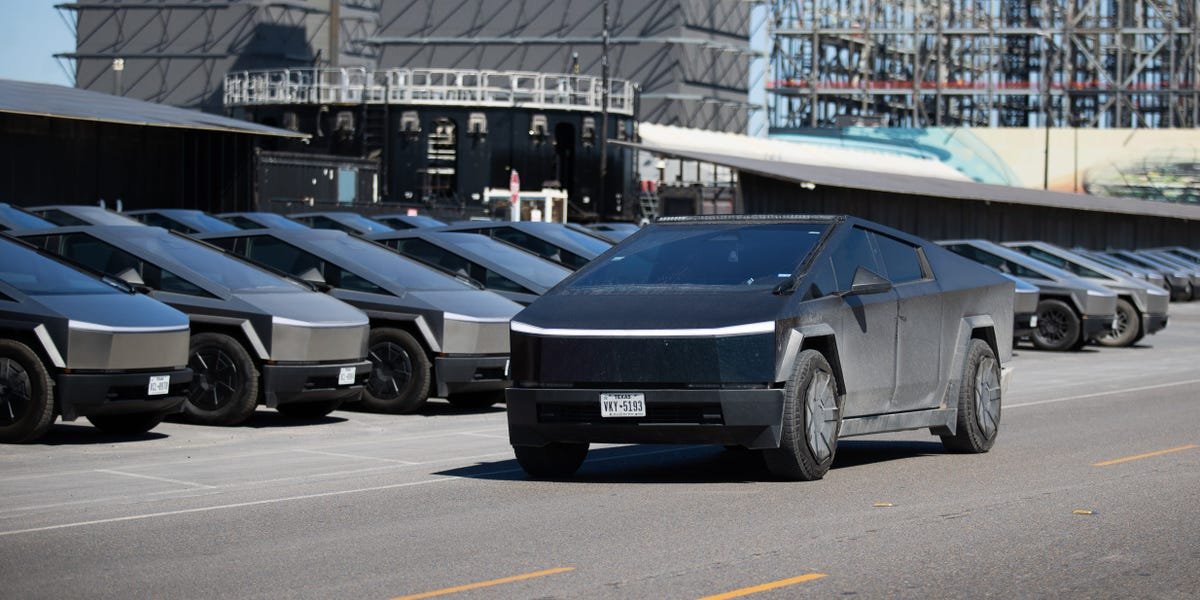
The new version of the Cybertruck is now listed in a Tesla comparison chart as the company’s “most affordable” Cybertruck. It has a lower towing capacity of 7,500 pounds, down from the 11,000 pounds listed for its “Premium All-Wheel Drive” and “Cyberbeast” versions.

Significant interior differences include heated seats only in the first row, compared to both rows for the premium versions. The cheaper Cybertruck comes with textile seats, unlike the “premium interiors” in more expensive iterations.

Musk once touted the truck as “apocalypse-proof.” It’s been subjected to recalls, including over its rearview camera, windshield wiper, and reports of jammed accelerator pedals.

The more affordable Cybertruck comes after a year of modest sales for Tesla’s electric truck.

Tesla sold 20,237 Cybertrucks in the US in 2025, according to data from Cox Automotive released in January — half of its 2024 sales figures. It also falls far short of Musk’s 2023 projection that the Cybertruck would sell 250,000 units a year.


Source link