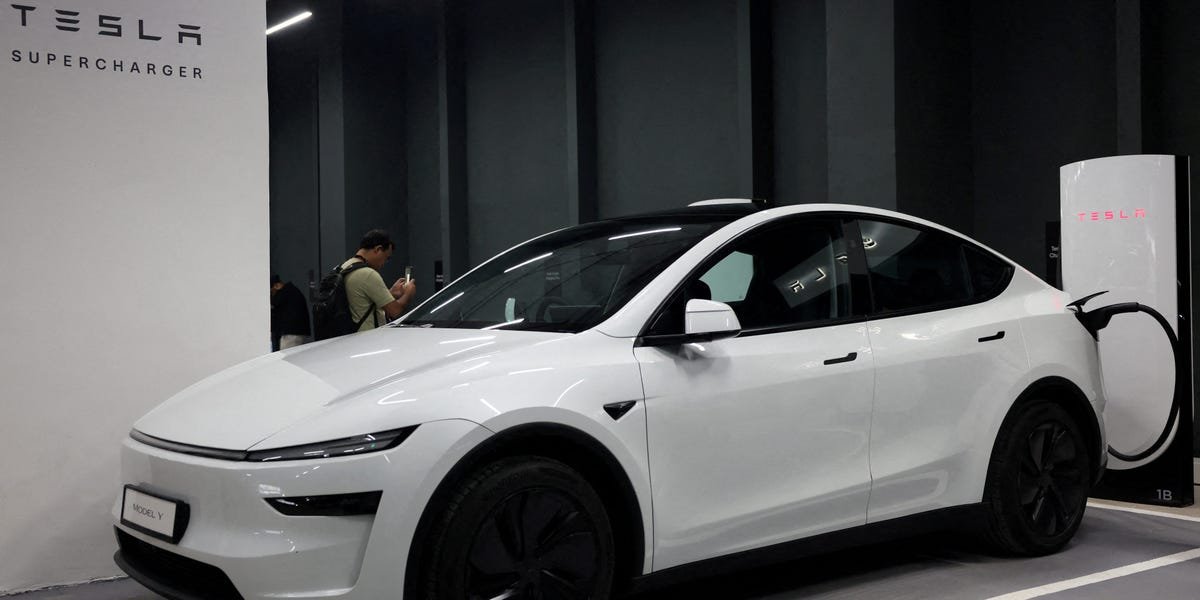
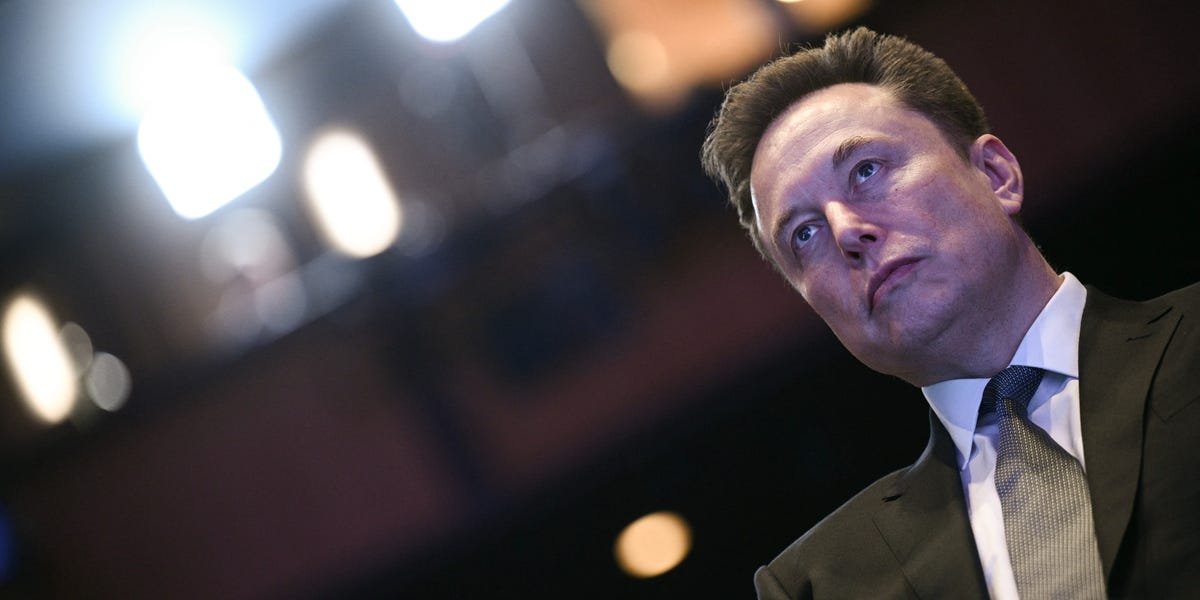
Tesla-says-the-first-Cybercab-just-rolled-off-the-production.jpeg

Tesla says the first Cybercab just rolled off the production line at Gigafactory Texas

  • Tesla is building a fully autonomous car, called Cybercab, for its robotaxi service.
  • Tesla CEO Elon Musk has said that people will be able to buy the car.
  • The Cybercab still needs regulatory approval in order to be street legal.

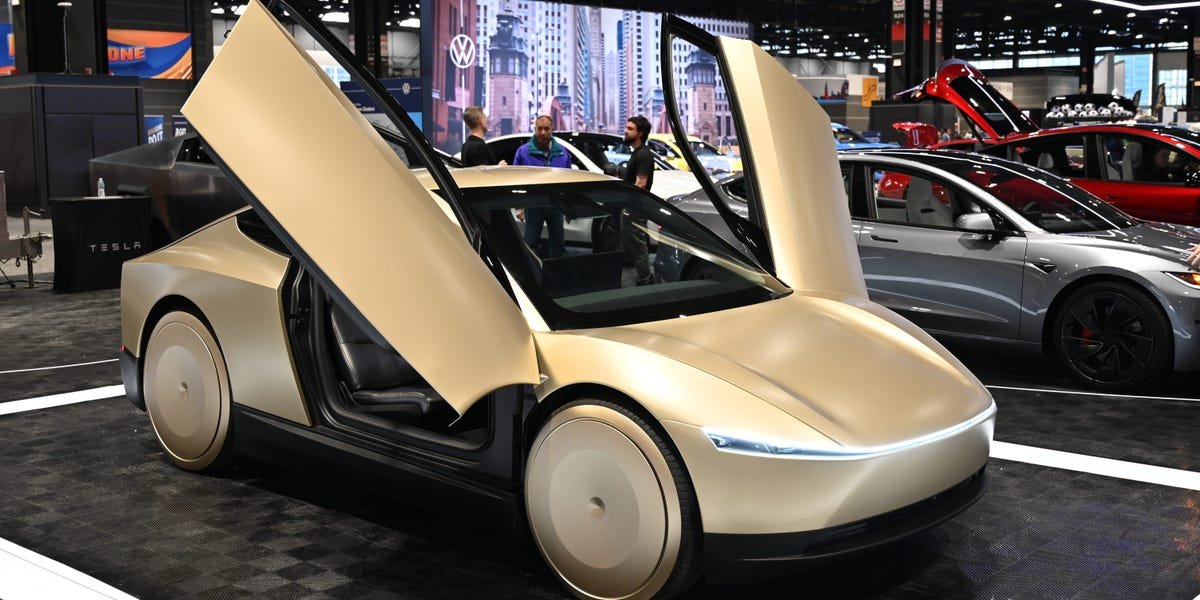
Tesla says its purpose-built robotaxi just reached an important manufacturing milestone.

In an X post on Tuesday, the company said the Cybercab, a two-door car without a steering wheel, came off the production line at Tesla’s sprawling Gigafactory in Austin.

“Congratulations to the Tesla team on making the first production Cybercab!” Tesla CEO Elon Musk said on X.

The Cybercab was designed for Tesla’s nascent robotaxi ride-hailing program.

Tesla’s robotaxi program has so far deployed only 2025 Model Ys and mostly relies on human safety monitors to supervise rides. Tesla began offering a limited number of unsupervised rides to the public in January.

Unlike the Model Y, the Cybercab doesn’t have a steering wheel or pedals — it’s intended to be fully autonomous. Amazon’s Zoox similarly manufactures purpose-built robotaxis designed solely to transport passengers.

Tesla has said it expects to start production of the Cybercab in April.

What’s less clear is the timeline for when the automaker expects the Cybercab to be fully street legal.

Federal vehicle safety standards were written with human control systems like a steering wheel in mind, which means Tesla would likely need special approval from regulators for any requirements it can’t meet. Notably, Zoox received such a federal exemption and now operates a limited public service in Las Vegas and San Francisco.

Musk also said people will have the option to buy the car. Selling a car without pedals or steering controls not only requires clearing federal regulatory hurdles but could also expose Tesla to a patchwork of state-by-state rules governing registration, insurance, and autonomous vehicle operation.

“What we designed is optimized for autonomy,” Musk said during an earnings call in October 2024. “It will cost on the order of — cost roughly 25K, so it is a 25K car. And you can, you will be able to buy one exclusively if you want.”

A Tesla spokesperson did not respond to a request for comment.


Source link

Tesla FSD

Tesla pulls the plug on one-time purchases of FSD


Edie Leong for The Washington Post via Getty Images

  • Tesla eliminated the option to purchase Full Self-Driving with a one-time fee over the weekend.
  • Previously, Tesla offered FSD as an $8,000 one-time purchase option.
  • Musk has said he plans to hike FSD subscription prices as its capabilities improve.

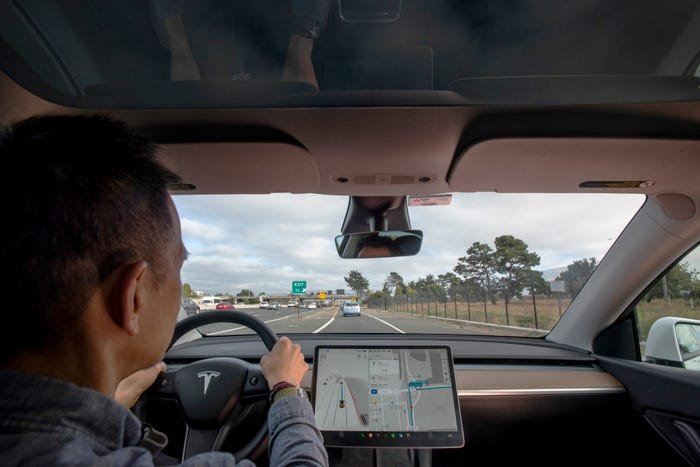
Tesla has shifted its Full Self-Driving feature to a subscription model.

Over the weekend, the company removed the option to purchase the feature in the US via a one-time flat fee of $8,000.

For years, Tesla owners have been able to purchase the service with a one-time payment that would allow them to use it for the full lifespan of their vehicle. Now, the driver-assist feature is available only via a $99-per-month subscription.

Tesla CEO Elon Musk first announced in January that the change would take effect the following month. In the past, Musk has said that Teslas would serve as “appreciating assets,” suggesting owners could benefit as the software became increasingly more autonomous.

The decision to remove lifetime FSD purchases comes shortly after the carmaker stopped offering Autopilot as a free feature for new Tesla purchases. Previously, Autopilot acted as a free driver-assist feature on the expressway, while FSD was an additional paid feature for navigating city streets.

Tesla first introduced FSD in 2016, and the pricing has swung dramatically over time. In its early days, FSD cost around $5,000, later climbing to a peak of $15,000. In 2024, Tesla reduced the upfront price to $8,000. The carmaker first introduced a subscription option in 2021 for $199 per month, but the price was later lowered to $99 per month.

Musk said in a post on X last month that the carmaker will raise FSD subscription prices as its “capabilities improve.”

Tesla’s move to a more subscription-focused model reflects a broader industry trend. Under an executive performance plan approved last year, Musk’s compensation depends in part on reaching 10 million active FSD subscriptions.

Do you work for Tesla or have a tip? Contact this reporter via email at gkay@businessinsider.com or Signal at 248-894-6012. Use a personal email address, a nonwork device, and nonwork WiFi; here’s our guide to sharing information securely.


Source link

Tesla-loses-another-sales-executive.jpeg

Tesla loses another sales executive

Raj Jegannathan, who was once tasked with managing Tesla’s sales and service team in North America, announced his departure from the company on Monday.

Jegannathan, Tesla’s vice president of IT, took over the sales organization shortly after Troy Jones, the former vice president of North America sales and service, left the company in July. During his time on the team, Jegannathan worked to incorporate more AI tools in sales and service team workflows, five people with knowledge of the issue told Business Insider.

“A comprehensive end-to-end understanding of the business has been essential—enabling the team to harness AI effectively to achieve meaningful outcomes across products and customer support,” Jegannathan wrote on LinkedIn on Monday.

The executive, who reported directly to Tesla CEO Elon Musk, left the company over the weekend, a person with knowledge of the issue told Business Insider. Jegannathan has not been active on internal company systems since late January, and he has not worked closely with the sales team for a few months, people with knowledge of the issue said.

Prior to taking over leadership of the sales team, Jegannathan worked in engineering and IT, rather than sales. He has worked at Tesla for over 13 years. Shortly after he took the reins, he became known for responding to sales and service requests on X.

Jegannathan has led the company through a tumultuous sales period. Tesla reported in January that its delivery numbers fell for the second year in a row. The carmaker reported a 16% year-over-year decline in deliveries during the quarter. Jegannathan led the sales efforts while Musk worked with the federal government as a part of the Department of Government Efficiency, before the organization was dismantled.

Several of Musk’s direct reports have left the company over the past year. One of Musk’s top lieutenants, Omead Afshar, parted ways with the carmaker in June, and Milan Kovac, the head of Tesla’s robotics division, left the company that same month.

Tesla and Jegannathan did not immediately respond to a request for comment from Business Insider

Do you work for Tesla or have a tip? Contact this reporter via email at gkay@businessinsider.com or Signal at 248-894-6012. Use a personal email address, a nonwork device, and nonwork WiFi; here’s our guide to sharing information securely.


Source link

Headshot of Ben Shimkus

All the ways Elon Musk’s companies are already intertwined, from a Tesla ‘collab’ with SpaceX to Grok in vehicles

Elon Musk has for years blurred the lines between the companies he leads.

The intermingling of Elon Inc. businesses — a number which shrank from six entities to five when xAI acquired X last year, and from five to four when SpaceX acquired xAI on Monday — is something of signature for the CEO.

Over the past three years, his companies have stepped up their internal dealings, investing billions in one another, agreeing to buy up each other’s products, and exchanging software and materials.

The result is a tightly knit corporate ecosystem centered on Musk, where work — and even employees — can flow between the various entities in the name of vertical integration.

Here are some of the recent sharing agreements, purchases, and investments between Musk’s companies.

Musk’s employees often work between companies


Elon Musk took over Twitter about a year ago.

Shortly after acquiring Twitter, Elon Musk brought Tesla engineers into the offices to work on its code base.

Photo by -/Twitter account of Elon Musk/AFP via Getty Images


Musk has repeatedly drawn on employees from one company to support others in his portfolio.

In 2022, about a month after Musk bought Twitter — now known as X — he sent roughly 50 Tesla employees to the social-media company’s headquarters to help overhaul its code-review systems, according to court filings.

Musk later argued in court that the Tesla employees had “volunteered” to do the work and that their temporary reassignment should not concern Tesla’s board.

Executives share overlapping functions on several of Musk’s companies, too, according to insider org charts obtained by Business Insider.

For example, Charlie Kuehmann, the vice president of materials and engineering at Tesla, also holds the same title at SpaceX.

SpaceX contributes to Roadster, Tesla provides SpaceX with energy-storage systems


A Falcon Heavy rocket from SpaceX takes off from a launch pad in Florida during a clear day.

SpaceX is lending rocket-boosting tech to Tesla’s upcoming hyper-powered sports car, Musk said.

Joe Raedle/Getty Images


SpaceX is a major customer of Tesla’s energy business, purchasing batteries for robotics power and Megapack energy-storage systems.

It also reportedly invested $2 billion into xAI as a part of a previous funding round.

Musk has also said that Tesla’s long-awaited next-generation Roadster will be a “Tesla/SpaceX collab” and feature SpaceX-built cold-gas thrusters. The hyper-powered sports car’s launch event is penciled in for April 1.

“It’s gonna be really cool, and it’s gonna have some rocket technology in it,” Musk also said during a 2024 sit-down with Don Lemon.

SpaceX and Boring Company buy Tesla cars


Boring Company Tesla entering tunnel

A Tesla entering the Hawthorne Tunnel, made by Elon Musk’s Boring Co.

Robyn Beck/Pool via REUTERS


Aside from full-blown investments or acquisitions, the most publicly visible example of Musk’s companies coordinating might be Tesla’s vehicle sales to his tunnel-building start-up.

The Boring Company, which operates tunnels in Las Vegas and Texas, uses fleets of Tesla vehicles to transport passengers through its underground systems. The tunnel builder has also constructed tunnels around Tesla’s Gigafactory in Austin, Texas.

It isn’t alone. SpaceX also purchased an unspecified number of Musk’s Cybertrucks.

Tesla and xAI’s ‘framework agreement’ follows Grok integration into cars, Optimus demo bots.


A person in light blue jeans sits in the front passenger seat inside a self-driving Tesla.

Tesla wants to build out its AI software, including its self-driving ambitions. CEO Elon Musk said a $2 billion investment in his software company would help.

Jay Janner/The Austin American-Statesman via Getty Images


Tesla’s earnings on Wednesday disclosed that it had agree to invest $2 billion in xAI, Musk’s artificial intelligence startup, with a related “framework agreement” to explore additional collaboration opportunities.

Tesla has already integrated xAI’s Grok into its vehicles, allowing drivers to chat with the AI and use it to add and edit navigation destinations.

Videos have shown early versions of Tesla’s in-development Optimus robot using xAI’s Grok AI chatbot for its voice.

xAI has also reportedly told investors that it’s working on AI that could power Tesla’s forthcoming Optimus humanoid robots.

Tesla executives said the $2 billion investment supports the automaker’s push into self-driving technology. For example, the earnings deck explained that xAI-developed software will analyze vehicle interiors and assist with route planning, including adding high-occupancy-vehicle lanes when the car is full.

For xAI, the investment adds capital to the cash-hungry buildout of data centers and their energy needs.

The deal marked one of the clearest examples of capital flowing from Musk’s public company into a privately held firm he controls.

It’s all par for the course for ‘Elon Inc.’

The growing web of internal deals has fueled discussion among investors and analysts about whether Musk’s companies are evolving into something closer to a single, vertically integrated enterprise.

And it’s not clear if it’ll stop at SpaceX combining with xAI.

There’s also been recent reports that Tesla could combine with SpaceX.

“In Tesla’s case, an important factor to consider is that investors are buying into Elon Musk’s vision for the future as much as they are buying into an automaker or clean energy company,” Lou Whiteman, a contributing analyst at The Motley Fool, told Business Insider.

“Since this group of companies, public and private, combine to represent Elon Musk’s full vision of the future, I’d bet that many investors are happy to see Tesla involved in all aspects of ‘Elon Inc.'”


Source link

Elon-Musk-says-subscription-prices-for-FSD-are-going-up.jpeg

Elon Musk says subscription prices for FSD are going up as Tesla kills Autopilot

  • Elon Musk said Tesla’s FSD subscription could soon cost more than $100.
  • He said the subscription price, currently $99, will rise as the FSD’s capabilities improve.
  • He said the price would be worth it, since the driver can sleep or use their phone the whole ride.

Elon Musk said Tesla will raise subscription prices for its Full Self-Driving software as it gets better, and it could cost more than $100.

The Tesla CEO said in an early Friday X post, “I should also mention that the $99/month for supervised FSD will rise as FSD’s capabilities improve.”

“The massive value jump is when you can be on your phone or sleeping for the entire ride (unsupervised FSD),” he said. Tesla’s FSD is an advanced driver assistance system that aims to enable its cars to be fully self-driving.

Currently, customers can buy the system for $8,000 on a one-time basis, per the vehicle’s listing on Tesla’s website. But this option will no longer be available from February 14.

The executive was responding to a post about Tesla killing its Autopilot service in the US. Autopilot comes with safety features and tools, such as Traffic-Aware Cruise Control.

Representatives for Tesla did not immediately respond to a request for comment from Business Insider.


Source link

Tom Carter headshot

Tesla just made an ‘unusual’ move — and it could mean a rough end to the year

Tesla had a surprise Christmas present for investors this year: more bad news about its EV business.

Elon Musk’s automaker published a press release on Monday with a consensus of analyst predictions for the company’s latest quarterly sales, the first time it has publicly given Wall Street such a heads-up.

The delivery consensus, which is a compilation of predictions from analysts selected by Tesla, estimated that the EV giant sold 422,850 vehicles in the last three months of 2025, around 14.6% fewer than the same period last year.

That’s lower than Wall Street’s wider expectations. Analysts were expecting Tesla to sell 440,907 EVs, according to data compiled by Bloomberg.

It’s also a surprising move from Tesla, which typically does not issue public communications ahead of critical sales announcements.

Tesla, which is expected to report its latest quarterly sales as soon as Friday, did not respond to a request for comment.

“This is highly unusual for Tesla to send out a press release with quarterly consensus delivery estimates,” said Gary Black, managing partner at Future Fund, which sold its Tesla holdings in May.

Black wrote in the Tuesday post on X that the release suggested Tesla’s Q4 sales were lower than the Bloomberg consensus and were, in his view, likely closer to 420,000.

Investors remain bullish

Tesla’s stock price hit a record high this month amid investor optimism over the company’s robotaxi push, but the Cybertruck maker’s core EV business has had a difficult year.

Tesla was hit hard by the collapse in electric car sales after the $7,500 federal tax credit expired in September.

The company’s US sales reportedly fell to their lowest level since 2022 in November, despite the launch of cheaper versions of Tesla’s bestselling Model 3 and Y EVs.

Things haven’t gone much better outside the US. Tesla has been buffeted by fierce competition from local rivals in China, where an army of EV startups has rolled out high-tech electric vehicles at rock-bottom prices.

In Europe, meanwhile, the US automaker’s sales have collapsed nearly 30% so far this year amid backlash over Musk’s political interventions.

The slump has left Tesla facing a race against time to avoid its second consecutive annual sales decline.

Tesla has rolled out a range of incentives in the US and is pushing to introduce its Full Self-Driving tech in China and Europe, but the surprise delivery consensus estimated that Tesla will end the year having sold over 100,000 fewer EVs than in 2024.


Source link

Henry Chandonnet is pictured

I worked at Tesla and Waymo. Here are the leadership lessons I bring to my startup.

This as-told-to essay is based on a conversation with Spencer Penn, the 33-year-old founder of LightSource, who lives in San Francisco. It’s been edited for length and clarity.

I moved to California 10 years ago, back when Tesla was a boutique car business. We were making 1,000 vehicles a week.

My friends and family were telling me it was a big career mistake to work at Tesla. They said it would never be someone’s main car, that it’s a tech toy, that it’s an iPad with wheels on it. But I was just excited to see what this Elon guy was up to.

My interactions with Elon were always very positive, but I’m not a fanboy. There were some things that were very notable about his leadership style.

Tesla is a very flat organization. When I was there, even relatively young and out of college, it was two levels between Elon and me. That’s very unusual to have such close proximity so early in your career.

Just because it’s a flat org structure, doesn’t mean it’s a horizontal power dynamic. Elon is the king. What he says goes. If you wanted to get something done, you really did have to go through Elon.

The drawbacks were that the guy didn’t have that much time. In 2017, he was running three different companies: Tesla, SpaceX, and Neuralink. He was just getting started with OpenAI. He had two and a half days a week to really focus on Tesla exclusively. You’d have to get things approved in that period of time.

But he was also very focused on the product. He would get involved in the way that things felt. If you wanted to change a texture on a paint, you’d want to get his buy-in.

Many CEOs go the opposite direction. They let themselves get so far removed from the product. Elon always felt the product was the thing, and the innovation would be what drives the company forward.

I like to embody that here at our company. I still do demos. If you take your hands off the wheel, things might veer in a direction you don’t like.

Elon has a knack for setting overly ambitious goals. There are benefits and drawbacks. Sometimes, you lose credibility. Certain products like the new Roadster were unveiled back when I was an employee, and they’ve yet to be delivered.

But there are certain things where you shoot for the moon and you do hit the stars. Nobody thought Starlink would be as successful as quickly as it has been.

If you apply the right amount of pressure, you can see where the leaks are. That kind of ambition is everything.

That’s the final thing Elon does: he’s really a risk taker. He’s bet the company multiple times; he always keeps putting the chips back on red. I think about that a lot. Sometimes it can be hard for professional management to take the risks they need to. Sometimes you can sleepwalk into a long-term, uncompetitive position.

There was some internal signaling. People knew that Elon was in the factory. They knew that he was going to stay there until the issues were fixed. Elon works about as hard as any human on earth possibly can.

There’s a hotel right across the street from the Fremont factory. Part of me always felt like, instead of setting up pillows in a conference room, I would like our CEO to be well-rested and go to the hotel five minutes away. But the signaling was very potent.

I try to embody that to some degree here, too. I like to come into the office five days a week. I want people to know that I’m coming in early and I’m staying late. I unload the dishwasher in the office. I’m assembling IKEA furniture.

How I found Waymo compared

Waymo was a very different organization. It’s a very vertical org structure. Google is a large organization with lots of levels, and that translated directly to Waymo, which is a much smaller business.

Even though it’s a very vertical org structure, it’s a horizontal power structure. It’s like it’s rotated 90 degrees from Tesla.

Some people compared the org to slime mold. It starts to spread and find all the crevices on its own. Individual contributors could construct their own ideas.

There are benefits and drawbacks. There is the possibility that there are duplicative teams doing the same things in different ways. But it also leads to a lot of creativity.

At Tesla, it was very clear that Elon and his lieutenants were driving a lot of the decisions. The decisions that the more junior people made would be incremental. At Google, I found that a lot of the best ideas come from the individual folks in the business, because they’re given the freedom to roam.

In a startup, you have limited resources. You have to be focused, but a lot of the best ideas come from experimentation.

We had an engineer who asked if he could move his start date by a month. He was like, “I want to spend a month before I get into work catching up on everything that’s happening in AI.” He came to the table, and he had so deeply immersed himself that he had a lot of new and fresh ideas. Many of those ideas have become product features.

I have to delegate innovation to folks on the team to find those opportunities. That’s something I learned from Google.


Source link

Tesla-is-ordered-to-rename-Autopilot-after-a-California-judge.jpeg

Tesla is ordered to rename ‘Autopilot’ after a California judge ruled that the EV-maker misled consumers

Tesla may have to rebrand Autopilot.

Steve Gordon, the Director of the California Department of Motor Vehicles, said in a media briefing on Tuesday that Tesla has 90 days to amend its advertising language or face a 30-day suspension from selling in California.

Gordon said on Tuesday that the DMV is specifically asking Tesla to change the name “Autopilot” to clarify that the company has advanced driving systems, which do not equate to an automated system or an autonomous vehicle. Changes must be made within 90 days, or the DMV will “enforce the cessation of sales.”

“My guess is that they will pursue some remedy,” said Gordon of what Tesla might do next, “but the easiest one for them is just to come into compliance.”

In response to the DMV’s decision, a Tesla spokesperson told Business Insider that this is “a ‘consumer protection’ order about the use of the term ‘Autopilot’ in a case where not one single customer came forward to say there’s a problem.”

“Sales in California will continue uninterrupted,” the spokesperson added.

On November 21, Administrative Judge Juliet E. Cox made a proposed decision about whether Tesla has misled consumers into thinking its cars are more capable of driving themselves than they actually are, and transmitted it to the DMV for consideration. The document containing the proposal, however, has been withheld from the public and won’t be released till December 22.

Gordon said during the Tuesday briefing that Cox recommended both a suspension of Tesla’s license to sell and to manufacture in California. The DMV, however, decided not to pursue a suspension of the license to manufacture and put a temporary 90-day stay on the suspension of the license to sell for Tesla to make amends.

“They’re very important to the state,” said Gordon of Tesla. “We want to be fair to them and give them a chance to see if they can find a resolution now that there is a ruling from the administrative law judge.”

“If you look at the Q3 report of this year, Tesla has the top-selling car, the Model Y, in its segment,” Gordon added. “We felt that the leverage via the sales channel was sufficient to get compliance.”

The notice to Tesla follows a weeklong hearing in July at the administrative court in Oakland. In 2022, the DMV sued Tesla, accusing the carmaker of misleading consumers through Tesla’s advertisements and by naming its driver assistance technologies “Full Self-Driving” and “Autopilot.”

Tesla, which had a rocky year, denied that the company had ever tried to conceal the fact that its vehicles cannot fully drive themselves.

The DMV sought to suspend Tesla’s ability to sell cars in the state for at least 30 days and award consumers monetary damages.

The CA DMV wrote in its complaint that on multiple occasions in 2021 and 2022, Tesla’s website advertised its FSD driver assistance system as being “designed to be able to conduct short and long-distance trips with no action required by the person in the driver’s seat.”

Tesla’s lawyers said during the hearing that the company has always informed buyers that they “cannot fully rely” on FSD or Autopilot.

“Cars with Full Self-Driving capabilities are currently not capable of driving themselves,” said Attorney Matthew Benedetto, a member of Tesla’s legal team, during the hearing.


Source link

What-is-Elon-Musks-net-worth-Find-out-the-wealth.jpeg

What is Elon Musk’s net worth? Find out the wealth of the Tesla, SpaceX CEO

Elon Musk has a net worth of around $638 billion, according to Bloomberg’s Billionaires Index.

His net worth is closely tied to Tesla’s share price, but the tech mogul’s wealth comes from several sources and often fluctuates. He crossed over the $600 billion threshold in December following an $800 billion valuation of SpaceX.

That means Musk regularly trades places with Amazon founder Jeff Bezos, Meta CEO Mark Zuckerberg, and Oracle CEO Larry Ellison for the title of world’s richest person.

How has Musk’s net worth changed over time?

Musk, who was born in South Africa, moved to Canada and dropped out of a Ph.D. at Stanford, became a millionaire before he hit 30. Musk started Zip2, a website that provided city travel guides to newspapers, with his brother Kimbal Musk, and sold it to Compaq for more than $300 million in 1999. Musk, then aged 27, is believed to have got $22 million from the deal.

He went on to cofound online bank X.com in 1999. It soon merged with Peter Thiel’s Confinity to become PayPal, and the company was bought for $1.5 billion by eBay in 2002. Despite having been ousted as CEO, Musk walked away with around $165 million. 

Musk cofounded space-exploration company SpaceX in 2002. In 2004, he became an investor in and the chairman of EV company Tesla.

During the financial crisis in 2008, he saved Tesla from bankruptcy with a $40 million investment and a $40 million loan. That same year, he was named Tesla’s CEO.

Musk said 2008 was “the worst year of my life.” Alongside problems in his personal life, Tesla kept losing money and SpaceX was having trouble launching the first version of its Falcon rocket. By 2009, Musk was living off personal loans.

Tesla went public in 2010, though, and Musk’s estimated net worth steadily climbed. In 2012, he debuted on Forbes’ Billionaires List with an estimated wealth of $2 billion. 

In 2016, Musk set up the tunnel-digging business, the Boring Company.

The next year, he founded the neurotechnology startup Neuralink.

Musk’s net worth began a rapid ascent at the start of the pandemic as Tesla stock prices soared. Musk started 2020 with an estimated net worth of just under $30 billion and was worth around $170 billion just a year later — a more than five-fold increase in just a year. His estimated fortune peaked at around $340 billion in November 2021.

Musk also bought Twitter for $44 billion in October 2022, serving as its CEO until he stepped down in early June 2023.

The stock is known to be volatile and has had its ups and downs since then.

The morning of Trump’s reelection on November 6, 2024, which Musk heavily campaigned for, Tesla’s stock was up about 15%, for instance.

Following an insider share sale at SpaceX, which boosted the startup to a $350 billion valuation, Musk’s wealth surged again in December 2024 by about $50 billion in one day, making Musk the first billionaire to reach the $400 billion mark.

But in the months following its election highs, Tesla’s stock dropped by over 50% following a number of factors, including a vehicle sales slump, a rising Tesla boycott movement, and Musk’s stint in the US government, which some investors felt took him away from his day-in-day-out Tesla CEO duties.

Tesla’s stock rose back up following the CEO taking a step back from his role in the Department of Government Efficiency, but it continues to have big swings. Musk had one of his single-day highest net worth losses in June 2025 following a public spat on social media with the President, in which Trump floated the idea of having his government contracts revoked, and Musk repeatedly criticized Trump’s “Big Beautiful Bill.”

The stock has since rebounded and was up over 25% in 2025 as of December.

Musk’s net worth reached unprecedented heights in December 2025, as Musk confirmed SpaceX was planning an IPO. After an insider share sale valued the private company at $800 billion, Musk’s estimated net worth surpassed $600 billion.

Musk was the first billionaire to have reached a net worth of over $500 billion, according to Forbes, making him one step closer to becoming the world’s first trillionaire.

Where does Musk’s fortune come from?

Musk’s wealth is largely dependent on Tesla shares. Though he takes no salary from Tesla, he’s awarded stock options when the company hits challenging performance metrics.

Musk’s previous $55 billion compensation plan was voided in January 2024 on the grounds that Musk had undue influence over the package and its approval due to close ties with several board members. At its annual shareholder meeting in 2024, investors voted to approve Musk’s pay package. However, the judge upheld the original ruling, and the company has since appealed the decision.

A compensation package Tesla proposed for its CEO in September 2025 could turn Musk into the first trillionaire. The unprecedented plan included a new set of 12 milestones to be completed over a 10-year period, such as boosting the company’s valuation to $8.5 trillion, selling 12 million cars, getting a million robotaxis on the road, and coming up with a succession plan.

A large part of Musk’s net worth comes from Tesla shares, while roughly over 20% comes from SpaceX stock.

The rest of his wealth comes from shares in Twitter and The Boring Company, as well as other miscellaneous liabilities.



Source link

Tesla-offers-new-deals-as-it-races-to-avoid-another.jpeg

Tesla offers new deals as it races to avoid another sales decline

  • Tesla has introduced a wave of incentives to shift as many EVs as it can before the end of the year.
  • The incentives include free paint jobs and financing deals.
  • Elon Musk’s automaker is racing to avoid another decline in annual sales after a difficult year.

Tesla is piling on incentives for buyers as it aims to end a rocky year on a high.

Elon Musk’s automaker has introduced a smorgasbord of discounts and deals in the US, with Tesla facing a race against time to avoid a second consecutive year of declining sales.

Tesla is offering 0% APR financing for up to 72 months on select Model Y Standard purchases and is also advertising the option to lease a Model Y without a down payment on its website.

Buyers can also trade in a gas car to receive 2,000 miles of free supercharging, and Tesla is offering complimentary upgrades, including premium paint jobs, tow hitches, and 19-inch “Nova” wheels valued at up to $1,500 on select inventory vehicles.

Tesla often offers more incentives toward the end of the year. But this time, the company is racing to avoid another year of declining sales, following Tesla’s first-ever year-over-year fall in sales in 2024.

Repeating that pattern would provide more evidence that Tesla’s momentum is stalling after years of rapid growth.

In October last year, Musk predicted Tesla sales would grow 20-30% in 2025. Tesla needs to sell 555,000 EVs in the final three months of the year — more than it’s ever sold in a quarter — just to match its sales figures from last year.

That’s a tall order, with Tesla facing difficulties in all its main markets. The Cybertruck maker’s sales have cratered in Europe amid backlash over Musk’s politics. In China, Tesla has been squeezed by a wave of competition from local rivals.

Tesla also faces major headwinds in the US after the Trump administration scrapped the $7,500 tax credit for new EVs in September. Tesla’s US sales fell 35% between September and October after the tax credit disappeared, according to data from Cox Automotive.

It comes as Musk has increasingly shifted Tesla’s focus toward AI and robotics. The billionaire has described the steering wheel-less Cybercab and Tesla’s Optimus robot as the future of the company, with both set to enter production next year.


Source link