

A-startup-founders-viral-post-about-messaging-a-colleague-on.jpeg

A startup founder’s viral post about messaging a colleague on their wedding day sparked a boundary debate

Slacking a colleague on their wedding day? This founder’s message set off a viral firestorm across social media.

A startup founder’s X post purporting to show a Slack exchange with an employee on their wedding day has sparked a debate about hustle culture and “always-on” expectations for employees.

On Tuesday, AJ Orbach, cofounder of the e-commerce analytics company Triple Whale, shared a screenshot on X that shows him asking a staff member on Slack, “How is it going?”

“It’s going, got married this morning/afternoon, but I am back online,” they replied, the screenshot shows.

In the X post, which has since been deleted, Orbach praised the employee’s dedication, calling it “special.”

“One of our team just got married today… and still popped online for a bit,” Orbach wrote in the Tuesday X post, which has since been deleted. “Not because anyone asked. Is on fully approved PTO. Just genuinely excited about what they’re building.”

“That kind of ownership is special. Also told them to log off,” he added.

The post quickly went viral, garnering millions of views and hundreds of responses before its deletion. It also sparked debates across many separate social media posts. Many internet users were critical of it, while others praised the employee’s work ethic.

Business Insider has not been able to verify the authenticity of the exchange Orbach shared on X.

In a LinkedIn post, Ariel Rubin, the head of content at software firm Air, called the original post “one of the bleakest things I’ve ever seen on this website.” Rubin’s post attracted nearly 300 comments.

On Thursday, Orbach posted an apology on X.

“I’ll be the first to admit that my excitement got the best of me here,” he wrote.

“I care a lot about this company. Probably too much sometimes. This was one of those times.”

Triple Whale did not immediately respond to several requests for comment from Business Insider about Orbach’s post. Orbach and the employee mentioned in his post, Dylan Gifford, did not immediately respond to requests for comment.

‘Always on’ culture

Conversations about how digital communication tools have helped perpetuate an “always on” culture have existed for as long as the tools themselves.

Lines blurred further during the pandemic with the rise of remote work, but a post-pandemic boom eased some of the pressure to grind for many tech workers.

However, mass layoffs and a renewed drive for efficiency in the past few years have put some of that pressure back on.

Flexible work has made it harder for employees to disconnect, but an uncertain market has also intensified their work, Thomas Roulet, a professor of organizational sociology and leadership at the University of Cambridge Judge Business School, told Business Insider.

“Work itself is fast-paced because of the high level of uncertainty and volatility in most industries. It does require people to often be available outside hours for urgent requests,” Roulet added.

Almuth McDowall, a professor of organizational psychology at Birkbeck University of London, has researched work-life balance and remote work.

“It’s a persistent issue in many organizations that Slack and WhatsApp messages are being fired off all the time, without boundaries or thought,” McDowall told Business Insider.

“Flexible communication methods can be such an enabler, but if we use them unwisely, they ‘enslave others’ because the expectation is you have to respond.”

Regarding Orbach’s apology, McDowall said: “If you are an authentic business leader, fess up, say what you are doing to repair damage and outline clear steps for how you are going to do better.”

Roulet said leaders need to manage expectations from the start on whether a role requires around-the-clock availability.

“Employees are also free to push back and be clear on what their boundaries are,” he said.

“Often, they accept to be contacted outside hours until a time where it becomes hard for them — it’s too late to flag an issue on their end as they have created some expectations,” Roulet added.



Source link

What-smart-people-in-economics-and-business-are-saying-about.jpeg

What smart people in economics and business are saying about a viral report warning of an AI-driven recession and stock crash

  • A viral research report warned of a stock market crash and double-digit unemployment by 2028.
  • The note sent software stocks sliding and rattled investors.
  • Critics said markets may be overreacting to a worst-case scenario thought experiment.

A research note warning that the AI boom could trigger a recession and a stock market crash spooked investors and sent software stocks sliding on Monday.

Citrini Research outlined a hypothetical 2028 scenario in which rapid AI adoption leads to mass white-collar layoffs and a collapse in consumer spending.

The report, which was published Sunday, went viral and amplified debate over whether AI is a productivity boom or a destabilizing shock.

Here’s what prominent economists and business leaders are saying about the note:

Claudia Sahm

Claudia Sahm, the chief economist of New Century Advisors and creator of the Sahm Rule recession indicator, raised concerns about the framing of the scenario.

“One concern with the Citrini scenario (and mirrored in the current moment) is the focus on destructive (left) rather than constructive (right),” Sahm wrote on X on Monday. “Maybe the latter takes longer, but it matters for the new equilibrium, too.”

In a follow-up post, she said that a labor market shock of the magnitude Citrini describes would likely trigger a forceful policy response.

“The labor market crisis they describe would generate a forceful fiscal/monetary response. They downplay that,” Sahm wrote. “The more likely scenario of gradual, limited job losses will be the hard one to get policymakers to focus and act.”

Michael Burry

Michael Burry.

Jim Spellman/WireImage

Michael Burry, the investor famous for predicting the 2008 housing crash and profiled in “The Big Short,” amplified the report to his millions of followers.

“And you think I’m bearish,” Burry wrote on X, linking directly to Citrini’s research.

His post included a chart from the Citrini report, titled “The AI Feedback Loop: A Non-Cyclical Disruption,” contrasting traditional recessions — which, it said, self-correct — with what Citrini describes as an AI-driven cycle with “no natural brake.”

Brendan Duke

Brendan Duke, a senior director for federal budget policy at the Center on Budget and Policy Priorities and a former senior policy advisor at the Biden-Harris White House National Economic Council, said many critics may be misreading Citrini’s premise.

“A lot of people have a hard time with the concept of a thought experiment,” he wrote on X.

However, Duke added that one underappreciated risk in the scenario is the financial market impact if “prime white collar borrowers who nobody ever thought would default… defaulting” becomes a reality — referring to the report’s suggestion that white-collar layoffs could cascade into prime mortgage and private credit stress.

Jeff Dorman

Jeff Dorman, chief investment officer at Arca, framed the response to the report as a lesson in investor psychology.

“The biggest takeaway from the virality of this Citrini doom porn is that fear sells,” Dorman wrote on X, referring to Monday’s stock market sell-off.

He said that markets and media often reward dramatic crash predictions, even if they rarely materialize.

“There are thousands of successful macro newsletters that you pay money to subscribe to, and all of them tell you to buy gold, build a bunker, and short stocks,” he wrote, adding that high-profile recession forecasters frequently get attention despite repeated false alarms.

Deepak Shenoy

Deepak Shenoy, founder of Capitalmind, compared the AI recession warning to past resource-scarcity warnings.

“This is the viral post that currently spooks everyone,” Shenoy wrote in an X post.

He pointed to 2008-era warnings that oil reserves were running out — fears that did not ultimately dismantle the energy industry.

“Doomsday porn is addictive,” Shenoy wrote. “AI based end of everything is the WWF of the world now, fun to watch but is mostly fake.”

Michael Bloch

Michael Bloch, a partner at VC firm Quiet Capital, published a rebuttal titled “The 2028 Global Intelligence Boom.”

He said that even if AI keeps improving rapidly, it doesn’t have to end in a crash — it could make the economy richer.

“What if our AI bullishness continues to be right… and what if that’s actually bullish?” he wrote on Substack this weekend.

Bloch said investors are confusing pain in parts of tech — like SaaS and middleman-style businesses — with a broader economic collapse, and that cheaper services could leave households and startups with more money to spend.


Source link

Katherine Li, West Coast breaking news reporter at the Business Insider.

The author of a viral AI report warns that blue-collar jobs won’t be safe from an AI-driven recession

The coauthor of an AI research paper is speaking out after his work triggered a global stock sell-off.

Citrini, a firm focused on thematic equity investing, alongside Alap Shah, CEO of Littlebird.ai, theorized a future where, instead of transforming the economy in a positive way, the AI boom erases white-collar jobs and severely reduces the spending power of those workers, and eventually stunts economic growth.

On Monday, Shah told “TBPN” podcast hosts John Coogan and Jordi Hays that despite how well it seems to be going for blue-collar jobs at the moment in terms of growth and the lack of mass layoffs, these jobs won’t be safe if white collar jobs go away because ultimately, there is only “one labor market.”

“Let’s say in our scenario, we talk about 5% of folks might get fired in a couple of years,” said Shah. “Those 5%, if there aren’t white collar jobs for them to relocate into, then they’re going to have to move into the gig economy and the blue collar labor force.”

“And so that puts pressure on the entire labor market, not just the white collar one,” Shah added.

Shah and Citrini published a report on Sunday, written from a futuristic point of view set in 2028, that predicts a negative domino scenario triggered by the AI boom. The research theorizes that AI will kick off a mass white-collar layoff too quickly, which will then deal a blow to the metro housing and mortgage market, and eventually lead to a global stock sell-off and a widespread recession in all sectors. In this scenario, the paper said, AI growth could also lose momentum due to a lack of funding.

“The system turned out to be one long daisy chain of correlated bets on white-collar productivity growth,” the paper theorizes. “The November 2027 crash only served to accelerate all of the negative feedback loops already in place.”

Shah elaborated on these concerns on “TBPN.” When asked what he thinks of the current growth in the health and education sectors, Shah said most of it could be spurred by government spending, which would go away if personal income declines.

“Those sectors continue to grow because government spending grows,” said Shah. “But again, gets very circular if government spending is coming primarily from taxes and primarily payroll taxes because the average worker pays a lot more in taxes per dollar than the average corporate does.”


Source link

This-Ikea-plushie-is-swinging-off-the-shelves-because-of.jpeg

This Ikea plushie is swinging off the shelves because of Punch the sad viral TikTok monkey

A sad baby monkey has turned an Ikea plushie into a viral must-have.

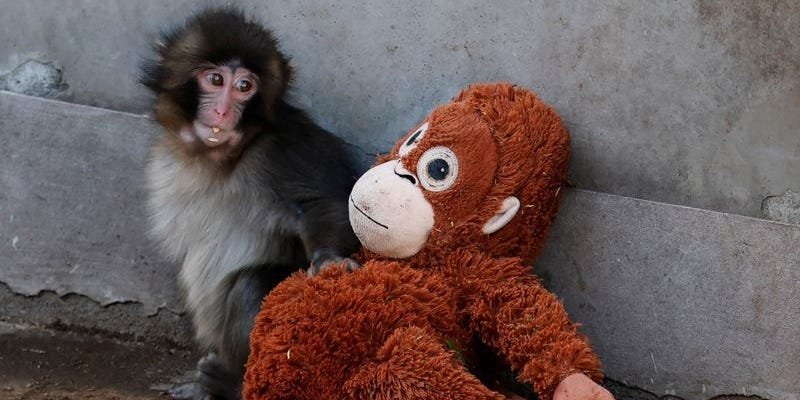
Punch, also known as Panchi-kun, is a seven-month-old Japanese macaque born in July. His mother abandoned him shortly after birth, and he was later rejected by other monkeys at Ichikawa City Zoo in Japan. To soothe him, zookeepers gave him a brown orangutan plush from Ikea.

Videos of Punch clinging tightly to the orangutan toy — hugging it after being brushed off by an older monkey, carrying it everywhere, even fending off curious monkeys who try to grab it — have racked up millions of views on TikTok. The clips turned the lonely macaque into an internet star.


monkey toy punch

Punch found comfort in an Ikea plush.

JIJI PRESS / AFP via Getty Images


A Japanese hashtag that translates to “hang in there, Punch” has also been trending, with users around the world rallying behind the baby monkey.

Viewers identified the plush as Ikea’s Djungelskog orangutan, and now it’s swinging off shelves at top speed.

Javier Quiñones, commercial manager at Ingka Group, which operates Ikea stores worldwide, told Business Insider on Monday that Ikea has “seen a clear increase in sales of the DJUNGELSKOG orangutan toy, particularly in Japan, the US, and South Korea” over the past few days.

The toy is sold out in some stores in those regions, and the company is “making sure that the toy is back in stock as soon as possible,” Quiñones said.

“The toy has long been one of our most sought-after across markets, and the story from Japan is now giving it a little extra love,” he added.

An Ikea spokesperson said the Japan team has reached out to the zoo to explore ways to help Punch.

“On February 17, IKEA donated several soft toys, including additional orangutans, as well as storage items to support Punch and enhance areas for children visiting the zoo,” the spokesperson said.

“Just like the zookeepers, we sincerely hope that Punch will soon become comfortable in an environment with the other monkeys and no longer need the soft toy,” the spokesperson added.

The orangutan plushie retails for $19.99 in the US, both in stores and online. Business Insider’s check of Ikea’s website on Tuesday found the toy out of stock at most US locations, with only about six stores still offering click-and-collect or in-store purchases.

The frenzy also spilled onto resale platforms, where prices climbed quickly.

A search on eBay on Tuesday showed multiple listings for the orangutan plush, with one seller asking as much as $328, more than 16 times the retail price.


Source link

Did-you-miss-Amtraks-viral-Trak-Suit-launch-You-may.jpeg

Did you miss Amtrak’s viral ‘Trak Suit’ launch? You may get another shot.

  • Amtrak’s ”Trak Suit,’ designed by a New York School of Design student, was on sale for four days.
  • The limited release, which ended February 2, was popular enough that Amtrak is considering a second run.
  • The rail line is considering mass production with more versions at varying price points.

As someone who has spent more than 150 hours on Amtrak trains, let me tell you, comfort and functionality are key when selecting an outfit. Bonus points if you can make it look cool.

Enter Amtrak’s ‘Trak Suit, a blue and white microfiber fleece poly fabric set that has a detachable sleep mask in the hood, a color block pant design, and an embroidered Amtrak logo. The suit sold for $279 on the rail line’s website from January 29 to February 2.

The limited release was so popular that Amtrak is thinking about bringing it back.

“Given the great response we are seeing from fans, we are evaluating an extension or second run,” an Amtrak representative told Business Insider. “If we choose to mass produce these in larger quantities, we may even consider a few different versions of the design at different price points.”


A model wears the Amtrak 'Trak Suit on a staircase

Amtrak’s ‘Trak Suit was designed by a student the New York School of Design, Anastasiia Lukinskaia.

Amtrak


The ‘Trak Suit was designed by New York School of Design student Anastasiia Lukinskaia last fall.

When Amtrak launched the NextGen Acela train in August 2025, the rail line selected seven students from the New York School of Design to create two track suits to showcase during New York Fashion Week in fall 2025.

“When we revealed the ‘Trak Suits collection during fashion week in New York, the response from our fans was incredible,” Amtrak Vice President, Digital & Brand Management, Jessica Davidson, said in a press release.

I plan to spend hundreds more hours on Amtrak trains, so if the ‘Trak Suit comes back, I just might get one.


Source link

Gary-Marcus-calls-out-viral-AI-essay-as-alarmist-hype.jpeg

Gary Marcus calls out viral AI essay as alarmist ‘hype’

If that viral essay about AI had been printed on paper, there’s a good chance AI researcher Gary Marcus would’ve ripped it up in disgust.

Marcus acknowledges something is happening in AI — just nowhere near the scale described in the recently viral essay, which predicted a looming disruption “worse than COVID.”

Marcus, who on X criticized the essay written by entrepreneur and investor Matt Shumer as having “not a shred of actual data,” dismissed its contents as alarmist in an interview with Business Insider.

“Hyped-up views have gotten us into a bad place, possibly one that’s going to lead to a serious economic recession or something like that,” Marcus told Business Insider. “And I guess I think that one should work from the facts rather than just trying to cause an alarm.”

In his essay titled “Something Big is Happening,” Shumer, whose past startup sells a subscription-based AI-assisted writing tool, warned that AI would upend not just software engineering, but most jobs done “on a screen.” Shumer also has a small VC fund.

Marcus said that while AI will replace some labor and affect jobs, the process will be much slower than what Schumer and others are describing.

AI can do some things well and help speed up work, but it’s just not near the point of replacing humans, Marcus said.

“AI can do a small subset of the tasks, and that sometimes speeds up human beings and things like that, but it rarely does all of what a human being can do in any particular domain,” he told Business Insider. “This will change over time, just to be clear. It is likely that AI will replace most human labor over the next century, but it’s not likely that it will over the next year or two.”

Companies that move too quickly to replace jobs with AI are likely to find themselves in a similar position as Klarna, Marcus said. In 2024, Klarna touted an AI assistant that could do the equivalent work of 700 people. By May 2025, CEO Sebastian Siemiatkowski, long a proponent of AI, said that “as cost unfortunately seems to have been a too predominant evaluation factor when organizing this, what you end up having is lower quality.” He added that “investing in the quality of the human support is the way of the future for us.”

“Six months or a year later, they come back with their tails between their legs because it turns out that the AI systems don’t do things as well as the human,” Marcus said. “So, I’m not saying that there’s nothing going on. I’m not saying that there’s no value in these AI systems, but they’re premature.”

Klarna told Business Insider that the number of its customer service queries handled by AI has increased “as it gets better at more complex requests,” and the company “has not reversed or scaled back its AI strategy.”

Marcus said that the more likely outcome in the short-term is not that AI will replace junior employees but rather that executives think it’s capable of doing so — and make what could ultimately prove to be a costly gamble.

“The biggest thing I think junior people have to worry about right now is a misapprehension by the C-suite that these techniques work better than they actually do,” Marcus said.

As of Friday morning, Shumer’s post has been viewed more than 80 million times on X alone. In a Substack post expanding on his criticisms, Marcus called Schumer’s post “weaponized hype.”

“The general impression that he conveys is basically that the sky is falling now, and at most, I think what’s really happening is the junior people are under some threat, and I think that threat is actually exaggerated,” Marcus told Business Insider.

Shumer previously told Business Insider that he wrote his essay in part to reach people like his dad, who may be skeptical or avoid AI entirely. He felt compelled to warn them about what might be on the horizon, even “if there’s just a 20% chance of it happening.”

Marcus’s biggest critique of Schumer’s post is that it doesn’t take into account current data and research showing that AI still has a long way to go, and that it didn’t present the full context behind a famous Model Evaluation & Threat Research graph assessing AI progress.

He said that other studies, including a June 2025 paper published by Apple’s Machine Learning Research Group, found limitations in what current models can do.

Marcus also said that many leading AI CEOs who have made bold predictions about the future of work have failed to deliver on past ones. He points to xAI CEO Elon Musk’s frequent rosy outlook on the number of robotaxis Tesla will put on the road (Musk once said one million by 2020) and to Nobel laureate Geoffrey Hinton’s 2016 statement that the world should stop training radiologists. (Last May, Hinton told The New York Times that his prediction was poorly worded and that while he was wrong on the timeline, the general direction for AI’s capabilities in radiology was correct.)

“What they have all learned to do is to sell the rosiest picture possible, and the media rarely calls them out,” Marcus told Business Insider.

On Thursday, Microsoft AI CEO Mustafa Suleyman made waves by predicting that most, if not all, white-collar tasks could be automated within the next year and a half.

One of the industries Suleyman mentioned is accounting. Marcus isn’t convinced.

“Think about accounting in particular,” he told Business Insider. “Even one mistake can cost a client hundreds of thousands of dollars or get them sent to jail or whatever. Accounting is a business that is built on accuracy. If you’re not accurate, you don’t have a business.”


Source link