By day, I was climbing the corporate ladder, eventually leading large operational teams at companies like Bank of America and later serving as a senior executive overseeing multimillion-dollar programs.
Outside the office, another calling was quietly shaping my life: surrogacy.
I spent years climbing the corporate ladder
My time at Bank of America culminated in 2014, when I led a 100-person team as vice president of program operations. I thrived in the fast-paced corporate environment and felt challenged every day. I next worked as the chief project management officer for a finance company and, at a consulting firm, managed technology projects with an operational lens.
My background as a state-qualifying debater and my natural inclination toward systems and structure made my work intuitive. Much of my time at BofA was spent rebuilding inefficient programs and redesigning broken processes. By every traditional measure, I had “made it,” but something from my past kept pulling me away.
While my career was stimulating, I found myself still chasing fulfillment.
I was 26 when I delivered my first baby for another family
I became a surrogate for the first time after having three children of my own and while attending night school to become a nurse, which was my career plan before BofA.
As an adopted person, my definition of family had always been broader than most. When my brother came out as gay, I vividly remember the day he confided in me that one of his greatest fears was not being able to become a parent. That moment left a lasting impression.
For me, becoming a mother had come easily — but I knew that wasn’t true for everyone. I wanted to help people like my brother experience the life-changing joy of parenthood. I loved being pregnant, met all the medical criteria, and applied to be a surrogate.
Over the next 13 years, I carried six children for three families
I helped expand two families through egg donation, and completed my own family — with my IVF-assisted daughter — at 37.
Carrying another person’s child is as intimate as you might imagine. Every intended parent I met was kind, generous, and deeply invested in the process.
What troubled me was the industry itself. I often saw surrogates treated as a means to an end, with inconsistent support and lax standards. Looking back, I shouldn’t have been approved for as many journeys, or as close together, as I was.
Yet despite those flaws, my experiences with third-party reproduction — witnessing new parents hold their babies for the first time and knowing people like my brother had options — affected me in a way I couldn’t shake.
After each journey, I felt called back. Despite my corporate success and the joy I found in motherhood, that pull only grew stronger. After a particularly grueling year in my consulting job, I decided to act on it and quit.
I started my own surrogacy company
In 2019, after years of envisioning what an ethical surrogacy agency could look like, I launched Alcea Surrogacy. My goal was to create a company that prioritized transparency, care, and integrity for everyone involved.
At the time, my children were 1, 13, 17, and 20 years old. Balancing their needs while launching a business felt like climbing a mountain in heels. I often rocked my youngest to sleep while answering client emails late into the night.
As the business grew, I strategized in the quiet hours, a toddler on my lap, while I spoke to clients on two hours of sleep.
The early days were unforgiving
Starting a business is never easy, and launching one during a pandemic made it harder. In 2021, I was flying back and forth between my home in Texas and New York before officially relocating my family there in 2022. I faced skepticism from an industry wary of disruption and judgment from people who didn’t understand my choices. I didn’t let that deter me.
Alcea has since grown into four channels: a referral network connecting surrogates and intended parents with ethical partner clinics; Alcea’s core surrogacy services; a private client division supporting high-profile families seeking discretion; and a philanthropic program assisting intended parents with financial need.
We’ve grown to 23 employees and $5 million in annual revenue, and I’ve surpassed the highest corporate salary I ever earned.
Some things just feel like kismet
From day one, it was clear that the combination of empathy, systems thinking, and grit I’d developed in the corporate world would serve me well as a founder. My healthcare background, repurposed for leadership and project management, taught me how to streamline processes, manage people, and anticipate challenges — lessons that proved invaluable in navigating the complex surrogacy landscape.
Launching Alcea wasn’t just a professional risk; it was deeply personal. I promised myself I’d always put my family first, but I also refused to let fear or expectation dictate my ambitions. Returning to work days after deliveries, breastfeeding while speaking with clients, and managing a growing business while raising four children taught me that determination, focus, and grit can overcome almost anything.
I haven’t found work-life balance, but my career satisfaction is immense. If I say I’ll do it, I’ll do it.
A person’s go-to Taco Bell order is a sacred thing.
Selena Gomez was eating a Mexican Pizza when Benny Blanco proposed. Jason Sudeikis grabbed two chicken tacos on the night his son was born. When Dolly Parton would go through the drive-thru on dates with her husband Carl Dean, she always ordered a Taco Supreme.
I’m partial to the Cantina Chicken burrito, and just last week, I convinced three different friends to try it during our 1 a.m. Taco Bell run (which somehow racked up to $117, but that’s another story).
So, when I recently sat down with Taco Bell CMO Taylor Montgomery, I knew I had to find out what his usual order is. Montgomery eats at the fast-food chain every other day, but his go-to hasn’t changed — nor has his wild hot-sauce count.
Taylor Montgomery and Benson Boone at Live Más Live on March 3.
Courtesy of Taco Bell
“My order is still the same,” Montgomery, who has worked at Taco Bell for a decade, told me. “Crunchy tacos, one Fire sauce packet per bite. I have like 10 sauce packets per taco.”
“If I’m really hungry, it’s three tacos,” Montgomery added. “If it’s a normal day, it’s two.”
“Per bite!?” I asked. I’ve been known to rip through a few of Taco Bell’s hot and avocado verde salsa packets myself, but 10 was a whole new level.
“Oh yeah,” Montgomery replied. “You gotta go big. Fire sauce, only Fire.”
‘We truly are one of one’
While some fast-food brands have spent the past week trying to outdo each other with burger taste-test videos, Taco Bell has been focusing on the premiere of Live Más Live, an annual event where the chain unveils every new menu item it plans to release during the year.
Montgomery was originally inspired by Apple’s Worldwide Developers Conference when he helped launch the first Live Más Live in 2024. This year, the CMO knew he wanted to shake up the format.
Taco Bell Live Más Live 2026 took place at the Hollywood Palladium in Los Angeles.
Courtesy of Taco Bell
“We truly are one of one, just like Apple, just like Amazon, just like Tesla,” Montgomery said. “So I started to look at how some of those companies are behaving, and they are behaving like entertainment companies. That’s what consumers want. That’s what consumers’ expectations are.”
“That’s how Live Más Live, an unhinged night in Hollywood, was born,” he added.
Taco Bell hired the production team behind the Academy Awards, made a streaming deal with Peacock, and rented out the Hollywood Palladium in Los Angeles for a one-hour awards show on March 3. Celebrities like Sudeikis, Doja Cat, Benson Boone, and Demi Lovato were on hand to help announce the 20-plus new items coming to Taco Bell’s menu in 2026.
Taco Bell’s Fire Queso Sauce Packet is an edible version of the famous hot-sauce packet.
Courtesy of Taco Bell
Montgomery said he hopes the event makes Taco Bell’s fans feel “seen and heard,” noting that the chain also listened to their pleas for more sweet treats.
“One of the most requested things we hear from our fans is, ‘I want more desserts at Taco Bell,'” he said.
Crème Brûlée Crunchwrap Sliders, Strawberry and Cream Mexican Pizza Bites, and chocolate fudge empanadas will all be coming soon, but Montgomery said the core of Taco Bell’s brand is still “crunchy, cheesy, saucy, spicy.” This year’s menu slate even includes an edible version of Taco Bell’s Fire hot-sauce packet.
The real question is, will Montgomery be using 10 of them per taco?
At the start of his Congressional deposition Friday, Bill Clinton addressed the trove of photos of himself with Jeffrey Epstein released by the Justice Department last year.
In opening remarks posted on social media, the former President said he didn’t have any knowledge of Epstein’s sex trafficking operation — despite anyone’s “interpretation of those 20-year-old photos.”
“I had no idea of the crimes Epstein was committing,” Clinton said of the convicted sex offender, who died in jail in 2019 while awaiting trial on sex-trafficking charges. “No matter how many photos you show me.”
Clinton posted the remarks ahead of his closed-door deposition in Chappaqua, New York, before members of the House Oversight Committee, which has been investigating Epstein’s connections to powerful people.
In December, in response to the Epstein Files Transparency Act, the Justice Department released several photos showing Clinton with Epstein and Ghislaine Maxwell, who is now serving a 20-year prison sentence for trafficking girls to Epstein for sex. The photos show Clinton and Maxwell swimming together in a pool, along with a woman whose face is redacted. They also show Clinton in what appears to be Epstein’s private jet with a female, whose face is redacted, on his lap.
The photos also show Bill and Hillary Clinton at parties and dinners with Epstein.
A photo of former President Bill Clinton, Ghislaine Maxwell, and an unidentified woman was included in the Justice Department’s Epstein files.
Department of Justice
The former president has long maintained he had no knowledge of Epstein’s sexual abuse. Epstein occasionally visited the White House while Clinton was president, and Clinton has said he traveled internationally with Epstein on his private jet four times between 2002 and 2003, following his presidency, for Clinton Foundation initiatives. There’s no indication the two were still in contact by the time Epstein pleaded guilty to soliciting prostitution from a minor in Florida in 2008.
“As someone who grew up in a home with domestic abuse, not only would I not have flown on his plane if I had any inkling of what he was doing — I would have turned him in myself and led the call for justice for his crimes, not sweetheart deals,” Clinton said in the opening statement of his deposition.
Maxwell appeared to have her own relationship with the Clintons.
Epstein files previously released by the House Oversight Committee include a photo of “Margaritaville” singer Jimmy Buffett, his wife, Bill Clinton, Ghislaine Maxwell, and Jeffrey Epstein.
House Oversight Committee
She worked to obtain funding for the Clinton Global Initiative, records released by the Justice Department show. Maxwell also said in an interview with Justice Department Deputy Attorney General Todd Blanche last year that she was closer to Clinton than Epstein was.
“President Clinton was my friend, not Epstein’s friend,” she said.
“President Clinton liked me, and we got along terribly well. But I never saw that warmth, or however you want to characterize it, with Mr. Epstein — so I didn’t see that,” Maxwell said in her interview. “I didn’t see President Clinton being interested in Epstein. He was just a rich guy with a plane.”
Bill Clinton’s deposition on Friday follows Hillary Clinton’s on Thursday. She said she didn’t think she ever met Epstein. She has said she met Maxwell on “a few occasions” in social settings.
Republicans on the House Oversight Committee said they would publicly release videos of the depositions of Bill and Hillary Clinton, as they did with a deposition of Les Wexner, the billionaire founder of L Brands, who previously hired Epstein as a financial fixer.
Clinton’s deposition marks the first time a former president has been compelled to testify to Congress pursuant to a subpoena.
Democrats on the committee say Clinton’s deposition marks a precedent that should require President Donald Trump, who has also been photographed with Epstein, to testify before the committee.
If you are a survivor of sexual assault, you can call the National Sexual Assault Hotline (1-800-656-4673) or visit its website to receive confidential support.
I didn’t set out to follow a political diet, or any diet at all, really. But it was January, the new food pyramid was out, and according to the people in charge, it was healthy and easy to do on the cheap. Plus, I like a challenge.
At the start of the year, Health and Human Services Secretary Robert F. Kennedy, Jr. announced the federal government’s new dietary guidelines for how Americans should aspire to eat. The gist: meat, full fats, and whole foods are in; sugars, processed foods, and excess carbs are out. After complaints that the recommendations leaned toward pricier food categories, the Secretary of Agriculture said you could follow the new protocol for as little as $3 a meal. I had my doubts, given grocery prices and inflation. Apparently she (or her staff) did, too, because Rollins later amended her indications to $15.64 a day.
Despite my reservations, I decided to try it myself. For seven days, I would follow what I came to think of as the “RFK diet” on a $15-a-day budget to see just how realistic this whole thing was. Would I have regrets? Of course. Would I learn something? Honestly, yes — among other things, that spices are my friend, that I don’t like apples that much, and that food is more political and emotional than we realize. Our identities, beliefs, and social statuses are wound up in every single decision we make, including what’s for breakfast, lunch, and dinner.
The Shopping Trip
I am not used to making a weekly grocery haul. One of the blessings of living in New York City is that there’s usually a store close enough that it’s fine to make multiple trips a week. This makes up for one of the curses of NYC, which is that most people don’t have a car, so whatever you buy, you carry. So I enlist AI’s help to ensure I don’t miss anything and to make my spending calculations easier. I input the new guidance, explain my financial constraints, and the machine spits out a shopping list. As I scribble it down, I decide that a line from ChatGPT will be my shopping philosophy: “This is not maximal pleasure. This is maximal compliance + realism.”
Once I’ve hit the aisles, I adopt a second shopping philosophy: undershoot the budget. I can spend up to $105, but I wind up paying $70.31, leaving myself a $34.69 emergency fund in case things go awry. I’m actually pretty close to that initial $3-a-meal estimate, which would have left me with a $63 weekly budget.
Since, besides the federal government, I am the one making the rules here, I decide on some adjustments. I’ll use the olive oil, butter, salt, pepper, and spices already in my apartment because part of thrift is utilizing the resources you already have. The same goes for my already-owned instant coffee that will serve as a vehicle for whole milk. Moderate alcohol consumption is not an official budget consideration, but it seems fine since Dr. Oz says it’s allowed and Dry January is passé. Price, quality, and availability are a delicate balance — I buy the cheapest peanut butter and ignore the ingredients list, which is surely not RFK Jr.-approved.
After making some tough calls, this is my haul:
1 bag potatoes
1 bag onions
1 can chickpeas
1 loaf whole grain bread, or the closest the store had to it
1 head cabbage
1 jar peanut butter
1 bag apples
1 block sharp cheddar cheese
½ gallon whole milk
2 dozen eggs
1 bag baby carrots
1 bag lentils
1 bag brown rice
1 bag frozen mixed vegetables
1 bag frozen peas
1.5 lbs ground beef
3 lb 8-piece cut chicken that I don’t think I understood what it was
Honestly, not a bad haul for $70.31.
Emily Stewart/Business Insider
Day 1: Tuesday
It would have made more sense to start this on a Monday morning, but there was a big snowstorm over the weekend, so Tuesday night kickoff it is. I start with some manageable basics, meaning I boil six eggs and rice and put them in the fridge, and I pick an easy recipe. Spoiler alert: I’m a terrible cook, so this is going to be a journey.
I’ve never been much of a food prepper (or life prepper), so I’m pretty impressed with myself for what I’d imagine others might consider a pathetic performance. My dinner is decent. ChatGPT has armed me with a plan for my leftovers. I have not yet over-potatoed, nor am I aware that sentiment is on the horizon.
Dinner: Roasted chicken breast with potatoes and carrots
The vibe: Cautiously optimistic, until I remember this plan does not allow for dessert.
One of the reasons I am bad at cooking is that my kitchen is tiny.
Emily Stewart/Business Insider
Day 2: Wednesday
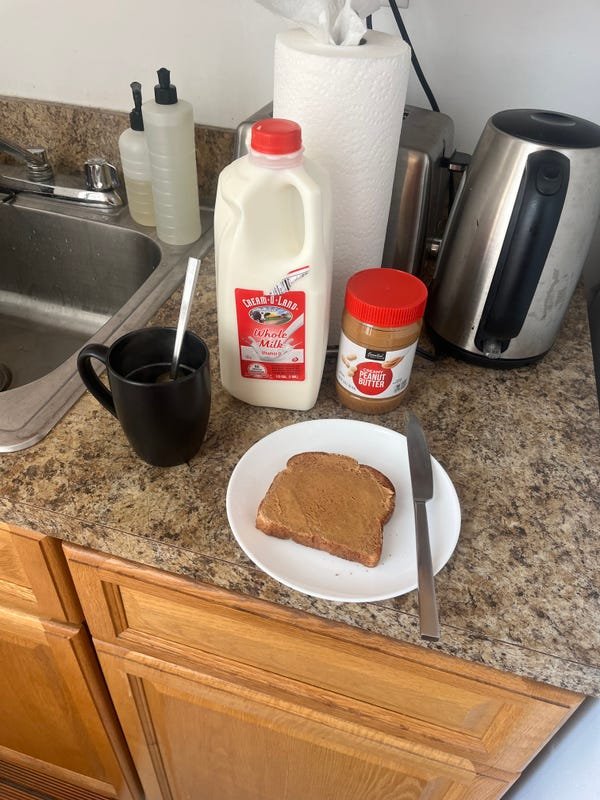
My AI-assisted meal plans tell me I have a variety of breakfast options. My heart tells me I have only one — bread with peanut butter — which I fear may be the culinary highlight of my week. A midday trip to the dentist and the accompanying novocaine make me nervous about the lunch situation, but luckily, my meal is basically mush — chicken, rice, and peas. I make a different combination of ingredients into what appears to be a largely identical plate of mush for dinner, and set aside the leftovers from my lunchtime mush for the office tomorrow.
At some point during all of this, I realize that I have the ingredients for an actual good mush: mashed potatoes. This is very exciting. Post-dinner, I notice a coworker’s Instagram story of his New York Times-inspired creamy lasagna soup creation, which fits neither my diet nor my budget. My excitement fades.
Breakfast: 1 piece of toast with peanut butter, coffee with milk
Lunch: Chicken breast, rice, and peas
Snack: 1 apple, 2 slices cheddar cheese
Dinner: Ground beef skillet with onion, carrot, cabbage, and rice
The vibe: This is a lot like how I ate when I was broke in my 20s. I remember why I’m not a big fan of peas. Thank God for cheese.
Breakfast. Emily Stewart/Business Insider
Food prep. Emily Stewart/Business Insider
The cheese <3. Emily Stewart/Business Insider
Day 3: Thursday
I’ve reached the “bargaining” stage of this endeavor quicker than I thought. I catch myself looking at the new and improved food pyramid multiple times throughout the day to see if there’s something affordable but delicious that I’m missing. Broccoli? An avocado? The official guidelines list kimchi, which seems like the coastal political elite seeping through. Also, it’s $10 in the grocery store, so no.
ChatGPT assures me the free seltzer water in my office is allowed, which is a treat. When someone in the office announces there are free Girl Scout cookies on her desk, I don’t bother asking the robot if that’s OK, because I already know the answer. I meet a friend for drinks after work and, somewhat ashamedly, explain that I can’t stay for dinner because I pitched what I have now definitely decided was a very stupid idea. I will probably cheat sooner rather than later, but not yet.
Breakfast: 2 hard-boiled eggs, coffee with milk
Lunch: Chicken, rice, and peas
Snack: 1 apple that I spent $1 on because I did not plan and forgot to bring one from home
Dinner: Ground beef skillet with onion, carrot, cabbage, and rice
Vibe: I have to find a way to mix this up tomorrow.
Mush 1. Emily Stewart/Business Insider
Mush 2. You can see the problem. Emily Stewart/Business Insider
Day 4: Friday
The point of food isn’t just nourishment — it’s pleasure. This is a sensation that this diet is severely lacking.
In the midst of my desperation, I text Morgan Dickison, a registered dietitian at Weill Cornell Medicine, to ask for advice. The first thing she asks after I show her my food diary is whether I’m hungry, which I’m not — I’m having some pretty big portions, and the food isn’t exactly triggering additional cravings. She suggests seeking out some herbs, spices, and flavored oils, budget permitting. This prompts me to take a harder look at the spices in my cabinet to see what I might be able to incorporate. Her most specific recommendation: Rao’s tomato sauce — it’s not ultra-processed, and there’s no added sugar. (This is not the case, unfortunately, with Rao’s pesto.) She also low-key recommends I cool it on so much red meat. I wonder what RFK would say.
I head to the grocery store to buy Rao’s, but over the course of my five-minute walk, I forget why I’m there. I leave with chicken, an avocado, broccoli, two tomatoes, and corn tortillas, totaling $12.62. I have $22.07 left. Plus the $1 apple, so $21.07. Despite blanking on the sauce, the Morgan consultation/pep talk inspires what has been my best meal yet. Things may be looking up.
Breakfast: 1 piece of toast with peanut butter, coffee with milk
Lunch: Beef skillet with onion, carrot, and lentils
Snack: Hard-boiled egg, 2 slices cheddar cheese
Dinner: Grilled chicken breast with mashed potatoes
Vibe: Real live dietitian >>>>> AI.
This tastes better than it looks.
Emily Stewart/Business Insider
Day 5: Saturday
I am pretty committed to this bit, but I also don’t want to be a freak. After a glass of wine at the Westminster dog show agility preliminaries (which is awesome), I realize I have to eat something, lest I be too buzzed to enjoy the amateur canine obstacle courses. I get an $8 chicken empanada, which almost certainly breaks the rules. I decide the day has no more rules and go out for dinner.
Breakfast: 1 corn tortilla with 2 slices of cheddar cheese, in a quesadilla-type situation
Lunch: 1 chicken empanada
Dinner: Don’t worry about it
Vibe: Between the very agile dogs and my cheat meal, I have had a great day.
The dog show empanada and, more importantly, a dog on the agility course, about to do “the weave.”
Emily Stewart/Business Insider
Day 6: Sunday
I wake feeling more confident about this experiment, thanks to my Friday dinner semi-success and probably the glow of Saturday’s rule-breaking. I make an actually good brunch-type situation, and by “I make” I mean I generally start some things and then my boyfriend, a much better cook, takes over.
For dinner, it’s too cold to go to the store, so I manage to scrounge up the ingredients from my boyfriend’s brothers’ apartment to make pasta and homemade pasta sauce. I use it to concoct the chicken Parmesan I’ve been thinking about since my failed Friday Rao’s trip. I’m not sure if this is completely allowed, with the pasta (which is organic!) and also chicken breading, but I’m following along in spirit.
Part of what set this exercise in motion was comments from Agriculture Secretary Brooke Rollins, where she recommended a meal composed of a piece of chicken, a piece of broccoli, a corn tortilla, and “one other thing.” This is what I choose for my lunch finale, adding a quarter of an avocado as my “other thing.” It’s pretty good, though I have to embiggen it from the description to make it actually filling.
Breakfast: 1 corn tortilla with 2 slices of cheddar cheese, ¼ avocado
Lunch: The Brooke Rollins Special — 1 corn tortilla, chicken, broccoli, and ¼ avocado
Dinner: Ground beef and chickpea skillet with broccoli
Vibe: Victory.
Thank you, Secretary Rollins, for the inspiration. Honestly, it was pretty good.
Emily Stewart/Business Insider
So what did I learn from the diet?
Doing the RFK diet on a $105-a-week food plan was not as hard as I thought it would be. I came in under budget by $13, even with the mid-week grocery trips and the dog show empanada (and not counting the Sunday freebies or Saturday cheat meal). But being on such a strict diet and budget did lead to some notable limitations. My regimen lacked any appreciable amount of variety, and it made eating into an act focused almost exclusively on survival.
I ask Dickison, the dietitian, for a final rating of my adventure once I wrap it up. She says that, like a lot of people, I have room for improvement with fruits and veggies, commends my integration of chickpeas and lentils, and says I did a good job with protein at every meal, even if I was too heavy on ground beef. The budget piece of this undertaking is the hardest part, she says. It makes it challenging to incorporate some of the new food pyramid recommendations, such as berries, fresh vegetables, and fish, and it’s not aligned with how people live. “When I’m speaking with patients, we talk about all the different ways that you get food,” she says. Sure, sometimes it’s cooking at home, but it’s also fast casual at the office, a restaurant on a night out, or delivery when people are pressed for time. “The more convenient the option, the more expensive it gets,” she says.
What’s also unrealistic: The ability to religiously follow such a rigid diet for an extended period of time. Hunger levels and cravings matter. “It can be really difficult to manage those biological drives and also this premeditated budget, even if you did have the best intentions,” Dickison says. I wish I could text her every day for food advice, but I fear she would block my number.
This funny little food journey of mine has coincided with a giant internet debate about some people using DoorDash too much and others scolding them for not cooking more at home. After a week of being bound to team cook-at-home, I’m overly sympathetic to team DoorDash, if only because I’ve spent the past week envisioning the treat I’m about to get myself — via my delivery app of choice, Seamless — now that this is all over. Variety is, as the eye-rolling adage goes, the spice of life. Being able to switch up not only the dish but also the delivery method from time to time is part of that.
The experience has made clear the sacrifices we constantly make around affordability, sustenance, and gratification when it comes to food. The cheapest option is never the healthiest option. The healthiest option is never the most thrilling option. The most thrilling option may be the cheapest, but it’s usually bad for you.
It’s an economic issue as much as it is cultural and political. When people on the lower end of the income spectrum — or public benefits — are told to focus on whole-food basics, they’re told to give up on ease and joy as well. When people rely too much on delivery, they’re almost certainly overspending, but they do so because it saves time and energy compared to an elaborate kitchen production. It’s true that it’s generally better to cook real meals with fresh ingredients at home. It’s also true that life is complicated, and for a variety of reasons, that’s not always possible. I probably could have stretched my budget just as far, if not farther, with frozen, preprepared options.
Ultimately, for most of us, dinner is less of an ideological project than it is a daily logistical problem — one that has to be solved, night after night, in perpetuity.
Emily Stewart is a senior correspondent at Business Insider, writing about business and the economy.
Business Insider’s Discourse stories provide perspectives on the day’s most pressing issues, informed by analysis, reporting, and expertise.
This as-told-to essay is based on a conversation with Zina Malas, 24, who lives in Beirut. The following has been edited for length and clarity.
When I visited Canada as a 5-year-old, it was the dream.
I was born and raised in Lebanon, and grew up fearing I’d get kidnapped in the streets or a random bomb would fall on me. After war broke out in 2006, our family moved to Canada to escape.
I loved it. There were nice parks, and “exotic” activities like ice skating.
After a few months, my family went back to Lebanon, where I did my undergrad.
Every time Charissa publishes a story, you’ll get an alert straight to your inbox!
Stay connected to Charissa and get more of their work as it publishes.
Malas loved living in Canada as a child.
Courtesy of Zina Malas
In 2022, at 21, I moved to Canada alone.
Three years in, I had struggled to find a job or save money, and began feeling very depressed, so I moved back to Lebanon.
I’d still advise others to try relocating abroad, but living in Canada just didn’t work for me.
I grew desperate to leave Lebanon
Living in Lebanon was a struggle. I felt like I’d lost my youth and was desperate to leave, even if I had to work a minimum wage job.
My time spent studying media and communication at the American University of Beirut was disrupted by a national revolution that started in fall 2019, COVID, and the Beirut explosion in August 2020.
I already had friends in Montreal and Canadian citizenship through one of my parents, so I headed to Canada and gave myself three months to find a job.
I didn’t realize how difficult it would be to find a job in Canada
Even though my Montreal friends warned me that finding a job wouldn’t be easy, I didn’t think it would be that hard.
They were right. It was absolutely horrendous.
In Lebanon, where I had some jobs during my studies, I experienced less competition for work. I was used to sending my application to a potential employer, DM’ing the company on Instagram, and having an interview the next day. But in Canada, I applied for roles across marketing, social media, and business development, which I felt I had the skills for, but didn’t land any.
Some recruiters told me I didn’t have the right experience. I’m not sure if it was because my experience was Lebanese or not Canadian, but it felt like people were treating me like I had no professional history.
Job hunting was difficult for Malas.
Courtesy of Zina Malas
I also struggled to understand interviewers who spoke Québécois French, a dialect used in Montreal. I went to a French school in Lebanon, so I’m fluent, but I couldn’t for the life of me understand this particular accent, which lost me opportunities.
After applying for what I’d estimate were at least 200 jobs, I connected with a Lebanese HR rep who saw my résumé and gave me the chance to interview for a content manager role. After roughly three months of searching,it became my first job in Canada.
I stayed at the company for 1.5 years, and then moved into tech sales at a different company for a few months.
The cost of living and isolation in Canada drove me to leave
In Lebanon, the work culture was generally less formal. I could show up late to work in a random outfit and no one would say anything. We could have disorganized files and communicate with team members over Whatsapp. It was friendly and laid-back.
In Canada, things were more organized. I knew exactly what my tasks were, and was given proper equipment. I remember being shocked when I was given a MacBook and phone number for work.
My compensation in Canada was good compared with what I could make in Lebanon. I had a nice life, a nice apartment, and ate well. But with the cost of rent, bills, and groceries, I feel like I wasn’t saving much, and was basically living paycheck to paycheck. It’s one of the reasons I left.
Malas struggled to make new friends in Canada.
Courtesy of Zina Malas
Another reason was how hard it was to meet new people, and my mental health suffered as a result. Canadian culture is highly individualistic, which is hugely different to the Middle East. In Lebanon, if I go out with one friend to a restaurant, I’ll end up meeting 10 new people. If I tried to talk to people in Canada while I was out, conversations would end abruptly. If my roommate didn’t have friends, with whom I was thankfully able to have a lot of fun, I probably would have been completely alone.
I imagined I’d meet so many new people and have the time of my life, but my expectations weren’t met. Plus, I couldn’t deal with the cold weather.
In September 2025, I went home.
I’m running my own business in Lebanon now, and I’m happier
I’m currently running my own company, Tawlé Consultancy, which helps businesses in the MENA region who are declining or feel stuck. I started it in Canada, but working on it from the West felt weird, as though I was righteously telling people what to do from a distance. Now, I can sit with people, help them come up with new ideas, and feel like I’m making a valuable impact.
Malas runs her own company in Lebanon
Courtesy of Zina Malas
I’ve noticed many people my age in Lebanon are also trying to build their own thing. Our generation has been through a lot, and we’re trying to figure things out and establish ourselves. When I go to coffee shops, I see so many founders around me. It’s very inspiring.
Being in a stable country like Canada eased my mind, as I wasn’t worried about my physical safety, and it helped me deal with the trauma I experienced in Lebanon.
But I’m happier living in Lebanon. I’ve realized I’m too Lebanese to live anywhere else.
Do you have a story to share about moving abroad and deciding to come home again? Contact this reporter at ccheong@businessinsider.com