Even if the partial government shutdown ends soon, the fallout at the Transportation Security Administration could spill into the summer’s marquee event.
In a House testimony on Wednesday, acting TSA administrator Ha Nguyen McNeill said that so many officers have quit since their pay stopped in mid-February that the agency can’t get replacements fast enough to adequately staff airports ahead of the World Cup in June.
She said TSA officers spend four to six months in training before working checkpoints, but the games — which will take place across 16 cities in the US, Canada, and Mexico — start in just 80 days.
“This is a dire situation,” she said, adding that more than 480 officers have quit so far. “We are facing a potential perfect storm of severe staffing shortages and an influx of millions of passengers at our airports.”
TSA agents haven’t been paid for nearly six weeks, yet are deemed “essential” and expected to work during the shutdown, with back pay promised afterward. Their annual pay starts at around $40,000 and averages $60,000 to $75,000 a year with experience.
Still, many live paycheck to paycheck and can’t afford to work unpaid for months at a time — quitting and finding another job or doing gig work is often their best option.
Mass TSA agent quits and callouts amid the shutdown, compounded by peak spring break travel, have already created hourslong security lines and stranded travelers. It’s a preview of the chaos that could repeat when an estimated 6 million fans descend on potentially understaffed airports for the World Cup.
“If we see any spikes [in attrition], we’re going to have to pivot and assess how we are going to staff the FIFA locations adequately,” McNeill said.
Passengers traveling to the scheduled World Cup games in San Francisco and Kansas City, however, are likely safe from staffing chaos.
Both city airports use private security officers employed by contract companies instead of TSA, meaning their agents are being paid despite the shutdown.
It’s not just the TSA sounding the alarm
Former Republican Sen. from Oklahoma, Markwayne Mullin — who was confirmed as the new head of the Department of Homeland Security on Monday after Kristi Noem’s ousting in early March — said in a Senate hearing last week that the US is “behind” on World Cup preparations and the shutdown is making it worse.
“It’ll take four months once funding comes in to start replacing those that we’ve lost for training before we can get them out in the field; we don’t have four months with FIFA,” he said. “How do we expect these people to stay on the job and work? We’re losing institutional knowledge, we’re losing people we’ve already trained.”
TSA agents have been working without pay. Many are calling out or quitting, causing lines to pile up at airports across the US.
CHARLY TRIBALLEAU / AFP via Getty Images
The mass quits are exacerbating a problem that was already flagged last year.
A February 2025 report from the US Travel Association — long before the shutdown’s impact could be factored in — warned that the TSA may not be efficient enough to handle surging travel volumes during the World Cup.
On its busiest days, the agency screened about 3 million passengers. During the games, the organization said that level of traffic would be the norm.
Lawmakers are still negotiating a funding deal to reopen DHS and end the partial shutdown.
The two big leagues in the toy world are joining forces: Pop Mart’s iconic Labubu doll is getting a Sanrio makeover.
The collection features Labubus dressed as popular Sanrio characters, including Hello Kitty, Cinnamoroll, Kuromi, My Melody, and more.
The small 7-inch Labubu keychains in the collection are priced at $39.99 and sold in blind boxes, which conceal the exact character inside, making the purchase feel like a gamble.
The collection also includes 15-inch plush dolls priced at $149.90.
The collection will go live on Pop Mart’s online store on Thursday at 10 p.m. E.T. It will be available in stores in April, Pop Mart said in the press release.
Every time Aditi publishes a story, you’ll get an alert straight to your inbox!
Stay connected to Aditi and get more of their work as it publishes.
“Both LABUBU and Sanrio have passionate fanbases, and this partnership engages collectors and fans alike, blending timeless Sanrio appeal with the playful mischief that has made LABUBU a global icon,” said Emily Brough, Pop Mart Americas’ head of licensing, in the press release.
This is not the first time Pop Mart, a Chinese toymaker, has pulled off a flashy collaboration. It’s partnered with brands like Uniqlo, Coca-Cola, and the anime One Piece.
Shunsuke Kuriyama, a Jefferies analyst who analyzes Sanrio, said the collaboration could be effective in “pooling fans from both sides,” and could “introduce one group to another brand IP, potentially leading to a win-win scenario.”
“Both brands are seeing solid demand from ‘kidults,’ so this collab could drive demand from both groups of fans,” Kuriyama added. “Kidults” is a term for adult collectors of toys who buy them for nostalgia or as emotional support objects.
Per its latest earnings report in September, The Monsters IP — which Labubu is part of — earned a half-year revenue of $700 million USD, accounting for nearly half of the company’s IP sales.
Historically, Labubu launches have drawn huge crowds to Pop Marts around the world. The company has shifted product launches online, but new launches still draw large crowds to physical stores.
In August, when Pop Mart launched its mini Labubu series, the dolls were sold out instantly, and customers flooded its stores in Singapore hoping to get their hands on them.
For Brian Auer, the operations manager at Historic Ships in Baltimore, the video of a US Navy submarine sinking an Iranian warship this week looked strikingly familiar.
“I saw the footage of that Iranian frigate getting torpedoed, and it looks like any picture I see from World War II of a similar attack happening,” he told Business Insider of the video released by the Department of Defense on Wednesday.
Before this week’s attack in the Indian Ocean, the last confirmed US Navy submarine to sink an enemy ship in combat was the USS Torsk, a World War II submarine that sank two Japanese vessels in 1945 before becoming part of the museum that Auer manages.
Since 1945, large-scale battles between warships have been rare. As naval warfare reemerges as a key strategy in Operation Epic Fury against Iran, museum ships that saw combat in World War II are finding new relevance, showing not just how naval war was fought, but how it might look today. Suddenly, the floating museums feel a lot less like history.
“Those of us who work on museum ships don’t like war,” Ryan Szimanski, the curator at Battleship New Jersey in Camden, New Jersey, told Business Insider. “In many cases, we work here to try and teach people about how awful wars were.
“However, the fact that the United States has fought a naval action — one of the first ones since World War II — is making museum ships like us relevant and part of the public discussion in a way that we haven’t been.”
Museum ships offer immersive experiences
Battleship New Jersey in Camden, New Jersey.
Talia Lakritz/Business Insider
There are around 75 World War II-era museum ships open to the public across the US. These decommissioned battleships, submarines, destroyers, aircraft carriers, and other vessels offer visitors the chance to climb aboard and explore the interiors themselves.
Guided tours, often led by Navy veterans with firsthand experience serving on similar vessels, take visitors through combat areas, such as torpedo rooms, gun turrets, and command centers.
Battleship New Jersey, for example, offers a rare look into Tomahawk cruise missiles as the first surface warship to carry them in 1982. The long-range missiles have also been used to sink Iranian ships during Operation Epic Fury.
The combat engagement center on board the USS New Jersey features a Tomahawk Weapons System.
Talia Lakritz/Business Insider
“Because those are contemporary systems, to be able to see a Tomahawk missile, to be able to see Tomahawk missile launchers in a museum — there’s only a handful of museum ships like us that you could come and see to get that experience,” Szimanski said.
Some ships even offer sleepover experiences where guests can eat meals in the crew’s mess and spend the night in sailors’ bunks.
“It is highly unlikely that the average person will get the chance to visit an active-duty Navy ship,” Szimanski said. “So to experience the conditions, to see what it’s like to serve on a warship, particularly one that has seen combat, visiting a museum ship is your best chance.”
‘Remarkably similar’ to modern Navy ships
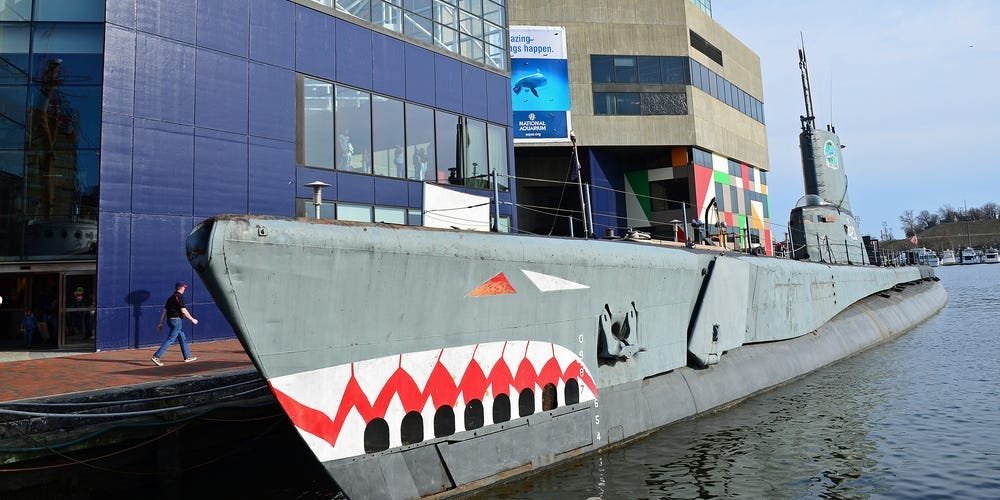
The USS Torsk submarine in Baltimore.
Vacclav/Shutterstock
While some technologies and configurations found in World War II submarines may be outdated, many aspects of how they operate remain the same.
“It’s important to remember that the Navy, the military, all of us, operate in a world governed by laws of physics, and so there are some things that are just never going to change in how submarines work,” Auer said. “If you walk through a modern Ohio-class, ballistic missile submarine, you’re going to find things that are exactly the same, or done exactly the same way, on the USS Torsk. And what we can really show is where those things were first done, and why they were done that way, and why they are still done that way.”
Modern submarines still appear “remarkably similar” to their museum counterparts, Szimanski said. The layout of submarines hasn’t changed all that much since World War II. They largely still have the same spaces to eat, sleep, and fire torpedoes.
Auer says that when he leads tours of the USS Torsk for active-duty sailors, he often gets the response, “Huh, we’re still doing it this way.”
The forward torpedo room inside the USS Torsk.
Pixel Doc/Shutterstock
The biggest differences can be found in the ships’ capabilities, Hugh McKeever, the shipboard education manager at the Independence Seaport Museum in Philadelphia, told Business Insider.
Diesel-powered submarines like the USS Becuna, which sank 3,888 tons of shipping in World War II before arriving at the Independence Seaport Museum, had to spend most of their time on the surface with only about 12 hours’ worth of oxygen at a time. Today’s nuclear-powered submarines operate with an unlimited fuel supply and can stay submerged for upward of six months.
“As far as going out to sea, their ability is pretty much limited only by food,” McKeever said.
Overall, World War II-era submarines are less antiquated than one might assume. Some even still work. The USS Torsk’s sister ship, the USS Cutlass, was commissioned in 1945, sold to Taiwan in 1973, and remains operational as part of the Republic of China Navy.
“These boats, to us, are so outdated that they’re museums, but for the rest of the world, they’re relatively advanced,” Auer said. “They’re still very capable of doing the function they were originally designed for. So, were they implemented by some foreign threat, they would be a threat.”
Floating museums find new relevance
The USS Becuna, a World War II submarine, is part of the Independence Seaport Museum in Philadelphia.
Talia Lakritz/Business Insider
For ship museum curators, the resurgence of naval battles in the US war with Iran underscores the contemporary relevance of World War II museum ships and the battle stars they earned. McKeever, for one, anticipates getting more questions about torpedoes as the summer tourist season ramps up.
“For the US as a maritime power, the economic prosperity of the country is tied to the sea and the Navy,” McKeever said. “Our museum vessels represent that constant need for change and growth as a country.”
After all, as Szimanski noted, it was just days ago that no active US Navy ships had ever sunk an enemy warship — the only Navy ships that had fought a naval battle were all museum ships. Despite some rust and peeling paint, it seems they still have a lot to teach us.
With more than 20 trips to Walt Disney World, I’ve visited during every season and most months of the year — a June work trip, November family trip for our Disney wedding, a 5th birthday trip in May, and in the runDisney ChEAR squad with a friend in February.
This year was my fourth time visiting in the winter months of January/February, and it was just my husband and me. Despite some very chilly days, this trip confirmed it — winter is officially my favorite time to visit Disney World, especially when it’s a kid-free trip.
Winter is a time to explore the parks differently
In the months when avoiding heat and crowds is a priority, it’s best to arrive early, stay late, and avoid being outdoors during the hottest hours of the day.
It was summer inside Olaf’s character meet but outside it was only 40 degrees.
Courtesy of the author
When it’s cold, it’s kind of the opposite. We focused on the indoor attractions and spots with indoor queues in the morning.
At 11 a.m., we searched for opportunities to be in the brisk afternoon air and lovely sunshine.
Once the sun started setting and it started getting chillier around 4:30/5 p.m., we headed to eat, taking our time over meals at restaurants geared more toward adults, like Takumi-Tei at EPCOT.
We found rare characters, cold-weather costumes, and new Cast Members
Late January/early February is one of the start times for the Disney College Program, also known as DCP in Disney lingo.
Meeting rare characters in training is a perk of winter visits.
Courtesy of the author
Some of my favorite Cast Member interactions have been with excited, brand-new college kids in “Earning My Ears” ribbons. These Cast Members are proof that some of the biggest Disney fans work in the parks.
This is also a time to randomly meet rare characters because characters are being “warmed up” (Disney speak for training) for parades, shows, and character meet and greets.
On this trip, we had two character firsts at EPCOT — meeting both Geppetto from“Pinocchio” and the mice from “Cinderella.” Usually, the only place to see these characters is during a parade.
I got a wave from Geppetto and helped the mice search for Cinderella’s glass slipper.
EPCOT is also home to many outdoor character meet-and-greets. When the temperature drops, the cold-weather costumes come out — Alice dons a gorgeous cloak, Moana has sleeves with seashells, and Aurora gets a stunning pink fur trim on her gown.
We found a new favorite location for a nighttime show, California Grill
With the not-so-magical weather, we changed our plans for the nighttime show.
Even in a hat, gloves, and multiple layers, the chilly nighttime air coming off the lagoon at EPCOT for Harmonious and the cold seats at Hollywood Studio Fantasmic! weren’t appealing.
California Grill has a unique view of the Magic Kingdom fireworks
Courtesy of the author
Instead, we made our first visit to California Grill. Seeing fireworks fill the sky over Magic Kingdom, toasty warm with a goat cheese ravioli and a glass of Skywalker wine, was an experience I will happily repeat.
The best EPCOT Festival is for a few weeks and only in the winter
I’ve been to every one of the four annual EPCOT festivals multiple times.
EPCOT International Festival of the Arts is, without a doubt, my favorite. It’s the smallest, shortest, and least busy festival.
We visited the festival every day of our four-day trip. We climbed inside 3D chalk art, saw popular Disney artists, hopped inside scenes from Disney movies, and sampled sips and bites almost too beautiful to eat.
Thousands of people from all over the world come together to transform this mural to a colorful celebration of community.
Courtesy of the author
What I love most about the Festival of the Arts is the sense of community and inclusiveness.
We joined thousands of people from around the world to transform a wall into a colorful community art piece.
And, before leaving the park for the evening, we stood with other guests watching Spaceship Earth light up in rainbows while The Muppets sang “Rainbow Connection.”
This trip, we were prepared for the cold weather
Almost every winter trip to Disney, I have come home with an impulse purchase made while freezing in the park.
There’s the blanket from the EPCOT Mexico pavilion we huddled under during the fireworks in November, and the Mickey sweatshirt bought at a very chilly late-night Mickey’s Very Merry Christmas Party. I have two hoodies from my last trip in February — it was so chilly, I wore both at the same time.
Wearing items purchased for an Alaska Disney Cruise in Orlando was a surprisingly fun first
Courtesy of the author
Not this time! We were prepared for the cold, and instead of a suitcase full of cute vintage-inspired Disney dresses — my usual park look — I packed packable puffer jackets and gloves, and got creative with Disney-esque layers.
Multiple guests and Cast Members complimented my Minnie Ear beanie and Mickey-inspired red and black puffer jacket layers — items I got for an Alaska Disney Cruise that I never thought I’d wear in Florida, but looked great in front of the magical glow of Spaceship Earth.
This story is available exclusively to Business Insider
subscribers. Become an Insider
and start reading now. Have an account? .
Børge Brende, the long-serving head of the World Economic Forum, is stepping down.
His resignation comes after the WEF launched an independent review into his ties to Jeffrey Epstein.
Emails released by the Department of Justice appeared to show Brende had dinner with Epstein three times.
The president and CEO of the World Economic Forum, Børge Brende, has announced he will step down in the wake of an investigation into his relationship with Jeffrey Epstein.
“I believe now is the right moment for the Forum to continue its important work without distractions,” Brende, who led the organisation behind the annual Davos conference for over 8 years, said.
The WEF co-chairs, André Hoffman and Larry Fink, said the independent review, which was made public earlier in February, found “there were no additional concerns beyond what has been previously disclosed.”
Emails released by the Department of Justice appeared to show Brende had dinner with Epstein three times in 2018 and 2019.
In a statement to Reuters earlier this month, Brende said he was “completely unaware of Epstein’s past and criminal activities.”
Hoffman and Fink said Alois Zwinggi will serve as the WEF’s interim president and CEO.
This is a breaking news story. Check back for updates.
This story is available exclusively to Business Insider
subscribers. Become an Insider
and start reading now. Have an account? .
Enola Gay, a B-29 bomber, dropped the “Little Boy” atomic bomb on Hiroshima on August 6, 1945.
The plane is on display at the National Air and Space Museum’s second, larger location in Virginia.
The exhibit has been the subject of controversy as interest groups have debated the plane’s legacy.
The Enola Gay, the Boeing B-29 Superfortress bomber that dropped the atomic bomb on Hiroshima in World War II, is so large that it couldn’t fit into the Smithsonian National Air and Space Museum’s flagship location on the National Mall in Washington, DC.
Instead, it’s displayed at the museum’s second location, the Steven F. Udvar-Hazy Center in Chantilly, Virginia.
The Udvar-Hazy Center features over 200 aircraft on display, but the Enola Gay remains one of the most prominent objects in its collection.
Take a closer look at the historic aircraft.
Enola Gay dropped the first-ever atomic bomb used in warfare on Hiroshima on August 6, 1945.
Enola Gay. Photo 12/Ann Ronan Picture Library/Photo 12/Universal Images Group via Getty Images
A second “Fat Man” atomic bomb was dropped on Nagasaki on August 9, 1945, by another Boeing B-29 Superfortress named Bockscar, which is on display at the National Museum of the US Air Force in Dayton, Ohio.
The emperor of Japan announced the country’s surrender on August 15.
The plane was named after pilot Paul Tibbets’ mother, Enola Gay Tibbets.
The crew of the Enola Gay. Paul Tibbets is second from the left. Art Edger/NY Daily News Archive via Getty Images
Tibbets commanded the Air Force’s 509th Composite Group in charge of deploying nuclear weapons. The hand-picked squadron trained at an abandoned airfield in Windover, Utah.
The “Little Boy” atomic bomb deployed by the Enola Gay weighed 9,700 pounds.
The “Little Boy” atomic bomb was loaded into the Enola Gay. PhotoQuest/Getty Images
To make the B-29 aircraft capable of carrying the atomic bomb, all of its protective and defensive armament, except for the 50-caliber tailguns, were removed to get rid of excess weight. It was also left unpainted, which saved the 850 pounds that the paint would have added.
The bomb exploded 1,900 feet above Hiroshima with devastating effects.
Hiroshima after the atomic explosion of August 1945. Universal History Archive/Universal History Archive/Universal Images Group via Getty Images
At least 70,000 people died in the initial blast from the bombing of Hiroshima, and the death toll over five years may have exceeded 200,000 people due to the aftereffects, according to the US Department of Energy’s Office of History and Heritage Resources.
Japan and anti-nuclear weapons scientists released an updated higher estimate in the 1970s that counted 140,000 deaths at Hiroshima.
The Enola Gay was rattled by shockwaves from the explosion, even as it had already flown 11.5 miles away.
After the Enola Gay spent decades in storage, the Smithsonian began restoration work on the bomber in 1984.
Restoration of Enola Gay at the Paul E. Garber facility of the Smithsonian in Silver Hill, Maryland. Ben Martin/Ben Martin/Getty Images
It took museum staff 300,000 hours to reassemble and restore the Enola Gay, with 12 truckloads transporting all of its parts.
The historical narratives around the use of the atomic bomb were fiercely debated when parts of the Enola Gay first went on display in 1995.
The fuselage of the Enola Gay on display at the National Air and Space Museum in Washington, DC, in 1995. Jeffrey Markowitz/Sygma via Getty Images
In 1995, the fuselage and other parts of the Enola Gay were displayed at the National Air and Space Museum’s flagship location in Washington, DC, in an exhibit tied to the 50th anniversary of the bombing of Hiroshima.
The script of the exhibit was rewritten several times as various interest groups debated how it was presented and how the decision to drop the bomb was framed, according to the Smithsonian Institution Archives.
Veterans’ groups pushed for the exhibit to emphasize Japanese aggression and present the narrative that dropping the atomic bomb saved lives by ending the war. Anti-war activists opposed having the exhibit justify the use of the bomb and sought to highlight its victims by protesting with alternative exhibits on the sidewalk outside the museum.
The Enola Gay went on permanent display at the National Air and Space Museum’s Steven F. Udvar-Hazy Center in 2003.
The Enola Gay Superfortress bomber at the Smithsonian Air and Space Museum’s Udvar-Hazy Center ahead of its opening in 2003. Mark Wilson/Getty Images
Weighing 137,500 pounds with a wingspan of 141 feet, the fully assembled plane is too large for the National Air and Space Museum’s flagship location on the National Mall in Washington, DC. The Steven F. Udvar-Hazy Center in Chantilly, Virginia, offers more room with 340,000 square feet of exhibit space.
The Udvar-Hazy Center features an elevated walkway, allowing visitors to view the plane from above as well as on the ground.
The Enola Gay viewed from an elevated platform at the National Air and Space Museum’s Steven F. Udvar-Hazy Center. Talia Lakritz/Business Insider
The Enola Gay is displayed among other aircraft from World War II, including the Northrop P-61C Black Widow, the first US aircraft designed for combat at night.
The Enola Gay stands out as one of the museum’s most historically significant aircraft.
The Enola Gay. Talia Lakritz/Business Insider
Over 80 years after the bombing of Hiroshima, the Enola Gay remains not just a World War II artifact, but a symbol of a turning point that ushered the world into the nuclear age.
After years of debate over how to present the aircraft, the permanent exhibition takes a minimalist approach, leaving visitors to decide how to understand its legacy.
This story is available exclusively to Business Insider
subscribers. Become an Insider
and start reading now. Have an account? .
The USS Lionfish was commissioned in 1944 and earned one battle star for service in World War II.
It sank a Japanese submarine, rescued the crew of a B-29 bomber, and served as a training submarine.
The Balao-class submarine is now a museum docked at Battleship Cove in Fall River, Massachusetts.
The World War II submarine USS Lionfish was part of America’s “Silent Service.”
Despite comprising less than 2% of all US Navy vessels during World War II, submarines like the USS Lionfish sank 55% of Japanese vessels in battle.
This once-fearsome vessel is now a 311-foot-long museum exhibit, allowing the public to learn about its top-secret wartime operations.
Take a look inside the USS Lionfish.
Commissioned in 1944, the USS Lionfish earned one battle star for service during World War II.
The USS Lionfish at sea in an undated photo. Arkivi/Getty Images
Over the Balao-class submarine’s two war patrols, she sank a Japanese submarine, destroyed a schooner, and rescued the crew of a downed American B-29 bomber.
The USS Lionfish was recommissioned for the Korean War, serving from 1951 to 1953.
From 1960 to 1971, the USS Lionfish served as a reserve training submarine, teaching crew members to operate similar vessels.
Since 1973, the USS Lionfish has been on display at Battleship Cove, a maritime museum in Fall River, Massachusetts.
The USS Lionfish. Talia Lakritz/Business Insider
Tickets to Battleship Cove cost $25 per adult. I visited the museum in January to take a closer look at the retired submarine.
The first stop on my self-guided tour was the forward torpedo room, where 16 torpedomen slept and worked.
The forward torpedo room. Talia Lakritz/Business Insider
The forward torpedo room featured six torpedo tubes, each storing a torpedo, and 10 reloads. The 16 crew members slept alongside the torpedoes on pull-out bunks, remaining ready to fire at all times.
Behind the torpedo room was officers’ country, which included the officers’ pantry.
The officers’ pantry. Talia Lakritz/Business Insider
In the officers’ pantry, meals for the higher-ranking crew members were reheated and plated on Navy china. They ate the same food as the rest of the sailors, but in a fancier setting.
Officers used the wardroom for dining, working, and relaxing.
The wardroom on board the USS Lionfish. Talia Lakritz/Business Insider
It could also serve as an operating room in medical emergencies.
Junior officers slept in a room with four bunks.
The junior officers’ quarters. Talia Lakritz/Business Insider
Officers enjoyed more privacy on board than enlisted men.
Senior officers had even more privacy in a room with a triple bunk.
The senior officers’ quarters. Talia Lakritz/Business Insider
The submarine’s second-in-command, known as the executive officer, slept in this room.
The commanding officer slept in the only private room on board the submarine.
The commanding officer’s stateroom. Talia Lakritz/Business Insider
The commanding officer’s stateroom featured a small desk that functioned as a private workspace.
Chief petty officers slept five to a room in their quarters.
The chief petty officers’ quarters. Talia Lakritz/Business Insider
Chief petty officers served as liaisons between the officers and the crew. This room was also colloquially known as the “goat locker” since the more experienced officers were affectionately nicknamed “old goats.”
In the ship’s office, an administrator known as the yeoman handled all of the ship’s paperwork.
The ship’s office. Talia Lakritz/Business Insider
Personnel files, orders of supplies, and other administrative tasks were the yeoman’s domain.
Equipment in the control room managed the submarine’s depth, speed, steering, and navigation.
The control room. Talia Lakritz/Business Insider
The commanding officer issued orders from the control center or the conning tower located directly above. The USS Lionfish’s conning tower wasn’t open to the public, but I did get to look inside one while touring another Balao-class submarine, the USS Becuna.
Communications and covert operations were handled in the radio room.
The radio room. Talia Lakritz/Business Insider
The USS Lionfish was equipped with sonar, or “sound navigation and ranging,” to listen for enemy ships in the surrounding waters.
Chefs prepared meals for the submarine’s 80 crew members in the main galley.
The main galley. Talia Lakritz/Business Insider
The galley prepared four meals a day: breakfast, lunch, dinner, and midnight rations known as “mid-rats.”
The crew’s mess was an all-purpose room where sailors ate, lounged, and played games.
The crew’s mess. Talia Lakritz/Business Insider
Frozen and refrigerated food was stored in compartments underneath the floor.
The bunks have been removed from the crew’s berthing during ongoing restoration work.
The crew’s berthing. Talia Lakritz/Business Insider
Other Balao-class submarines held 35 or 36 bunks in this space.
The USS Lionfish featured two engine rooms, each containing two diesel engines.
The forward engine room. Talia Lakritz/Business Insider
Each engine room was responsible for half of the ship’s electric and propulsion power.
In the maneuvering room, switches controlled the flow of electricity to the submarine’s generators.
The maneuvering room. Talia Lakritz/Business Insider
While surfaced, the submarine’s four diesel engines powered its generators, which in turn powered the ship’s motors. While submerged, storage batteries powered the motors.
My tour ended with the after torpedo room at the back of the submarine.
The after torpedo room. Talia Lakritz/Business Insider
Around 13 enlisted men worked and slept in the after torpedo room, which featured four torpedo tubes.
The USS Lionfish remains unique among World War II submarines.
The USS Lionfish docked at Battleship Cove in Fall River, Massachusetts. Talia Lakritz/Business Insider
Over 50 submarines underwent a Greater Underwater Propulsive Power 1-A, or “GUPPY,” modernization after World War II. However, the USS Lionfish remained as it was.
Museum staff and volunteers are working to restore the USS Lionfish and preserve its original configuration. Even in frigid temperatures, I saw volunteers holding tools and walking carefully around the deck’s open panels, revealing the complex mechanics beneath.
This as-told-to essay is based on a conversation with Kat Smith, 35, who has lived abroad since 2015. Smith, the founder of Away Abroad, a website for female travelers, currently lives in Trieste, Italy, with her husband. This conversation has been edited for length and clarity.
I think people don’t always believe me when I say it, but living abroad has always felt more fun to me. I love the cultural challenges, the language barrier, the different food, and the process of figuring out the day-to-day.
I’m originally from Conyers, a small town just outside Atlanta. In high school, I moved to Athens, Georgia. It was a typical small, suburban place — there weren’t many people traveling internationally. Certainly, no one was moving abroad the way I eventually did.
When I was 18, between graduating from high school and starting at the University of Georgia, my parents basically forced a gap semester on me. They came home from a dinner party one night and were like, “Instead of going to college, you’re going to Guatemala.”
I did not want to go, but hindsight is 20/20.
Going to Guatemala was the best thing that could have happened to me. While I was there, I met a Peace Corps volunteer. Spending time with them and being in the country changed my perception of the world and opened my eyes to what was even possible.
When I got back and started university, I met with an advisor who had also served in the Peace Corps. After talking with him more, it just felt like the right path for me.
Living abroad changed me as a person
In 2013, almost exactly a month after I graduated from university, I joined the Peace Corps and left the US for Ecuador.
At the time I applied, you didn’t really have much say in where you went. I basically said, “Send me anywhere in the world,” and they sent me to Ecuador. During training, they placed me in a community based on my skill set and the community’s needs.
I ended up in Tumbaco for 3 months for training and then in Arenillas, a really small town in the southwestern province of El Oro, where I lived for about two years.
When my service ended, a friend of mine and I hitchhiked through the Peruvian Amazon and ended up working at an eco-lodge in the middle of the rainforest for a few months.
Smith’s boat ride on the Amazon River.
Courtesy of Kat Smith
Around that time, in 2015, my dad was like, “Okay, you haven’t been home in almost three years. I’m buying you a ticket—you’re coming to visit.” So, begrudgingly, I went back to the US.
I remember feeling reverse culture shock more intensely than I ever felt culture shock. It completely caught me off guard. All of a sudden, the US didn’t feel like home anymore. I felt like I didn’t fit in.
I also knew I wasn’t the same person I’d been when I’d left, which created an internal conflict. I don’t want to be that dramatic, but I had a different mindset, and trying to be the old me was hard.
I’ve traveled and lived all around the world
Over the years, I’ve lived in Panama City, been to Colombia, worked on a yacht in the South of France, and backpacked through Eastern Europe for a couple of months. I also backpacked between Vietnam and Thailand, and taught English in South Korea.
Smith and her husband, Rafael Tudela, in Cartagena, Colombia.
Courtesy of Kat Smith
Somewhere in the middle of all of that, I fell in love and got married in Colombia in 2018. Not long after, my husband and I moved to Vietnam, where we stayed for three years while I was teaching English, before leaving in 2021 because of COVID restrictions.
After Vietnam, we went back to the US for a while. We bought a van, converted it, and traveled up and down the West Coast. I loved nature, but after a few months, I was ready to leave again.
Smith inside of the van she traveled with across the West Coast.
Courtesy of Kat Smith
So we tried Albania next. We stayed for a couple of months, but it didn’t feel like the right long-term fit. Instead, we kept moving and spent time around the Balkans — traveling through Montenegro, Serbia, Bosnia, and Croatia.
My journey hasn’t been perfect
Looking back, I’ve made a few mistakes along the way.
One of the things I cringe about most is how I treated my friends and family back home. I was pretty insensitive about their choices — friends who just wanted to graduate, buy a house 10 minutes from where they grew up, and settle into a typical, structured, no-surprises kind of life. I think I judged that because I felt like what I was doing was so extravagant.
But honestly, I was a bit of a brat about accepting other people’s paths.
I did something similar with my family, too. I didn’t really consider what it meant for them when I left. I was so focused on what it meant for me, and not necessarily on how it was affecting everyone around me.
Smith and friends exploring a neighborhood in Seoul.
Courtesy of Kat Smith
Italy is home — for now
In 2023, we moved to Italy for a job opportunity for my husband. He has an EU Blue Card — basically a work permit for skilled workers — and I’m on a family reunification visa linked to his.
We’ve been living in Trieste for the past 2.5 years. Trieste is fantastic, but it’s also an up-and-coming city that’s gotten really expensive, fast. Even in the short time we’ve been here, we’ve seen a big jump in costs. Our rent, for example, increased by $308 a month, which still feels crazy.
Our apartment is really nice: one bedroom, one bath, open floor plan, and close to everything. I’m really into nature, and we have a beautiful view of the sea and the hills. We were paying $1,423 a month, and now it’s $1,732.
The view from Smith’s apartment in Trieste.
Courtesy of Kat smith
That rising cost of living is one of the reasons we started looking at other places — just to get more for our money.
We ended up buying an apartment in Belluno for $260,955, and we’ll move in April. Belluno is a much smaller town, kind of a gateway to the Dolomites, and it sits north of Venice. We’re big mountain people, and the Dolomites are genuinely my happy place. Being closer to them means we can hike and snowboard more regularly without a long drive, which was a huge perk for us.
Although we didn’t choose Italy initially and only moved here for my husband’s job, there are a lot of reasons we’ve chosen to stay rather than move on like we typically do after a few years.
Italy has a strategic geographic position. I love living smack dab in the middle of the world. Not only is this exciting adventure-wise, but it’s also meant more people have been able to visit us, including our parents, who aren’t as keen on the long-haul flights.
Smith and her dog on a hike in Montenegro.
Courtesy of Kat Smith
On top of that, the culture clicks for both of us. As an intercultural couple, we have different triggers, things we look for, and things we want to avoid. Northern Italy has provided the perfect balance for us.
I really hope Italy can be our home base, at least for the foreseeable future. But I also know myself: If, two years from now, it doesn’t feel right, we’ll pivot. I’m not setting a deadline; it’s more about whether it still feels like home. And right now, it does.