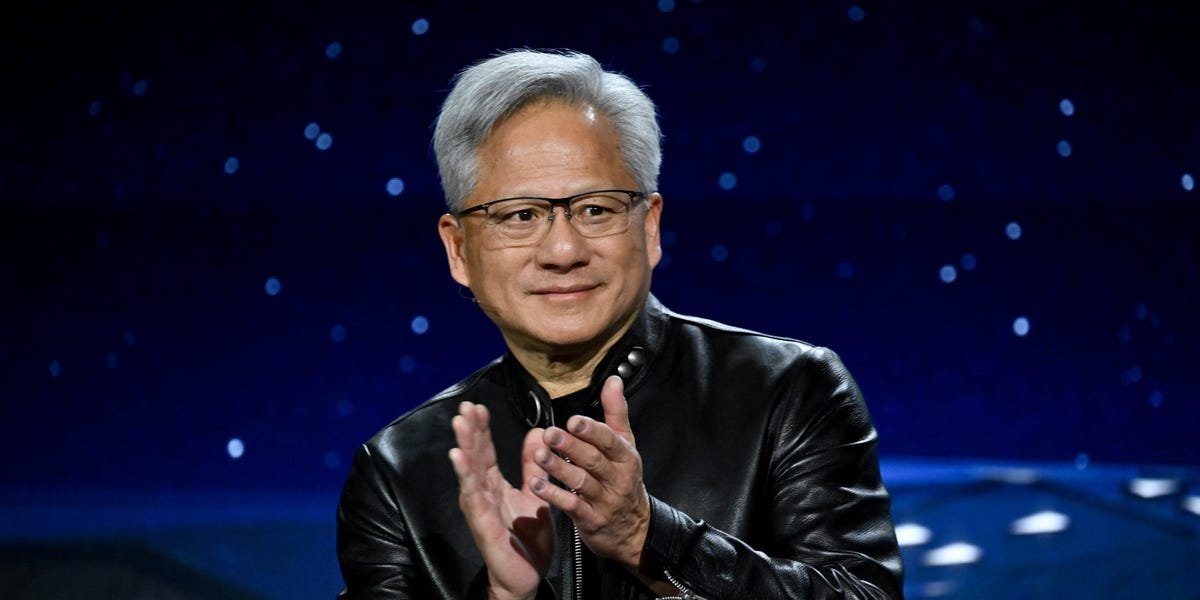
Jensen Huang says Nvidia invests in a lot of tech companies, instead of selecting a handful, for a reason.
“There are so many great, amazing foundation model companies, and we try to invest in all of them,” he said on an episode of the “Dwarkesh” podcast released on Wednesday. “We don’t pick winners. We need to support everyone.”
Huang, who cofounded Nvidia in 1993, said that there were two reasons behind this. One, he said its not Nvidia’s job to pick winners. Two, the company’s history is a lesson.
“When Nvidia first started, there were 60 3D graphics companies,” Huang said. “If you would have taken those 60 graphics companies and asked yourself which one was going to make it, Nvidia would be at the top of that list not to make it.”
Hesaid that at the time, the company’s graphics architecture didn’t look promising.
“Everybody would have counted us out,” he said. “And here we are. So I have enough humility to recognize that. Don’t pick winners.”
Nvidia, which is the most valuable company in the world, has heavily invested in companies across the AI stack and related industries, including biotech, robotics, and self-driving. The chipmaker has big stakes in public companies, including CoreWeave, Intel, Synopsys, and Nokia.
Nvidia has also cast its bets wide in the large language model space.
In November, Nvidia committed to investing up to $10 billion in Anthropic to develop Claude. In February, the company announced it invested $30 billion in OpenAI.
In a March conference appearance, Huang said that the investments are likely to be Nvidia’s last in the two private companies.
“The reason for that is because they’re going to go public,” Huang said.
Nvidia is also invested in French frontier lab Mistral AI.
The tech giant has also cut smaller checks to startups such as autonomous driving company Wayve, data labeling firm Scale AI, and Figure AI, which is building humanoid robotics.
Hiring has slowed sharply across many advanced economies, but companies may simply be getting better at picking the right people, according to Goldman Sachs.
That’s due in part to a decline in short-term job separations: workers leaving or losing jobs soon after being hired. That decrease suggests firms and workers are increasingly finding better matches from the start, even as labor markets cool after the post-pandemic hiring surge.
“Most of the pullback in churn reflects a decline in job separations within one or two quarters after hiring, a pattern that suggests that workers and firms have gotten better at identifying ‘good’ matches over time,” Goldman’s economists wrote in a Tuesday note.
Historically, short-term separations have been common because some hires turn out to be poor matches between employers and workers. However, they have steadily fallen across developed economies over the past two decades, and the decline accelerated after the pandemic.
The trend is borne out by US Census Bureau data and Canadian labor force data.
Every time Huileng publishes a story, you’ll get an alert straight to your inbox!
Stay connected to Huileng and get more of their work as it publishes.
Fewer bad hires
The decline appears broad across industries. It’s explained by changes in the workforce composition, suggesting a structural shift in how workers and firms form job matches.
“In our opinion, the best explanation of the decline in short-term separations is that increased information and improved screening processes have increased both firms’ and workers’ ability to identify ‘good’ matches,” wrote the Goldman economists.
Platforms such as LinkedIn, Glassdoor, and Indeed give workers insight into company culture and working conditions before they accept a role. At the same time, employers are increasingly using digital screening tools — including AI — to evaluate candidates and screen applicants.
Those tools may help reduce hiring mistakes, the economists wrote.
Better matches mean fewer early job exits — and less need for companies to hire replacements.
The shift could also make the labor market more efficient overall. With fewer failed job matches, there is less frictional unemployment — the type of joblessness that occurs when workers move between jobs.
Goldman’s analysis comes amid debate about the current labor market, which some economists describe as a “low hiring, low firing” environment.
In such an environment, a further drop in hiring could push unemployment higher more quickly because displaced and younger workers have fewer opportunities.
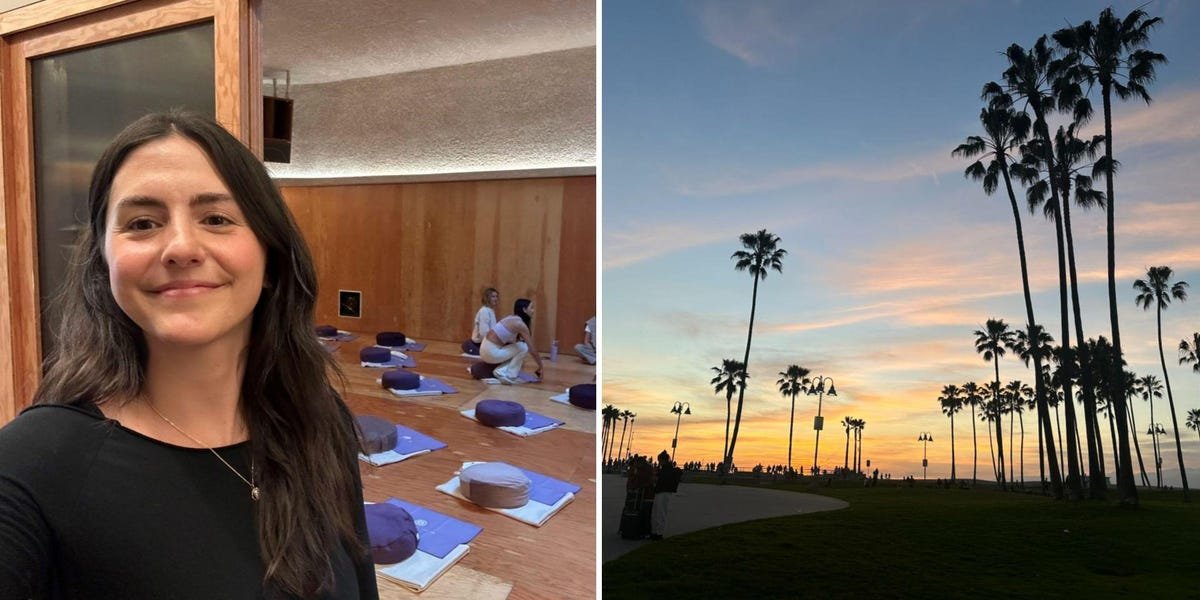
It was a scene you’d expect at a Wednesday afternoon wellness class in Los Angeles. About 40 people with matching athleisure sets, iced matcha lattes, Salomon sneakers, and at least one Fendi baguette filed into a meditation studio tucked in an alley just off the Venice boardwalk.
Toryo Ito, a Japanese Zen Buddhist monk, was already seated at the front of the room. A sculptural, oblong skylight cut into the ceiling, casting a beam of sunlight onto the floor. He sat cross-legged, wearing a black robe, with a set of small tools laid out before him: an incense holder, a spray bottle, and various blocks and mallets made with metal or wood.
Ito is the vice abbot of Ryosokuin Temple in Kyoto, which dates back over 600 years. His modern approach to Zen has made him something of an ambassador for mindfulness in the corporate world, leading meditation workshops for companies like Meta and Salesforce.
Marc Benioff, Jack Dorsey, Alex Karp, and other business and tech leaders have embraced mindfulness practice. Meditation apps have raised hundreds of millions in funding, and companies are increasingly offering programs to employees to combat burnout and improve performance.
As a business reporter living in California, the wellness capital of the US, my prior experience with meditation mostly consisted of adding it to the list of habits I’d like to start each new year, and then proceeding to complete a handful of five-minute sessions sporadically, primarily as a means to squeeze in a little sun time before a full day at my desk. Maybe a class with a real-life Zen monk would be just the motivation I needed.
What I’d actually find was that my concept of meditation was way off and that it’s a lot simpler — and more attainable — than I’d made it out to be.
Meditation does not mean thinking about nothing
The class was held at the Venice studio of Open, a mindfulness startup, and organized by Tatcha, a luxury skincare brand whose founder has her own corporate-to-mindfulness origin story. Vicky Tsai worked on Wall Street as a credit derivatives trader before quitting to start Tatcha. She met Ito in 2016 during a class at his temple in Japan. He became the company’s first-ever “global well-being mentor” in 2021.
Toryo Ito sat still and at ease while most of us fiddled with our phones.
Kelsey Vlamis
Attendees — Tatcha fans who had signed up for the class through their socials — took photos of the room and spoke quietly to one another. Some set up cameras to record themselves. One attendee took an especially aesthetic flat-lay shot of her Tatcha-branded mat and towel alongside her purple shoulder bag, which matched perfectly.
I was immediately struck by the contrast between Ito and the rest of us.
Ito sat erect but calm, doing nothing. Sometimes he looked around the room and smiled. Other times, he looked ahead or softly closed his eyes. He didn’t fidget. Meanwhile, the rest of us were on our phones, taking photos, scrolling, anything but simply sitting still.
After about 10 minutes, the room quieted, and all attention shifted to him.
He welcomed us and asked if anyone had been to Kyoto, seeming surprised when a good chunk of the room raised their hands. He said Zen emphasizes two concepts: mindfulness and expanding the boundary of the self in order to dissolve it.
Ambitious, I thought, but intriguing.
Ito said that while there’s no perfect meditative state, we should focus on paying attention. The class was broken into three rounds of meditation, each lasting 10 minutes, give or take, during which we sat in silence with our eyes closed.
For the first session, he told us to pay attention to what we heard and smelled: the chime he rang to start the session, the birds chirping on the nature soundtrack playing in the studio, the air conditioner kicking on, the sound of a spray bottle, and the earthy smell that followed. He rang another chime at the end of the session, which felt like it flew by as I tried to focus on my senses.
For the second session, he told us to focus on the sensations in our bodies and had us lift one arm, hold it in place, then the other. Lastly, he asked us to meditate on a series of questions related to self-love: What color do you associate with self-love? “Light pink,” I thought. What drink? “Sparkling water.”
It was more involved than I expected. I thought the point of meditation was not to think about anything. What Ito taught me was that it’s actually about noticing.
“Intentionally disrupt that autopilot,” Ito told me after the class, adding that he prefers dynamic meditation, like walking, where you can feel the grass beneath your feet.He said he’d spent time earlier that day walking through Venice Beach.
The Open studio was a short walk away from the Venice boardwalk.
Walter Cicchetti/Getty Images
For people with high-stress jobs, Ito said meditation can be practiced in small moments throughout the day, for 10 minutes or even just one. He recommends lighting incense and actually paying attention to the smell. When you drink coffee, notice the taste.
Doing these little practices of just noticing things you previously missed can bring the benefits of mindfulness, which he said include stress management, increased creativity, and openness to new ways of thinking.
Small moments of noticing
When the class ended, the first thing I noticed was how different the attendees seemed.
There was a newfound stillness that had previously been missing, and very few immediately reached for their phones. We sat in silence, no one rushing to get up, as several people shared how they felt with the whole class.One busy mom said she felt “at peace.”
I did not become a perfect meditator that day — although Ito would likely say there’s no such thing — but what I learned was that I actually meditate, or practice mindfulness, more than I realized.
Each time I take a walk without headphones and notice the smell of jasmine. Or when I’m camping and zone out in front of the fire, doing nothing but observing the movement, warmth, and sound of the flames.
Which also might explain why, after each of these experiences, I feel some of the benefits that ancient wisdom and modern science have associated with meditation: lower stress, better sleep, and an overall sense of calm.
Since the class, I’ve been a bit more lenient with myself about what counts as meditation, which has helped me prioritize and appreciate these small moments of noticing.
The idea of noticing the taste of your coffee as a mindfulness practice might feel a bit silly. Then again, it’s a bit silly that I’ll weigh and grind my own beans, pull espresso in my expensive machine, and drink it in front of my computer, without even noticing once I’ve finished.
Anthropic’s lawyer said the US government is “pressuring” the startup’s customers to go to rival AI providers amid an escalating fight between the Claude developer and the Department of Defense.
During a status conference on Tuesday, Michael Mongan, an attorney for Anthropic, said the Defense Department’s decision to effectively blacklist the startup from working with the US military is bringing “real and irreparable harm” to the company each day.
Mongan said customers have begun “expressing doubt” about working with Anthropic and that the government has been on a pressure campaign to get Anthropic’s customers to drop the provider and go to competing AI companies.
“We’ve had university systems and business-to-business companies that have switched to competing AI companies,” Mongan said. “And this is all the predictable result of the defendant’s actions and the uncertainty they’ve created, as well as the fact that defendants have been affirmatively reaching out to our customers and pressuring them to stop working with Anthropic and switch to other AI companies.”
Last month, after contract negotiations with the AI startup fell apart, Defense Secretary Pete Hegseth announced that Anthropic was a “supply chain risk” and framed the move as extending beyond direct military work.
Every time Lloyd publishes a story, you’ll get an alert straight to your inbox!
Stay connected to Lloyd and get more of their work as it publishes.
“Effective immediately, no contractor, supplier, or partner that does business with the United States military may conduct any commercial activity with Anthropic,” Hegseth said in an X post on February 27.
The scope of the supply chain risk label is in dispute. Microsoft previously told Business Insider that its lawyers concluded the company can still use Anthropic for non-military-related work. The company also filed an amicus brief, urging the federal court to temporarily block the government’s supply chain risk designation.
The issue centers on Anthropic’s stance that its frontier model, Claude, cannot be deployed for autonomous weapons and mass surveillance of US citizens. Defense officials have said in response that a private company cannot dictate what the military can and cannot do.
Anthropic CEO Dario Amodei said in a blog post on February 26 that the company could not accede to the government’s demand for unrestricted, lawful use of its model. A day later, Hegseth formally designated Anthropic a supply chain risk.
Anthropic sued the government on Monday, seeking a temporary restraining order to continue doing business with the government as the case proceeds. The company said in the suit that the Defense Department did not provide adequate grounds to label it a national security risk.
In addition, the company said the designation has never been applied to an American company and that the move was retaliatory, violating the company’s First Amendment rights to express its views on AI safety and limitations.
The fallout from Anthropic’s blacklisting has been swift, according to legal filings.
Krishna Rao, Anthropic’s chief financial officer, said in a declaration filed on Mondaythat the DoD had contacted several “portfolio companies about their use of Claude” and that those clients have “grown worried and uncertain” about their ability to use the model.
The CFO said the government’s action could reduce Anthropic’s 2026 revenue by “multiple billions of dollars.”
Spokespeople for Anthropic and the Pentagon, as well as Anthropic’s lawyer, did not respond to a request for comment.