Passion could be the best defense against AI taking your job, Bill Gurley says.
“The people that are most at risk are the ones that are sitting idly in the job and don’t really have a why or a purpose for it,” the legendary venture capitalist said during the latest episode of the “On with Kara Swisher” podcast.
“I think a lot of the people that go through that college conveyor belt, that are chasing a safe job, that end up working as a widget or a cog in an industry they may not love — I think they are ripe for disruption,” he added.
Advances in AI have spurred numerous high-profile companies to slow hiring or make layoffs in anticipation of cheaper, more productive digital workers replacing human ones.
Technology giants such as Meta, Microsoft, Amazon, and Alphabet are also spending hundreds of billions of dollars to build AI infrastructure, fueling widespread concerns of future job losses.
Every time Theron publishes a story, you’ll get an alert straight to your inbox!
Stay connected to Theron and get more of their work as it publishes.
Gurley is a general partner at Benchmark who’s known for placing early bets on businesses such as Uber, Nextdoor, OpenTable, and Zillow.
He recently published a book titled “Runnin’ Down a Dream: How to Thrive in a Career You Actually Love.”
The veteran investor said on the podcast that young people should choose careers they enjoy and care about. Warren Buffett, who famously “tap dances to work” at Berkshire Hathaway, has long offered similar advice.
“For people that are in a job they love, the honing’s free,” Gurley said. He explained that when someone is passionate about what they do, they don’t need to set aside time or convince themselves to polish their skills and knowledge; they naturally prioritize improvemen and feel energized by the process.
“It really becomes an unfair advantage in almost any industry if you’re that person because you’re learning constantly,” Gurley said.
One key thing they should learn is how to harness AI to bolster their efforts, he said.
“Be the most AI aware person in your job,” Gurley said. “And you’re going to then be the last person that they want to get rid of.”
Gurley compared AI to “jet fuel” that can expand a worker’s capabilities. Employees can now learn more quickly and thoroughly than ever before, he said, so if they’re focusing their learning on AI, they’re “going to have even better chance of winning,” he added.
In the months before Block CEO Jack Dorsey laid off 40% of staff on Thursday, workers were embracing AI tools in what one called an almost “celebratory” way.
Dorsey and other company leaders had made no secret of their interest in AI, but the company was profitable, and some workers couldn’t imagine the technology fully replacing humans at scale any time soon, they told Business Insider.
Still, there were pockets of unease. Block, the parent company of financial tech firms including Cash App and Square, had executed a series of smaller performance-based cuts in previous months. At least one employee said he’d had a nagging feeling that the AI tools he was using had gotten really good.
“I had a hunch that, at some point, the company would cut people because of AI. I just didn’t think it would be right now,” Ivan Ureña-Valdes, a data analyst who was laid off after four years at Block, told Business Insider.
When Dorsey dropped the hammer via a memo posted on X, he said AI was the reason 4,000 workers were losing their jobs.
“A significantly smaller team using the tools we’re building can do more and do it better,” Dorsey told analysts on Block’s earnings call on Thursday following the news.
Two hours after the layoff announcement, Dorsey logged onto a video call with the calendar title “gratitude,” sporting a baseball cap that said “love” to address the staff.
As he spoke with employees about Block’s layoffs and his reasoning for the deep cuts, some sent comments thanking him for the opportunity to work at the company. One asked if his hat was appropriate given the context. Dorsey answered that it was about gratitude.
Throughout the meeting, he was flooded with waves of emojis from muted participants, three attendees told Business Insider. Popular reactions were the thumbs-down, thinking face, and crying-laughing emojis, two people said. Dorsey explained the cuts in his trademark monotone and said he was doing what’s best for the company.
Business Insider spoke to seven former Block employees about the internal push to use AI in the last year; many said they were happy to oblige. Some were laid off on Thursday; others lost their jobs in recent performance-based cuts. Though they adopted AI tools to varying degrees, they view the technology as unable, at the moment, to do all the jobs of the thousands of workers who were let go. So it came as a shock to see half the company chopped in one fell swoop.
While some in the tech world expressed skepticism that AI was the true impetus for the cuts, suggesting that Dorsey had bloated Block’s ranks, others saw it as the first wave in a coming tsunami of job cuts across the industry. The alarm over a potential white-collar jobs apocalypse has gotten louder in recent months. Amazon CEO Andy Jassy has signaled that AI could lead to white-collar job cuts at the company. Last year, Salesforce made cuts to its customer support team, thanks to the use of AI agents, CEO Marc Benioff said.
Block’s layoffs are so large in scope and more pointedly attributed to AI than most that they added fuel to a fear sweeping the white-collar world: AI is coming for your job, and learning to use it isn’t enough to save you.
“I’ve seen a lot of public commentary about this layoff and how workers need to be using AI to protect our jobs,” said one nontechnical worker laid off on Thursday. “I was actively building with AI and know that many of my impacted colleagues were doing the same.”
Jack Dorsey ‘loves AI’
Dorsey has planted a flag in painting Block as an AI-forward company. He said on Thursday’s earnings call that Block was “one of the first to harness agentic capabilities.” And in July, Dorsey made headlines for using an internal coding tool called Goose to vibecode a “weekend project” that led to the messaging app Bitchat.
Investors appeared to favor Dorsey’s narrative of cutting costs with AI: After being down roughly 16% year to date before the layoffs, Block’s stock ended Friday up nearly 17% on the day.
“Jack loves AI and was constantly pushing us to use it,” Ureña-Valdes said. “I got to use these tools as much as possible every single day.”
He said he’d “felt the rumblings of AI disruption for a while” because he was using it in his work and noticed the tools were getting better.
One former software engineer said that Block had many internal AI demos and that her coworkers’ feelings about AI were “mostly celebratory.”
Another former software engineer let go during performance cuts earlier in February said the company had warned that output expectations for engineers would increase. He said the company’s head of engineering voiced productivity expectations that left them worried quality would suffer. After this week’s layoffs, his team shrank from eight engineers to one.
One employee laid off on Thursday said she had embraced AI at Block, but saw that it required human oversight. The day before the layoffs, she said, she caught errors in a company chatbot. She said the cuts surprised her manager, who was spared from the layoffs. The two sat together and cried it out.
AI is not ‘layoff insurance’
Several researchers and former Block employees say they’re skeptical about AI’s actual role in the layoffs.
“Block must have uncovered a secret sauce, perhaps within the software development process, to claim all of these jobs are AI-related,” said Jason Schloetzer, a business professor at Georgetown’s McDonough School of Business. “From the dozens of executives across industries that I’ve spoken with about AI deployment, they certainly aren’t seeing these types of gains outside of the software development process.”
On Thursday’s earnings call, Dorsey said there has been a marked improvement in AI’s capabilities and that “Block wanted to get ahead of this shift rather than be forced into it reactively.”
“The models just got an order of magnitude more capable and more intelligent,” Dorsey said. “And it’s really shown a path forward in terms of us being able to apply it to nearly every single thing that we do.”
Some former Block employees, as well as others in the industry, said pandemic overhiring, rather than AI, spurred the layoffs — a common refrain for Big Tech in recent years.
“Over the course of my time at Block, leadership did repeatedly signal the need for a ‘smaller Block,'” the laid-off nontechnical worker, who worked at Block for two years, said.
Companies like Block are conducting layoffs “with a chainsaw, not a scalpel,” said Chris Kaufman, a leadership consultant in Detroit.
“They’re not conducting audits of who took an AI course,” Kaufman said. “They’re making macro decisions about cost structure and organizational design. That’s usually just looking at headcount and salary across the board.”
Being AI savvy, Kaufman said, “can increase productivity, but I don’t think it is any way layoff insurance.”
Danielle Bell, a business communications professor at Northwestern University, said it’s obvious the workforce — both inside Block and out — is worried about AI. “If this is the new reality that we’re in, executives need to be more honest with themselves, with stakeholders, with the board, Wall Street, and particularly employees about what AI is here to do.”
Whatever the reason, one of the engineers cut on Thursday said there was a feeling in the air that something was coming. This engineer said she noticed that performance reviews were moved up from their February start. She thought she was safe after the earlier performance-based cuts — until she was laid off on Thursday.
“People were tense, even after good news would come through,” she said. “Lots of rumors flying around the office in person.”
I didn’t know what chocolate ganache was before watching reruns of an old Food Network pre-teen baking championship with my kids. But I did spot an opportunity to talk with them about how one contestant kept building her cake after it crumbled. We talked about the word perseverance.
That’s the thing about “screen time” as a modern parenting panic: the same rectangle can either be a sedative or a springboard.
But my wife and I are still fairly new at this — our kids are under 5 — so we talk with other parents about evolving opinions on the use of phones, tablets, computers, and TVs.
From those conversations and our own parenting experience, we’re slowly realizing that it’s not about screen time, but more about what type of content we’re letting our kids watch.
We try to keep screen time to a minimum in our house
My wife, kids, and I live in a Philadelphia rowhome. We’ve kept TV out of our bedrooms and devices out of our daily routine. On trips in the car, bus, and subway, we rely on music and games (I’ve come to loathe “I spy”).
Every time Christopher publishes a story, you’ll get an alert straight to your inbox!
Stay connected to Christopher and get more of their work as it publishes.
In good weather, we enjoy long walks and frequent visits to our neighborhood rec center. Forced into boredom at home, our kids have developed their own imagined worlds: singing karaoke on the couch, lava-ringed obstacle courses, and preparing elaborate meals in a play kitchen.
But especially on freezing days, when you’re stuck indoors, and everyone’s energy is somehow both too high and already spent, screens help. What’s become clear to me is that a screen’s value depends on what we watch.
Governments are cracking down on youth screen time
In recent years, the global discourse has turned aggressively anti-screen.
Governments are now intervening not just in social media but in screens more broadly. France, for example, has prohibited screen exposure for kids under 3 in childcare settings, and Virginia has moved to make schools “cell phone-free.”
Meanwhile, theAmerican Academy of Pediatrics has long advocated against the simplistic yardstick of screen time, noting there isn’t enough evidence for a single universal time limit, emphasizing family context and habits instead.
It’s more important to me to monitor what my kids are watching than how much
It seems to me that no one can agree on what the maximum screen time should be for children, so that’s why I’m focusing less on time and more on the content.
Watching a kids’ baking show as a family, especially when we can connect the events to our own lives, can be healthy. I’ve seen the positive effects of a great show on my own kids.
For parents of young kids, the difference between cartoons like “Bluey” and “Cocomelon” is obvious: In one, characters develop over seven to 10 minutes, and in the other, brightly colored, computer-animated characters sing hypnotically rhythmic songs in short bursts.
This holds true for older kids, too. With the right guardrails, I think that screens can be genuinely social and developmental, like collaborating with friends in a shared Minecraft world, building a Roblox obstacle course over a week, or editing a goofy video together that takes planning and patience.
I see “good” screen time often involves characters, cause-and-effect, enough plot for us to talk about it together, and a bonus for when it’s social. I don’t see why there should be a time limit on any of that.
Open relationships have gotten a cultural glow-up among younger adults. In practice, though, they’re hard to pull off.
There’s a lot of social media chatter where people in happy non-monogamous relationships report perks such as greater sexual satisfaction, multiple deep partnerships, and less restrictive love lives.
Still, outside the tweets, threads, and curated Instagram grids, the story is a bit more nuanced. A 2023 Pew Research report found that Americans are divided on open marriages. Of about 5,000 US adults surveyed, 37% found open marriages completely unacceptable. Younger generations approved more than anyone else: roughly half of 18- to 29-year-olds were accepting of open marriages.
Dr. Justin R. Garcia, the executive director of the Kinsey Institute, has also witnessed the growing popularity of non-monogamy in his work.
“People were talking about swinging in the 60s and 70s, but the language and the amount of attention to it changed, particularly over the last decade,” Garcia told Business Insider, citing Amy C. Moors, a sexuality scientist who noticed a steady increase in people searching for terms related to polyamory between 2006 and 2015.
Every time Julia publishes a story, you’ll get an alert straight to your inbox!
Stay connected to Julia and get more of their work as it publishes.
However, showing interest and actually engaging in the activity are two different things. In his new book, “The Intimate Animal,” Garcia said that research from his lab at the Kinsey Institute, one of the most prominent research centers for human sexuality and relationships, found that one in five single adults in the US, out of about 8,700 studied, have had some kind of consensual, non-monogamous relationship at some point in their lives.
Studies suggest that more people have tried non-monogamy than have maintained it long-term.
Vershinin/Getty Images
When looking at the past five years in another study of Garcia’s, however, that number dropped significantly, suggesting that “more people try it than decide that it is a lifelong relationship structure for them,” Garcia said. “In my social networks, that’s been my experience as well.”
It doesn’t mean that they never work, he added. According to multiple studies, “while consensually open relationships might not work for everyone, or even for most people, there are many people for whom they do work perfectly well,” he wrote in his book. Those in happy non-monogamous relationships, for example, don’t fare psychologically or emotionally worse than content monogamous couples.
“In terms of who’s a good candidate for it? My cheeky answer, but it’s actually true, is those people who really want to do it,” Garcia said. “It’s similar to ‘What’s the right amount of sex that we should be having?’ It’s as much as you want.”
Still, that doesn’t mean open relationships work for everyone. Based on his research, Garcia shared the most common reasons non-monogamous partnerships don’t work out.
It takes work to balance partners
Devoting enough time to your partners can be challenging.
FG Trade/Getty Images
One of the most common challenges to non-monogamous partnerships might be our own biology.
“We have such a fundamental, evolved drive to form intense pair bonds,” Garcia said, ones that biologists theorize helped us thrive as a species over time. In his book, he said that “our brains don’t appear particularly well-suited to processing intimacy with more than one partner at a time,” be it another romantic partner or a sexual fling. Even fantasies of threesomes, Garcia said, more often involve an existing partner.
If romance is most often defined by sustained attention and effort, then it becomes more difficult when one or both partners have other people to focus on. Introducing a new partner into a shared home can cause friction with a spouse, as can skipping dinner with a spouse to spend it with another significant other.
Garcia said one of the “prevailing rationales” for consensual non-monogamy is having “too much love to give.” However, he wrote, the opposite is true: “Most people don’t have the biological, psychological, and social tools to love more than one person at a time.”
Extra communication can be a turn-off
Healthy non-monogamous relationships require extra communication, which some people find off-putting.
Tom Werner/Getty Images
In his research, Garcia said the happiest non-monogamous couples have the same thing in common: “They tend to engage in a lot of communication.”
One 20-person polycule, for instance, uses a software engineer strategy called “agile scrum” to resolve any relationship issues. It involves monthly reviews, discussion questions, and action points.
“Even casual polyamorous encounters take substantial effort and negotiation,” Garcia wrote, including lots of communication. “Who needs more touch? Less? Who is feeling neglected? Who needs more time with whom? What is the state of things between each member of the polycule and each of the others?”
Some people find that level of frequent, in-depth communication builds their intimacy and brings them closer. Still, for many people, it’s just too much work.
It can magnify issues instead of fixing them
Non-monogamy can heighten existing issues like jealousy and mismatched libidos.
gorodenkoff/Getty Images
In any healthy relationship, Garcia said there’s a basic framework you have to follow: “There’s me, there’s you, and there’s us.” What might make one person happier, like having more romantic partners, might make the other feel neglected.
For a non-monogamous relationship to work, “you want to be able to both navigate your feelings of jealousy,” Garcia said. Furthermore, he added, it helps if you actively enjoy knowing that your partner is with others.
The last reason you should be in a polyamorous or open relationship is because you want it to “fix” your current relationship. Often, he wrote, “the same issues that plague monogamous relationships — mismatched libidos, jealousy, boredom, and more — tend to surface in consensually non-monogamous ones.” In fact, he added, they can multiply when partners aren’t communicating or devoting enough time to each other.
“As one of my friends who had attempted to form a polycule once told me, ‘It didn’t work,'” Garcia wrote. “‘I just pissed off two women instead of one.'”
This story is available exclusively to Business Insider
subscribers. Become an Insider
and start reading now. Have an account? .
Of the 240 financial CEOs EY surveyed, only 28% see AI reducing head count in 2026.
Nearly half of the CEOs said AI is the most critical factor in their company’s ability to adapt.
Some Wall Street leaders have said AI will eliminate some roles, but ultimately increase head count.
Banks’ analyst classes probably won’t swap fresh-faced college grads for bots — at least not this year.
Some 60% of the 240 financial services CEOs that EY surveyed for its Quarterly CEO Outlook Survey said they think investing in AI will maintain or even increase their current head count in 2026. Only 28% of those surveyed predicted head count would drop this year.
Leaders at some of the biggest banks, including JPMorgan and Goldman Sachs, have said that they’re resisting hiring growth where it makes sense to prioritize efficiency. They, along with some other bulge-bracket leads, have predicted that AI could grow head count in the long run, though. Still, some roles are becoming obsolete: Citi CEO Jane Fraser said in a recent internal memo that some jobs “will no longer be required” as AI advances.
For their part, the financial services CEOs that EY surveyed are similarly bullish about AI’s capacity to transform the workplace, and nearly half see AI and digital investment as the most important factor in their companies’ ability to thrive and adapt this year.
Around a quarter said their AI initiatives have significantly beaten expectations, and 57% said they’ve shown results faster than expected. Just more than half said they expect the biggest transformations to come from generative AI.
When it comes to hiring for AI talent — itself a highly competitive market — 87% of CEOs in EY’s survey are optimistic about their ability to attract and keep talent in 2026. The question of returns on the AI investment, for talent and in general, also seems top of mind for the financial services leaders. Seventy-six percent of boards in the survey said they’ll review transformation ROI metrics as often as financial results.
Firms of all sizes are being asked to justify their AI spends, as analysts and investors begin to wonder whether the sometimes billion-dollar bets will show up on balance sheets.
“I’ve fallen prey to the pixie dust thing as well, where it’s like, ‘Oh, we’ll hire someone from Google or Apple, and they’ll be immediately successful,'” Musk told Stripe cofounder John Collison and tech Dwarkesh Patel during a 3-hour-long appearance on a special joint episode of their podcasts.
It’s why Tesla’s CEO doesn’t put his full faith in a candidate’s résumé.
“Generally, what I tell people—I tell myself, I guess, aspirationally—is, don’t look at the résumé. Just believe your interaction. The résumé may seem very impressive, and it’s like, ‘Wow, the résumé looks good.’ But if the conversation after 20 minutes is not “Wow,” you should believe the conversation, not the paper,” he said.
He said he’s made other mistakes, too. “My batting average is still not perfect, but it’s very high,” he said. That includes the times he’s discounted certain personality traits.
Every time Brent D. Griffiths publishes a story, you’ll get an alert straight to your inbox!
Stay connected to Brent D. Griffiths and get more of their work as it publishes.
“I think it’s a good idea to hire for talent and drive and trustworthiness,” he said. “And I think goodness of heart is important. I underweighted that at one point. So, are they a good person? Trustworthy? Smart and talented and hard working? If so, you can add domain knowledge.”
Musk said that it takes a lot to truly impress him.
“The things I ask for are bullet points for evidence of exceptional ability.”
The examples “can be pretty off the wall,” but he’s looking for evidence of something truly great.
“If somebody can cite even one thing, but let’s say three things, where you go, ‘Wow, wow, wow,’ then that’s a good sign,” he said.
Hiring is just part of the battle.
When companies like Tesla are successful, Musk said, their competitors take notice and do everything they can to poach top talent.
“Tesla had a further challenge where when Tesla had very successful periods, we would be relentlessly recruited from,” he said. “Like, relentlessly.”
Musk said when Apple had its own electric car program, recruiters for the tech giant were “carpet bombing” Tesla employees to the point that some engineers just unplugged their phones. (In 2024, Apple reportedly abandoned its secretive car program.)
“Their opening offer without any interview would be like double the compensation at Tesla. So we had a bit of the ‘Tesla pixie dust’ thing where it’s like, ‘Oh, if you hire a Tesla executive, suddenly everything’s going to be successful,'” he said.
Some former employees have complained about Musk’s management style. During the interview, the Tesla CEO joked about his reputation as a micro manager, insisting that it be called “Nano management, please.” Musk said that, in reality, he now doesn’t have enough time to oversee every aspect of his sprawling empire.
Ultimately, though, Musk said he just wants one thing.
“If somebody gets things done, I love them, and if they don’t, I hate them,” he said. “So it’s pretty straightforward. It’s not like some idiosyncratic thing.”
When I was born in March 1999, my parents were both 25 years old. They were married and owned a house with a mortgage, and throughout my life, they’ve always seemed like “real” adults.
I’m now older than they were when they had me. I’m turning 27 and, though I don’t want children, it’s sometimes difficult not to measure my life against theirs.
They got married at 21. When I was 21, I was finishing my bachelor’s degree in the middle of a pandemic. At 25, rather than having a child, I was moving in with my girlfriend, and we became cat parents.
In some ways, and especially when I see my rent money leave my account at the start of each month, I feel like I’m falling behind.
I remind myself that life is different now
I know I’m not alone in feeling this way. Milestones that have long defined adulthood — like getting on the property ladder — don’t seem as realistic to everyone my age as they did for our parents’ generation.
While I do know people around my age who’ve been able to buy a house, for example, it’s definitely not the majority of my friends. Even if I did want kids, I wouldn’t have even considered it in my 20s, saving that conversation for my 30s.
Also, income hasn’t risen to keep pace with rising housing prices. Becoming a homeowner in your 20s is simply not realistic anymore.
Still, I sometimes don’t feel like an adult
I don’t think any of my generation, especially my friends, truly feels like we’re adults. It feels like I’m winging it most days.
I haven’t followed any traditional path. I moved to another city for university at 18, completed my master’s in another city, then shared an apartment with a friend somewhere else, and moved cities again when I moved in with my partner.
The author has cats instead of children.
Courtesy of Adam England
Sometimes it feels like I’m a teenager cosplaying as an adult. But then I remember that I do have my life together. I live with my long-term partner and our cats. I have a master’s degree. I freelance full-time for a living, my finances are stable, and I try to be reasonably healthy.
Now and again, I’ll say or do something that makes me realize I am a “real adult.” I’ll mention something about personal finance in a conversation with a friend, or get really excited about my air fryer being delivered.
In some ways, I’m further along than my parents were at this age
My dad often reminds me that I’ve had more life experience than my parents did at my age. I continued my education, I’ve lived in multiple cities across the UK, and I’m more well-traveled.
My life is richer in ways that aren’t necessarily measured by the traditional life plan. Sometimes comparing my life to that of my parents has made me feel stressed, but I’m now more comfortable embracing my own path; after all, adulthood isn’t a race.
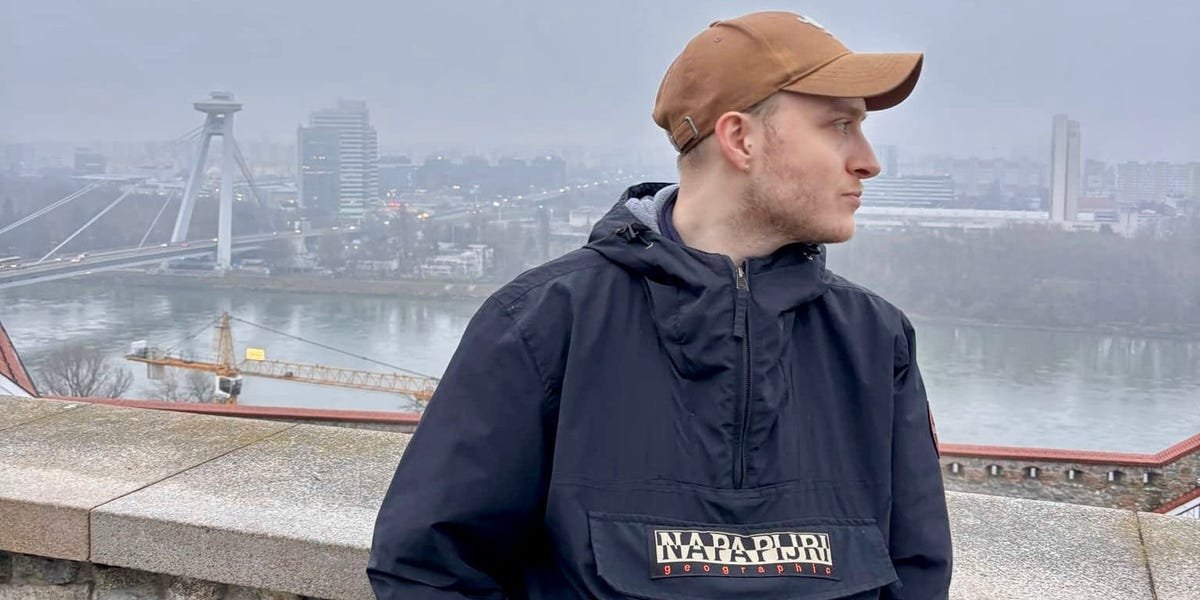
In December, I was on a boat on the Danube River with my girlfriend, drinking mulled wine and looking at Bratislava by evening as we enjoyed a well-deserved long weekend away from work before Christmas.
When my parents were the same age as us, they would have been at home with a one-year-old, and traversing adult life in a way I don’t think I’d be able to. Yet, looking back at when I was growing up, they made it seem so easy.
Neither version of your 20s is the objectively correct way to do it, but the contrast made me realize that I’m not falling behind or failing at adulthood. I’m simply doing it differently.
This story is available exclusively to Business Insider
subscribers. Become an Insider
and start reading now. Have an account? .
Business Insider looked at jobs projected to grow that typically pay at least $75,000 and don’t require a college degree.
First-line supervisors of construction trades and extraction workers ranked No. 1 based on our methodology.
Some of the jobs usually require related work experience.
Depending on the position, a high school diploma could be the ticket to a growing, high-paying job.
Business Insider looked at wages and growth projections for jobs that usually need a high school diploma, its equivalent, or a postsecondary nondegree award. We then took the geometric mean of the ones that pay at least $75,000, based on 2024 median annual wage data, and are expected to need more workers, based on projected employment growth from 2024 to 2034. We then ranked the jobs, with the larger the geometric mean, the better the rank.
Many of the top 12 fell into one of three job groups: construction and extraction; protective service; or installation, maintenance, and repair.
First-line supervisors of construction trades and extraction workers took the top spot. Employment of these supervisors is expected to grow by 49,000 from its 2024 level, and they typically make about $79,000 annually. It’s also one of the roles that typically don’t require a degree, but often require job seekers to have relevant experience.
Employers may be interested in candidates with higher educational attainment. The Bureau of Labor Statistics said commercial pilots usually need a postsecondary nondegree award, but some employers may prefer a degree or even require it.
Below are the top 12, along with information from the Bureau of Labor Statistics.
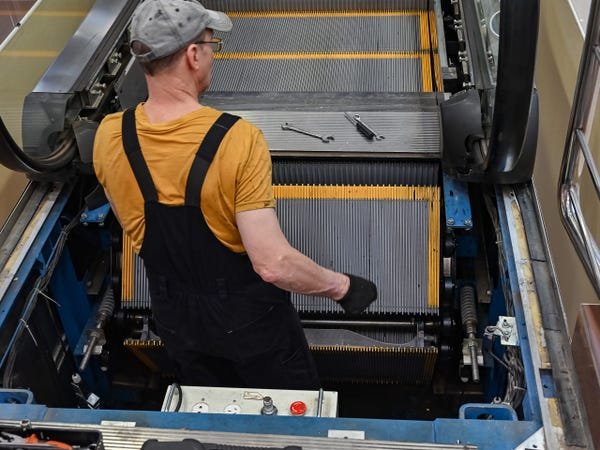
12. Elevator and escalator installers and repairers
Svetlana Verbitskaya/Getty Images
Median annual wage: $106,580
Job growth: 1,200
Typical education required: High school diploma or equivalent
11. Electrical and electronics repairers, powerhouse, substation, and relay
Shinyfamily/Getty Images
Median annual wage: $100,940
Job growth: 1,300
Typical education required: Postsecondary nondegree award
10. Avionics technicians
Monty Rakusen/Getty Images
Median annual wage: $81,390
Job growth: 1,700
Typical education required: Postsecondary nondegree award
9. First-line supervisors of firefighting and prevention workers
carlofranco/Getty Images
Median annual wage: $92,430
Job growth: 3,400
Typical education required: Postsecondary nondegree award
8. Commercial pilots
AlexeyPetrov/Getty Images
Median annual wage: $122,670
Job growth: 2,800
Typical education required: Postsecondary nondegree award
7. Aircraft mechanics and service technicians
Monty Rakusen/Getty Images
Median annual wage: $78,680
Job growth: 5,600
Typical education required: Postsecondary nondegree award
6. First-line supervisors of police and detectives
kali9/Getty Images
Median annual wage: $105,980
Job growth: 4,600
Typical education required: High school diploma or equivalent
5. Electrical power-line installers and repairers
RyanJLane/Getty Images
Median annual wage: $92,560
Job growth: 8,400
Typical education required: High school diploma or equivalent
4. Transportation, storage, and distribution managers
MoMo Productions/Getty Images
Median annual wage: $102,010
Job growth: 13,100
Typical education required: High school diploma or equivalent
3. First-line supervisors of mechanics, installers, and repairers
Nitat Termmee/Getty Images
Median annual wage: $78,300
Job growth: 19,100
Typical education required: High school diploma or equivalent
2. Police and sheriff’s patrol officers
Douglas Sacha/Getty Images
Median annual wage: $76,290
Job growth: 22,000
Typical education required: High school diploma or equivalent
1. First-line supervisors of construction trades and extraction workers
Vukasin Stanojlovic/Getty Images
Median annual wage: $78,690
Job growth: 49,000
Typical education required: High school diploma or equivalent
In the world of robotaxis, there’s a stigma around remote driving. Are you really “driverless” if there’s a person — even remotely — at the wheel?
One startup is fully embracing it.
Vay is a Berlin-based startup founded by two engineers and a former Zoox employee.
Vay cofounders Fabrizi Scelsi, Thomas von der Ohe, and Bogdan Djukic
Vay
The company is taking a somewhat contrarian approach to what it calls a “driverless car.”
Instead of automating the ride-hailing service, which can be technically challenging and costly to scale, Vay wants to rethink how we rent cars.
Every time Lloyd publishes a story, you’ll get an alert straight to your inbox!
Stay connected to Lloyd and get more of their work as it publishes.
To do so, Vay wants to leverage remote-driving technology and, eventually, autonomy to deliver cars without humans inside to people who need a private vehicle for less than a day.
Thomas von der Ohe,cofounder and CEO of Vay, told Business Insider that the goal is to be cheaper than an Uber and more convenient than a traditional brick-and-mortar rental program.
“It’s basically by far the most affordable A to B transport,” von der Ohe, a former technical program manager during the early days of Zoox, said. “It’s half the price of Uber and half the price of robotaxis. How it works: We just bring the car, you then drive, and then when you’re done, you don’t have to park.”
Autonomy’s shifting timelines
Von der Ohe spent less than two years at Zoox when the company was just 60 people large and had yet to be acquired by Amazon. The Vay cofounder said he oversaw some of the first public testing of Zoox cars when there were safety drivers inside the vehicle.
At the robotaxi company, von der Ohe said he saw a goal with an ever-shifting timeline.
“It always felt like it was three years out,” he said of autonomous driving. “And then every year it shifted by a year. So we wanted to have self-driving cars everywhere in 2020 at Zoox. And then it was 2021 and so forth.”
Von der Ohe left Zoox in 2018. Instead of fixating on robotaxis, von der Ohe wanted to stay in mobility but work on something that could be faster to bring to market and easier to scale with less capital. Vay was born.
How it works
Customers order a car the same way they hail an Uber or Lyft through Vay’s app. To rent a car, users have to upload a driver’s license and a photo of themselves.
Users can order a Vay rental car through a proprietary app.
Lloyd Lee/BI
Vay proposes that users can get a car delivered to them without a driver within minutes, as long as they’re within the service area or geofence. If you’re out of the service area, then you’re out of luck.
Once the car is delivered, the renter takes over.
The startup services Las Vegas, where it manages a fleet of 100 Kia Niros, a compact, all-electric SUV. Each Kia is retrofitted with four cameras. There are no other sensors, von der Ohe said.
The Vay cofounder told Business Insider that the service area is about twice the size of San Francisco.
Inside Vay’s Vegas office, there are about eight driving stations, in which a trained human operator remotely controls Vay’s vehicle fleet. The setup looks like a video game simulation with three computer screens and a disembodied driver’s seat.
A large red button to the left of the driver’s seat activates an emergency protocol during which the car pulls over to the side of the road.
Vincent Reddy, an operations lead for Vay, remotely drives a car.
Lloyd Lee/BI
Vincent Reddy, an operations lead for Vay, said that there are several criteria a remote driver needs to meet, including completing about 1,000 kilometers of remote driving. Reddy remotely drove Business Insider during a demo ride.
“It’s similar to kind of like a high-grade racing sim,” Reddy said of the driving experience. “The thing that feels the most different is not having the feedback of what it feels like driving over bumps and things on the road because the seat doesn’t move. There’s no G-force, or you don’t get the feeling of accelerating or braking.”
To deliver the cars, Vay only uses the remote-driving technology on local roads and stays under 25 mph. The car can go on the highway once the customer takes over the vehicle.
There were no notable incidents during a 10-minute driverless ride around the block of Vay’s Vegas office.
50% cheaper than an Uber
Vay’s value proposition to customers is that the service is cheaper and more flexible than hailing an Uber.
Von der Ohe told Business Insider that the service should be about 50% cheaper than the average Uber ride.
Vay hands out business cards that advertise a “driverless car” that’s half the price of hailing an Uber.
Lloyd Lee/BI
Users are charged by the minute, with a decreased price if they are parked, in case they, for example, need to grab groceries or hit the gym.
When Business Insider viewed the app, the pricing was at $0.35 per minute while driving and $0.05 per minute while parked. At those prices, a 30-minute drive to and from a destination, including an hour-and-a-half stop, would cost around $25.
When asked if the pricing will change based on demand, von der Ohe said the company doesn’t yet have a pricing mechanism, such as surge pricing, in place, but expects there will be changes to the structure.
The CEO said he can keep the costs low because Vay’s vehicle fleet doesn’t have a complex sensor suite, and the remote operators manage multiple cars.
Von der Ohe said that as of January 2026,there is one remote operator for every 10 vehicles. However, that doesn’t mean a remote driver is operating 10 vehicles at the same time. Instead, a remote operator can deliver one car and immediately move on to the next vehicle.
“So I have much more cars and remote drivers, and that’s why we make it half the price,” he said.
Vay’s future
Vay employs about 200 people and raised more than $200 million, including a $60 million investment from Grab Holdings, the Singaporean tech company that owns Grab, the super app of Southeast Asia.
Vay’s vehicle fleet is currently made up of 100 Kia Niros.
Lloyd Lee/BI
While von der Ohe told Business Insider that building a fully autonomous ride experience like Waymo is not on Vay’s road map, the CEO said his startup will gradually add autonomous driving features.
“We’re not in competition with them,” von der Ohe said of robotaxi operators.
Since its founding, Vay has provided 35,000 trips, according to the CEO.
He said the service has especially seen high demand during the Consumer Electronics Show.
When Von der Ohe opened the app, the wait time to get a car was 31 minutes.
“It’s extremely busy today already,” he said. “It’s a long way. It should be five.”
Growing up, the grandparents who raised me were a generation removed from me, and because of it, I never felt like I could go to them with real issues or problems.
I hid the deep and dark stuff because children were to be seen and not heard. We did not talk about the big things like sex or drugs. Instead, the warnings were direct and often frightening. They went something like this, “Do not do drugs or you’ll die.” The pregnancy mantra was similar: “Do not have sex or you’ll get pregnant.”
Alongside the lack of communication was a heavy dose of fear and threats. I suppose their own parents passed down less-than-stellar communication skills and used threats in an effort to protect.
I was terrified of my grandparents
I remember coming home after having a few drinks at a high school party. “You can do this one step at a time. Say hello and walk (in a straight line) to your room,” I whispered to myself as I climbed the steep front steps leading to our second-floor apartment. There was no getting caught, or I would die, or at least endure endless punishments preventing me from going to said parties until I was an adult capable of making my own decisions.
Not only did I not know how to talk to my grandparents, but I was also terrified of them.
Every time Nicole publishes a story, you’ll get an alert straight to your inbox!
Stay connected to Nicole and get more of their work as it publishes.
Sometimes, this lack of communication led to unwise decisions. I didn’t feel like I had an adult I could call if I’d done something I wasn’t supposed to do. If I did something foolish, I was on my own. It wasn’t safe, and I’d watched more than one friend get seriously injured (either physically or mentally) when they made a typical teen choice and felt they didn’t have an adult they could trust to help them.
I wanted my kids to trust me
With my own kids, I wanted to keep the lines of communication open, which became especially important as my children navigated middle school and high school. These years of adolescence included poor decision-making and a desperate struggle between being a kid and trying to grow up.
I talked openly with them about drugs, sex, and drinking. No subject was off limits. They knew they could tell me anything. Keeping our communication open and honest showed them a level of trust that other parents found difficult to understand. I often had my kids’ friends telling me things they couldn’t say to their parents. I tried to listen without judgment. I knew it was a fine line between discipline and acceptance. I also knew no matter what, keeping my kids safe was my first and most important job as a parent.
As my second set of kids head into the muddy waters of middle school and high school, these discussions are again at the forefront. “If you drink, I’ll be more upset if you get in a car with someone who’s been drinking or if you decide to drive than I will because of the drinking,” I recently told my high school daughter. Realistically, while I don’t openly condone underage drinking, I know it is, more often than not, a part of the teen years. “Call me,” I said, “and I’ll come get you.
I try to stay open-minded
While there were many things I did not accept, I also did my best to remain open-minded. It was sometimes difficult to parent this way. My kids did and continue to do things I often don’t agree with. I looked at these as teaching opportunities, rather than seeing them as moments to punish. Viewing things this way has helped me foster and maintain very close relationships with my kids. It is something others have commented on, including a social worker I visited with my son. “No matter what is going on,” she said, “you two seem to have a really tight and open relationship.” It remains one of the best compliments I’ve received as a parent.
There was another side to those comments, though. Parenthood is often filled with judgment and criticism. When my son dropped out of school, and my teens struggled with typical teen things like drinking, drug use, and sex, I remember hearing a neighbor refer to me as a loosey goosey parent. The neighbor in question didn’t understand my relationship with my kids. They didn’t share my parenting philosophy. Really, they didn’t have to. While the comment initially bothered me, I knew I was parenting in the only way I could. I parented in a way that I wasn’t parented, but wished that I had been.
As my two oldest kids hit adulthood and my youngest two become teenagers, I’m not sorry for being loosey goosey. I would do it the same way all over again. In fact, I am. I have no regrets. I hope the neighbor who judged me feels the same way when their kids go through the tough teen years.