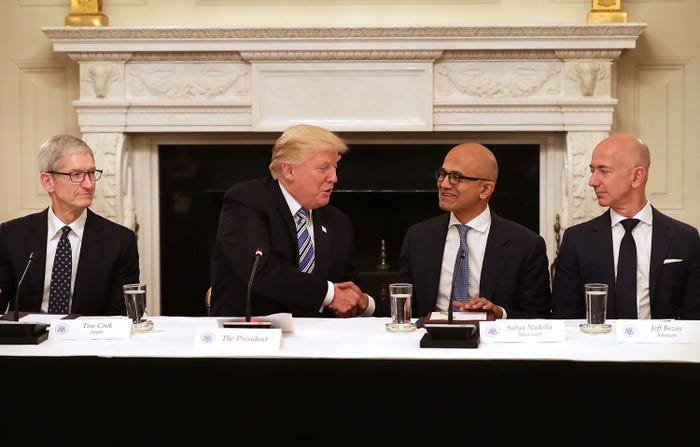
President Donald Trump speaks during an American Technology Council roundtable in the State Dinning Room at the White House in Washington, DC on Monday, June 19, 2017. From left, Tim Cook, Chief Executive Officer of Apple, Trump, Satya Nadella, Chief Executive Officer of Microsoft, and Jeff Bezos, Chief Executive Officer of Amazon. (Photo by Jabin Botsford/The Washington Post via Getty Images)

Trump says that Microsoft will ‘ensure’ Americans don’t ‘pick up the tab’ for its data center power consumption


Chip Somodevilla/Getty Images

  • President Donald Trump asks tech companies to “pay their own way” for their data centers.
  • Data centers drove up utility bills in at least 13 states, Business Insider previously reported.
  • Trump says that Microsoft will be the first to work with the White House to keep utility bills down.

President Donald Trump said on Monday that even though data centers are “key” to the AI boom, tech companies must “‘pay their own way,'” so that Americans don’t have higher utility bills.

“First up is Microsoft, who my team has been working with, and which will make major changes beginning this week to ensure that Americans don’t ‘pick up the tab’ for their POWER consumption, in the form of paying higher Utility bills,” Trump said on Truth Social, hinting at additional announcements “in the coming weeks.”

Data centers drove up utility bills in at least 13 states, Business Insider previously reported.

Over the past year, Microsoft has been planning for data centers in Wisconsin, Atlanta, Texas, and Michigan.

The White House and Microsoft did not immediately respond to a request for comment.

This is a developing story; check back for updates.


Source link

I-tried-14-high-protein-drinks-so-you-dont-have-to.jpeg

I tried 14 high-protein drinks so you don’t have to. Here’s what’s actually worth buying.

Just checking in — yup, it seems everyone is still obsessed with protein.

The new year means new health goals, and the government’s new dietary guidelines echoed what many have been calling a widespread protein obsession.

The Dietary Guidelines for Americans, released Wednesday, emphasized the role of protein and dairy products in its recommended daily diet, although dietitians have cautioned against protein-maxxing at the expense of other nutrients.

Whether it’s thanks to social media gym bros or Ozempic, more people are reaching for ultra-high-protein products, and if you remember the 1990s’ meal-replacement milkshake craze, this might feel a bit familiar.

Nutritional shakes — whether they’re used by athletes seeking nutrients on the go, parents to supplement their growing children’s diets, or adults with dietary needs seeking to pack in as many nutrients in a compact, easily digestible form — aren’t new to everyone’s diets.

As high-protein products, from protein pasta to protein beer, continue to take over grocery stores, the list of high-protein drinks continues to grow.

To better understand the high-protein drinks on sale today, I visited two New York City grocery stores and picked up every drink that advertised its protein content, with the lowest having 12 grams of protein, which is as much as two eggs.

I tried every brand’s chocolate flavor to best compare their taste and ranked all 14 based on flavor, as well as taking into consideration their nutritional content.

In general, I looked for drinks that tasted chocolatey, were sweet enough to serve as a sweet treat without going overboard, and were overall enjoyable to drink on their own.

It’s worth noting that many shakes on the market are considered ultra-processed foods, which the new government guidelines recommend avoiding.

Here’s how I ranked them, from lowest to highest.

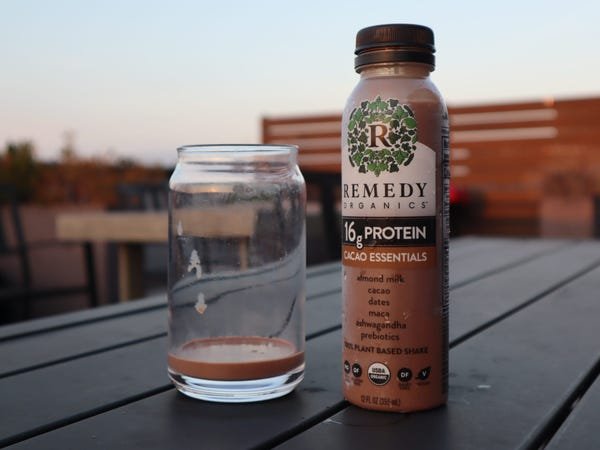
14. Remedy Organics Cacao Essentials Protein Shake

Remedy Organics Cacao Essentials Protein Shake had my least favorite flavor in the ranking.

Kristine Villarroel/Business Insider

Cost: $4.99 for 12 fluid ounces

Calories: 210 calories

Protein: 16 grams

Added sugar: 7 grams

The taste of the Remedy Organics Cacao Essentials Protein Shake was what I could best describe as healthy.

The date-sweetened drink is packed with plant-based ingredients, including adaptogens like ashwagandha and maca root powders as well as tapioca prebiotic powder.

But taste-wise, they weren’t as sweet-treat-like as some of the other shakes. It tasted strongly of cacao, but it felt a little chalky, and seemed saltier than it did sweet.

While I liked the drink’s ingredients, I really disliked the taste. If you’re looking for a plant-based, adaptogen-full drink that will also help you reach protein goals, this could be an option for you — but don’t go into it expecting a sweet chocolate milk type of drink.

Flavor rating: 1/10

Overall rating: 6/10

13. Muscle Milk Zero Sugar Chocolate Protein Shake


muscle milk zero sugar taste test

I found the Muscle Milk Zero Sugar Chocolate Protein Shake to be overly sweet.

Kristine Villarroel/Business Insider

Cost: $3.99 for 14 fluid ounces

Calories: 170 calories

Protein: 25 grams

Added sugar: 0 grams

When I first poured the Muscle Milk Zero Sugar shake, I noticed just how dark and thick it was. Tasting it, I found that it was way too sweet for my taste. This, combined with the thick texture, made for a pretty interesting drinking experience — I had to wash down the shake with some water to follow up the sweet taste left in my mouth.

Although I couldn’t finish drinking the small taste I’d poured myself, it also had the fewest calories and grams of sugar in the ranking, the highest fiber, and I felt like the protein payoff was great, which made the overly sweet taste feel more like a trade-off.

If you’re trying to get half of your daily protein in as few calories as possible while also watching out for sugar content, this drink might be good to have on your radar … but you’ll have to remind yourself of the nutrients in every sip.

Do it for the protein, bro.

Flavor rating: 3/10

Overall rating: 6/10

12. Koia Cacao Bean Protein Shake


koia protein drink taste test

I also did not love the taste of the Koia Cacao Bean Protein Shake.

Kristine Villarroel/Business Insider

Cost: $4.99 for 12 fluid ounces

Calories: 190 calories

Protein: 18 grams

Added sugar: 4 grams

Compared to some of the other protein drinks, I found Koia’s Cacao Bean protein shake to be very thin and light in color when I first poured it.

Its flavor, as the name would indicate, is very cacao-bean forward. To me, it tasted exactly like cacao nibs, which can lean more nutty and earthy than chocolate-y.

In a statement to Business Insider, Koia said the Cacao Bean protein shake is “crafted to highlight cacao’s naturally bold, slightly bitter profile rather than masking it with excessive sweetness or artificial flavoring,” resulting in a flavor that “may be less sweet than traditional protein shakes.”

The almond-based, monk-fruit-sweetened drink, which isn’t too sweet and packs in plant-based ingredients like rice, pea, and chickpea protein and a prebiotic blend, wasn’t one of my favorites for taste, although it was fairly competitive with the other options in terms of nutrients.

Flavor rating: 4/10

Overall rating: 5/10

11. Chocolate Sport Shake


sports shake protein drink taste test

Although enjoyable and tasty, Sport Shake’s high sugar content wasn’t a worthy trade-off for me.

Kristine Villarroel/Business Insider

Cost: $2.00 for 11 fluid ounces

Calories: 350 calories

Protein: 12 grams

Added sugar: 39 grams

I found the flavor of the chocolate Sport Shake to be one of the most enjoyable in the ranking, and it reminded me a lot of plain chocolate milk — it was very, very sweet. I also liked that it didn’t taste too much like dairy, something that bothered me with other drinks in the lineup.

However, the drink’s sweet and tasty flavor was overshadowed by its ultra-high added sugar content of 39 grams, or more than 9 teaspoons.

While the drink has some fiber in it, coming in with 3 grams, and it was the cheapest of the ranking, I couldn’t justify that much sugar. I will probably not reach for this again.

Flavor rating: 8/10

Overall rating: 1/10

10. Nesquik Chocolate Low Fat Milk


nesquik drink taste test

The Nesquik Chocolate Milk was a fun and nostalgic add to this lineup, although it wasn’t the best for protein.

Kristine Villarroel/Business Insider

Cost: $2.50 for 14 fluid ounces

Calories: 250 calories

Protein: 14 grams

Added sugar: 18 grams

I was shocked when I learned that Nesquik’s classic chocolate milk could be considered a nutritional drink.

At 14 grams of protein, as advertised on the bottle, the drink has more grams of protein per serving than other drinks labeled as protein drinks.

Tasting it was just as nostalgic as expected. Compared to some of the other drinks, however, I noticed it had a stronger dairy taste and was very sweet, with a total of 18 grams of added sugar.

I also noticed that the bottle recommended a portion of half a bottle, probably due to the drink’s high sugar content, which would also result in half the protein intake overall.

I probably wouldn’t have reached for this in adulthood if not to compare it here, and I probably won’t really reach for it again.

Flavor rating: 6/10

Overall rating: 4/10

9. Muscle Milk Pro Knockout Chocolate Protein Shake


msucle milk protein taste test

The Muscle Milk Pro packs an impressive 40 grams of protein.

Kristine Villarroel/Business Insider

Cost: $5.99 for 14 fluid ounces

Calories: 220 calories

Protein: 40 grams

Added sugar: 0 grams

Like its low-sugar version, the Muscle Milk Pro looked dark and thick. Taste-wise, the drink was sweeter than chocolate-y, and I didn’t love the flavor.

Although the drink packs an impressive 40 grams of protein in 14 ounces and 220 calories, has the highest ratio of protein to fluid ounces, and also has the highest fiber content in the list, the taste was one of my least favorites, and I had to wash it down with some water after tasting, as it had such a lingering flavor on the tongue.

When considering the nutritional aspects of the drink, however, I felt like the taste was a solid trade-off for one of the most protein-efficient drinks in the ranking, having the second-highest amount of grams of protein in a single bottle.

But if you’re strictly going for the ultra-high-protein option, the Fairlife Core Power Elite — which comes later in this ranking — might be a better bet for flavor.

Flavor rating: 4/10

Overall rating: 7/10

8. OWYN Pro Elite Chocolate Protein Shake


owyn protein taste test

I felt that the plant-based OWYN Pro Elite tasted a bit weird for my taste.

Kristine Villarroel/Business Insider

Cost: $4.49 for 12 fluid ounces

Calories: 200 calories

Protein: 32 grams

Added sugar: 0 grams

When I first poured the OWYN — which stands for Only What You Need — Pro Elite Protein Shake, it looked much thicker than some of the other drinks in the ranking.

It tasted vastly different from the others, too. The ingredients gave some clues as to why: The main ingredients — water, pea protein, pumpkin protein, and flaxseed oil — were completely different from the other shakes.

The plant-based, dairy-, soy-, and wheat-free drink, which contains 3 grams of prebiotics, uses monk fruit extract to sweeten its cocoa-heavy flavor, and also has a greens blend that includes spinach, kale, and broccoli.

I figured that the odd flavor I experienced was perhaps due to some of its most health-forward ingredients, like the greens blend.

In a statement to Business Insider, OWYN said that the exclusion of artificial sweeteners and sugar alcohols in the formula “sometimes means a more natural, earthy taste profile,” when compared to their regular shake, which uses a blend of organic cane sugar and monk fruit.

Ultimately, I wasn’t a fan of the taste and probably wouldn’t reach for this drink again, although nutrition-wise, it was a solid ultra-high-protein plant-based option.

Flavor rating: 5/10

Overall rating: 6/10

7. Fairlife Core Power Elite Chocolate High Protein Milk Shake


corepower elite shake taste test

I found the Fairlife Core Power Elite to have a very strong dairy taste that I didn’t love.

Kristine Villarroel/Business Insider

Cost: $5.99 for 14 fluid ounces

Calories: 230 calories

Protein: 42 grams

Added sugar: 0 grams

One of three protein shakes in Fairlife’s line, the Core Power Elite shake was a bit thinner than many of the other drinks I tried.

It was less sweet than Fairlife’s regular chocolate milk, which I didn’t mind. However, it had a much stronger dairy taste — I don’t love the taste of dairy milk, so this worked against the drink for me.

Still, its insane amount of protein — as much as a whole chicken breast — earned it extra points in my ranking.

This drink was something I didn’t mind drinking, even if I wouldn’t usually go for it. Even as a non-gym-bro, I would probably reach for this drink if I were trying to get well over half of my needed protein for the day in a single serving.

Flavor rating: 5/10

Overall rating: 8/10

6. Chocolate Nutrament


nutrament protein drink taste test

The chocolate Nutrament was tasty, although packed in added sugar.

Kristine Villarroel/Business Insider

Cost: $2.50 for 11 fluid ounces

Calories: 330 calories

Protein: 15 grams

Added sugar: 29 grams

When I poured the chocolate Nutrament, I noticed its consistency was among the runniest in the ranking.

The drink, the second-cheapest drink in the lineup, tasted just like chocolate milk, although it was still a bit too sweet for me.

I also noticed it had a long ingredients list with many unfamiliar terms, but on closer inspection, some seemed to be added vitamins and minerals. The drink also had the second-highest added sugar content at 29 grams.

The high sugar and comparatively low protein knocked this drink down a few points for me, and although I enjoyed it, I probably wouldn’t reach for this.

Flavor Rating: 9/10

Overall Rating: 5/10

5. Fairlife Chocolate Ultra-filtered Milk


fairlife protein drink taste test

Fairlife’s chocolate milk has 23 grams of protein in a 14-ounce bottle.

Kristine Villarroel/Business Insider

Cost: $3.29 for 14 fluid ounces

Calories: 250 calories

Protein: 23 grams

The second in Fairlife’s line, its chocolate ultra-filtered milk, was another nostalgic offering.

It was very sweet, but if I were craving chocolate milk, this is definitely the option I would choose.

While it’s not marketed as a protein drink, it contains 23 grams in a 14-ounce bottle and has the second-lowest cost per gram of protein.

Flavor rating: 7/10

Overall rating: 7/10

4. Rich Chocolate Boost Plus Nutritional Drink


boost protein drink taste test

Aimed at weight gain or maintenance, Boost Plus is a tasty and enjoyable option.

Kristine Villarroel/Business Insider

Cost: $18.99 for a six-pack of 8-ounce bottles (or $3.17 for 8 fluid ounces)

Calories: 360 calories

Protein: 14 grams

Added sugar: 18 grams

While some of the drinks in this lineup are aimed at the ultra-protein-efficient crowd and others are more directed at children, the Boost nutritional drink line is marketed toward adults with specific nutritional needs. The Boost Plus product, specifically, is aimed at adults hoping to gain or maintain weight.

Taste-wise, this was one of my favorites. The sweet and rich drink was very chocolatey, and it felt like a nice sweet treat.

With the product’s purpose in mind, the drink’s higher calories didn’t bother me, and I was pleased to see its nutrition label flooded with vitamins and minerals.

Out of many of the options, this is one I could see myself reaching for solely based on its taste, even though I wish it had a higher protein content.

Flavor rating: 9/10

Overall rating: 7/10

3. Nesquik Protein Power Chocolate Milk Beverage


nesquik protein taste test

I liked the taste of Nesquik’s Protein Power more than its classic chocolate milk.

Kristine Villarroel/Business Insider

Cost: $3.00 for 14 fluid ounces

Calories: 290 calories

Protein: 23 grams

Added sugar: 18 grams

When I poured this drink, I was surprised by how runny it was compared to some of the other options. I really enjoyed the taste, even if it wasn’t exactly the same as the nostalgic chocolate-milk flavor of Nesquik’s classic option.

In fact, I actually liked this one more, even before factoring in the added nutritional value. It was adequately sweet, not too dairy-tasting, and it didn’t have the aftertaste that had put me off the classic option.

With 23 grams of protein, this drink could compete with some of its more nutrition-leaning counterparts. At $3 for a bottle, it was also one of the cheapest options with the highest protein content.

I could totally see myself reaching for this.

Flavor rating: 8/10

Overall rating: 8/10

2. OWYN Dark Chocolate Protein Shake


owyn taste test protein

The OWYN Dark Chocolate Protein Shake was my favorite plant-based drink and my second-favorite overall.

Kristine Villarroel/Business Insider

Cost: $4.29 for 12 fluid ounces

Calories: 180 calories

Protein: 20 grams

Added sugar: 4 grams

Compared to the higher-protein drink on OWYN’s line, the regular protein shake wasn’t as dark or as thick when I poured it.

While the OWYN Pro Elite had a taste I didn’t like, the OWYN Dark Chocolate Protein Shake had a simpler flavor that reminded me of chocolate milk.

It was very tasty and chocolatey, and I liked that it also had 3 grams of fiber.

Overall, this felt like a very solid option that I could see myself reaching for. It was also my favorite plant-based drink.

Flavor rating: 8/10

Overall rating: 10/10

1. Fairlife Core Power Chocolate High Protein Milk Shake


core power protein taste test

Fairlife’s Core Power shake was my favorite overall.

Kristine Villarroel/Business Insider

Cost: $4.99 for 14 fluid ounces

Calories: 170 calories

Protein: 26 grams

Added sugar: 0 grams

While this drink didn’t exactly feel like a dessert or chocolate milk since it leaned more chocolatey and cocoa-tasting than sweet — and it did have somewhat of a dairy taste — I still found it very enjoyable and a very nice pick for both taste and protein.

Tied with the Muscle Milk Zero Sugar for the lowest calories in the ranking, I found the Fairlife Core Power shake much more enjoyable and even winning by a gram in the protein category.

Overall, this drink had the best balance between flavor and nutrition, and I can see myself reaching for it whenever I need a quick post-workout pick-me-up or just want to get a significant portion of my daily protein on the go.

Flavor rating: 8/10

Overall rating: 10/10


Source link

I-left-a-mom-group-over-parenting-decisions-I-dont.jpeg

I left a mom group over parenting decisions. I don’t regret it.

I should have sensed the judgment the minute I arrived at the first playdate with four kids in tow and another on the way. Instead, I was thrilled to finally find my “village” that I’d heard so much about — a group of moms who met a few times a month at nearby play spaces and coffee shops to commiserate and encourage each other.

I even brushed off the first comment I was met with, which, in hindsight, should have been a warning sign. “Wow, are they all yours?” It wasn’t the first or last time someone had a “witty” one-liner about my family size, which was completely on purpose and by choice, if they must know. My kids jumped into the playground with the others, and I settled in to find my new besties.


Mom and daughter

The author felt her parenting style didn’t match that of her moms’ group.

Courtesy of the author


The thing about mom groups, though, is that they often aren’t obviously terrible. In fact, they check all the boxes — moms at similar ages, stages, and struggles, getting together for camaraderie and community. We all had similar jogger set mom uniforms and extra-strong lattes on hand, hidden in the pockets of diaper bags to make it past “no food or drink” signs at indoor parks (no? Just me?).

But they aren’t always necessarily a good fit. All the feelings from this almost-perfect mom group I was once a part of resurfaced when Ashley Tisdale wrote an essay in The Cut, talking openly about how her mom group turned toxic.

I’m a free-range parent

My first feelings that I was “different” came when two of the younger kids had a small collision at the bottom of a slide. They tripped, fussed a bit, and in my parenting world, were ready to get back up and carry on. I’m used to being around people with widely differing parenting styles, but not used to being judged for mine.

I felt like my free-range parenting was judged by other moms who were more helicopter parents. The mom of the other kid who collided picked the child up, brushed them up, and performed a full check-up. Meanwhile, my own child popped up, whined a little, and ran off.


Boy in park

The author needed a safe space to vent and felt like the group she found was not it.

Courtesy of the author


Band-Aids and tissues were coming out to counteract tears, and a full-scale breakdown of the situation, complete with apologies and moment-by-moment recaps, had commenced. I enjoyed my coffee and didn’t give it much thought. I hadn’t noticed yet that my parenting style was a mismatch. To be clear, this is just my perception.

I needed a place to vent and feel safe

Slowly but surely, questions about my family size began to infiltrate conversations. I was used to one-liners from grannies at the grocery about having my hands full, but it felt like an onslaught.

It was the same thing with my career. After the group learned I was a working mom, running my own business full-time, I started to feel like an outsider. People spoke a lot about the negative sides of daycare, and the perks of being able to be a full-time mom, Their comments made it seem they weren’t interested in a different perspective, nor was there a question about why I work (because I want to) or about the immense benefits my kids have gotten through day care. I felt like there was an assumption that I was stuck in this terrible world of working motherhood against my will, with no way out.

Over time, I felt like the circus spectacle, and felt I had to have all the i’s dotted and t’s crossed on parenting topics, to show the naysayers that I was doing just fine with many kids, rather than finding a soft landing place to vent and share.

Parenting can be so isolating

I was lonely and desperate, so I clung to my mom group. The alternative was too scary. Nobody to hang out with on a boring Saturday or text when things get tough. It’s not just me — two-thirds of parents find the role isolating and lonely. But one day, I realized the abyss was better than the alternative.

This was the day they moved all the get-togethers to 10 a.m. on weekdays. They knew exactly where I’d be at 10 a.m. every weekday — working.

Although I haven’t found a similar style group, I realized that instead of looking for a whole village of besties, my village was already around me. It just didn’t look like 10 moms with lattes at play group. Instead, it involves the trainer who asks if my kid is over his third bout of strep, or my mom’s friend who texts me with some press-on nails she likes that would look good on me.

My real friends don’t demand we have precisely only 1.5 children, helicopter around our babies, or only wear pink on Wednesdays.


Source link

I-run-alcohol-free-nightlife-events-in-NYC-Most-of-my.jpeg

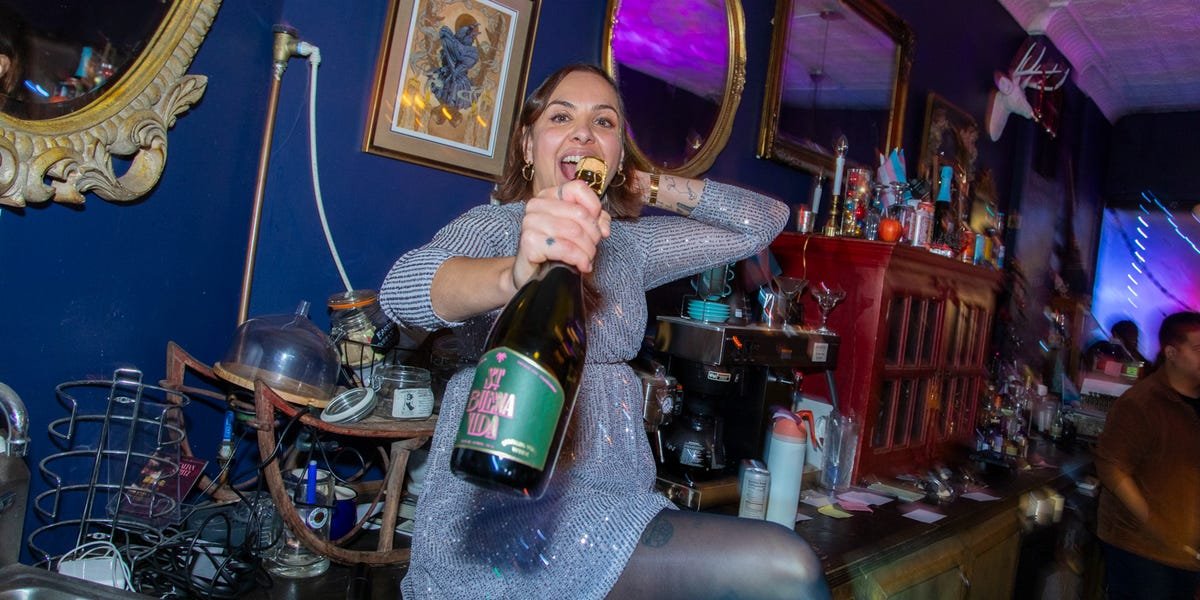
I run alcohol-free nightlife events in NYC. Most of my guests aren’t sober — they just don’t want to drink.

This as-told-to essay is based on a conversation with Sam Bail, a data engineer and the founder of the alcohol-free pop-up event company, Bright Nights Social. It has been edited for length and clarity.

Three years ago, I had the idea to open an alcohol-free bar in New York City.

I don’t drink, but I still wanted nightlife — dancing, music, meeting new people, getting out of the house on a Friday or Saturday night. What I didn’t want was another alcohol-free space that was centered on wellness, meditation, or yoga. I wanted something that still felt like real nightlife, just without booze being the main event.

Instead of signing a lease, I started testing the idea by hosting pop-up events. I’d take over coffee shops or other venues at night and turn them into alcohol-free bars for the evening.

What started as an experiment quickly took on a life of its own.

Over the past three years, I’ve collaborated with tons of venues, experimented with a variety of new formats, and thousands of people have come through our doors. That’s been the most surprising part of all of this: the demand.

What’s even more interesting? Most of the people who attend my events aren’t even sober.

Who actually comes to alcohol-free nightlife

When people hear “alcohol-free event,” they often assume the crowd is made up entirely of sober or sober-curious people. That hasn’t been my experience at all. Based on conversations with guests, I estimate that at least 75% of the people who attend my events don’t identify as sober or even sober-curious.

They’re mostly in their mid-20s to early 30s — older Gen Z and very young millennials. Gender splits depend on the event, but many of my parties are close to 50-50 men and women. What they have in common is that they want to go out, socialize, and have fun without making drinking the center of their entire social life.

I’m 40, so I’m an elder millennial who’s already done the heavy partying phase and is over it. But many of the people who come to Bright Nights Social are younger than me and feel the same way. They’ll tell me things like, “I still drink sometimes, I just don’t want to do it every time I go out,” or “Alcohol makes me feel terrible the next day.”

They’re not abstaining out of moral opposition to alcohol or because of addiction. They’re opting out because they don’t like the cost, the hangovers, or the way drinking dominates social life in cities like New York.

Experiences > drinking

What I see aligns with a broader shift happening right now, especially among younger people. There’s a growing focus on experiences rather than just going to a bar and spending money on drinks. In New York City, you can see it everywhere: pottery classes, cooking classes, rug tufting, late-night library events, group reading clubs.

Some of my favorites have been hosting cooking classes and our crafting events, like rug-making. Coming up this month, we have a tea bar, a bagel-making (and eating!) class, and a full-on dance party, complete with DJs and a full non-alcoholic bar, to close out Dry January.

People want to do something. They want to make memories. They just don’t want to wake up feeling awful the next day.

Cost is also a big factor. When cocktails are $15 or $20 each, it doesn’t take long for a casual night out to become extremely expensive. A lot of people tell me they’d rather spend their money on an experience than on alcohol that doesn’t even make them feel good.

That doesn’t mean Gen Z isn’t drinking at all. In fact, some recent data suggests younger people are actually drinking more now than they were a year or two ago. I think part of that is a post-pandemic catch-up effect — many Gen Zers reached legal drinking age during lockdowns and simply didn’t have the chance to go out.

What I see on the ground is moderation. People might have one drink at dinner and then switch to a nonalcoholic beer. Or they’ll alternate between alcoholic and nonalcoholic drinks throughout the night — what some people call “zebra striping.” They’re being much more intentional about how and when they drink.

THC, nonalcoholic drinks, and what’s next

Another huge shift I’m seeing is the role of legal THC. I don’t serve THC products at my events, but I don’t stop anyone from having one before they come, and I hear about them constantly from guests and friends who work at nonalcoholic bottle shops. THC drinks are some of the best-selling products in those stores.

People understand what THC does. They say it helps with social anxiety, takes the edge off, and feels more manageable than alcohol when used in moderation. Compared to that, there’s still skepticism around functional or adaptogenic drinks — things with nootropics, ashwagandha, or functional mushrooms. Many people aren’t convinced that those drinks actually do anything beyond being a placebo.

That said, I think we’re still early. As people learn what works for their own bodies — whether that’s L-theanine, lion’s mane, or something else — those functional beverages may gain more traction.

At the same time, I’m also seeing conversations online about people pulling back from THC after overdoing it, so I think we’ll see a similar trend as people try to find nightlife events that best suit their needs.

I don’t think most people want to be completely sober forever, but they are actively experimenting with what moderation looks like.

Alcohol-free doesn’t mean anti-fun

The biggest misconception about alcohol-free nightlife is that it’s boring or restrictive. What I’ve learned is that people don’t want to be told what not to do — they just want more options.

Bright Nights Social isn’t about sobriety as an identity. It’s about creating a space where alcohol isn’t the default. You can still dance, flirt, meet strangers, and stay out late. The only difference is that you’re not expected to drink to participate.

The fact that so many non-sober people show up tells me this isn’t a niche idea anymore. Alcohol-free nightlife isn’t just for people who’ve quit drinking entirely. It’s for anyone who wants to go out — and wake up the next day feeling like themselves.

Do you host or attend alternative nightlife events? Contact this reporter at ktl@businessinsider.com.


Source link

Lauren Crosby

I stopped being the first to reach out to friends. It made me realize I don’t need to be liked by everyone.

Ever since I was a little girl, I remember that friendships were a priority for me; I would constantly ask my mom to let me have friends over for playdates and sleepovers.

As a teenager, I had a Nokia brick phone and a driver’s license, and I could always be found planning to see friends or inviting them over to mine.

The craving for friendship has continued ever since, with my incessant desire for it fuelled by an innate need to feel accepted. I moved a number of times when I was a kid, and I fought against the outsider mentality by developing relationships that would help me become part of social circles.

I moved from the US to Wales

As an adult, I moved from the US to Wales, and once again, had to find a way to fit in — through friendship.

I invited myself to people’s houses for coffee and asked them to go for walks with me. I texted and rang to check in on friends I had made through church, work, my kids’ school, and my husband’s previous social circles.

These friends were incredibly important to me, and I had to hold on to them. I felt the only way to do this was to maintain frequent contact, more often than not initiated by me.

In recent years, I found myself thinking: What would happen if I didn’t text, call, or plan to meet up with friends? Would they get in touch with me?

It’s led to little monthlong experiments — going quiet to see who I’d hear from, if anyone.

The results have been both disappointing and frustrating, yet reaffirming. There were some friends who didn’t make any contact (and I felt rejected as a result), others who got in touch with me.

All of my childhood fears about exclusion and rejection were acutely felt once again.

I’m a loyal friend

I had lots to think through. Did I mind being the one who initiated the friendship — the one who kept it going? Was my concept of friendship too intense for other people? Were there some friendships I was willing to put in the work, even if I felt it wasn’t always reciprocated? Was I a needy friend?

This soul-searching led me to understand a few things about myself and the nature of friendship.

I’m a loyal friend who values deep, meaningful relationships that require time and effort. I make space for close friends, even though I work full-time, am married, and have three children, and I crave friendships with people who share the same values. A twice-a-year check-in just doesn’t do it for me. I want sisterhood.

However, this is not necessarily a value that everyone else has, and that’s OK. I suppose some people don’t need such intense friendships. Or perhaps they already have them with family or other friends. I can’t get frustrated with or feel rejected by friends who don’t have the same idea of friendship as I do.

To avoid frustration and feelings of rejection, over the last year, I’ve decided to mentally note which friends want the depth of friendship I offer and those who are happy with a surface-level relationship.

I stopped chasing friends

I leaned into those deep friendships (three of them) — people who valued relationships as much as I did. They feel like my village, those who depend on me, and those who I can depend on. They’re the ones who check in with me, just as I check in on them. It’s not me who initiates everything — they’re texting and calling too. They’re fiercely loyal.

But I stopped chasing friends who didn’t seem to place the same value on friendship as I do. I didn’t cut them out (and would happily still see them for a coffee), but I didn’t prioritize contact as I had before. I didn’t feel any resentment, but rather an understanding that we had different ideas of what friendship entailed. And that’s totally OK — I can accept this without feeling rejected or unwanted. When we do see each other, at school gates, on the streets, or for an infrequent meet-up, I enjoy their company, expecting no more than they are able to give.

And then, there were a couple of friends whom I knew I would have to initiate contact with if I wanted to maintain our friendship — I’d have to accept that for it to continue. I appreciated their friendships too much to only see or hear from them occasionally.

Over the past year, with these changes in place, I feel completely content in my friendships, as I have never before. I know where I stand with friends, and as a result, don’t feel rejected — no longer that child with an insatiable desire to be accepted by everyone. I know I’m wanted and loved, not by everyone, but by a few, and that’s enough now.


Source link

Prepare-to-pay-45-at-airport-security-if-you-dont.jpeg

Prepare to pay $45 at airport security if you don’t have a REAL ID

  • The TSA announced a $45 fee for travelers without acceptable ID at airport security checkpoints.
  • The alternative identity verification system, TSA Confirm.ID is set to be implemented on February 1.
  • It’s unclear how TSA Confirm.ID will work, but it’s intended as an option for flyers without a REAL ID.

The Transportation Security Administration has taken a page from the budget airline playbook.

The agency said Monday it is implementing a new alternative identity verification system, TSA Confirm.ID, that would charge travelers $45 at security checkpoints if they show up without a REAL ID or another acceptable government-issued ID, such as a passport or permanent resident card.

The new fee option is set to begin on February 1. The TSA said the fee would cover a 10-day travel period. Details about how the fee and identity verification would work were not yet available. The TSA did not immediately respond to a request for comment.

“TSA urges all travelers who do not have a REAL ID to pay the fee online before traveling,” according to a press release about TSA Confirm.ID and the new fee. “For passengers who arrive at the airport without paying the fee, information about how to pay for the TSA Confirm.ID option will be available at marked locations at or near the checkpoint in most airports. Travelers who undergo TSA Confirm.ID processing at an airport should expect delays.”

The TSA had previously proposed an $18 fee that would cover the costs for a biometric kiosk system designed to verify a traveler’s identity more quickly than the current manual process.

Under that proposal, the TSA said the new technology would be less time and resource-intensive than the current process when a flyer lacks these IDs, which involves providing personal information or answering detailed questions to match flyers to government databases.

“This notice serves as a next step in the process in REAL ID compliance, which was signed into law more than 20 years ago,” a TSA spokesperson previously told Business Insider about the $18 fee proposal.

Congress passed the REAL ID Act of 2005 in response to the 9/11 attacks, but it just rolled out in 2025.

In May, the TSA began requiring travelers to present a REAL ID or another government-approved identification to pass through airport security checkpoints.

The TSA says 94% of flyers already use REAL ID or another acceptable form of identification.

The agency is encouraging travelers who do not have a REAL ID to schedule an appointment with their local DMV to update their ID as soon as possible. A REAL ID card shows a star inside a circle in the upper right corner.


Source link