What-to-do-if-youre-an-American-in-the-Middle.jpeg

What to do if you’re an American in the Middle East right now

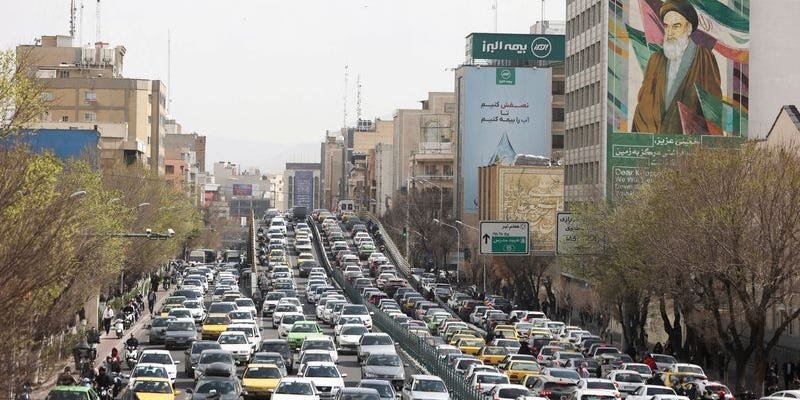
Americans in many Middle Eastern countries have been advised to shelter in place after the US and Israel launched strikes against Iran on Saturday.

The US Department of State Consular Affairs and related embassies posted on X that US citizens in countries including Iran, Bahrain, Jordan, UAE, Qatar, were advised to shelter in place until further notice.

Hours later it posted guidance for US citizens in Iraq, advising them to “exercise increased caution, limit their movements, and be prepared to shelter in place.”

“There are reports of missiles, drones, or rockets in Iraqi airspace. The security environment remains complex and can change quickly,” the US Department of State Consular Affairs wrote.

“If you are in Iraq, you should review your personal security plan and evaluate options to shelter in place or depart Iraq should the situation deteriorate,” it continued.

The US Embassy in Jerusalem said it had directed all US government employees and their families to shelter in place, and that Israel had closed airspace to all civilian flights.

The US Department of State Consular Affairs also warned of imminent drone and missile attacks in Bahrain.

Read more of our coverage:

The US Embassy in Beirut wrote that the Department of State “urges U.S. citizens to depart Lebanon now while commercial options remain available.”

Iran, Iraq, Kuwait, Bahrain, and Qatar have closed their airspaces. A video shared on Flightradar24 showed airplanes leaving the region.

Of the approximately 3,400 flights scheduled to the region, 230 were cancelled as of 12 p.m. Central European time, while 40 due to fly on Sunday were preemptively cancelled.

Airports in the region shared travel updates online. Dubai Airports said all flights at Dubai International and Dubai World Central – Al Maktoum International were suspended until further notice. It advised passengers not to travel to those airports at this time, and to contact their respective airlines for updates on flights.

King Abdulaziz International Airport in Saudi Arabia, Hamad International Airport in Doha, and Abu Dhabi Airports gave similar advice to passengers.

In a video statement posted on social media on Saturday, President Donald Trump vowed to destroy Iran’s missile program and navy and said the objective of the strikes is to “defend the American people by eliminating imminent threats.”

“My administration has taken every possible step to minimize the risk to US personnel in the region. Even so — and I do not make this statement lightly — the Iranian regime seeks to kill,” Trump said.

“The lives of courageous American heroes may be lost, and we may have casualties. That often happens in war,” Trump continued.

This is a breaking story and will be updated.


Source link
The-US-Navy-is-pulling-more-and-more-warships-into.jpeg

The US Navy is pulling more and more warships into its Middle East force buildup

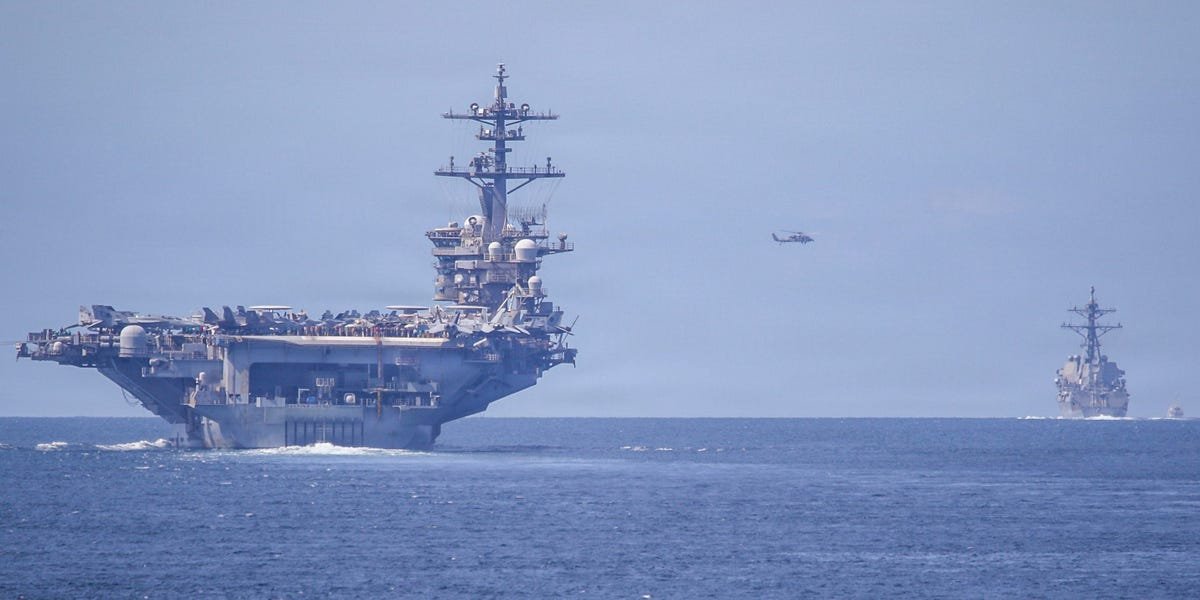
The US military added another warship to its large Middle East buildup in recent days, and a second carrier strike group is on its way, bringing additional fighter jets and missiles toward the region.

The large-scale deployment of American forces to the Middle East has escalated significantly this month as the Trump administration pressures Iran to strike a deal that would limit its nuclear and military capabilities.

As the US Navy’s Middle East force presence has grown, its footprint in the Caribbean Sea — once the site of a substantial show of force ahead of US military action against Venezuela and its former president Nicolás Maduro — has shrunk dramatically.

There are 10 warships and an aircraft carrier positioned in the Central Command area of responsibility, the Middle East, and two more vessels situated on the outskirts of the region, according to a defense official.

Middle East

Much of the US naval force in the Middle East was operating in the Arabian Sea as of Tuesday. That includes the aircraft carrier USS Abraham Lincoln and its strike group — the guided-missile destroyers USS Spruance, USS Frank E. Petersen Jr., and USS Michael Murphy.


An F/A-18E Super Hornet, attached to Strike Fighter Squadron (VFA) 14, prepares to make an arrested landing on the flight deck of Nimitz-class aircraft carrier USS Abraham Lincoln (CVN 72) on Jan. 9, 2026.

The carrier Abraham Lincoln has dozens of embarked fighter jets.

US Navy photo by Mass Communication Specialist Seaman Samuel Evarts


The Lincoln has dozens of embarked aircraft, including fighters, electronic attack jets, and early warning planes. The destroyers escorting the carrier are equipped with Tomahawk cruise missiles. Among its air wing are F-35 stealth fighters.

Three additional destroyers — USS Mitscher, USS McFaul, and USS Pinckney — are also in the Arabian Sea. Pinckney arrived in the region in the past couple of days, the defense official said.

Another destroyer, USS Delbert D. Black, is in the Red Sea. And three littoral combat ships — USS Santa Barbara, USS Tulsa, and USS Canberra — are in the Arabian Gulf. These warships are designed for near-shore operations.

European waters

USS Roosevelt and USS Bulkeley, two destroyers capable of ballistic missile defense, are operating in the Eastern Mediterranean Sea, which is part of US Naval Forces Europe and Africa’s area of responsibility.

The defense official said the aircraft carrier USS Gerald R. Ford and its strike group — destroyers USS Mahan, USS Winston S. Churchill, and USS Bainbridge — are also operating under that command, which covers the eastern half of the Atlantic Ocean.


The world's largest aircraft carrier, Ford-class aircraft carrier USS Gerald R. Ford (CVN 78), transits the Caribbean Sea during Carrier Air Wing 8's aerial change of command ceremony, Jan. 19, 2026.

The Ford is the Navy’s largest and most advanced carrier.

US Navy photo


The Ford carrier strike group had been operating in the Caribbean for months. However, earlier this month, it was reported that the Navy’s newest and most advanced aircraft carrier was being sent to the Middle East.

As of Wednesday, the aircraft carrier was operating off the coast of Morocco near the Strait of Gibraltar, ship-tracking data shows.

Two additional destroyers — USS Thomas Hudner and USS Stockdale — that were previously in the Caribbean are now in the US Naval Forces Europe and Africa area of responsibility as well.

Caribbean

The departure of Ford and the five destroyers has diminished the Navy’s presence in the Caribbean, which falls under the Southern Command area of responsibility.

The US armed forces initially positioned a large number of warships in the waters near Venezuela last year as part of President Donald Trump’s effort to pressure Maduro. A few weeks after his capture, a dozen vessels were still present in the region.


Ticonderoga-class guided-missile cruiser USS Gettysburg prepares to steam alongside Supply-class fast combat support ship USNS Supply and San Antonio-class amphibious transport dock USS Fort Lauderdale (LPD 28), in the Caribbean Sea, January 29, 2026.

The Navy had a dozen warships deployed to the Caribbean earlier this year.

US Navy photo


Now, only five remain, the defense official said. Those include the cruiser USS Lake Erie, the destroyer USS Truxtun, the amphibious assault ship USS Iwo Jima, and the amphibious transport dock ships USS Fort Lauderdale and USS San Antonio.

Eyes on Iran

The US and Iran held indirect talks earlier in the week, and officials hinted that additional dialogue could be on the horizon.

However, US military assets — including aircraft such as fighter jets and refueling tankers — are still moving into and toward the Middle East, giving Trump plenty of options to strike Iran for a second time, which he has threatened. The US military bombed Iran’s nuclear sites last year as part of Operation Midnight Hammer.

Iran, meanwhile, conducted military exercises in the strategic Strait of Hormuz this week, and Tehran’s leadership warned the US warships deployed to the region that it is capable of sinking them in the event of a fight.


Source link

Jamba-Juices-former-CEO-says-middle-management-is-crucial-for.jpeg

Jamba Juice’s former CEO says middle management is crucial for success.

In the era of America’s “Great Flattening,” one longtime executive still believes that middle management has an important role to play.

Speaking in a Monday episode of Yahoo Finance’s “Opening Bid” podcast, Jamba Juice’s former CEO, James D. White, said companies should not lose sight of the fact that humans and company culture drive bottom-line growth.

And White said that middle managers are crucial for driving a good company culture.

“It’s really hard to drive culture into an organization if you’re not focused on the middle management of the organization,” he told host Brian Sozzi.

White said one reason for this is because most workers report to middle management.

“If that part of the organization doesn’t have the tools, hasn’t bought into the mission and vision, and they’re not being appropriately rewarded or invested in, you don’t have the best chance of getting that message into the heart of the organization,” White said.

White was the CEO of Jamba Juice from 2008 to 2016 and has held executive roles in Gillette, Coca-Cola, and Nestlé Purina. He now sits on the board of directors for several consumer companies, including Cava Group and Simply Good Foods.

White’s advice contrasts with that of other executives, who have sworn by a flat company hierarchy.

In recent years, companies like Microsoft, Meta, Amazon, Intel, and Google have all slashed their middle management head count in the name of efficiency. But it’s not just Big Tech: retail giants like Walmart have followed suit.

And in November, Keily Blair, the CEO of OnlyFans, said her company was making $7 billion in annual revenue with a staff count of only 42.

She said her company thrives from having only “incredibly senior talent” and “incredibly hungry junior talent.”

“We do not have that sort of squidgy layer of middle management in the middle, because nobody’s ever had a really good middle manager in my experience,” Blair said in the interview during a Web Summit technology conference in Lisbon.


Source link

Paramount-wanted-to-use-24-billion-in-Middle-Eastern-money.jpeg

Paramount wanted to use $24 billion in Middle Eastern money to help buy WBD. That’s not why Netflix won.

Larry and David Ellison, who own Paramount, want to use $24 billion in Middle Eastern money to finance their bid for Warner Bros. Discovery. Is that a problem for WBD?

You might think so — especially since $10 billion of that came from the Saudi government. That’s the same government that US intelligence said killed a Washington Post journalist in 2018. The kind of partner you might think a major American media conglomerate would want to keep at arm’s length.

But that’s not a problem WBD raises in its newest communication to shareholders, where it urges them to take the deal offered by Netflix instead.

What actually worries WBD about the Ellisons’ bid isn’t the Ellisons’ particular partners. It’s that the Ellisons had partners.

In a regulatory filing that tells the backstory of the proposed WBD sale, WBD execs and their reps repeatedly told the Ellisons they wanted a firm commitment that Larry Ellison — currently the world’s 5th-richest man, with an estimated net worth of $243 billion — would guarantee the deal himself.

Instead, WBD argues, the Ellisons never gave them the assurances they wanted.

The filing does bring up the fact that money from Middle Eastern sovereign wealth funds would likely complicate regulatory issues for a proposed Ellison/Paramount deal. (Ditto for a proposed $1 billion investment from China’s Tencent, which the Ellisons later took out of their proposal.) But those are presented as technical hurdles. Not moral or patriotic dealbreakers.

And they’re just part of a laundry list of complaints WBD makes about the Ellisons. Among them: A December 2 tweet from New York Post reporter Charlie Gasparino, which WBD said violated a confidentiality agreement Paramount had signed.

And when it comes to the main pitch WBD is making to investors, all of that stuff disappears. It just boils down to “we did our homework, and the Netflix deal is better.”

That’s not shocking: If you’re a WBD investor, you are (supposedly) only interested in getting the maximum value for shares. And WBD’s filing argues that Netflix is the one that can pay the most.

Now we’re waiting to see what the Ellisons do next: Many observers believe they’ll return with yet another, higher bid. Will this one have Gulf money, too?


Source link